You open the Common App for the first time, click into the requirements, and see it: "Personal Essay." You have heard the term, but you are not sure what it actually is, what it is for, or how much it matters compared to your GPA. This guide covers all of it: what the college admission essay is, the different types you will encounter, how much weight it carries, and what admissions officers are actually looking for when they read yours.
What Is a College Admission Essay? Complete Guide
What Is a College Admission Essay, Exactly?
A college admission essay is a 250 to 650-word personal statement submitted as part of your college application, giving admissions officers insight into who you are beyond your grades and test scores.
It gives admissions officers a human context for everything else in your file. Your transcript, test scores, and activities list can tell them a lot, but they cannot tell them who you actually are.
Most four-year colleges in the US require at least one essay as part of the application. Officers read hundreds, sometimes thousands, of them per cycle. They are looking for a real person behind the numbers.
In terms of where it sits in the process: you write and submit your essay through whichever application platform you are using, whether that is Common App, Coalition, or QuestBridge. Once you submit your application to a school, that essay goes with it automatically. You do not submit essays separately to each college. For schools that require supplemental essays, those are submitted through the same platform, usually at the same time as your main application.
After submission, your college admission essay is read by at least one admissions officer, sometimes two. At most schools, readers spend three to five minutes per application, which means your essay gets roughly that same window. At highly selective schools, essays that make it past an initial read may go to a committee.
The essay does not get graded or scored on a rubric. The reader forms an impression of you as a person, and that impression gets weighed alongside everything else in your file.
Do you Have to Write an Essay to Apply for College?
For most four-year colleges in the US, yes. The Common App, which covers the majority of US colleges, requires a personal essay for every school you apply to through that platform. Some large public universities are exceptions; a handful require no essay at all. But if you are applying to private colleges, selective schools, or any school through the Common App, you will need to write one.
What a College Essay Is | What a College Essay Is Not |
A personal story that reflects who you are | A list of achievements or a resume |
A chance to show your personality and voice | A formal, robotic academic paper |
Focused on growth, experiences, and insights | Just repeating grades, scores, or awards |
Honest and authentic | Exaggerated or overly dramatic |
Structured but conversational | Strictly rigid or overly technical |
Tailored to the prompt and audience | Generic or copied content |
"Your grades tell colleges what you have done; the admission essay tells them who you are."
How Is the College Admission Essay Different From a Regular Essay?
Almost every rule you have been taught about academic writing does not apply here.
There is no five-paragraph structure. No formal thesis, no counterargument paragraph, no tidy conclusion that restates your intro. The college essay is closer to personal storytelling than academic writing. For a full breakdown of length requirements, see our guide on how long should a college admission essay be.
It is also not a journal entry. You are not free-associating on the page. Good college essays are still shaped and intentional; the writing just does not look formal.
One of the biggest differences: officers are reading your essay in three to five minutes, often less. A wall of text, a slow opening, or a generic topic gets dropped fast. An opening that pulls them in makes them slow down.
Unlike anything you have written for school, the HOW matters more than the WHAT. Two students can write about the exact same topic and produce completely different results because one has a distinct voice and real reflection, and one does not.
"The college essay breaks every rule your English teacher taught you, and that is intentional." |
If you are still figuring out what to write about, our guide on college admission essay topics walks through 50+ ideas worth considering.
The Main Types of College Admission Essays
Here is where a lot of students get confused. There is not just one essay. Depending on where you apply, you will likely write several, and they each serve a different purpose.
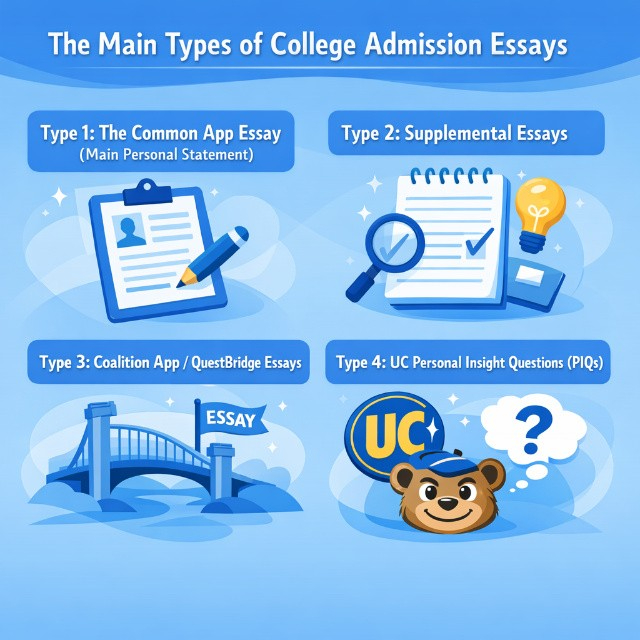
Type 1: The Common App Essay (Main Personal Statement)
This is the big one. If you are applying to most US colleges, you will apply through the Common Application, and this platform requires a single main Common App essay of up to 650 words. You choose from seven prompts, things like a challenge you have faced, a background that shapes your identity, or a topic of your choice. This essay gets sent to every school you apply to through the Common App.
Type 2: Supplemental Essays
These are school-specific essays. Once you have submitted your main Common App essay, individual schools may ask you to write additional, shorter supplemental essays, usually 100 to 500 words each. These tend to be things like "Why do you want to come to our school?" or "Describe a community you belong to." Every school has different requirements.
Type 3: Coalition App / QuestBridge Essays
Some students apply through the Coalition Application or QuestBridge. Both have their own essay prompts, separate from the Common App. If you are using these platforms, check their specific requirements.
To find out how this type of essay differs from a Common App one, check out our Common App vs. Coalition App guide.
Type 4: UC Personal Insight Questions (PIQs)
If you are applying to any University of California campus, whether UCLA, UC Berkeley, UC San Diego, or others, you will not use the Common App at all. UC schools use their own application system, which requires you to answer four out of eight UC Personal Insight Questions (PIQs) at 350 words each. These are not the same as a personal statement. They are shorter, more focused, and each one targets a specific aspect of your background, character, or experience. If UC schools are on your list, treat PIQs as an entirely separate essay track from your Common App work.
A note for international students: if you are applying to US colleges from outside the country, the essay requirements are the same. Most international applicants apply through the Common App just as domestic students do, using the same prompts and word limits. The only difference is that some schools ask international applicants additional short questions about language background or country of origin, but the main personal statement process is identical.
A quick note on the statement of purpose: you will see this term come up in searches, but it is a graduate school concept, not an undergrad one. If you are applying to college rather than grad school, you are not writing a statement of purpose. For a deeper breakdown of how the two compare, see our guide on personal statement vs college admission essay.
Essay Type | Word Count | Required By | Purpose |
Common App Essay | Up to 650 words | Most US 4-year colleges | Reveals personality, values, and story |
Supplemental Essays | 100 to 500 words | School-specific | Fit, motivation, specific qualities |
UC Personal Insight Questions | 350 words each (4 of 8) | UC system schools | Character, background, specific experiences |
Statement of Purpose | 500 to 1,000 words | Graduate programs only | Academic goals, research focus |
"Most students applying to US colleges write one main Common App essay plus several shorter supplemental essays, with each school requiring different combinations."
Facing four essay types across multiple platforms is a lot to take on at once. If you already know you would rather hand off the writing, tell us your school, your prompt, and your deadline, and our writers can write my college admission essay for you. Most students get a complete draft back within 24 hours.
Why Does the College Admission Essay Matter?
More than it used to. Here is why.
A lot of selective schools have permanently dropped SAT and ACT requirements since 2020. When test scores are optional or not considered, admissions officers have one less data point to differentiate applicants. The essay fills that gap.
According to NACAC's most recent State of College Admission report, the majority of admissions counselors rate essays as having "considerable" or "moderate" importance in the decision-making process, a share that has grown as more schools have moved away from standardized test requirements. |
How Much It Matters Depends on Where You Are Applying
Large public universities, think the Big Ten and many state flagships, process tens of thousands of applications per cycle. At that volume, GPA and test scores do most of the filtering, and essays play a supporting role. They matter, but they are unlikely to single-handedly change a decision.
Private and highly selective schools are a different story. When you are competing against thousands of applicants who all have a 4.0 and a 1500 SAT, the essay is often the only remaining differentiator. Admissions officers at schools like Georgetown, Vanderbilt, or any Ivy are reading essays specifically to break ties between otherwise identical files. At those schools, a weak essay can eliminate a strong candidate. A genuinely good one can move a borderline applicant into the accepted pile.
Mid-tier private schools fall somewhere between those two poles. They have more time per application than large publics, and they are often building a class with specific personality types, backgrounds, and interests in mind. A well-written essay that shows genuine fit carries real weight there, too.
The One Thing the Essay has that Nothing Else Does
Your GPA is locked in. Your test scores are what they are. The essay is the only part of your application you still control at the time you are writing it. Every other element of your file is already fixed. That is not pressure; it is opportunity. It is the one place where you can walk into the conversation and say something nobody else can say.
"At selective schools where dozens of applicants share your exact GPA and test scores, the essay is often the deciding factor." |
What Are Admissions Officers Actually Looking For?
They are not grading your vocabulary. They are not expecting literary genius. What they want is to feel like they have met a real person by the end of the page.
Voice and Authenticity
Admissions officers read thousands of essays per cycle. They can spot a polished PR version of a student from a mile away. The essays that land are the ones that sound like a real person, with a specific way of seeing things, a specific sense of humor, and a specific set of concerns, rather than a curated highlight reel.
The most common mistake students make is writing what they think the officer wants to hear. They pick the most impressive-sounding topic and then write about it in the flattest, most professional language possible. The result is an essay that technically ticks boxes and feels like nobody wrote it. Write the essay only you could write. That is the whole brief.
Specificity
"I love science" tells them nothing. "I spent three months trying to understand a research paper on CRISPR because I could not stop thinking about it," tells them something. Concrete details beat vague claims every time.
This applies at every level. Not "I worked hard" but "I rewrote the opening paragraph eleven times." Not "my grandmother influenced me" but "she kept a notebook of every word she learned after moving to the US, and I still have it." Specificity is what makes an essay feel real. It is also what makes it memorable, and memorable essays are the ones that move files.
Reflection, Not Just Narration
Something happened to you, great. What did you do with it? What did you learn? What changed? The insight matters more than the event itself.
A student who writes "I lost the championship game, and it was hard" is narrating. A student who writes "I spent the next three weeks trying to figure out whether I cared more about winning or about being the kind of player my teammates trusted" is reflecting. Officers are reading for the second one. They want to know how you think, not just what happened to you.
Clarity Over Complexity
Simple, clear writing beats convoluted sentences that try to sound impressive. If you have to read a sentence twice to understand it, rewrite it. Short sentences often hit harder than long ones. A paragraph that ends on something surprising, whether a specific detail, an honest admission, or a quiet observation, stays with the reader longer than a paragraph that ends with a tidy summary.
Most students try to sound sophisticated. The ones who get remembered try to sound clear.
"Admissions officers are not scoring your essay on vocabulary; they are looking for the real person behind the application." |
You now know what officers are looking for: voice, specificity, real reflection over polished performance. Knowing what they want and producing it are two different problems. If you would rather work with someone who has written thousands of these and knows exactly how to shape a story that lands, our professional college admission essay writing service delivers a complete draft matched to your school, your prompt, and your voice.
How Many College Admission Essays Do You Have to Write?
More than you might expect.
Through the Common App, you write one main essay that goes to every school you apply to. Then each school can require its own supplemental essays on top of that, anywhere from zero to five or more, depending on the school.
Highly selective schools like Ivy League universities, MIT, and Stanford tend to require three to five supplemental essays each. Large public universities often require just one essay, or sometimes none at all.
If you apply to ten schools, it is not unrealistic to write 15 to 20 total essays. If you apply to twenty, that number climbs further. Before you start, it is worth mapping out how many admission essays you will actually need to write by school type, so you can build a realistic timeline instead of realizing mid-November that you have six supplements due in two weeks.
"Depending on how many schools you apply to, you might write anywhere from 2 to 20 or more essays in total." |
Conclusion
You know what the college admission essay is, what types you are facing, and what officers are actually looking for. The hard part, finding the right story and the right voice, is still ahead. Tell us your school, your prompt, and your deadline, and CollegeEssay.org's admission essay writers will handle the writing. Most students get a complete first draft back within 24 hours.
Frequently Asked Questions
Can I reuse my college admission essay for every school I apply to?
Your Common App personal statement goes to every school automatically, so you only write it once. Supplemental essays are school-specific and cannot be reused without significant reworking, since prompts like "Why this school?" require answers that are specific to each institution.
Does a college admission essay have a required font or formatting style?
The Common App uses a plain-text box, so font and spacing choices you make in a Word document or Google Doc do not carry over. Paste your essay into a plain-text editor first to strip any formatting, then repaste it into the application. Keep paragraphs separated by a blank line so the structure stays readable on the officer's screen.
When is the best time to start writing a college admission essay?
Ideally, begin 8 to 10 weeks before your earliest deadline. Starting earlier gives you time to find the right story, write a rough draft, revise it properly, and get feedback from two or three people who will be honest with you. Anything under four weeks makes meaningful revision nearly impossible.
Can a college admission essay make up for a low GPA?
At large public universities with high application volume, a strong essay is unlikely to offset a GPA that falls well below their typical range. At smaller private schools and highly selective ones, admissions decisions are more holistic, and a genuinely compelling essay can shift a borderline file. It is a real factor in the decision, not a rescue mechanism.
Is it acceptable to use a professional writer for a college admission essay?
Working with a professional writer is a widely used practice, similar to working with a college counselor or writing coach. The key is that the story, the experiences, and the voice remain yours, so the final draft reflects your background and sounds like you.
Benjamin C. Verified
Author
Benjamin C. holds an MS in Marketing from Imperial College Business. He has over 6 years of experience in academic research and writing, specializing in admissions essays, personal statement writing, and scholarship essays. Benjamin has contributed articles to reputable publications such as USA Today and The Huffington Post. He is the recipient of the National Association for College Admission Counseling's Rising Star Award, recognizing his outstanding contributions to the field of college admissions essay writing. With his extensive knowledge and expertise, Benjamin has helped many students achieve their academic and professional goals.
Specializes in:
Ivy League Admissions Essays
Personal Statement Writing
Scholarship Essays
Read All Articles by Benjamin C.
Keep Reading
Was This Blog Helpful?
On this Page