You've got an essay to write and probably a lot of advice telling you to "be yourself" and "start early." This is not that. Below are 15 specific, tested tips, organized by phase so you know exactly when each one applies, that separate admission essays that get remembered from ones that disappear into the pile.
> >
College Admission Essay Writing
>15 College Admission Essay Tips That Actually Change What You Write
15 College Admission Essay Tips That Actually Change What You Write
What Admissions Officers Actually Look For (And What Most Students Miss)
An admissions officer at a selective school might read 30 to 50 essays on a Tuesday afternoon. By the time they reach yours, they've seen the soccer injury that taught a lesson in resilience, the mission trip that changed their perspective, and three essays about deceased grandparents. None of those essays was bad. They just didn't stick. Trying to understand what is a college admission essay can be the foundation for everything below.
What actually sticks is specificity. Officers aren't looking for your most impressive story. They're looking for your most specific one. A single afternoon at your kitchen table can reveal more about who you are than a year-long leadership position, if you write it right.
Three things consistently make an essay memorable:
- Specificity. Not "I love science" but "I spent six months trying to understand why my sourdough kept collapsing, and that became the foundation of my interest in fermentation chemistry."
- A genuine voice. The essay sounds like a person, not a college application.
- A moment of real self-insight. You learned something about yourself, and you let the reader feel that moment rather than just announcing it.
Expert Tip
What they're not looking for: a résumé in paragraph form. If your essay reads like a list of accomplishments with transitions, it's not an essay. It's a cover letter. Officers already have your activities list. The essay is supposed to show them who you are beyond it.
Two patterns cause officers to mentally check out within the first paragraph:
- The throat-clear opening. A sentence that describes what the essay is about to do rather than doing it. "Throughout my life, I have always been passionate about helping others" tells the reader nothing about you specifically; it could have been written by any of the 5,000 other applicants in the pool.
- The lesson-first structure. Opening with the insight before earning it with a story. Officers reach the conclusion before they've had any reason to care.
Both share the same root cause: the student is writing to impress rather than to reveal.
The college admission essays that get read twice are the ones where the officer finishes and thinks: I know exactly what kind of person wrote this. Not this student is impressive, they already knew that from the transcript. But I know how this person thinks. That is the only job the essay has, and specificity is the only way to do it.
College Admission Essay Tips for Before You Write
Most students spend 90% of their time on the draft and almost no time on the decision that matters most: what to write about and how to frame it. These six tips, applied before you open a blank document, will save you more revision time than anything else you do.
Tip 1: Choose a Small, Specific Moment Over a Big, Dramatic Event
Admissions officers see a lot of big topics: cancer diagnoses, immigration stories, and championship games. Those can work, but they're harder to write well because the stakes feel so high that students often spend the whole essay explaining what happened instead of showing who they are.
A specific afternoon teaching your younger sibling to read will almost always produce a better essay than an entire year of volunteering, because a small moment gives you room to go deep.
Tip 2: Write for One Reader, Not a Committee
Imagine the admissions counselor from your top school reading your essay alone, at 9 pm, after a long day. That's your audience. Not a committee, not a rubric, not your English teacher. Writing for one specific person makes your voice more direct and your choices more confident.
Tip 3: Reverse-Engineer Your Topic
Every part of your application tells the officer something different:
Application component | What it shows |
Transcript | Your grades and academic rigor |
Activities list | What you've done and how long you committed |
Recommendations | How others perceive you |
Essay | How you think, what you notice, what you care about when no one's watching |
Before you pick a topic, ask what part of you is completely invisible in the first three columns. Then find a story that reveals exactly that.
Tip 4: Know Your Word Count Before You Write a Single Sentence
Word limits vary significantly by platform:
Platform | Limit |
Common App personal essay | 650 words |
UC Personal Insight Questions | 350 words each |
Most supplemental essays | 150 to 500 words |
Coalition App essay | 500 to 650 words |
Writing without knowing your limit is like packing without knowing how big your bag is. Every platform and prompt type has different requirements, and how long a college admission essay should be covers all of them in one place.
Tip 5: Read Your Full Application Before You Write the Essay
Look for the gap. If every other part of your application is polished and achievement-focused, your essay needs to show vulnerability, curiosity, or humor. If your application already shows depth in one area, your essay might be stronger in showing range. The essay doesn't exist in isolation. It completes the picture.
Tip 6: Read Real Essays that Worked Before You Finalize Yours
Seeing what a strong essay actually looks like calibrates your instincts faster than any amount of advice.
If reading those made you realize your current approach needs more than a tweak, our writers apply these same principles to your admission essay, starting from your raw notes or an existing draft and shaping it into something that works for your specific schools and prompts.
College Admission Essay Tips While You Draft
Once you know what you're writing about, these tips apply from your first sentence to your last. Keep them nearby during your draft, not just for revision.
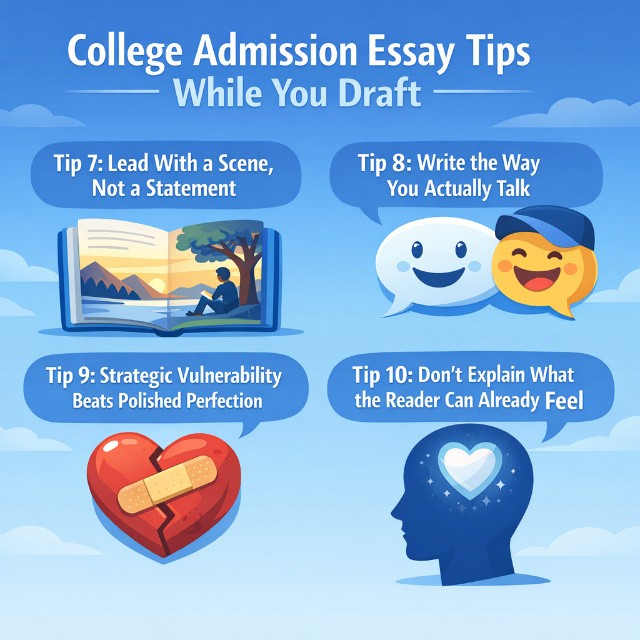
Tip 7: Lead With a Scene, Not a Statement
Don't open with "I have always been passionate about..." Open in the middle of a moment. Put your reader somewhere specific before you start explaining anything. "I was holding a spatula, not a trophy, when I figured out what I wanted to study." That kind of opening earns the reader's attention. A thesis statement does not.
Tip 8: Write the Way You Actually Talk
Read each sentence out loud. If you'd never say it in a real conversation, cut it or rewrite it until you would. "Throughout my academic journey, I have developed a profound appreciation for..." is not how any 17-year-old actually speaks. "I didn't expect chemistry to be the class I looked forward to most, but here we are." The essay should sound like you.
Tip 9: Strategic Vulnerability Beats Polished Perfection
Admissions officers have a term for essays that feel too perfect: written for an audience. These essays have great sentences and zero humanity. The essays that get remembered are the ones where a student admitted to being confused, scared, wrong, or unsure, and then showed what they did with that. Doubt and failure, written honestly, read as more authentic than confidence performed for a committee.
Tip 10: Don't Explain What the Reader Can Already Feel
If your story is working, the insight is already there. You don't need to close every paragraph with "this taught me that perseverance is important." Trust your reader. If you've done the work of showing the moment clearly, they'll get it, and they'll trust you more because you didn't spell it out.
College Admission Essay Tips for After Your First Draft
You've written something. Now comes the part most students skip. These revision tips are what separate a decent draft from a strong final essay.
Tip 11: Read the Whole Thing Out Loud, Every Sentence
Every stumble is a rewrite. If you lose your breath, your sentence is too long. If you read something twice before it makes sense, it needs to be clearer. Reading silently lets your brain autocorrect for what you meant to write. Your ear catches what your eye misses.
Tip 12: Get a Reader Who Doesn't Know Your Story
Your parents and best friends already know the context behind everything you've written. They'll fill in the blanks automatically and miss the places where you've assumed background knowledge. Find someone who doesn't know your story. If they're confused, you've left out something essential.
Tip 13: Cut Your First Paragraph and See if the Essay Reads Better
Most first paragraphs are warm-up writing. You were finding your footing. Try deleting yours entirely and see if the essay starts stronger at paragraph two. More often than not, it does. This is probably the single most useful revision move most students never try.
Tip 14: Check for the Résumé Trap
Read through your essay and ask: could any of these sentences have been a bullet point on my activities list? "I served as captain of the debate team for two years, leading a group of 20 students to state finals" is an activities list entry, not an essay sentence. If it belongs on a list, it doesn't belong in the essay.
Tip 15: Time Your Reading
At 650 words, your essay should take roughly 3.5 to 4 minutes to read aloud at a normal pace. If it feels rushed, you're probably trying to cover too much. Tighten your scope and let fewer things breathe more.
You've got the full toolkit now. The gap between knowing these principles and executing them on your actual essay, under a real deadline, for schools you actually care about, is where most students get stuck. CollegeEssay.org's admissions-informed writing team works from your prompt, your notes, and your voice to produce a draft you can submit or build from. Most students have a complete draft back within 24 hours.
Common App vs. Supplemental Essays: Different Jobs, Different Approach
The tips above apply to both formats, but they serve different purposes and require a different approach. Treating them the same is one of the most common reasons a strong Common App essay doesn't translate into strong supplemental writing.
Your Common App essay (650 words) is your one chance across all schools to show personality. It needs depth, narrative, and voice. Give yourself the full word count if the story needs it. Cutting to 500 words because it feels long is a mistake; cutting to 500 words because the last 150 words are repetitive is the right call. If you're not certain what the correct length, structure, or formatting looks like across different platforms, the college admission essay format guide covers every prompt type in one place. |
Your supplemental essays are school-specific and serve a completely different function. They're not asking who you are. They already got that from the Common App. They're asking one of three things:
- Why this school. Requires specific research: a professor, a program, a course, an organization that doesn't exist anywhere else. Three specific reasons outperform three paragraphs of general enthusiasm every time.
- What you'll contribute to their community. Not your achievements, the officer already has those. A specific habit, perspective, or practice you would bring into a room, a class, or a conversation on that campus.
- How you'll engage with a particular program or opportunity. Requires you to connect your specific background or interests to what that program actually does.
Your Common App essay and supplements should tell different stories, not the same story at different lengths. Read them together before you submit. If the same theme, moment, or insight appears in more than one place, one of them needs to change.
You've read every tip. You know what makes an essay land and what makes it disappear. The part that's left, sitting down, working this into your specific prompt, for your specific schools, before your specific deadline, is the hard part. If you'd rather spend that time on something other than a fourth draft that still doesn't feel right, tell us your prompt, your schools, and anything you've already written, and have your admission essay written by an expert who has done this hundreds of times.
Frequently Asked Questions
Can I reuse the same college admission essay for every school I apply to?
Your Common App essay goes to all Common App schools unchanged. Supplemental essays cannot be reused. Each supplemental is school-specific, and submitting a recycled response to a why-us prompt is one of the most common and costly mistakes applicants make. Officers read thousands of applications from students at the same high schools; a generic supplement is easy to identify.
How do I know if my college admission essay topic is too common?
The topic is rarely the problem. Officers have read strong essays about sports injuries and weak essays about rare experiences. The right question is whether your treatment of the topic is specific to you. If someone else who had the same experience could have written the same essay, the topic is not the issue; the execution is. Push further into the specific detail, the specific moment, and the specific thought you had that no one else would have had.
Is it acceptable to write a college admission essay about a failure or a mistake?
Yes, and it often produces stronger essays than success stories. The condition is that the essay must show what happened after the failure, not just what went wrong. Officers are not looking for resilience as a theme; they're looking for evidence of how you actually process difficulty. An essay that lingers on the failure without showing real reflection or change reads as self-pity rather than self-awareness.
How many people should review my college admission essay before I submit?
Two or three readers is usually enough. More than that and the feedback starts to conflict, pulling the essay in different directions until it no longer sounds like you. Prioritize one reader who doesn't know your story well, and one who knows your writing well enough to flag sentences that don't sound like you. Never revise based on every note you receive; filter for feedback that identifies a real problem, not a personal preference.
Does the college admission essay carry the same weight at every school?
No. At highly selective schools the essay carries significant weight because the academic credentials of the applicant pool are nearly indistinguishable at the top. At schools with higher acceptance rates, the essay matters less for the admissions decision itself but can still influence scholarship consideration, honors program placement, and merit aid. Writing a strong essay regardless of selectivity is worth the effort for those downstream reasons alone.
Benjamin C. Verified
Author
Benjamin C. holds an MS in Marketing from Imperial College Business. He has over 6 years of experience in academic research and writing, specializing in admissions essays, personal statement writing, and scholarship essays. Benjamin has contributed articles to reputable publications such as USA Today and The Huffington Post. He is the recipient of the National Association for College Admission Counseling's Rising Star Award, recognizing his outstanding contributions to the field of college admissions essay writing. With his extensive knowledge and expertise, Benjamin has helped many students achieve their academic and professional goals.
Specializes in:
Ivy League Admissions Essays
Personal Statement Writing
Scholarship Essays
Read All Articles by Benjamin C.
Keep Reading
Was This Blog Helpful?
On this Page