Your essay is done, or almost. Now you need the exact specs before you submit: font, spacing, margins, whether to include a header, and how to paste into Common App without the formatting collapsing. Everything is below, starting with the quick specs and ending with a full pre-submit checklist.
> >
College Admission Essay Writing
>How to Format a College Admission Essay: The Complete Spec Guide
How to Format a College Admission Essay: The Complete Spec Guide
The Quick-Reference College Admission Essay Formatting Specs
These are the accepted standards across Common App, Coalition App, and most school portals. Use this table as your baseline before you touch anything else.
Formatting Element | What to Use |
Font | 12-point Times New Roman, Arial, or Calibri |
Spacing | Double-spaced |
Margins | 1 inch on all sides |
Paragraph indentation | Tab indent at the start of each paragraph |
Title | Optional. Include only if it genuinely adds something. |
Header (name, date, class) | Skip it. That is for school assignments, not personal statements. |
Bold or italics | Avoid unless absolutely necessary |
Alignment | Left-aligned. Do not justify. |
A well-formatted essay does not impress admissions officers. It gets out of their way so your story can.
On Titles
Most strong college essays do not have one. If you have a title that is genuinely clever or reframes the essay in an interesting way, use it. If you are adding a title just to fill the space, leave it blank. Bold and italics are worth avoiding, not just because they are unnecessary, but because they often do not survive the Common App paste step.
On Headers
Do not add your name, date, or class at the top. That format belongs to school assignments. A college admission essay is a personal narrative, not a class paper, and it starts with the first line of your story. If you are applying to schools that upload a document rather than use a text box, you will want your name on the file itself. More on that in the submission section below.
On Alignment
Left-align your paragraphs. Do not use justified alignment. Justified text can create uneven spacing between words that looks clean on a printed page but reads poorly on a screen, which is how most admissions officers will see your essay.
If the formatting side is handled but the essay itself still needs work, CollegeEssay.org handles the formatting and structure alongside the writing, so you submit one finished piece rather than assembling it yourself.
Word Count and Length for a College Admission Essay
The Common App essay has a hard cap of 650 words and a minimum of 250. Most strong essays land between 500 and 650 words. Going significantly under the limit looks like you ran out of things to say, and understanding how long a college admission essay should be is worth doing before you decide you are done. Going over is impossible in the Common App text box, but if you are uploading a document, do not exceed the limit.
For supplemental essays, word limits vary by school and prompt. Check each school's portal directly before you draft. The same formatting rules apply regardless of the word count target.
One practical note: the Common App text box does not show a formatted word count until you paste your essay in. Write in Google Docs or Word first, verify the count there, and then paste.
How to Submit Your College Admission Essay: Three Scenarios
The correct college admission essay format depends partly on how you are submitting. There are three scenarios, and they have different requirements.
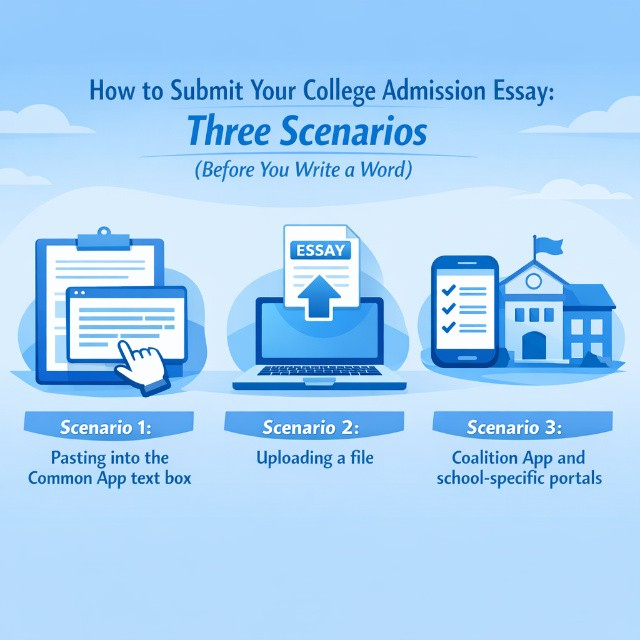
Scenario 1: Pasting into the Common App Text Box
This is how most students submit. The Common App uses a plain-text box. When you write your essay in Word or Google Docs and paste it directly into that box, formatting breaks. It is completely avoidable if you follow the two-step paste process.
What typically breaks when you paste directly:
- Curly quotes turn into straight quotes or symbols
- Em-dashes can disappear or render as strange characters
- Tab indents may not transfer, so your paragraph indentation could vanish
- Bold and italics are stripped entirely
- Extra spaces between paragraphs can double up
How to paste safely:
- Copy your essay from Word or Google Docs
- Paste it into Notepad (Windows) or TextEdit in plain text mode (Mac). This strips all invisible formatting code.
- Copy again from Notepad or TextEdit
- Paste into the Common App text box
Once it is in the box, use the Preview button in Common App to see exactly what an admissions officer will see. Do not skip the preview. It is the only way to confirm what your essay looks like on their end.
Expert Tip
One thing to know about the Common App text box: it applies its own display font once you paste. Your font choice in Word does not carry over. This means the font spec matters specifically for file upload submissions.
Scenario 2: Uploading a File
Some schools offer the option to upload a file instead of using a text box. If you have this option, save your essay as a PDF rather than a Word document. PDF locks in your formatting exactly as you set it. Word documents can render differently depending on which version of Word the reader is using.
Name the file clearly: FirstName_LastName_Essay.pdf
Do not use generic names like essay_final_FINAL2.docx. A clearly named file looks organized. An unreadable file name looks careless.
Scenario 3: Coalition App and School-Specific Portals
Coalition App portals vary. Some allow richer formatting in their text boxes; some are as plain as the Common App. The safe default is always to preview before you submit. The plain-text paste step applies here, too. Check each school portal's specific instructions because some ask for a file upload rather than a text paste.
For official word count limits and prompt requirements, check the Common App essay requirements directly.
How to Structure Your College Admission Essay
The structure of a college admission essay should serve your story, not the other way around. It is not a five-paragraph argumentative essay. It is a narrative, and the structure should flow from what you are trying to say.
Most successful essays follow a natural shape.
- The introduction paragraph drops the reader into a specific moment, question, or observation. You are not arguing a position.
- The body paragraphs typically run two to four, each focused on a single moment or idea. Think of each paragraph as a scene or a turn in the story. Avoid listing accomplishments or jumping between unrelated topics. If you want to see what this looks like when it works, Ivy League admission essays are worth reading not for their topics but for how they move.
- The conclusion paragraph reflects on what the experience or moment revealed about you and gestures toward where you are going. Keep it tight. Most students write conclusions that are too long because they feel the need to summarize everything.
There is no hard rule on total paragraph count. Three to five is common, but follow the story. You are not being graded on hitting a paragraph quota.
- On paragraph breaks vs. indentation: In the Common App text box, tab indents often do not transfer. If your indentation disappears after pasting, switch to a blank line between paragraphs instead. Either approach is acceptable as long as you are consistent throughout the essay.
Most structural problems in college essays are easier to fix than students expect, but harder to catch without knowing what to look for. The most common ones are covered in college admission essay mistakes to avoid, and most come down to the same handful of issues: opening too broadly, summarizing instead of showing, and ending with a restatement rather than a reflection.
The Do's and Don'ts of College Admission Essay Format
DO | DON'T | Why |
Use a standard font at 12pt | Use decorative or novelty fonts | Unusual fonts read as trying too hard and can render incorrectly |
Double-space your draft | Single-space to fit more content | Spacing is about reader comfort, not word density |
Keep 1-inch margins on all sides | Shrink margins to hide a long draft | Readers notice, and it signals you are trying to cheat the word count |
Indent each paragraph with a tab (or use blank lines consistently) | Mix indentation and blank lines | Inconsistency looks like a formatting error, not a stylistic choice |
Use a title only if it adds meaning | Add a title just to fill the space | A weak title draws attention to itself for the wrong reasons |
Write in clear, connected prose | Use bold headers or bullet points inside the essay | This is a personal narrative, not a slideshow |
Left-align your text | Use justified alignment | Justified text creates uneven word spacing on screen |
Preview in the portal before submitting | Submit without checking | Formatting breaks happen. Always confirm what the reader sees. |
Save uploads as PDF | Upload a Word document without checking compatibility | PDF preserves your formatting exactly. Word can render differently on older software. |
With formatting handled, the harder question most students face at this point is whether the essay itself is strong enough, whether it says something true and specific in a way that actually lands with an admissions reader. That is where structured admission essay writing matters more than the specs: our writers work with you from the first draft through to a submission-ready final, formatted correctly for every portal.
Your Pre-Submit Formatting Checklist for a College Admission Essay
Run through this before every submission. It takes two minutes and catches most formatting mistakes.
- [ ] Font: Standard font (Times New Roman, Arial, or Calibri) at 12pt
- [ ] Spacing: Double-spaced in draft document
- [ ] Margins: 1 inch on all sides
- [ ] Alignment: Left-aligned
- [ ] Title: Included only if it adds something meaningful; skipped if not
- [ ] No header (no name, date, or class at the top)
- [ ] No bold, italics, or bullet points inside the essay body
- [ ] Word count verified against your school's specific limit (250 to 650 for Common App)
- [ ] Pasted into the Common App text box via the plain-text step (Notepad or TextEdit first)
- [ ] Preview button clicked and essay reviewed in the portal
- [ ] File named correctly if uploading as an attachment (FirstName_LastName_Essay.pdf)
- [ ] Saved as PDF if submitting as a file upload
Go through this list before every school submission, not just the first one. Supplemental essays go through the same portals and hit the same issues.
You have got the specs, the checklist, and a clear picture of how to submit without anything breaking. If the essay itself is the remaining problem, getting the story right, cutting it to the word limit, and making it sound like you, let our admission essay writers put it together for you. Tell us your prompt, your deadline, and what you want to say. We will deliver a finished, formatted draft.
Frequently Asked Questions
Does the college admission essay format follow MLA or APA style?
No. The college admission essay format does not follow MLA, APA, or Chicago style. Those citation formats are for academic papers. A personal statement uses standard formatting (12pt font, double spacing, 1-inch margins) with no citations, no header block, and no works cited page.
Does the college admission essay format differ when submitting a file versus pasting into a text box?
Yes. When pasting into the Common App text box, the portal applies its own display font, so your font choice in Word does not carry over. When uploading a file, your formatting is preserved, which is why saving as a PDF is recommended. The specs for font, spacing, and margins matter most for file uploads.
What is the correct font size for a college admission essay format?
12-point. This applies to the body text and any optional title. Do not reduce font size to fit more words. Admissions readers notice, and it signals you are trying to work around the word limit.
Does the college admission essay format apply to supplemental essays, too?
Yes. The same formatting rules apply to supplemental essays: 12pt standard font, double spacing, 1-inch margins, no academic header. Word limits vary by school and prompt, so check each portal individually before drafting.
Can I use a different college admission essay format for schools outside the Common App?
The same baseline formatting applies across Common App, Coalition App, and school-specific portals. Where portals differ is in how they handle text box submissions versus file uploads. Always check each school's specific instructions and use the portal preview before submitting.
Benjamin C. Verified
Author
Benjamin C. holds an MS in Marketing from Imperial College Business. He has over 6 years of experience in academic research and writing, specializing in admissions essays, personal statement writing, and scholarship essays. Benjamin has contributed articles to reputable publications such as USA Today and The Huffington Post. He is the recipient of the National Association for College Admission Counseling's Rising Star Award, recognizing his outstanding contributions to the field of college admissions essay writing. With his extensive knowledge and expertise, Benjamin has helped many students achieve their academic and professional goals.
Specializes in:
Ivy League Admissions Essays
Personal Statement Writing
Scholarship Essays
Read All Articles by Benjamin C.
Keep Reading
Was This Blog Helpful?
On this Page