What Makes a College Admission Essay Different From Other Writing?
This isn't a school essay, so you can drop the thesis-argument-evidence structure right now. Admissions officers aren't grading your argument. They're trying to figure out who you are and whether you'd be a good fit for their campus.
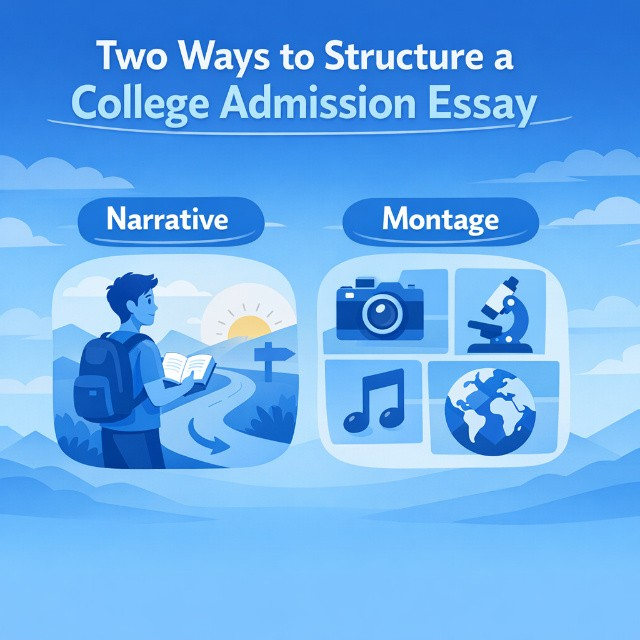
There are two ways to structure a college admission essay:
- Narrative: a single experience told as a story, with a clear before-and-after arc that reveals something about how you think or what you value.
- Montage: a series of seemingly unconnected moments that, taken together, reveal one underlying truth about you.
Both work. Which one is right for you comes down to your topic.
The one thing every great essay shares? A specific, personal truth told in a natural voice. Not a lesson you learned. Not an impressive accomplishment. A real moment, rendered clearly, that makes the reader feel like they know you.
How Much Does a College Admission Essay Actually Matter?
It depends on where you're applying, and that's worth understanding before you write a single word.
At highly selective schools with acceptance rates below 15%, your grades and test scores get your application read. They don't get you in. When 80% of applicants are academically qualified, the essay is often what separates the ones who get an offer from the ones who don't. At schools like these, treat this essay as seriously as any exam you've ever prepared for.
At less competitive programs (large state schools, in-state applications, or programs where your academic profile is clearly stronger than the typical applicant), the essay carries less weight. It still needs to be good. It just isn't the deciding factor in the same way.
One thing worth knowing: many schools have moved to test-optional admissions in recent years, which means the essay now fills some of the space that SAT and ACT scores used to occupy. If you're applying to a school that doesn't require test scores, your essay is doing more work than it would have been five years ago. |
The short version: if your target school is competitive, this essay matters more than almost anything else you'll submit. Write accordingly. |
"The best college essays don't impress. They connect."
How to Write a College Admission Essay: Complete Process
To write a college admission essay: choose a specific personal topic, pick a narrative or montage structure, open with a scene-in-motion hook, write a vomit draft, revise for voice, and proofread against the portal's word limit.
Step 1: Brainstorm Your Topic (Time: 1–3 Hours)
The Common App personal statement gives you seven prompts to choose from:
- Background, identity, interest, or talent that's meaningful to you
- Obstacle, challenge, or failure, and what you learned
- Belief or idea you've questioned or examined
- Problem you've solved or would like to solve
- Accomplishment, event, or realization that sparked growth
- Topic that captivates you and why
- Topic of your choice
Here's the thing, though: you don't pick a prompt first. You find your story first, then match it to a prompt afterward. The prompts are broad enough that almost any genuine personal story fits one of them.
Start with what's called the "peak moments" exercise. Grab a piece of paper and write down 5–10 defining moments from your life. Don't filter. Don't evaluate yet. Just list the moments that made you who you are: things that changed how you think, moments you keep coming back to, experiences that nobody else in your graduating class had.
Run Each One Through the "So What?" Test
What does this moment reveal about me that isn't already visible in my grades, my activities list, or my rec letters? If the answer is "not much," cross it off.
- Some college admission essay topics to avoid: the mission trip where you "realized how lucky you are," the sports injury and the comeback, the generic "I worked hard and learned a lesson" arc. These aren't bad experiences. They're just overrepresented in the applicant pool, which makes them harder to distinguish.
- When to start: Ideally, 8–10 weeks before your earliest deadline. Here's a realistic breakdown:
Week | Task |
1 | Brainstorm and topic selection (Steps 1–2) |
2–3 | Hook and full draft (Steps 3–4) |
4–5 | Revise, read aloud, get feedback (Step 5) |
6 | Polish and proofread (Step 6) |
7–8 | Buffer for supplementals and second opinions |
Starting fewer than four weeks out makes meaningful revision nearly impossible.
Deliverable for Step 1A shortlist of 2–3 potential topics. One of them should feel different from what everyone else is writing. "Your topic doesn't have to be dramatic. It has to be specific." |
Step 2: Choose Your Structure (Time: 30 Minutes)
Once you have your shortlist, pick your structure before you write a single sentence.
Here's how to decide. Ask yourself: "Is there a single experience that fundamentally changed how I see something?"
- If yes, go with a narrative structure. Set the scene, build toward a turning point, then reflect on what shifted for you.
- If no, and your identity is better captured across multiple experiences rather than one defining moment, go with a montage structure. You'll open with one image, pivot with a connecting thread, build out 2–3 more images, and land the theme in your final paragraph.
Narrative asks for one great story. Montage asks for one great theme.
Whatever structure you choose, your essay needs a hook that immediately drops the reader in. We'll cover that in Step 3. For now, your job is just to decide. Questions about college admission essay format, including margins, spacing, and what happens to your formatting when you paste into the Common App portal, are worth reviewing before you submit.
Deliverable for Step 2A one-sentence "essay thesis": what this essay is really about. Not the topic. The underlying truth. Example: "This essay is about how fixing motorcycles taught me that most problems aren't mechanical. They're about patience." "Structure isn't a cage. It's the scaffold that lets your voice hold up." |
Step 3: Write Your Hook and Opening Paragraph (Time: 30–60 Minutes)
Your first sentence has one job: make the reader want to read the second sentence. That's it.
The most effective hooks drop you into a moment in progress. The two types that consistently work are scene-in-motion hooks, like "I'm elbow-deep in a carburetor when my dad tells me I got in," and specific sensory detail hooks, like "The smell of burnt solder is the smell of 11 pm in my room for the last three years."
What you want to avoid: "My whole life, I have been passionate about…" and dictionary-definition openers. Both are guaranteed to make an admissions officer's eyes glaze over.
Here's what a strong opening paragraph looks like in full:
"I'm holding a spatula, not a trophy, when it finally clicks. It's 11 pm on a Wednesday, and I've just burned my fourth attempt at my grandmother's pepper soup. My notes are spread across the counter, half chemistry, half memory, and I realize I've been treating this like an experiment when what it actually is, is a conversation."
That paragraph drops you into a specific moment, establishes voice, and raises a question, all before the essay has technically started. That's what your opening needs to do.
Deliverable for Step 3A first paragraph that makes you want to keep reading. "If your first sentence could describe any student, rewrite it." |
Step 4: Write the Full Draft (Time: 2–4 Hours)
Write the vomit draft first. Everything out, no filter, no editing as you go. Resist the urge to make every sentence perfect before moving on. A rough draft that exists is more useful than a polished one you haven't started.
Once you're drafting, your structure determines your path:
- For a Narrative essay: Set the scene; build tension toward the turning point; reach the turning point; reflect on what changed. The reflection is usually the shortest part. Don't over-explain what the story "means." Trust the story to do that work.
- For a Montage essay: Establish your first image; pivot with a connecting line that signals a pattern; build out 2–3 more images; land the theme in your final paragraph. The connecting thread is the hard part. If readers don't see why these images belong together, you've lost them.
Across both structures: show, don't tell. Don't write "I worked hard." Write the night you stayed up until 2 am, reworking the same paragraph because something still felt off. Don't write "my grandmother was important to me." Write the specific thing she said that you still hear in your head.
The word limit for the Common App personal statement is 650 words, and the right length target for most students is 550–650. Essays that land well below 500 words usually signal that something important was left out; essays that strain toward 650 on every sentence usually have padding that should be cut.
Deliverable for Step 4A complete rough draft at or near your target word count. "A rough draft that exists is better than a perfect draft you haven't started." |
Step 5: Revise for Voice and Clarity (Time: 1–2 Hours Over 2–3 Days)
The biggest revision mistake students make is editing for impressiveness instead of clarity. You're not trying to sound smart. You're trying to sound like yourself on your best day.
Start with the read-aloud test. Print your draft or pull it up on your phone, and read every sentence out loud. If you stumble or trip over a phrase, rewrite it. If a sentence sounds like something you'd never actually say to another person, cut it or replace it with something you would say.
Then audit what you've written for these patterns:
- Résumé repetition: If something is already in your activities list or transcript, don't repeat it in the essay. The essay is for what doesn't fit anywhere else.
- Generic claims: "I'm a hard worker" and "I care deeply about my community" tell the reader nothing. Replace them with the specific moment that proves it.
- Filler transitions: "As a result of this experience, I learned that…" Cut the preamble and just say what you learned, directly.
Get one or two readers who will tell you the truth. Not just "this is good, you should be proud." You need someone who'll say, "I don't understand what you're trying to say in paragraph three."
Watch out for the over-editing trap: revising so many times that all the personality gets sanded away. Edit for clarity. Edit for truth. Don't edit out your voice, trying to make it sound more "professional." The college admission essay tips that matter most at this stage are about knowing when to stop, not how to keep improving.
Deliverable for Step 5A revised draft that sounds like you, not a guidance counselor. "The goal isn't to sound smart. It's to sound like yourself on your best day." |
Step 6: Polish and Proofread Before You Submit (Time: 30–60 Minutes)
You're almost there. This step is about polishing. If you're still making structural changes at this point, you're not in Step 6 yet. Go back to Step 5.
Run a final proofread for grammar, spelling, and punctuation. Tools like Grammarly can catch most of it, but also read it manually. Software misses things that your eye will catch.
Check your word count against the portal's actual limit. The Common App caps at 650 for the personal statement, but supplemental essays have their own limits, which vary by school. Don't copy-paste your essay into a portal and assume the formatting will hold. Open it in the submission text box and preview it. Common App strips bold and italics, so make sure the essay still reads clearly without them.
Then read your conclusion. Does it end with something that lands? Or does it just stop? Knowing how to end a college admission essay is its own skill, and a weak final sentence can undercut an otherwise strong draft.
Deliverable for Step 6A submission-ready draft you'd be proud to send right now. "Submitting a polished, honest essay beats a brilliant unfinished one every time." |
Your personal statement goes to every school on your list automatically. You don't resubmit it per school. What you do handle school-by-school are supplemental essays, which brings us to the next point.
You've followed all six steps, and you have a draft. The next question most students hit at this point is whether it's actually working, whether a stranger reading it would feel like they'd met a real person or just read another application essay. If you want that answer from someone who reads these every day, our college admission essay writing service covers full drafts, rewrites, and review. Tell us your school, your prompt, and your deadline.
A Note on Supplemental Essays
The six steps above apply to your Common App personal statement. Supplemental essays follow the same principles but with different constraints.
Most supplementals fall into one of three types: "Why Us" essays that ask why you want this specific school, "Why Major" essays about why you chose your field, and "Community/Identity" essays about what you bring to campus. The principles for supplemental essay writing are similar to what you've done here, but each type has its own structure and its own traps.
One rule applies across all of them: never recycle your personal statement. Each essay should reveal something the others don't.
Common Mistakes to Watch For Throughout the College Admission Essay Writing Process
Most essay problems start before you write the first word. Here are four of the most common college admission essay mistakes to keep in mind across all six steps:
- Writing about your accomplishments instead of your character. Admissions officers already have your transcript. Use the essay to show them who you are, not what you've done.
- Trying to sound like what you think admissions wants to hear. They've read thousands of essays. They can tell. Write the true thing, not the impressive thing.
- Starting too late. Ideally, begin 8–10 weeks before your deadline. Anything less than four weeks makes meaningful revision nearly impossible.
- Skipping the read-aloud test. This is the single fastest way to catch problems. Do it every time you revise.
"Most essay mistakes happen before you write a single word."
You've got a draft, you've read it aloud, and you've revised it until it sounds like you. The last step is making sure it lands the way you intend it to, which is harder to judge from the inside than it sounds. If you want a second set of eyes from writers who know exactly what admissions officers respond to, CollegeEssay.org's admission essay writing service is the place to start. Tell us your school, your word count, and your deadline.