You have a college admission essay to write and a blank document where a topic should be.
This page gives you 50+ ideas organized by category, a four-question test to run on any topic before you commit, and a guide to matching your story to the right Common App prompt. Most students find a usable direction in under ten minutes.
50+ College Admission Essay Topic Ideas by Category
These are not prompts to fill in mechanically. Use them to surface something from your own life you might not have thought to write about. Each category includes a note on what makes that type of story work, because even a strong topic can be executed in a way that kills it.
If you are looking for unique angles, Categories 7 and 8 tend to produce the most unexpected essays. For intellectually distinctive topics, Category 6 is built for that. For college admission essays that convey maturity and real-world experience, Category 5 is the most underused. Browse all eight; most students find the right direction somewhere they did not expect
Category 1: Identity and Background
What makes it work: This category needs to show how your background shaped the way you see or think, not just who you are. The essay should leave the reader with a specific lens, not a biography.
- A tradition in your family or culture that outsiders would find strange but that carries real meaning for you
- The moment you first understood your identity as something layered, not one label, but several coexisting
- Growing up between two cultures or languages, and the specific tension or gift that experience created
- A neighborhood, city, or physical place that shaped how you understand people or the world
- How your name, its origin, meaning, or history of being mispronounced, connects to your sense of who you are
Category 2: Overcoming a Challenge or Failure
What makes it work: The challenge itself matters less than the specific way you responded to it and what you genuinely learned. Saying you grew stronger is not enough on its own.
- A time you failed publicly and what you actually did with that failure afterward
- Learning something that directly challenged a belief you had held for years
- Staying with something difficult despite having no external validation that it was worth it
- Navigating a family difficulty that required you to act older than your age
- An academic struggle that forced you to completely change your approach, not just try harder
- Being the only person in a room who disagreed and deciding whether or not to say so
- A time you changed your mind mid-project and had to defend that decision to someone who had been counting on you
Still not sure which college admission essay topic is yours? Tell us your grade level, the schools you are applying to, and a few things about yourself (activities, experiences, or things you care about), and our admission essay writers can pick and develop a topic for you, starting from scratch or working from an angle you are already considering.
Category 3: Passions, Hobbies, and Obsessions
What makes it work: The subject of the passion is almost beside the point. What matters is how you think about this thing and what it reveals about how you engage with the world.
- An obsession that most people find unusual, but that has taught you something surprising about yourself
- The moment your relationship with a creative hobby shifted from casual fun to something serious
- Something you have built, created, or made with your hands, and what the process actually taught you
- A niche interest (historical maps, competitive crossword, obscure film, fermentation science) and the way it has expanded how you think
- A passion that started as something else entirely, and how you got there
- What do you do when no one is grading you, paying you, or watching
- A book, film, or piece of music you have returned to at different points in your life, and what changed each time
- A skill you are still a beginner at, and why you have chosen to stay with it anyway
Category 4: Relationships and Community
What makes it work: The essay must stay focused on you. The relationship is a lens, not the subject. The other person matters only insofar as they reveal something about how you think, grow, or change.
- A relationship that changed what you believe about friendship, loyalty, or trust
- What you have learned from being a sibling, a caregiver, or the responsible one at home
- A mentor, coach, or teacher, but only if the focus is on what you did with what they gave you
- A moment when your community showed you something about yourself you had not seen before
- A friendship across a significant difference (age, background, belief) and what it genuinely taught you
- A time you realized you had been wrong about someone for a long time, and what that showed you about how you form judgments
Category 5: Work, Responsibility, and Independence
What makes it work: This is one of the most underused categories. Students who have worked real jobs, supported their families, or taken on serious responsibilities often have rich, specific material that conveys maturity in a way traditional topics do not.
- A job, even an unglamorous one, and what it taught you about people, effort, or yourself
- Managing something real: finances, a household responsibility, a younger sibling's schedule
- A time you were trusted with genuine responsibility and how you handled it
- The accomplishment you are most proud of that almost no one else knows about
- A decision you made independently that your parents would not have made for you
- Starting something yourself (a small side project, service, or idea) and what the attempt taught you, even if it did not succeed
Category 6: Intellectual Curiosity and Ideas
What makes it work: This category rewards depth over breadth. Do not list all your interests. Go deep on one question, one concept, one idea, and show how you think. Admissions officers see essays about being curious all the time. They rarely see ones that demonstrate it.
- A question you genuinely cannot stop thinking about, not one with a clean answer, but one that stays open
- A time you followed a research rabbit hole and where it actually took you
- The moment you realized you cared about something you had been told was not useful
- A concept or theory you encountered in class that changed how you see something unrelated
- What you would study if grades and career paths did not exist, and no one was watching
- An argument or debate you had with yourself about something you used to believe
- A time you disagreed with something you were taught, and what you did with that disagreement
Category 7: Quirks, Contradictions, and Unexpected Angles
What makes it work: These essays live or die on authenticity. They succeed when students trust their own specificity enough to commit to it. The best essays in this category make admissions officers pause and re-read. If you want the most distinctive, unexpected college admission essay topic in the pile, start here.
- Something small and mundane that you take more seriously than most people, and why
- A contradiction in yourself that you have come to accept or even value
- A collection, ritual, or habit that sounds odd from the outside but means something to you
- A joke that became serious, or a serious thing that became a kind of joke
- The version of yourself that only exists at home, or around one specific person
Category 8: Growth, Change, and New Understandings
What makes it work: The shift has to be specific. Saying you grew up or became more open-minded is not a conclusion; it is a placeholder. Name the exact moment, the exact thing that changed, and why. These essays work best when the before and after are both visible and the distance between them is real.
- A belief you held with confidence until something small quietly dismantled it
- The version of yourself from three years ago that you would genuinely argue with now
- A decision that felt right when you made it and wrong in retrospect, or the reverse
- Moving, transferring, or starting over somewhere new, and what you noticed that you could not have seen before
- The moment you stopped performing a version of yourself for someone else's benefit
- The habit or routine that holds your life together, and what it says about who you are becoming
College Admission Essay Topics to Avoid and Why They Usually Fail
Every list of college essay topics includes a section on what not to write. Most just name the topics without explaining why they tend to fail. The explanation matters because understanding the mechanism of failure helps you figure out whether your specific version of that topic might actually work.
Topic | Why It Usually Fails |
The sports injury or big game | Often focuses on the event instead of the person. The lesson about teamwork and perseverance is one admissions officers can predict before they finish paragraph one. |
The mission trip abroad | Tends to center your experience of helping others rather than genuine self-reflection. Hard to write without sounding unintentionally tone-deaf. |
The death of a grandparent as the primary subject | Centers someone else's story. It only works when the specific impact on you is the true subject, not the loss itself. |
The big achievement or award | Reads like an extended resume bullet. Topics should reveal who you are, not just what you have accomplished. |
A summary of your entire life | Essays that open with where you were born try to cover everything and end up saying nothing. Essays need depth, not breadth. |
The career aspiration essay | Future-focused essays often skip the vulnerability and specificity that make personal statements worth reading. Aspirations are fine as context, not as the whole essay. |
These topics do not fail because they are bad ideas. They fail because the standard execution is predictable. A sports essay can absolutely work. A mission trip essay can work. The bar is just higher, and most students do not clear it.
How to Know If Your College Admission Essay Topic Is Strong (Before You Write a Word)
Here is the mistake most students make: they pick a topic, open a blank document, write 400 words, realize it is not working, and start over. Sometimes this happens two or three times before they land on something worth finishing.
You can avoid most of that by testing your topic before you write. Run it through these four questions. If it stalls on any of them, adjust or find a different angle.
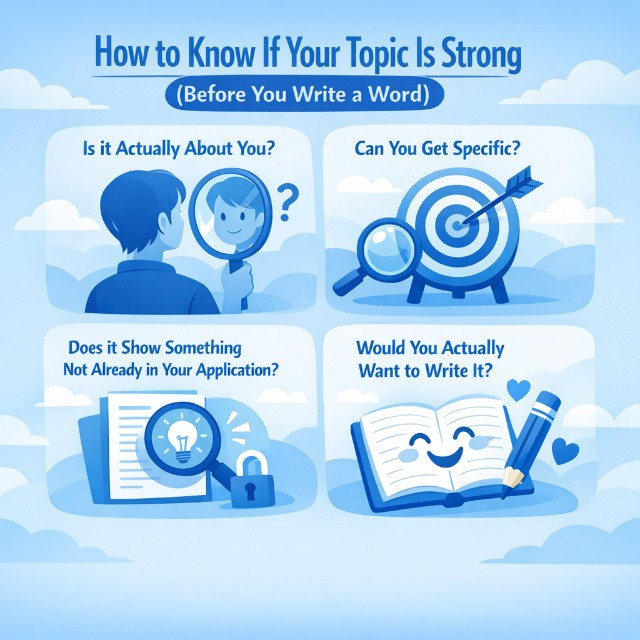
1. Is it Actually About You?
Not about a person you admire, a place you visited, or a cause you care about. The focus has to be on you. What does this topic reveal about your character, your values, or the specific way you think? If your essay would be mostly about someone else, you are writing the wrong essay.
2. Can You Get Specific?
Vague topics do not work. Saying you love music is not a topic. Describing the three months you spent teaching yourself to read sheet music after a shoulder injury is. If you cannot identify a concrete scene, moment, or turning point, your topic is still too broad. Keep narrowing until you can point to something real.
3. Does it Show Something Not Already in Your Application?
Your essay should not be a prose version of your activities list. Admissions officers have already read about your AP scores, your team captaincy, and your volunteer hours. The essay is your chance to show a dimension of yourself that none of that captures. If your topic mostly restates what is already there, find a different angle.
4. Would You Actually Want to Write It?
A lot of students choose topics they think they should write about rather than ones they genuinely want to explore. If you are dreading the blank page before you have even started, admissions officers will feel that flatness in the final product. The essays that get remembered are usually the ones the writer actually cared about.
A strong college admission essay topic is not the most impressive story you have. It is the one that lets the most authentic version of you come through.
You have your topic, and you know which prompt it fits. Writing an essay that actually sounds like you, specific, honest, and worth 650 words of an admissions officer's attention, is where most of the real work starts. The college admission essay writers at CollegeEssay.org build personal statements around your topic, your voice, and your target school. Most students have a complete draft back within 24 hours.
How to Match Your College Admission Essay Topic to the Right Common App Prompt
Here is something most students get backward: they read the Common App prompts first and try to force a topic into one of them. The better approach is to lock in your topic first, then find the prompt it fits.
Strong topics usually work for at least two or three prompts. If your topic only fits one very specific prompt, it is a signal that the topic might be too narrow, or that you are thinking about it the wrong way.
Visit the Common App essay prompts page to read the current 2025-26 prompts in full. Here is how they map to the categories above:
- Prompt 1 (background, identity, or talent): Natural fit for Category 1 and Category 7. This is the broadest and most flexible prompt.
- Prompt 2 (challenge, setback, or failure): Best for Category 2, but only when the failure is genuinely specific and the reflection is earned rather than stated.
- Prompt 3 (questioned a belief or idea): Best match for Category 6. This is the intellectual curiosity prompt, and it is underused by students who have strong ideas-based topics.
- Prompt 4 (gratitude for someone's impact): Works for Category 4, but requires keeping the essay focused on you. The other person is the context, not the subject.
- Prompt 5 (accomplishment, growth, or realization): Best fit for Category 8 and the turning-point topics. The growth needs to be specific and traceable, not just asserted.
- Prompt 6 (captivating topic, idea, or concept): Natural fit for Categories 3 and 6. If you have a genuine intellectual obsession or an unusual passion, this prompt is built for it.
- Prompt 7 (topic of your choice): Works for anything in Categories 1-8. The most flexible and open-ended option.
The prompt you choose matters less than the story you tell. Most strong topics can fit at least two or three prompts.
Once your topic is confirmed, the next challenge is the opening line. Our guide on how to start a college admission essay covers the hook patterns that work and the ones admissions officers have seen too many times.
Conclusion
You have your topic. The next step is an essay that does it justice. Tell the CollegeEssay.org admission team your topic, your target prompt, your target schools, and anything you want the essay to convey. They will handle the rest, from the opening hook to the final line. Most students receive a complete draft within 24 hours.