Most college essay mistakes have nothing to do with writing ability. They are choices made before the first draft, during it, and in the last five minutes before you hit submit. This guide covers everyone, sorted by phase, with a specific fix for each.
> >
College Admission Essay Writing
>College Admission Essay Mistakes to Avoid: A Phase-by-Phase Guide
College Admission Essay Mistakes to Avoid: A Phase-by-Phase Guide
Before You Write: College Admission Essay Mistakes That Doom You Before You Start
The three errors below happen before a single sentence is written, which makes them easy to overlook and almost impossible to fix late in the process.
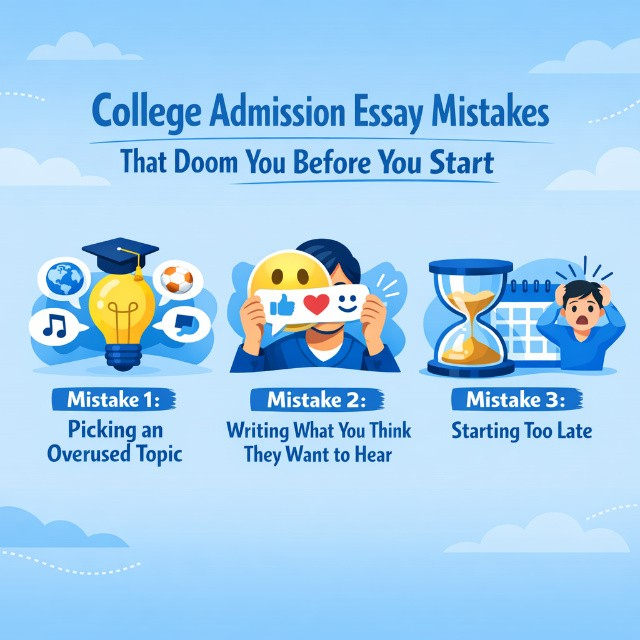
Mistake 1: Picking an Overused Topic
What it looks like: The sports injury comeback. The mission trip epiphany. "I volunteered at a food bank and learned to be grateful." These topics aren't bad because they're emotional. They're bad because they're familiar.
Why it fails: Admissions officers read thousands of college admission essays per cycle. When they see a topic for the hundredth time, they already know how it ends. The topic signals that you went with your first idea rather than your most honest one.
The fix: Try the "zoom in" test. Can you describe a specific ten-minute window of your life that only you lived? That's usually the real topic hiding behind the generic one. A scene at 6 am, loading a truck with your dad, tells an admissions officer more about you than a month-long service trip ever could. The best topics aren't dramatic. They're specific. |
Mistake 2: Writing What You Think They Want to Hear
What it looks like: Performing maturity you don't fully feel yet. Padding the essay with leadership experiences or service hours you didn't actually care about. Writing the version of yourself that sounds impressive rather than the version that's actually true.
Why it fails: Admissions officers are trained to spot essays where a student is performing rather than being. The prose gets vague, the reflection sounds scripted, and the voice disappears. They've read enough authentic essays to feel the difference immediately.
The fix: Read your draft out loud to yourself. If you'd be embarrassed to read it to a close friend who knows you well, that's your signal to rewrite. The goal isn't to sound mature. It's to sound like you, thinking clearly. |
Mistake 3: Starting Too Late
What it looks like: One week before the deadline. A single rushed draft. No time for feedback or real revision.
Why it fails: Rushed essays feel rushed. The prose is flat, the opening hook is generic, and the reflection stays surface-level because there wasn't time to go deeper. You can't revise your way out of a timeline problem in 72 hours.
The fix: Target your first complete draft by the end of junior year. That leaves time for at least three revision passes, feedback from someone who'll tell you the truth, and enough distance between drafts to see the problems you couldn't see when you wrote it. |
A ten-minute window that only you could describe will outperform a mission trip essay every time. Finding that opening moment is often the hardest part.
While You Write: College Admission Essay Mistakes That Undercut a Good Topic
Even a strong topic can be wrecked by execution. These four errors are the most common and the most likely to cost you, even when your instincts about the topic were right.
Mistake 4: Telling Instead of Showing
What it looks like: "I learned perseverance." "That experience taught me resilience." "I realized I could overcome anything." These are conclusions without evidence.
Why it fails: Assertions are empty without the scene behind them. Admissions officers want to feel the experience, not read a summary of what you took away from it. "I learned perseverance" tells them nothing. A scene where you stayed at the piano for three hours on a piece you hated, until it finally clicked, shows it.
The fix: Go through your draft and highlight every sentence that starts with "I learned," "I realized," or "I became." For each one, replace it with the specific moment that proves the point. |
Mistake 5: Making It About Someone Else
What it looks like: Four hundred words about your grandmother's illness. Two hundred words about your coach's philosophy. Fifty words about how it affected you.
Why it fails: The essay is a character study of you, the applicant. If an admissions officer finishes reading and knows more about the other person than they know about you, the essay missed its purpose entirely. Other people can appear, but they can't be the subject.
The fix: Apply the 80/20 rule. At least 80% of every paragraph should be about your thoughts, your reactions, your growth. The other person provides context. You're the story. |
Mistake 6: Using an Unnatural Vocabulary
What it looks like: Thesaurus abuse. Academic prose. Sentences constructed for a reader you imagined rather than the voice you actually have.
Why it fails: Authentic voice is one of the strongest signals admissions officers look for. Stilted, formal language is a red flag. It suggests either a ghostwritten essay or a student who doesn't trust their own voice. Either reading hurts you.
The fix: Read the essay out loud. If you wouldn't say a sentence to a classmate, rewrite it in plain language. The goal isn't to sound smart. It's to sound like a thoughtful version of you. What that actually looks like on the page, the difference between natural and polished versus natural and sloppy, is something the college admission essay tips from former admissions officers piece illustrates well with real examples. |
Mistake 7: Trying to Cover Everything
What it looks like: The highlight reel essay. Five achievements crammed into 650 words because you're afraid to leave anything out.
Why it fails: When everything is included, nothing lands. Short-form essays reward depth, not breadth. An officer reading a highlights list feels like they skimmed your resume, not like they met you.
The fix: Pick one moment, one theme, one insight. Use supplemental essays to cover everything else. A single well-developed story with specific details and honest reflection will stay with an officer far longer than five bullet points about how well-rounded you are. |
An essay that tries to cover everything ends up saying nothing. Pick one moment and go deep. Depth is what makes officers remember you.
If you've been nodding at any of these, including the highlights-reel structure, the vocabulary that sounds like someone else, the reflection that stays surface-level, our admission essay writers know exactly what not to do, and more importantly, they know what a version of your essay that avoids all of it actually looks like. Tell us your topic and where you're stuck.
Before You Submit: College Admission Essay Mistakes That Happen at the Finish Line
Submission mistakes are avoidable. Your essay could be excellent and still damage your application because of something you did in the last five minutes before clicking submit.
Mistake 8: Not Proofreading (and Trusting Only Spell-Check)
What it looks like: Typos that slipped through. Grammar errors your eyes auto-corrected. Punctuation that's almost right.
Why it fails: A polished application with a sloppy essay signals you didn't care enough to read what you sent. It's not about perfection. It's about effort. And spell-check doesn't catch "their" when you meant "there."
The fix: Read the essay aloud from start to finish. Then hand it to someone who hasn't read it and ask them to read it cold. Finally, read it backwards, sentence by sentence, to catch typos your brain fills in automatically when you read forward. |
Mistake 9: Leaving In the Wrong College Name
What it looks like: You wrote your Georgetown essay, loved it, and copy-pasted it for Yale. You updated most of it. "Georgetown" is still in paragraph three.
Why it fails: This is one of the most frequently cited instant-rejection scenarios among admissions officers, and it's easy to understand why. It signals that you didn't read what you sent. That's hard to recover from at any school.
The fix: Before submitting any application, run a Ctrl+F search for every school name you've ever written in an essay draft. Make it a non-negotiable step in your pre-submission routine. Five seconds of searching can save your application. |
Mistake 10: Going Over the Word Count
What it looks like: 680 words on a Common App limit of 650. Or 280 words on a 250-word supplemental.
Why it fails: The Common App truncates your essay at the word limit, so the reader may literally never see your final paragraph. Even where it doesn't cut, going over signals an inability to edit yourself, which is a skill admissions officers care about.
The fix: Hit 90–100% of the word limit. Not more. If the essay needs 700 words to breathe, the structure is wrong, not the limit. Cutting almost always improves an essay. Word count is one piece of a larger set of formatting decisions, including line spacing, font, margins, and whether to use a title, and the college admission essay format lays out the rules for each application type clearly. |
Mistake 11: Submitting an AI-Written Essay
What it looks like: Using AI to draft the full essay, or running your draft through a model for a heavy rewrite.
Why it fails: Many selective institutions now use AI detection tools as part of their review process. Beyond detection risk, AI-written essays lack the idiosyncratic voice and specific lived detail that officers rely on when evaluating authenticity. Holistic review specifically looks for evidence of the applicant's genuine perspective, something a model cannot supply.
The fix: Use AI for brainstorming, structural feedback, or a light grammar pass if needed. The voice and the story must be yours. An essay that sounds like it was written by a specific, confident high school student will always outperform one that sounds polished but generic. |
Submission mistakes are the easiest to avoid and the hardest to recover from. A pre-submit checklist takes five minutes and can save your application.
You've got the full map: every trap, sorted by phase, with a fix for each one. The harder part is sitting down and executing against all of it, in your own voice, under a real deadline. If you'd rather hand the draft to someone who knows what selective admissions actually responds to, a professionally written college admission essay from our team is built around your specific story and prompt.
Quick-Reference College Admission Essay Mistakes Checklist Before You Hit Submit
Before Writing
- Topic is specific to your experience, not the first idea that came to mind
- Topic is genuinely yours, not a performance of what sounds impressive
- First draft started early enough for at least three revision passes
While Writing
- Opening scene, not a summary or a definition
- At least 80% of every paragraph is about you, your thoughts, your reactions
- Vocabulary sounds like you speaking, not an essay template
- One moment, one theme, not a highlights reel
- No "I learned / I realized / I became" summaries without the scene behind them
Before Submitting
- Read aloud, top to bottom
- Ctrl+F every school name you've ever written in any draft
- Word count sits at 90–100% of the limit, not over
- No AI-drafted sections
- Someone else has read it cold
You now know every trap in this process: the overused topic, the performed voice, the wrong school name left in paragraph three. What's left is writing something an admissions officer actually remembers. Tell CollegeEssay.org's admission essay team your prompt, your target schools, and the story from your life you haven't figured out how to tell yet. Every essay is written by a human, no AI, no templates, and most drafts come back within 24 hours.
Frequently Asked Questions
How long should it take to write a college admission essay?
Most students need six to eight weeks from the first draft to a submission-ready version. That includes at least three revision passes and time for feedback from a reader who will give you honest notes. Starting in the summer before senior year is the safest timeline.
How many people should review a college admission essay before submitting?
One or two readers is enough. More than that creates conflicting feedback and a tendency to revise toward what other people think rather than what is true to your voice. Choose a reader who knows you well and one who can catch grammar and clarity issues.
Can you reuse the same college admission essay for multiple schools?
Yes, with careful adaptation. The personal statement submitted through the Common App goes to every school as-is. Supplemental essays are school-specific and should never be reused without meaningful changes, as admissions officers can tell when an essay has been recycled.
Does a college admission essay need a title?
No. The Common App and most application portals do not require or expect a title. Adding one is neither an advantage nor a mistake on its own, but it costs you words and can create an expectation the essay then has to live up to. Most strong essays skip the title entirely.
What tense should a college admission essay be written in?
Past tense works best for narrating events and scenes, which is where most of the essay lives. The present tense can be used for reflection or observations that are still true. Mixing the two is fine as long as the shift is intentional. Avoid writing in the future tense about outcomes you haven't experienced yet.
Benjamin C. Verified
Author
Benjamin C. holds an MS in Marketing from Imperial College Business. He has over 6 years of experience in academic research and writing, specializing in admissions essays, personal statement writing, and scholarship essays. Benjamin has contributed articles to reputable publications such as USA Today and The Huffington Post. He is the recipient of the National Association for College Admission Counseling's Rising Star Award, recognizing his outstanding contributions to the field of college admissions essay writing. With his extensive knowledge and expertise, Benjamin has helped many students achieve their academic and professional goals.
Specializes in:
Ivy League Admissions Essays
Personal Statement Writing
Scholarship Essays
Read All Articles by Benjamin C.
Keep Reading
Was This Blog Helpful?
On this Page