You're inside the Common App, staring at that 650-word box, and you want to know: is that a hard limit, a target, or just a rough guide? Here's the short answer: 650 is the hard cap for the Common App personal statement, and you should get as close to it as possible without going over. The rest of this page covers every major platform, what to do when a prompt gives no word count, and what "close enough" actually means in practice.
How Long Should a College Admission Essay Be?
What's the Word Limit for the Common App Essay?
The Common App personal statement has a hard cap of 650 words. You can submit as few as 250 words, but the platform will not let you paste or type past 650. It simply stops accepting text. There is no workaround, no way to sneak in an extra paragraph, and no admissions officer who will read the portion you trimmed off the bottom.
The Coalition App follows a similar range, with most schools expecting 500 to 650 words for the personal essay.
Expert Tip
Where should you aim? Get as close to 650 as you can without going over. Most experienced college counselors suggest targeting 620 to 650 words. That range signals you took the prompt seriously and had enough to say to fill the space, without padding just to hit a number.
A note on the 10% rule: treat the word limit as a target, not just a ceiling. Being 10% or more under the limit (say, 580 words or below on a 650-word essay) starts to look thin. You'll see why in a later section. If you are still building a clear picture of what the college admission essay actually is and how it fits into your application, the college admission essay guide covers prompts, purpose, and how admissions officers read them.
How Long Should Common App Supplemental Essays Be?
Supplemental essays vary by school and by prompt. Most fall somewhere between 150 and 650 words, and the specific limit is almost always stated directly in or near the prompt on the application.
When a range is given (e.g., "200 to 250 words"), aim for the upper end. Writing 200 words when 250 is allowed leaves value on the table. |
When only a max is given (e.g., "up to 350 words"), aim for 90 to 95% of that limit. For a 350-word prompt, that puts you around 315 to 335 words. |
Short-answer prompts (150 words or fewer) are their own category. Treat every sentence like a headline. There is no room for a warm-up. |
Here's how the limits break down at commonly applied-to schools:
School | Supplemental Type | Word Limit |
MIT | Five short answers | 100 words each |
Stanford | Three short essays + short answers | 250 words / 50 words |
Harvard | No supplemental essay required | N/A |
Yale | "Why Yale" + short takes | 200 words / 35 words |
Columbia | List-based + "Why Columbia" | 150 to 300 words |
UChicago | Extended essay (choose a prompt) | Up to 650 words |
Georgetown | Three essays | 1 page / 1 page / 250 words |
NYU | "Why NYU" | 400 words |
Boston University | "Why BU" | 300 words |
Northeastern | "Why Northeastern" | 300 words |
Word limits change between application cycles. Always verify on the school's Common App portal before you write. The table above reflects typical ranges, not guaranteed current limits.
One thing that catches students off guard: some schools ask for multiple short essays rather than one longer one. MIT's five 100-word responses are harder to write than one 500-word essay. Every word is doing more work. Budget more time per word for short-answer formats, not less.
Length by Application Platform: Quick Reference
Here's a consolidated view of word count expectations across the major application systems:
Platform | Essay Type | Word Range | Hard Cap |
Common App | Personal Statement | 250 to 650 | 650 |
Coalition App | Personal Essay | 500 to 650 | 650 |
UC Application | Personal Insight Questions (PIQs) | Up to 350 each | 350 per question |
Common App | Supplementals | 150 to 650 | Varies by school |
Common App | Activities section | Up to 150 | 150 |
Direct Admit Portals | Varies | Usually 250 to 500 | Varies |
- UC PIQ note: You answer 4 of 8 questions. Each has its own 350-word cap. You can't carry unused words from one answer into another.
- Coalition App note: Coalition schools also use the Scoir platform, which follows the same 650-word cap for the personal essay.
- How many pages is a 650-word essay? Approximately 1.3 pages double-spaced, or 0.7 pages single-spaced, in a standard 12pt font. If you're submitting as a file attachment, this is a useful check before you upload.
Always verify the current requirements directly on each platform. Limits occasionally shift between application cycles.
Not sure whether your draft is hitting the right target for your specific platform and prompt? Essay length guidance from our admission specialists can confirm you are within spec and flag anything that needs adjusting before you submit.
How Long Are UC Application Essays (Personal Insight Questions)?
UC applicants answer 4 of 8 Personal Insight Questions (PIQs). Each question has a hard cap of 350 words. There's no minimum stated by the UC system, but competitive applicants typically use 330 to 350 words per question, staying close to the cap without going over, which is the same logic as the Common App.
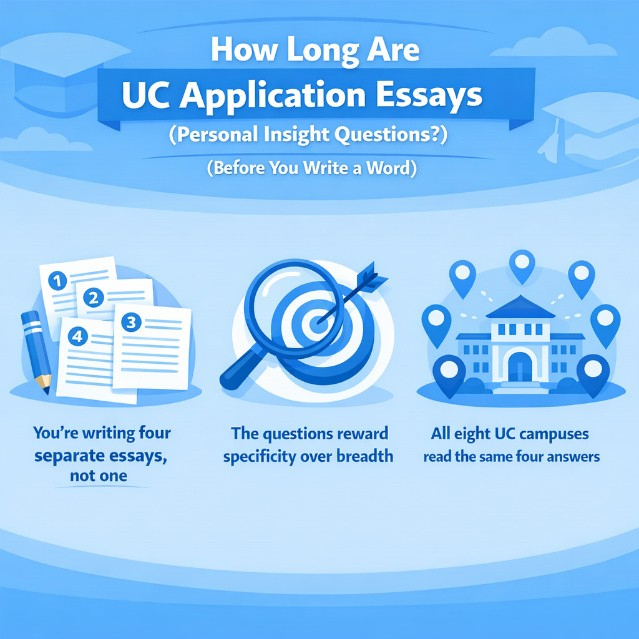
A few things that work differently here than on the Common App:
- You're writing four separate essays, not one. Each PIQ is its own answer with its own cap. You cannot use words left over from one question on another. If you wrote 300 words for question 3, those 50 unused words don't carry forward.
- The questions reward specificity over breadth. 350 words is not a lot of room. The PIQs that read best are the ones that go deep on one concrete example rather than trying to cover multiple angles. Pick the tightest version of your story and develop it fully within the limit.
- All eight UC campuses read the same four answers. You don't write separate essays per campus the way you might with Common App supplementals. Your four PIQ responses go to every UC you apply to: Berkeley, UCLA, San Diego, Davis, and any others. This differs from the Common App model, where each school's supplemental is a separate submission.
For the writing itself: treat 350 words the same way you'd treat a 650-word personal statement that got cut in half. Every sentence has to earn its place. Cut any sentence that summarizes what you just said. Cut any sentence that sets up what you're about to say. Get straight to the story.
What If the Prompt Doesn't Give a Word Limit?
Some supplemental prompts, especially at smaller schools or on direct admission portals, don't mention a word count at all. Before you panic, do these three things:
- Check the school's admissions FAQ page, which often lists general essay expectations.
- Search "[School Name] supplemental essay word limit." A current-cycle forum thread or prep site usually has the answer.
- If you genuinely can't find guidance, 400 to 500 words is a safe default for an open-ended prompt.
You can also call or email the admissions office. They won't penalize you for asking, and you get a definitive answer straight from the source.
Should You Use Every Word You're Given?
Yes. Get as close to the limit as possible without going over.
Admissions officers read hundreds of applications in compressed cycles. They don't count words manually, but they do notice when an essay feels cut short, or when a student clearly had more to say and stopped early.
A 400-word essay on a 650-word prompt sends a signal, whether you intend it to or not. It can read as a student who ran out of material, lost interest, or didn't treat the application as a priority. |
A tight 640-word essay that's specific, vivid, and complete? That reads as someone who used every tool available to represent themselves. |
The goal isn't to fill space. It's to tell a complete, honest story and then use your full word count to do it well.
If you've written a compelling 500-word draft on a 650-word prompt, you haven't finished yet. Go back and ask: where did I tell instead of show? Where did I gloss over a detail that's actually interesting? That's where your remaining 150 words live.
You know the limits. The harder part is filling 640 words with something worth reading. If you'd rather hand the writing off entirely, we'll write it to the exact length required, matched to your platform, your prompt, and your deadline. Most students get their first draft back within 24 hours.
Can You Go Over the Word Limit?
If you're submitting through a portal like the Common App or Coalition App: no. The portal physically won't let you paste or type past the cap. Your text will be cut. Full stop.
If a school asks you to submit an essay as a file attachment (this is rare), going over is technically possible, but not advisable. Some admissions officers follow the stated limit as a reading boundary. If the prompt says 500 words and your file has 600, they may stop at 500.
The practical takeaway: don't try to beat the limit. If your draft is over, you need to rewrite, not just cut the last paragraph. Trimming the ending produces a worse essay, not a shorter one.
One or two words over in a file submission is rarely a real problem. Fifty-plus words over is a real problem. Exceeding the limit is one of the more avoidable errors in the application process. Our roundup of college admission essay mistakes to avoid covers the others worth knowing before you submit.
Is 400 Words Enough for a College Admission Essay?
For the Common App personal statement: no, not really. The cap is 650 words, and submitting 400 puts you 38% below the limit. That is not a minor gap. Admissions officers will notice the essay feels thin, even if they don't know the exact word count.
There are a few cases where a shorter draft is acceptable:
- A supplemental prompt with a 400-word cap or lower: in that case, 400 is right on target
- A short-answer prompt where brevity is the point
- An open-ended prompt with no word count stated, where 400 is the low end of acceptable (aim for 500 in this case)
For the personal statement specifically, if your draft is at 400 words, treat it as a first draft that isn't finished yet.
What About the "Quality Over Quantity" Advice?
You've probably heard someone say, "quality matters more than length." That's true, but it's often used as an excuse to submit a shorter, thinner draft.
Expert Tip
Quality over quantity doesn't mean writing less. It means every sentence earns its place. A 640-word essay that's tight, specific, and vivid is better than a 640-word essay padded with vague observations. But it's also better than a 540-word essay that stops before the story is finished.
The real process: write to the limit first, then edit down to only the strongest version of that limit. Cut the weak sentences, not the sections. If you want to make sure your structure is holding the word count together properly, our guide on college admission essay format walks through length, structure, and style together. Those three things work as a system, not independently.
You've got your word counts and your platform rules. The essay itself is still ahead of you, and that's where most students run out of time. Tell us your prompt, your platform, and your deadline, and CollegeEssay.org admission writers will handle the rest. First draft in 24 hours, revision included.
Frequently Asked Questions
Does the college admission essay word limit apply to every school I send the Common App to?
Yes. The Common App personal statement is a single essay submitted to every school on your list at once. One word count, one submission. The 650-word cap applies universally, regardless of how many schools you are applying to.
Can I submit a college admission essay that is significantly shorter than the limit if I have said everything I need to say?
You can, but it carries risk. Admissions officers reading hundreds of applications develop a feel for whether an essay is complete. A 450-word personal statement on a 650-word prompt almost always reads as unfinished, not concise. If you think you are done at 450, read it again and look for places where you told instead of showed.
Do different versions of the Common App for international students have different college admission essay word limits?
No. The Common App operates on the same platform and the same 650-word cap for all applicants, domestic and international. The prompts are also identical. Word limits only differ when a school's supplemental essays have country-specific prompts, which is rare.
If I am applying to both UC schools and Common App schools, do I need two separate college admission essays?
Yes. The UC application is entirely separate from the Common App. Your UC Personal Insight Questions are written and submitted exclusively through the UC application portal. They do not transfer to or substitute for the Common App personal statement. You will need both sets of writing for a split application list.
How does the college admission essay length compare to what I wrote in high school?
High school essay assignments typically run 500 to 1,000 words with some flexibility. The college admission essay is more compressed and more competitive. At 650 words maximum, every sentence carries more weight than in a classroom essay. The standard is also higher: admissions officers are reading for voice, clarity, and story, not just argument structure or factual accuracy.
Benjamin C. Verified
Author
Benjamin C. holds an MS in Marketing from Imperial College Business. He has over 6 years of experience in academic research and writing, specializing in admissions essays, personal statement writing, and scholarship essays. Benjamin has contributed articles to reputable publications such as USA Today and The Huffington Post. He is the recipient of the National Association for College Admission Counseling's Rising Star Award, recognizing his outstanding contributions to the field of college admissions essay writing. With his extensive knowledge and expertise, Benjamin has helped many students achieve their academic and professional goals.
Specializes in:
Ivy League Admissions Essays
Personal Statement Writing
Scholarship Essays
Read All Articles by Benjamin C.
Keep Reading
Was This Blog Helpful?
On this Page