Your Ivy League application is due soon, and you want to know what a winning essay actually looks like, not described in general terms, but broken down move by move. What you'll find here are 6 essays from students admitted to Harvard, Yale, Princeton, Columbia, Brown, and Cornell, each one annotated for the specific craft decisions that made it work. The full texts are not reproduced, as these are copyrighted student submissions, but the analysis goes deep enough that by the end, you'll know exactly what each writer did and how to make the same moves in your own draft.
Ivy League Admission Essay Examples & Analysis
What Makes Ivy League Admission Essays Different From Other College Essays
The academic bar at Ivy League schools is already cleared by most students in the pool. Harvard, Yale, and Princeton routinely reject applicants with perfect GPAs and near-perfect test scores. At acceptance rates of 4 to 7%, the competition is not between average and excellent students. It is between excellent and exceptional ones.
That's what makes the college admission essay so critical. When grades, test scores, and extracurriculars look similar across thousands of applications, the essay is the final differentiator. Admissions readers go through hundreds of essays per day. The standard is not good writing. It is memorable.
Expert Tip
Here's what most students get wrong: they assume Ivy essays require extraordinary life events. Many of the most successful Harvard and Yale essays are built around ordinary moments, like cooking with a grandmother, debugging code at 2 am, or a sibling argument over something trivial. The difference is not the event. It's the quality of observation.
The Common App personal statement (650 words) is what most students think of as "the essay," and it's the focus of most examples here. Two of the six are supplementals, clearly labeled.
At Ivy League schools, the essay is not the icing. It's often the deciding factor between two otherwise identical applications. If you haven't started writing yet, our full guide on how to write a college admission essay walks you through every step before you look at examples.
The 4 Patterns That Appear in Successful Ivy League Admission Essays
After reviewing accepted essays from across all eight Ivies, four patterns appear again and again. These are not rules. They're architectures. The most successful essays fit one of them cleanly, rather than blending multiple approaches into something muddled.
Pattern 1: The In-Media-Res Open
The essay drops into a specific moment mid-action. The reader is inside the scene before they've had time to decide whether they're interested. There's no "I've always loved..." preamble. Just a precise moment already in motion.
What it signals: confident narrative voice, precise observation, and the structural maturity of a student who has thought carefully about how to tell a story, not just what story to tell. |
Pattern 2: The Unexpected Angle on a Common Experience
The essay takes something many students have done (a sport, a family tradition, a part-time job, learning a language) and finds the non-obvious meaning in it. The topic is not the differentiator. The lens is.
What it signals: intellectual depth, genuine self-awareness, and originality of thought. It tells the admissions reader that this student does not take their own life at face value. |
Pattern 3: The Intellectual Curiosity Essay
Less personal story, more evidence of how the student's mind works. The essay focuses on an idea or question the writer has genuinely grappled with. The "I" is present, but the essay is as much about what the student thinks as who the student is.
What it signals: academic readiness and genuine intellectual hunger, both qualities Ivy schools look for in a community built on seminar-style learning and independent research. |
Pattern 4: The Vulnerability and Growth Arc
An honest acknowledgment of difficulty or failure, followed by genuine reflection. Not performed humility. Not a neat lesson-learned bow at the end. Real, complicated perspective on something hard.
What it signals: emotional maturity, self-awareness, and readiness for college independence. This pattern is also the most frequently done badly, which means a genuinely honest version stands out sharply. |
6 Ivy League Admission Essay Examples (Annotated)
These are not full essay reproductions. Each college admission essay example includes a description of the essay, brief representative language, and craft-specific annotations focused on technique. The goal is not for you to read a great essay and feel inspired. It's for you to understand exactly what the writer did so you can make the same moves in your own work.
Example 1 | Harvard | Pattern: In-Media-Res Open
What the essay is about: A student describes the moment a robotics component they built fails at a regional competition. It opens at the exact second the circuit board stops responding, three minutes before judging begins.
Representative language: The essay opens with something like: "Three minutes. The display is blank." No context. No introduction. Just a problem, already in motion.
Annotations:
Hook technique: The essay opens with two sentence fragments. No subject-verb sentence in the first paragraph. Fragments move faster than complete sentences, and speed creates urgency. The reader is inside the crisis before they've processed what's happening.
The turn: At paragraph three, the writer zooms out from the broken circuit board to a larger question. Not "will I fix this?" but "what does it mean that I'm most alive when something is broken?" That's the structural move that elevates personal narrative into self-analysis.
What admissions officers see: A student who can observe their own experience with enough distance to find the larger meaning, the kind of thinking required in college seminars and independent research.
What you can steal: Drop your reader into a specific moment before you tell them what it means. Trust them to stay.
Example 2 | Princeton | Pattern: Intellectual Curiosity
What the essay is about: A student writes about their obsession with prime numbers, not as a math talent essay, but as a meditation on why they're drawn to things that refuse to be divided.
Representative language: The student describes primes as numbers that "can only be themselves," a phrase that becomes the essay's central metaphor rather than just a math fact.
Annotations:
Conceptual anchor: The essay picks one mathematical concept and follows it all the way. No pivoting to accomplishments. The idea stays in the foreground throughout.
The personal-intellectual bridge: About halfway through, the student connects their relationship with prime numbers to a specific experience of feeling out of place in a group setting. The bridge works because it's specific. Not "I've always felt different" but a named moment with named detail.
Evidence of genuine engagement: The essay references a specific theorem the student found in a library book outside of class. That detail signals authentic curiosity rather than constructed passion.
What admissions officers see: A student whose intellectual life happens outside of class requirements. Princeton, in particular, values students who contribute to campus intellectual culture beyond their major.
What you can steal: Go deeper into one idea rather than covering more territory. Depth signals genuine interest. Breadth signals a resume.
Example 3 | Yale | Pattern: Vulnerability and Growth Arc
What the essay is about: A student writes about failing to make the varsity soccer team junior year, not as a sports essay, but as an honest examination of how they had built their identity around athletic achievement and what happened when that identity collapsed.
Representative language: The writer describes sitting in their car after getting cut, looking at the steering wheel, and thinking: "I had no idea who I was without this."
Annotations:
The vulnerability is specific: The essay does not say "it was hard" or "I was disappointed." It names a specific, uncomfortable thing: the student realized they had no self-concept beyond soccer. That specificity is what makes the vulnerability real rather than performed.
The growth is not neat: Rather than ending with "I discovered who I really was," the essay acknowledges the student is still figuring it out and frames that uncertainty itself as a form of growth. That's a more honest arc than the tidy redemption ending most essays use.
What admissions officers see: A student who can sit with discomfort and examine it honestly. That's what Ivy seminars require: intellectual and emotional honesty in front of peers.
What you can steal: Resist the urge to resolve a vulnerability essay neatly. The honest version of growth is messier than the tidy version, and readers can tell the difference.
You've seen the patterns in action across different schools and different writers. If you can't yet see which one fits your own story, or you can see it but don't know how to open, tell us your target schools, your story, and where you're stuck. Our Ivy specialists handle the rest: just say write my Ivy League admission essay and most students get a complete draft back within 24 hours.
Example 4 | Columbia | Pattern: Unexpected Angle on Common Experience
What the essay is about: A supplemental "Why Columbia" essay. Instead of listing Columbia programs and professors, this student frames their essay around how they navigate cities. They grew up in a small town and describe the deliberate way they've learned to move through unfamiliar urban spaces, asking questions, noticing patterns, getting lost on purpose.
Representative language: The essay describes New York as "a city that rewards the kind of attention I already know how to pay."
Annotations:
The inversion works: Most "Why Columbia" essays describe Columbia's attributes. This essay describes the student's attributes and argues that they match Columbia. The reader comes away thinking about the student, not the school's programs.
Specificity over flattery: There are no generic phrases about Columbia's "diverse academic community." The student references one specific professor's published work and one specific neighborhood visited on a campus tour. Specificity signals genuine interest. Generic praise signals a student who did not do their homework.
What admissions officers see: A student who has thought carefully about fit rather than prestige. The metaphor of urban navigation as intellectual curiosity works because it's earned across the essay, not asserted in the conclusion.
What you can steal: For supplemental essays, resist the urge to describe the school. Describe yourself in a way that makes the fit obvious.
Example 5 | Brown | Pattern: Intellectual Curiosity
What the essay is about: A supplemental essay for Brown's Open Curriculum. The student argues that Brown's Open Curriculum is not just an attractive feature but the only structure that fits how they actually learn. The essay traces a specific sequence of intellectual obsessions across three years (classical rhetoric, algorithmic bias, and medieval mapmaking) and explains how each led unexpectedly to the next.
Representative language: The essay describes the learning path as "less like a road and more like a river changing course."
Annotations:
The essay answers Brown's actual question: Brown's Open Curriculum essay wants to know if a student can self-direct. This essay demonstrates that capacity by showing a concrete track record of self-directed learning, not just claiming it.
Sequence matters: The three subjects are not random. The student explains the specific intellectual connection between each one. That chain of reasoning shows a genuinely curious mind.
What admissions officers see: A student who can build structure from curiosity, not requirements. That's exactly what Brown's Open Curriculum demands.
What you can steal: Show the connections between your intellectual interests. Random interests look scattered. Connected interests look like a developing mind.
Example 6 | Cornell | Pattern: Unexpected Angle on Common Experience
What the essay is about: A student writes about repairing their family's aging dishwasher three times over two years, not as a demonstration of technical skill, but as an examination of why they keep choosing repair over replacement and what that preference reveals about how they approach engineering problems.
Representative language: The student describes the third repair as "the same problem, a different failure point" and explains why that distinction matters to an engineer.
Annotations:
The topic earns its specificity: Choosing a dishwasher for a Cornell Engineering essay is a risk. It works because the student never loses the engineering lens. Every observation connects back to how engineers think about systems, failure, and iteration.
The unexpected angle is the thesis: The essay argues that repair is an undervalued mode of thinking in a culture that defaults to replacement. That argument proves the student thinks like an engineer without listing a single achievement.
What admissions officers see: A student who will contribute an identifiable intellectual perspective to Cornell's engineering community.
What you can steal: A specific, unglamorous topic handled with genuine depth will always outperform a prestigious topic handled at the surface.
How to Choose the Right Pattern for Your Ivy League Admission Essay
The four patterns above are not equally available to every student. The right one is the one where you have the most specific, concrete detail, not the most impressive story, but the most specific one.
Here are four questions to help you identify which pattern fits:
- Do you have a specific scene or moment you can open with, something you remember in real sensory detail? The In-Media-Res Open is probably your architecture. The pattern lives and dies on the specificity of that opening scene. If you can describe what you saw, heard, or felt in that moment with precision, you have what you need. If your memory of it is fuzzy or general, forcing it will produce a vague opening that loses the reader in the first paragraph.
- Is there something you do that seems ordinary to others but carries a deeper meaning you've never quite articulated? That gap is the Unexpected Angle. Your job is to close it on the page. The key test: can you explain what the activity means to you in a way that would surprise even someone who knows you well? If yes, you have material. If the meaning is obvious ("soccer taught me teamwork") you're describing the surface, not the lens.
- Is there an idea, question, or problem you can't stop thinking about because it won't let you go, not because a teacher assigned it? The Intellectual Curiosity Essay is built on that. The evidence admissions readers look for is engagement that happens outside of class requirements: the book you read because you had to know more, the problem you kept returning to after the assignment was done, the question you brought up at dinner when no one asked. If you can trace how one obsession led to another, you have the material.
- Have you been through something genuinely difficult and developed a real, complicated perspective on it, not a rehearsed lesson-learned? The Vulnerability and Growth Arc requires actual honesty. The test is whether the conclusion of your essay still makes you a little uncomfortable. If it resolves too cleanly, if you tied a neat bow, the essay will read as performed. Choose a different pattern and come back to this one when the distance is right.
If more than one fits, pick the one with the most specific detail. Specificity is the deciding vote.
What Ivy League Admission Essay Officers Are Actually Looking For
The essay is answering one question above all others: "Who is this person, and do we want them on our campus for four years?"
Everything else (the tone, the structure, the college admission essay topic) is in service of that question. Former admissions officers from Harvard and Yale have described in interviews and published guides that the essay needs to signal three things: intellectual curiosity, self-awareness, and a genuine voice. Not a polished voice. Not an impressive voice. A genuine one.
What admissions officers consistently say they are not looking for is what most students assume they want. They do not want a trophy listing. The essay is not a place to re-summarize your resume, as the activity section does that. The essay is for what the activity section can't capture: how you actually think. |
Performed humility is another common failure. The "I'm not perfect, but..." opener that leads into near-perfect credentials reads as calculation rather than self-awareness. |
Admissions officers read thousands of essays. The ones that get remembered show a student thinking on the page, not performing for a committee.
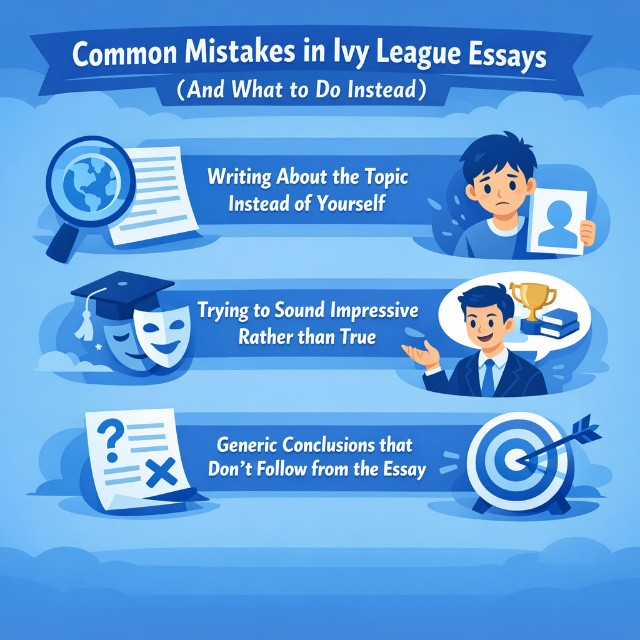
Common Mistakes in Ivy League Essays (And What to Do Instead)
Most essay mistakes happen in three ways, and they show up in Ivy applications just as often as anywhere else.
Writing About the Topic Instead of Yourself
A travel essay mostly about the country you visited. A sports essay where most words describe the game. The topic is the vehicle. If it's taking up more space than your perspective, the essay is not working.
Trying to Sound Impressive Rather than True
The language gets formal, sentences get longer, and the student disappears behind the prose. Ivy readers notice this immediately. The fix is simple and uncomfortable: write a draft that sounds exactly like you talk, then refine from there. Don't start refined.
Generic Conclusions that Don't Follow from the Essay
If your specific, original story ends with "I learned that perseverance leads to success," you've abandoned everything the essay built. The conclusion should follow from your specific story. It should be the only possible conclusion for this particular essay, not an ending that could be transplanted onto anyone else's.
For a full breakdown of mistakes to avoid across the entire application, see our guide on college admission essay mistakes to avoid. These mistakes are fixable. The harder problem is what comes next.
You now know the four patterns, what each one requires, and the three mistakes that sink otherwise strong essays. The next step is the hardest one: applying all of it to your own story under deadline pressure. If you'd rather hand that part off, our Ivy League college admission essay writing team works with Ivy applicants specifically. You share your story, your school list, and your deadline, and they build the essay around you.
How Ivy League Admissions Readers Actually Read Your Essay
Most students imagine their essay being read by a single person who sits down, reads carefully from start to finish, and deliberates. The reality is different, and understanding it changes how you write.
At schools like Harvard and Yale, each application is typically read by two admissions officers independently before any committee discussion. Each reader has dozens of applications in a single session. They are not skimming; they are reading. But they are reading with pattern recognition built from thousands of prior essays. They know within the first paragraph whether an essay is going somewhere specific or circling. The opening is not just a hook. It is the signal that tells a trained reader whether to lean in or brace for another hour of generic prose. |
What readers are marking varies by school, but the common thread is voice. Admissions officers consistently describe the essays they remember as the ones where they forgot they were reading an application, where the writing pulled them into a specific person's specific mind. That is not a lyrical standard. It is a specificity standard. The essays that disappear from memory are the ones that could have been written by any of the ten thousand other applicants with similar backgrounds.
Expert Tip
One practical implication: your essay will almost certainly be read in a batch. The reader has context from your transcript, your activity list, and your recommendations before they open it. They are not discovering who you are from scratch. They are checking whether the essay matches, or better, extends what the rest of the application already suggests. An essay that retreads the activity list is not just redundant. It is a missed opportunity to show a dimension of yourself that no other document in the file can show.
Moving From Pattern to First Draft in an Ivy League Admission Essay
Choosing your pattern is the analytical work. The draft is the harder part, and most students stall between them. Here is the shortest path from pattern to a working first draft.
If you Chose the In-Media-Res Open
Write the scene first, before anything else. Don't write the opening sentence; write the whole scene. Ten minutes, no editing. Get the specific sensory details on the page: what you saw, heard, and felt in the moment. The opening sentence will emerge from that scene, not from staring at a blank page trying to craft something impressive. Once the scene exists, write a single sentence that answers: what does this moment mean to me? That sentence is your turn, the bridge between the scene and the self-analysis. The rest of the essay builds from that bridge.
If you Chose the Unexpected Angle
Start with the activity or experience, not the meaning. Write two paragraphs describing what you actually do, the concrete, specific actions, before you attempt to explain what it means. Students who start with meaning produce abstract essays. Students who start with the concrete thing and work toward meaning produce essays that earn their insight. The meaning lands because the reader has already been inside the experience.
If you Chose the Intellectual Curiosity Essay
Write a single paragraph answering this question: when did I first encounter this idea, and what was my first reaction? That moment of encounter is usually more interesting than the idea itself. From there, trace one or two specific turns in your thinking, moments when the idea deepened or complicated itself. Admissions readers are looking for evidence that your mind moves. Show the movement, not just the destination.
If you Chose the Vulnerability and Growth Arc
Write the difficult moment in plain language first. No craft, no shaping, just what happened and what you felt. Then write what you think now, also in plain language. The gap between those two things is your essay. The editing process shapes it; the raw honesty has to come first. Students who try to write the polished version of a vulnerability essay without first writing the unpolished version almost always produce something that reads as performed.
In all four cases, your first draft should be longer than 650 words. Write past the word limit. Cut later. The instinct to stay within the limit during drafting produces compressed, underdeveloped writing. Give yourself room to find the essay inside the material, then cut to the bone.
You've seen the four patterns, six essays broken down craft move by craft move, and the specific mistakes that cost otherwise strong applicants. What you have now is a clear picture of what Ivy League essays do that most essays don't. The harder part is executing it in your own draft, finding your pattern, your opening moment, your honest arc, before your deadline. If you want that part handled by someone who works specifically with Ivy applicants, our admission essay writers can build you an essay at that level: tell us your story, your schools, and your deadline, and most students get their draft back within 24 hours.
Frequently Asked Questions
How many essays does an Ivy League admission application typically require?
Most Ivy League schools require one Common App personal statement (650 words) plus two to five school-specific supplemental essays. Total essay count across a full Ivy list can reach 20 or more, depending on how many schools you apply to and how many supplemental prompts each one uses.
Which of the four Ivy League admission essay patterns is most commonly used in successful applications?
No single pattern dominates. Each of the four appears regularly in admitted essays. The right pattern is the one where you have the most specific, concrete material, not the one that sounds most impressive. Forcing a pattern you don't have strong material for is one of the fastest ways to produce a generic essay.
How long should an Ivy League admission essay be?
The Common App personal statement is capped at 650 words. Most competitive essays use 600 to 650 words. Supplemental essays vary by school, typically ranging from 150 to 400 words. Always check the current requirements for each school directly, as word counts occasionally change between application cycles.
Can you reuse an Ivy League admission essay across multiple schools?
The personal statement goes to every school you apply to through Common App, so it is submitted to all of them. Supplemental essays cannot be reused. Each school's supplementals are written to specific prompts and require original responses tailored to that institution.
What does it mean that the Ivy League admission essay examples on this page are annotated rather than reproduced in full?
These are accepted students' personal essays, which are copyrighted. Reproducing them in full would be a copyright violation. Instead, each example includes a description of the essay, a short representative phrase, and detailed craft annotations covering the specific structural and stylistic decisions that made each essay work. The annotations are designed to be more actionable than reading the full text, because they tell you not just what the essay does but why each decision matters and how to replicate it in your own writing.
Benjamin C. Verified
Author
Benjamin C. holds an MS in Marketing from Imperial College Business. He has over 6 years of experience in academic research and writing, specializing in admissions essays, personal statement writing, and scholarship essays. Benjamin has contributed articles to reputable publications such as USA Today and The Huffington Post. He is the recipient of the National Association for College Admission Counseling's Rising Star Award, recognizing his outstanding contributions to the field of college admissions essay writing. With his extensive knowledge and expertise, Benjamin has helped many students achieve their academic and professional goals.
Specializes in:
Ivy League Admissions Essays
Personal Statement Writing
Scholarship Essays
Read All Articles by Benjamin C.
Keep Reading
Was This Blog Helpful?
On this Page