Your first sentence is the hardest one. You know what you want to say, but you do not know how to begin. This page gives you six hook types with real opening-line examples for each, a framework for choosing the one that fits your specific essay, and five openers that look smart but routinely backfire.
> >
College Admission Essay Writing
>How to Start a College Admission Essay: 6 Hook Types That Actually Work
How to Start a College Admission Essay: 6 Hook Types That Actually Work
Why Your Opening Sentence Matters in a College Admission Essay Start
Admissions officers read thousands of essays every season. Each one gets a few minutes, sometimes less. Your opening sentence determines whether they lean in or start skimming. Once they are skimming, even strong paragraphs cannot save you. If you have not settled on a topic yet, start with our guide on how to write a college admission essay. The hook becomes much easier once you know what your essay is actually about.
A strong opening does not need to be dramatic. It needs to be specific enough that only you could have written it. A generic opener about the importance of hard work could have come from any of the thousand essays in that pile. A sentence that drops the reader into a real, specific moment from your life? That one stands out.
The stakes are straightforward: a weak opening makes every good paragraph after it work harder than it should. So here is what actually works.
The 6 Types of College Admission Essay Hooks (With Examples)
Most college admission essay guides list three or four hook types and call it a day. This covers six, with real opening sentences for each and not placeholder lines. Knowing the names of hook types is not enough; you need to see what they actually look like on the page.
1. In Medias Res: Drop Into the Action
In medias res means you start mid-scene. The reader is thrown into the story before they even know what is happening. No setup, no background, no "when I was young." You are just there, in the moment, and the reader has no choice but to follow.
This works best for narrative essays where you have a clear central moment, a competition, a conversation, or a decision that the rest of the essay builds around. If your essay does not have a strong single scene, this hook is harder to pull off. Try the unexpected statement or scene-setting approaches instead.
Examples:
"I'm elbow-deep in the engine bay when my dad finally says what he's not been saying for three days." |
"The judge calls my number, and I realize I've been mispronouncing the word I'm about to spell." |
"Coach tells me to sit down, and something about the way he says it makes me understand this isn't about strategy." |
Each of those drops you into something already in progress. You want to know what happens next. That is exactly the point.
2. The Unexpected Statement
This hook opens with a sentence that surprises the reader, either because it contradicts what they would expect or because it says something familiar in a way they have never heard before. It does not need to be shocking. It just needs to be unexpected.
It works especially well when the central insight is counterintuitive, or when the topic seems ordinary on the surface but turns into something more interesting.
Examples:
"I've never been good at breathing." |
"The most useful thing my grandmother ever taught me was how to lie." |
"Losing was the only decision I ever made that I'm proud of." |
Notice what those sentences do: they make you ask a question. What do you mean you cannot breathe? Which grandmother? What did you lose? That question is what pulls the reader into the next paragraph.
Still have not landed on the right line? If you have worked through all six types and nothing is clicking, it usually means the essay angle itself needs sharpening before the hook can follow. Tell us your topic, your school, and what you are trying to convey, and get your admission essay opening written by a professional who can develop the hook and the full essay from there.
3. Scene Setting: Vivid Sensory Detail
Instead of starting with an action or a surprising line, you put the reader somewhere. A specific place, with specific details: what they would see, hear, smell. You are not describing a setting in general. You are putting the reader in this exact moment.
This works best when the physical environment is central to your story or reveals something real about who you are.
Examples:
"The back room of my uncle's restaurant smells like ginger and burnt sugar and twelve-hour shifts." |
"At 4 a.m., the hospital hallway has a particular kind of silence. Not quiet, just emptied of the daytime noise." |
"Every surface in the ceramics studio is coated in a pale gray dust that never fully washes off." |
One warning: Avoid weather openers. "It was a stormy night" or "The sun was just rising when..." are the most overused scene-setters in college essay history. If you are going to set a scene, make it specific to your life, not to a season.
4. The Challenging Assumption
You open by naming something people commonly believe, then flip it. You are not just surprising the reader. You are inviting them to question something they thought they knew.
This works when your essay runs counter to conventional wisdom, or when your experience contradicts what most people assume about your background, sport, culture, or field.
Examples:
"Everyone says debate teaches you to argue. It taught me when to stop." |
"My parents immigrated here for opportunity. I spent most of high school trying to give it back." |
"People assume caring about fashion is shallow. They've never watched someone find themselves in a thrift store dressing room." |
The pattern is simple: name the assumption, then break it. The rest of your essay explains why.
5. The Question: Used Carefully
A question can be a strong hook, but only when it is specific enough that it could not have come from anyone else's essay. A broad rhetorical question like "What does it mean to belong?" signals nothing. A narrow, concrete question pulls the reader into your particular version of a problem.
Use this when the essay is built around a question you have genuinely been wrestling with.
Examples:
"How do you explain a color to someone who has never seen it?" |
"What do you do when the person you're supposed to respect most is wrong?" |
"Is it still your culture if you only know it through your parents' homesickness?" |
Notice what separates those from weak rhetorical questions: they are specific, personal, and do not have easy answers. "What does it mean to be a leader?" is a question any student could ask. The ones above belong to someone.
6. Dialogue: A Single Line of Conversation
Open with one line of spoken dialogue that drops the reader into a real moment. No setup, no attribution yet. Just words, hanging there, making the reader want context.
This works best for essays built around a specific conversation or relationship that shaped how you think.
Examples:
"'You don't have to be the best,' my father said, 'just the last one standing.'" |
"'That's not how we do it here,' the head chef told me, and I understood for the first time that I was an outsider." |
"'Are you sure?' she asked, and I realized I had never been less sure of anything in my life." |
The key is that it needs to feel like a real moment, one specific conversation that actually happened. Real dialogue is a little messy, a little specific, a little strange. That is what makes it work.
How to Choose the Right Hook for Your College Admission Essay
Knowing six hook types is useful. Knowing which one fits your specific essay is what actually gets you unstuck. The simplest way to think about it: match the hook type to what your essay is mostly about.
If your essay is mostly about... | Try this hook |
A specific moment or event | In Medias Res |
A place or environment | Scene Setting |
An insight that surprised you | Unexpected Statement |
A belief you questioned | Challenging Assumption |
A conversation that changed you | Dialogue |
A question you have lived with | Careful Question |
If you are not sure which category your essay fits, try this: write three different hook versions for the same essay, one in medias res, one unexpected statement, and one in whatever format feels most natural. Then read each one aloud. Pay attention to which one sounds like you talking, not like you performing. That is the one.
If none of them click, that is usually a signal that the essay topic itself needs more definition before the hook can land. The best hook is not the most dramatic one. It is the one that sounds like only you could have written it. To see how each of these hook types plays out across a full essay, browse our college admission essay examples.
You have got your hook approach. The harder part for most students is what comes after it: building an essay body and conclusion that actually live up to a strong opening. If you are working against a deadline and want a complete draft to build from, hand your college admission essay off to our team. We deliver fully structured, original essays within 48 hours.
5 College Admission Essay Openings That Look Smart but Backfire
These hook types show up constantly in college essays, and they consistently fail. Not because they are wrong in theory, but because they have been used so many times that admissions officers recognize them immediately. They signal a lack of original voice.
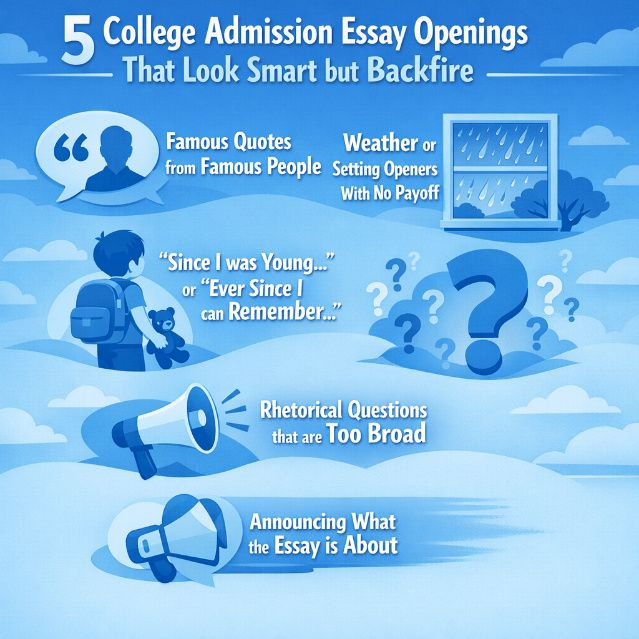
I. Famous Quotes from Famous People
Opening with Einstein, Mandela, or Maya Angelou is one of the most common mistakes in college essays. The problem is not the quote. It is what it signals. You are borrowing someone else's words to start an essay that is supposed to demonstrate your voice. Admissions officers have read a thousand essays that open with an Einstein quote. Yours will disappear into that pile.
II. Weather or Setting Openers With No Payoff
"The rain pattered softly against the window." These might create atmosphere, but they create the same atmosphere as every other essay that opens this way. If you are going to set a scene, it needs to be specific to your life, not a season.
III. "Since I was Young..." or "Ever Since I can Remember..."
Every admissions officer has read thousands of essays that begin this way. It is the written equivalent of clearing your throat before you start talking. Skip the runway and start the flight.
IV. Rhetorical Questions that are Too Broad
"What makes a community?" "What does success really mean?" These sound thoughtful, but they are too vague to create any tension. If the reader can answer your opening question in one sentence, it is not pulling them in. It is letting them go.
V. Announcing What the Essay is About
"In this essay, I will discuss my experience on the robotics team and how it shaped my understanding of teamwork." This is an introduction to a high school essay, not a college application hook. Admissions officers do not want to be told what they are about to read. They want to read it.
Avoiding these five mistakes gets you through the door. The same attention to craft applies at the other end of the essay. Our guide on how to end a college admission essay covers conclusions with the same level of detail.
What Comes After the Hook in a College Admission Essay Start
The opening gets the reader in. What keeps them is how well the rest of the essay earns the promise of that first sentence.
A few things that determine whether the body lives up to the hook. First, the hook should grow directly into the essay rather than pivot away from it. If your opening sentence drops the reader into a moment in a ceramics studio, the next paragraph has to deepen that moment, not abandon it for a general statement about creativity. Second, every paragraph after the hook should advance the story or the insight, not restate it. Admissions officers lose interest fastest when an essay says the same thing in three different ways across three paragraphs. Third, the essay should end somewhere different from where it started. The best college admission essays move, and the reader learns something about you by the final sentence that they did not know from the first.
The hook is the hardest sentence to write. The conclusion is the second hardest. Once both are solid, the body tends to follow.
You have worked out how to open your essay. What most students find is that the opening unlocks the rest, until they actually have to write it. If you would rather spend the next hour doing something other than staring at a draft, give CollegeEssay.org's admission essay writing team your topic, your school, and your deadline. You will have a complete, structured essay back before the night is over.
Frequently Asked Questions
Can you start a college admission essay with a question?
Yes, but only if the question is specific enough to belong to you alone. Broad questions like What does it mean to succeed? signal a lack of original voice. A narrow, concrete question that only someone in your situation could ask, and that does not have an easy answer, can be one of the strongest hooks in a college admission essay.
How long should the opening paragraph of a college admission essay be?
Two to four sentences. Your opening paragraph needs to hook the reader, signal the direction of the essay, and move quickly into the body. Most college admission essays run between 500 and 650 words total, so a long introduction burns space you need elsewhere.
Does the hook need to connect directly to the college admission essay's main point?
Yes. A hook that grabs attention but then pivots to a completely different subject will confuse the reader and weaken the essay. The best openings in a college admission essay drop you into a moment or idea that the rest of the essay grows directly out of.
Is it acceptable to revise the hook after writing the rest of the college admission essay?
Strongly recommended. Many students find that the real opening only becomes clear after the full draft exists. Writing the body first, then returning to the hook, often produces a sharper and more accurate entry point into the essay.
How many drafts does it typically take to get the opening of a college admission essay right?
Most students go through three to five versions of the opening before it feels right. If the first draft hook is not working, try a completely different hook type rather than rewriting the same approach. Switching from in medias res to an unexpected statement, for example, often unlocks the essay faster than continuing to refine a hook that is not the right fit.
Benjamin C. Verified
Author
Benjamin C. holds an MS in Marketing from Imperial College Business. He has over 6 years of experience in academic research and writing, specializing in admissions essays, personal statement writing, and scholarship essays. Benjamin has contributed articles to reputable publications such as USA Today and The Huffington Post. He is the recipient of the National Association for College Admission Counseling's Rising Star Award, recognizing his outstanding contributions to the field of college admissions essay writing. With his extensive knowledge and expertise, Benjamin has helped many students achieve their academic and professional goals.
Specializes in:
Ivy League Admissions Essays
Personal Statement Writing
Scholarship Essays
Read All Articles by Benjamin C.
Keep Reading
Was This Blog Helpful?
On this Page