You've written the whole thing. The story is there, the details are in place, and then you hit the last paragraph and stall. You type "In conclusion, this experience taught me..." and immediately know it's wrong. You delete it. You stare at the screen.
Below are six specific techniques for ending a college admission essay, each with an example and a note on when it fits. Read the descriptions, find the one that matches the essay you actually wrote, and use it tonight.
What Every College Admission Essay Conclusion Must Do
Before you pick a technique, understand what you're trying to accomplish. Every strong conclusion has three jobs:
- Create closure so the reader feels the essay is complete (not cut off, not trailing into vagueness)
- Reinforce your core narrative without restating it, so the ending echoes the central theme rather than summarising it
- Leave a specific emotional impression. Not just "hopeful" or "mature," but something the reader can actually feel. The more specific the emotional note, the more memorable the close.
One more thing worth knowing: you don't have to write your conclusion first. Most students try to plan the ending before they've finished the body, which is backwards. Write the whole draft, read it back, and then figure out what ending it's actually asking for. If you're still working on the structure of the body itself, the complete guide to writing a college admission essay covers every section from hook to close.
6 Techniques for a College Admission Essay Conclusion
Technique 1: The Full-Circle Callback
Return to an image, object, phrase, or scene from your opening paragraph. The essay forms a loop, which is structurally satisfying and emotionally resonant. The reader gets the feeling that everything is connected.
Example closing line: "I still keep the broken metronome on my desk. I haven't needed it to find the beat in years."
Best for: Essays that open with a specific object, scene, or moment.
Technique 2: The Forward Look
End by gesturing toward who you're becoming, what you'll study, pursue, or keep asking about. This works best when it's grounded in something specific from the essay rather than a generic statement about the future.
Example closing line: "I don't know exactly what I'll study yet. But I know I'll keep asking the question that got me here."
Best for: Essays about intellectual curiosity, identity evolution, or career-adjacent passion.
One caution: avoid generic future statements like "I look forward to contributing to campus life." That's the acceptance plea in disguise. Stay specific to your story.
Technique 3: The Kicker
A short, punchy final line, often one sentence, that reframes everything before it with a new angle, quiet wit, or unexpected turn. The reader gets a beat of recognition, the feeling that the essay just clicked into place.
Example closing line: "I came to debate class to win arguments. I left knowing which ones were worth having."
Best for: Essays with a clear arc of change or realization, especially if you have a natural voice for restraint or dry wit.
Still not sure your draft is ready for a conclusion? Tell us your essay's core story and where you're stuck, and get your admission essay conclusion written by a specialist who can take the draft from here.
Technique 4: End in the Action
Stop the story right at the pivotal moment. The arm lifting. The call home. The door opened. No wrap-up, no moral. Let the reader sit with the image and draw their own conclusions.
Example closing line: "She looked at me for a second longer than she needed to. Then she smiled and went back to her work."
Best for: Narrative essays built around a single defining scene. This technique works especially well for writers who trust their readers not to need a bow on top.
Technique 5: The Unresolved Question
End with an open loop, something still in process, still uncertain. This signals self-awareness and intellectual honesty. The conclusion doesn't wrap up the story because the story isn't actually over.
Example closing line: "I still haven't figured out how to hold both of those things at once. But I'm starting to think that's the point."
Best for: Essays about identity, belonging, or cultural tension. These are topics that resist tidy resolution. This is one of the stronger techniques for college essay conclusions because admissions officers read a lot of essays that tie everything up too neatly.
Technique 6: The Quiet Statement of Values
End by naming what you actually believe, not a life lesson, but a core value you've arrived at. Written plainly, without fanfare. No "I learned that..." framing.
Example closing line: "The work matters more than the recognition. I knew that before. Now I know why."
Best for: Essays where intellectual conviction or personal ethics are central, such as service, research, philosophy, or equity-focused experiences.
3 College Admission Essay Endings to Cut Immediately
Think of this as permission to delete. These three endings show up constantly, and they all undercut essays that were going well.
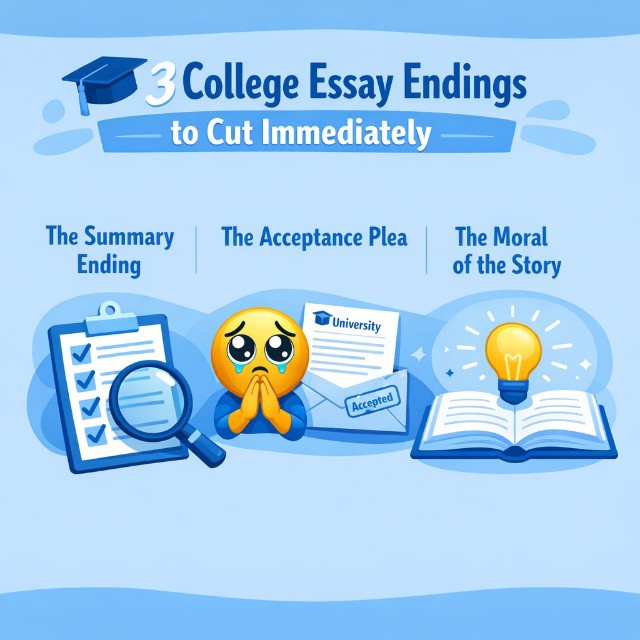
The Summary Ending
"In conclusion, this experience taught me to believe in myself. These lessons will stay with me as I enter college." You've already shown the reader everything in the essay. Restating it in the last paragraph kills all the momentum you built. If your last sentence explains what your essay means, you've written a summary. Delete it and look at the sentence before it. That's often where your real ending was hiding.
The Acceptance Plea
"I hope this essay shows why I belong at [School] and that I'd be a strong addition to the community." You don't have the word count for the obvious. Admissions officers know why you're writing to them. Pointing it out wastes the only space you had to actually land something.
The Moral of the Story
"That's when I realized hard work always pays off." "I learned that family comes first." These endings tell the reader what to feel instead of making them feel it. They also tend to flatten whatever was specific and interesting about your story into a bumper-sticker takeaway. Trust your reader to get it.
How to Choose the Right Conclusion Technique for Your College Admission Essay
The right ending technique isn't the one that sounds the most sophisticated. It's the one that feels most true to the essay you actually wrote.
Use this chart as a starting point:
Essay Theme | Recommended Technique |
Overcoming adversity | Full-Circle Callback or Kicker |
Identity / belonging | Unresolved Question or Quiet Statement of Values |
Intellectual passion / curiosity | Forward Look or Kicker |
Family / relationship | End in the Action or Full-Circle Callback |
Service / leadership | Quiet Statement of Values or Forward Look |
Creative / artistic pursuit | End in the Action or Kicker |
If you're not sure which technique to use, try two. Write one version using your first instinct, then write a second using a different technique from the chart. Read both out loud. The one that sounds less like a student trying to sound impressive is usually the right one.
For essays on identity or belonging, where the Unresolved Question often lands best, it helps to see how other students have handled the close. The college admission essay examples that worked break down exactly what each closing is doing and why it earned a read.
You've got the technique, and you know what a strong ending looks like. Writing one that actually lands in your specific essay, with your specific story and voice, is the part most students get stuck on. If you're working against a deadline, our writers can close your college admission essay the right way. Send them your draft, and they'll write the conclusion, or rewrite it if you already have one that isn't working.
One More Thing Before You Finalize Your College Admission Essay Conclusion
Before you lock in your conclusion, run it through these four checks:
- Does your last line include at least one concrete image or specific detail? Abstract endings ("I grew as a person") don't land the way specific ones do.
- Is your closing paragraph under 80 words? Longer endings almost always drift into summary territory. The tighter you stay to the key image or statement, the stronger the close.
- Does the ending match the tone of the rest of the essay? Don't go formal in the last paragraph if the rest of the essay is conversational. Readers notice the shift. If you're unsure whether your overall tone is working, the college admission essay tips from former admissions officers is worth a read before you finalize.
- Read your last sentence in isolation. Does it work as the final beat of your story? If it only makes sense in context, it might not be the right line to end on.
The technique is there. The checklist is there. If you sit down to write and the ending still doesn't feel right after two attempts, that's usually a signal that the issue is upstream, in the opening, the arc, or the core narrative thread. That's the kind of thing the admission essay writing team at CollegeEssay.org can diagnose and fix quickly. Tell them where you're stuck, and they'll take it from there.