What Do Admissions Officers Actually Look for in a College Essay?
Admissions officers are looking for three things in a college essay: who you are, what you will bring to campus, and whether you can write. Every other consideration follows from these three.
Most of the college application is a record of the past. Grades, test scores, and activity lists built over four years tell an admissions committee where you have been. The essay is the one place where you show who you are right now and what you will bring to campus when you arrive.
At schools with acceptance rates below 15 percent, roughly 80 percent of the applicant pool is already academically admissible. Grades and test scores get your file opened. They do not get you admitted. The essay is one of the few remaining variables that can move an application from the consideration pile to the admit folder, which means it needs to do something the rest of your application cannot: reveal a person, not a profile.
How to Write a College Application Essay Step by Step
Writing a strong college application essay follows the same five stages for most students: understand the prompt, generate raw material, choose a focus, draft without stopping, and revise for specificity.
Each stage has a predictable failure point, and most problems in the final essay trace back to one of the first three.
Step 1Understand the Prompt Before You Write Anything
The Common App offers seven prompts, and most school supplements add their own. Choose the prompt that gives you the most room to write about something specific and true, not the one that sounds the easiest to answer. Read the prompt three times before you open a document.
Step 2Generate Raw Material Before You Narrow Anything Down
Spend 20 minutes writing about five moments, objects, or habits that are specific to your life. Do not evaluate them yet. Write down what happened, what you noticed, and what shifted in how you thought about something. The goal at this stage is volume, not quality.
Step 3Choose One Focus from What You Generated
The strongest essay usually comes from the item with the most specific detail already attached to it, not the one that sounds the most impressive or universally relatable.
Step 4Write a Complete First Draft Without Stopping to Edit
Most students write their worst essays by correcting as they go. Write the whole thing from opening scene to closing line, then step away before you read it back.
Step 5Revise for Specificity and Length
The revision pass has one job: replace every vague sentence with something a reader can picture, and cut every sentence that does not add something new. Most first drafts need 100 to 150 words removed, not added.
If you have worked through the steps and are unsure whether your essay is specific enough or the angle is strong enough to stand out, our college admission essay writing service pairs you with a writer who has worked with applicants at your target schools. They assess the angle, develop the draft, and revise it until the essay reflects your actual experience and voice.
How to Outline a College Application Essay
An essay outline gives you a structure to follow before you draft, so you know exactly what goes in the opening, body, and conclusion before you write a single sentence.
College Application Essay Structure
How to Write a College Application Essay Introduction That Gets Read
The first sentence of your college essay is the only part every admissions officer reads in full: it either earns the next sentence or it does not.
What not to do: definitions, rhetorical questions, “I have always been passionate about,” “ever since I was young,” and any sentence that could open a student council speech instead of a personal story.
Compare these two:
- Weak opening“Leadership has always been important to me.”
- Stronger opening“The first time I gave an order that someone followed, I was twelve and standing in my grandmother’s kitchen.”
The second sentence does not explain anything yet. That is exactly why it works. The reader wants to know what happened next.
How to Write a College Application Essay Conclusion
The conclusion of a college application essay is not a summary: it is the moment where the reader learns something specific about who you are now that they could not have known from the story alone.
Most weak conclusions do one of two things. They restate what the reader just read, or they end with a broad lesson that sounds like a caption on a motivational poster. Neither leaves the reader with a clear sense of the person behind the essay.
A strong conclusion does three things in 75 to 100 words.
The test for a strong closing is simple. Read the last sentence and ask whether it could end any other essay. If it could, it is not specific enough. The closing line of a college essay should feel like it could only belong to this story.
What to avoid in the conclusion: the phrase “in conclusion,” any version of “this experience taught me that,” restating the opening hook as a callback, and any sentence that would fit on a graduation card. The reader does not need to be told what they just read. They need to leave with something they did not have before they started.
How Long Should a College Application Essay Be?
The Common App caps the main essay at 650 words, and most admitted essays land between 550 and 650. Shorter essays are accepted regularly, but under 500 words rarely gives enough room to show a full arc from opening scene to reflection to closing.
School specific supplements vary significantly. Some ask for 150 words, others for 350. Always check each school’s portal before you draft, because a 650 word essay cannot be trimmed to 200 without a full rewrite.
What Makes a College Application Essay Stand Out (and What Kills It)
Admissions officers read between 50 and 100 essays in a single day, and the ones that stand out are those where the topic could only have been written by one person.
Three signs your essay is working:
- The first sentence could not be the first sentence of anyone else’s essay.
- At least one body paragraph describes something the reader can picture in their head.
- The ending leaves the reader knowing something specific about you that they did not know before they started.
CollegeEssay.org writers find that essays built around one specific scene produce stronger submissions than essays covering multiple achievements.
Five things that kill an otherwise strong essay:
- Opening with a definition or a rhetorical question (“Have you ever wondered...”).
- Writing about what you plan to do instead of what you have already done or experienced.
- Summarising what happened rather than showing a specific moment of it.
- Making the essay about an achievement rather than about what the achievement revealed about you.
- Ending with a lesson that sounds like it belongs on a motivational poster.
Run the replacement test on every paragraph. Read a section and ask whether any other applicant could have written it with their name swapped in. If the answer is yes, the section needs more specificity.
Specificity is not a stylistic preference in a college essay: it is the difference between an essay that functions and one that gets forgotten.
You now know what admissions officers look for, how to move through the writing process step by step, and how to avoid the patterns that sink otherwise strong applications. The harder part is executing all of it in the time you have left. Our admission essay writing services match you with a specialist who covers draft, revision, and prompt alignment from start to finish.
What to Check Before Submitting Your College Application Essay
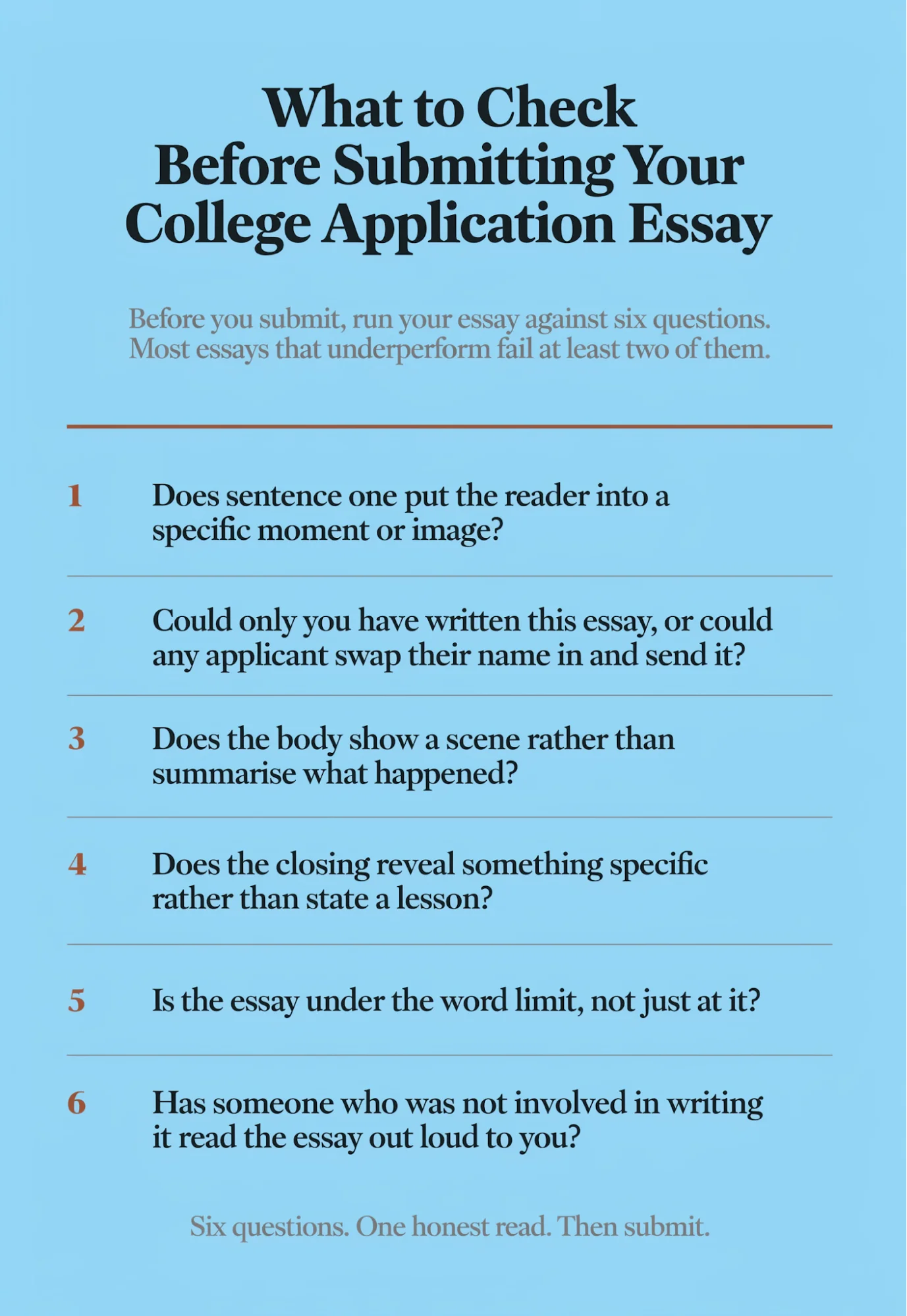
If any answer is no, that is your revision target. One week before the deadline is enough time to fix two of these. One day before is enough to fix one. Prioritise in that order.
You now have a writing process, an outline, an opening strategy, a conclusion approach, and a checklist. The remaining gap between knowing how to write a strong college application essay and actually having one is time and execution. If finishing it yourself before your deadline still feels uncertain, CollegeEssay.org’s college admission essay service gives you a finished, reviewed draft built around your actual experiences and the schools you are applying to.
Frequently Asked Questions