You've finished your personal statement. Now you're looking at five college portals, each with its own prompts, its own word limits, and its own version of "why us?", and no system for getting through all of it.
This guide covers every supplemental essay type you'll encounter, gives you a process for managing multiple schools at once, and shows you exactly what separates the essays that move admissions officers from the ones that don't.
What Are Supplemental Essays (and Why Do They Matter)?
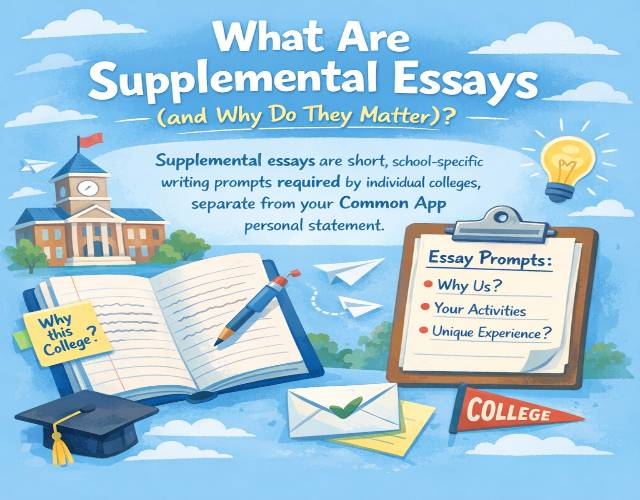
Supplemental essays are school-specific writing prompts that colleges require in addition to your Common App personal statement. Most competitive schools ask for 1 to 5 of them, and they carry real weight in the admissions decision, often more than students expect until the decisions come back.
Supplemental essay are typically 150 to 650 words and each one targets something different: why you're applying to that school, what you'll study, what you bring to campus.
Colleges use them to distinguish between similarly-qualified applicants. When two students have nearly identical GPAs, test scores, and activities, the supplementals are often what tips the decision. At selective schools, a weak supplemental essay can undo a strong application, and a great one can tip the scales in your favor.
Not every college requires them. But most competitive schools do. Harvard, Yale, Stanford, MIT, and nearly every other top-25 school will ask for at least one. Some schools (looking at you, UChicago) ask for several.
The key thing to understand: admissions officers use supplements to move students from "maybe" to "yes", or to the reject pile. They're not a formality. They're a real part of your case. |
The 5 Most Common Supplemental Essay Types
Before you write a single word, know what you're dealing with. Most supplemental prompts fall into one of five categories.
1. The "Why This College?" Essay
This is the most common supplement, and the one that separates students who did their research from those who didn't. It's not asking for flattery. It's testing whether you actually know the school and can articulate a genuine fit.
A simple framework that works:
- Academic fit: Name a specific program, professor, research opportunity, or course that connects to your goals
- Extracurricular fit: Mention clubs, organizations, or campus initiatives aligned with your interests
- Cultural fit: What makes this school's community or values unlike any other?
- Your goals: Tie it back to where you're headed and why this school is the right step
|
What to avoid: ranking mentions, "beautiful campus," and anything you could have pulled from the school's homepage without reading past the first paragraph.
2. The "Why This Major?" Essay
This prompt wants your intellectual origin story, not just that you've always loved biology, but the moment or experience that made it click. Pair that with something specific about why this school's program is the right fit for that interest.
The trap: writing a generic "I've always been passionate about…" opening. Every applicant writes that. Start with the experience, not the conclusion. For school-specific examples, explore Penn Supplemental Essays guide. |
Colleges are building a class, not just admitting individuals. This prompt asks what perspective, background, or identity you bring that enriches the campus community, and how you'll actually contribute.
Specific community + what you've learned from it + how you'll share it. That's the structure. Vague answers about "diverse perspectives" won't cut it. Some universities emphasize this heavily. |
Your activities list already tells them what you did. This essay needs to tell them what it means. Pick one activity and go deep, the change it created, the leadership you grew into, the problem you solved.
Depth over breadth, every time. Don't summarize three activities. Go all the way in on one. |
5. The Creative/Oddball Essay
UChicago is famous for these, but other schools use them too. They're testing your curiosity, your thinking style, and your personality, not your ability to write a "correct" answer. The unusual response can work beautifully here, as long as it actually reveals something true about you.
The weird answer still needs to be your answer. If someone else could have written it, keep going. |
Five prompt types. Multiply across eight, ten, and twelve schools, and you're looking at 20 to 30 individual essays before the system kicks in. If you'd rather have finished drafts than a blank document and a deadline, write my supplemental essay. School-specific, built around your story, most back within 24 hours.
How to Start Writing Supplemental Essays: A Step by Step Process
The students who get overwhelmed by supplements usually make the same mistake: they start writing too early, without a system.
Step 1: Gather every prompt before writing anything.
- Open all your college portals and copy every supplemental prompt into one document. You need the full picture before you write a single word.
Step 2: Group prompts by type.
- Sort them into categories, "Why This College," "Why This Major," Community, Activities, Creative. You'll quickly see that you have 4 to 5 core prompt types, not 12 completely different essays.
Step 3: Finish your personal statement first.
- Your personal statement is the "big story." Supplementals add chapters. Know your main narrative before you write the supporting material, otherwise you risk repeating yourself or missing opportunities to show new sides of who you are.
Step 4: Prioritize by deadline.
- ED and EA schools first, always. Don't write in the order that feels most comfortable, write in the order that protects your application timeline.
Step 5: Write your anchor essay for each type, then adapt.
- Don't write 12 essays from scratch. Write 4 to 5 strong core responses and adapt them thoughtfully.
For most prompt types, a well-crafted anchor essay can be adapted for 3 to 4 schools with targeted edits.
The exception: "Why This College?" essays. Those always need to be written from scratch for each school, no shortcuts. If you want to learn more about the adapting strategy, check out our guide on how to reuse supplemental essays across multiple schools. |
How to Write a Strong "Why This College?" Supplemental Essay
The "Why This College?" essay matters more than most students realize. It's the clearest test of demonstrated interest, and admissions officers can spot a generic answer in ten seconds.
The best "Why This College" essays make admissions officers feel like they couldn't have been written about any other school.
Here's a research framework that makes specificity achievable:
1. Academic Fit
Look beyond the department page. Find a specific professor whose research connects to something you care about. Find a course that doesn't exist anywhere else. Find a research center, lab, or clinical opportunity that aligns with your goals. Name it. Explain why it matters to you specifically.
2. Extracurricular Fit
What clubs, organizations, or campus initiatives tie into your actual interests, not the ones that sound impressive? Look for things you'd genuinely join. Mentioning the debate club because you've debated for three years lands differently than name-dropping a club you've never thought about.
3. Cultural Fit
What's the vibe of this school's community? Is it collaborative or competitive? Research-focused or teaching-centered? What does the student body value? This doesn't mean writing PR copy for the school, it means finding the authentic overlap between what they value and who you are.
4. Connect It To Your Goals
The essay shouldn't just describe the school. It should show why this school is the right next step for you, specifically. Where are you headed? How does this program, this community, this opportunity, move you closer?
What NOT to do: mention rankings, cite the campus as "beautiful," or reference information that's on the school's homepage without connecting it to yourself. Admissions officers read thousands of "I was drawn to your vibrant campus community" sentences. It doesn't help. |
You now have the complete picture, every prompt type, a system for getting through a long school list, a research framework for the why-us essay, and a clear read on what separates the essays that work. The thing most students tell us is that they wish they'd started the actual drafting sooner, because that's where the time disappears.
If you're sitting on a school list and a pile of prompts with less runway than you'd like, our supplemental essay writing service works from your notes, your voice, and your story, not a template, and gets you a draft that's already good enough to edit, within 24 hours.
What Makes Supplemental Essays Stand Out (vs. What Gets Them Ignored)
A great supplemental essay adds a new chapter to your application; it doesn't retell the same story.
1. Specific Beats Generic, Every Time
"I want to study environmental policy because of Professor Singh's work on urban water systems and the semester I spent monitoring lead levels in our city's pipes" is specific. "I've always been passionate about environmental issues" is not. One of those moves an admissions officer. The other doesn't.
2. New Information Beats Repetition
If your personal statement is about your role in student government, your supplemental activity essay shouldn't cover student government again. Use each essay to reveal a new dimension. Show them more of who you are.
3. Voice Beats Polish
A slightly unpolished essay that sounds genuinely human will outperform a technically perfect essay that sounds like it was written by a committee. Admissions officers read thousands of supplements. Real voice cuts through.
4. Brevity is a Skill
Most prompts are 150 to 300 words. Every sentence has to earn its place. If you can remove a sentence without losing meaning, remove it.
To Wrap Up!
Supplemental essays are your chance to go beyond the personal statement and show each college why you truly belong there. You've got the strategy. You know every prompt type, you have a process for a long school list, and you know what an admissions officer is looking for when they open your file.
What's left is 20 to 30 essays on a timeline that doesn't forgive slow starts. Our supplemental essay writers work from your school list, your prompts, and the experiences you want each essay to convey. Most students have a draft that's already good enough to submit, or edit, in their inbox within 24 hours.