What Are UC Personal Insight Questions? (And Why They Matter)
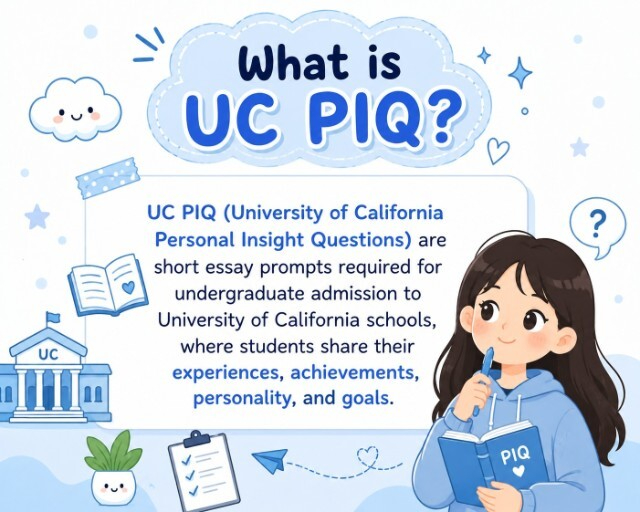
The UC application is one application that goes to all 10 University of California campuses. That means you're not writing separate essays for UCLA, Berkeley, or San Diego; you write once, and every campus you apply to sees the same four responses.
There are eight prompts total. You choose four. Each response has a 350-word maximum, and that limit is firm, no exceptions. The UC application won't even let you submit if you go over.
When do you write UC PIQs?
The UC application opens August 1, and the submission window is November 1–30. That deadline is firm across all UC campuses; there are no early decision or rolling admission options in the UC system.
Most students underestimate how long the PIQs take. If you're a rising senior, aim to have rough drafts of all four done before school starts in September. That gives you October to refine rather than draft under deadline pressure while managing other applications.
If you're also applying to non-UC schools via the Common App, note that many Common App deadlines fall on November 1, the same day the UC window opens. Starting your UC PIQs in the summer is not optional if you want to do well.
How do UC readers actually evaluate PIQs?
UC readers use your PIQs holistically. They're not trying to find a "story." They're trying to understand who you are beyond your GPA, test scores, and list of activities.
The UC system uses a framework called the 13 Points of Comprehensive Review, a set of factors every campus weighs when evaluating applications. Your PIQs are one of the primary ways you demonstrate several of those factors, including:
- Academic achievement in context, what you've accomplished given the opportunities and obstacles in your specific environment
- Special circumstances, challenges, barriers, or unusual life experiences that shaped your path
- Personal qualities, character, resilience, leadership, and the traits that don't show up in a transcript
This is why vague, general PIQs hurt you more than you might expect. An admissions reader isn't just reading for a nice story; they're actively looking for evidence of these factors. If your essay doesn't surface any of them with specificity, it registers as a missed opportunity, not a neutral one.
All eight prompts are weighted equally; no prompt is harder, easier, or more impressive to answer than another.
For context on why this matters: the UC system accepted 77% of California residents systemwide for fall 2025, but UCLA held at 9.4% and UC Berkeley at 11.4%. At those campuses, the PIQs are often the only tool an admissions officer has to separate two academically identical candidates.
One thing worth knowing early: transfer students have a slightly different setup, with a required first prompt and three of seven additional prompts. If that's you, check out the UC transfer personal insight questions guide for the full breakdown. |
UC readers aren't looking for the most dramatic story; they want to see who you actually are beyond your GPA and activities list.
The 8 UC PIQ Prompts (Quick Overview)
Here's a condensed look at all eight prompts. These are what each one is really asking, not the full UC prompt text. (For a complete understanding of each prompt, follow the UC personal insight question examples blog)
# | Prompt Focus | What It's Really Asking |
1 | Leadership | Show a specific moment of influence, a title is not leadership, what you did with it is |
2 | Creativity | Demonstrate creativity through a specific process or project, not a list of hobbies |
3 | Talent or Skill | Pick one skill, show its development arc, and explain what it reveals about how you think |
4 | Educational Opportunity | Focus on what you did in response to the opportunity or barrier, not what happened to you |
5 | Significant Challenge | Spend one sentence on the hardship, and the rest on your specific response and what changed |
6 | Academic Subject | Show obsession, not interest. What did you do with this subject outside of a grade? |
7 | Community | Identify a concrete contribution with real impact, informal counts as much as organized |
8 | Wild Card | Add a dimension that your other three PIQs couldn't cover. This prompt should surprise the reader |
Knowing what each prompt is looking for, not just what it says, changes how you approach it.
Don't deep-dive into individual prompts here. That's what the prompt-specific guides above are for. Right now, you're getting oriented.
Looking at all eight prompts and already feeling the math four essays, 350 words each, four different angles on your life, is the moment most students realize this is going to take a lot longer than they thought. Tell us which four prompts you're considering and a few things you'd want to write about, and our UC PIQ writing team can deliver complete drafts of all four of your stories, your voice, within 24 hours.
How to Write a UC PIQ: A 5 Step Process
This is the part most guides skip. They tell you what the prompts are asking, but not how to actually sit down and write one. Here's a clean process that works.
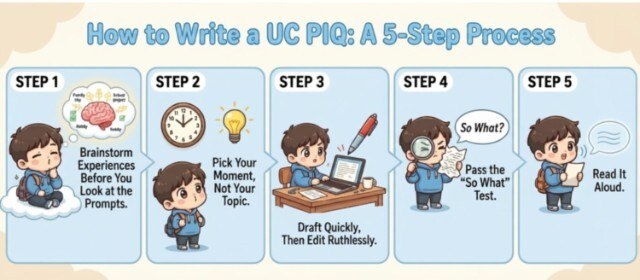
Step 1: Brainstorm Experiences Before You Look at the Prompts
Don't start with the prompts. Start with yourself. Grab a blank page and list 10 to 15 moments, experiences, or characteristics that say something true about who you are.
Think small as well as big; an awkward conversation that changed how you see things counts as much as winning a competition. Once you have your list, look at the prompts and see where things match.
If you start by reading the prompts first, you'll write to the prompt rather than to your actual life. That's how you end up with a generic essay.
Step 2: Pick Your Moment, Not Your Topic
UC essays are short stories, not reports. The best ones center on one specific moment, something that happened, a decision you made, a conversation you had.
Bad version: "My leadership experience taught me a lot about communication and teamwork." Better version: "The power went out twenty minutes before our spring play, and I had to make a decision in front of forty people who were looking at me." |
One specific moment beats a broad theme every single time.
Step 3: Draft Quickly, Then Edit Ruthlessly
Write your first draft over the 350-word limit. Don't worry about length while you're writing. Get the story down, then cut. Every sentence needs to earn its place. If a sentence describes what happened but doesn't show anything about you, it probably goes.
The 350-word limit isn't a punishment; it's actually what makes UC essays stronger than longer essays.
Here's what ruthless editing actually looks like in practice:
Before (93 words that could be 40): "I have always been passionate about environmental science and have spent a lot of time thinking about how climate change affects local communities. When I heard about a volunteer opportunity with a local conservation nonprofit, I thought it would be a great chance to get involved and make a difference. I signed up and attended my first meeting, where I learned about the work they were doing and felt inspired to contribute in a meaningful way." After (38 words): "I showed up to the conservation nonprofit's Tuesday meeting not knowing anyone. By the end, I'd volunteered to coordinate a survey of invasive plant species in three local parks starting the following weekend." |
The previous version describes attitude. The latter version shows action. Cut every sentence that describes how you felt about doing something, and replace it with the sentence that shows you doing it.
Step 4: Pass the "So What" Test
After you draft, read each paragraph and ask: Why does this reveal something about me? If a paragraph is mostly about someone else, your coach, your parent, or your teammate, you need to reorient it toward your perspective and what it shows about you.
If you can cut a paragraph and the essay still makes sense, cut it.
Step 5: Read It Aloud
This is the single most useful editing step. Read your essay out loud. If it sounds like a report, rewrite it. If you'd never say something that way to a person, don't write it that way either.
Your voice should be audible in the essay, not polished out of existence.
Understand Which 4 UC PIQs to Answer
Here's the mistake most students make: they read all eight prompts and pick the four that sound most impressive or most interesting. That's backwards.
The right approach is to figure out which four prompts give you the best specific stories. The best prompt to answer isn't the one that sounds most interesting; it's the one where your story is most specific and most yours.
A few principles guide the decision, but the full strategy takes more than a few bullets to do properly, which prompts tend to overlap, how to avoid repeating themes across your four responses, and what to do when your best story fits two prompts at once.
The right approach is to figure out which four prompts give you the best specific stories, and there's a clear method for doing that before you write a single word. Read how to choose which 4 UC PIQs to answer before you start drafting. The prompt you pick shapes everything that comes after. |
Common UC PIQ Writing Mistakes to Avoid
A few patterns come up constantly in weak UC essays, and they're specific enough that naming them here without the full context of why they happen and how to fix them isn't particularly useful.
The most damaging mistakes aren't obvious ones like going over the word count. They're subtler: writing about the wrong person, choosing a story that duplicates one of your other three responses, or reflecting in a way that sounds borrowed rather than earned.
If you can imagine 1,000 other students writing the exact same essay, yours needs a rewrite.
The mistakes that hurt most aren't the obvious ones. Read the UC essay mistakes to avoid guide after your first draft, before you decide you're done. |
You now have everything you need to write strong UC PIQs: If you'd rather hand the first draft over and edit from there, the UC personal insight questions writing service team writes complete, structured PIQs from your story inputs and gets drafts back to most students within 24 hours.
UC PIQs or the Common App?
If you're applying to both UC schools and non-UC schools, you'll be writing both sets of essays, and they're not the same thing.
If you're applying to both UC schools and non-UC schools, you're writing two different sets of essays that require two different approaches. The length difference of 650 words versus 350 is only part of it. The format, tone, and what admissions readers are looking for are genuinely different, and treating one as a shorter version of the other is one of the most common application mistakes.
| The full comparison including what each format rewards, where students go wrong trying to adapt one for the other, and how to manage both without burning out, is in the UC PIQs vs. the Common App essay guide. |
A Note for Transfer Students
If you're applying to UC as a transfer student, your PIQ setup is different. Transfer applicants answer a required first prompt, then choose three from the remaining seven prompts. The approach and strategy differ from those of freshman applicants.
By now, you know what the UC prompts are actually asking, how to pick your four, and the difference between a UC essay that works and one that reads like every other application. The remaining work is the writing itself, and for most students, that's the part that eats the most hours. Send us the four prompts you've chosen and the moments from your life you'd want to draw on, and get your UC PIQs written by experts. Most drafts come back within 24 hours and arrive fully structured, edited, and ready for you to refine or submit.