You've read UC PIQ Prompt 2, and your first reaction was probably: I'm not really a creative person. That's the most common reaction, and it's almost always wrong.
This guide walks you through what UC actually means by creativity (it's much broader than art), how to find your angle even if nothing obvious comes to mind, and exactly how to structure 350 words that give admissions readers something they haven't seen.
What Does UC Prompt 2 Actually Want?
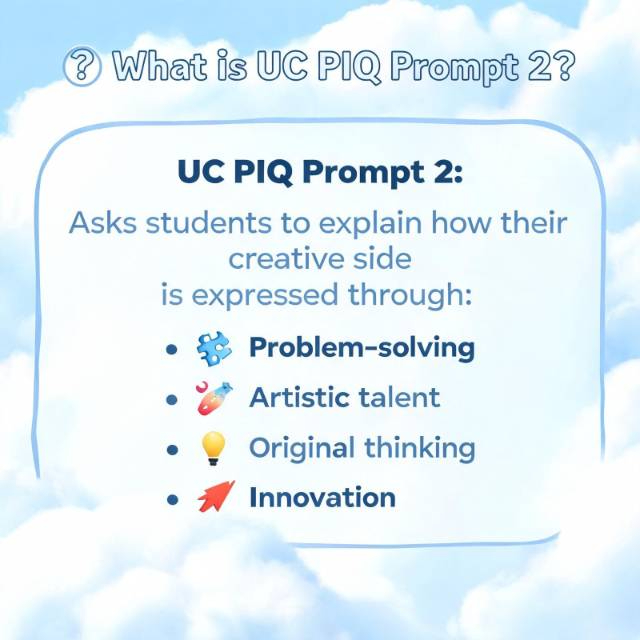
Here's the full prompt:
| "Every person has a creative side, and it can be expressed in many ways: problem solving, original and innovative thinking, artistic works, writing, coding, and more. Describe how you express your creative side." |
The key phrase is "many ways." UC is explicitly telling you that creativity doesn't mean art. It means any time you approach something with originality, when you come up with your own solution, make something that didn't exist before, or think through a problem differently than everyone else around you.
UC's official "Things to Consider" for this prompt pushes you to answer three questions: What does creativity mean to you? How do you express it? How has it shaped who you are or what you want to do?
If you want an overview of all 8 PIQ prompts first, start with our complete UC PIQ guide.
That last question matters more than most students realize. The essay isn't just about what you create, it's about what creating reveals about how your mind works.
UC also publishes a set of brainstorming questions specifically for this prompt. They're worth running through before you settle on a topic: What does creativity mean to you? Do you have a creative skill that's important to you? If you used creativity to solve a problem, what was your solution? How has your creative side shaped who you are or what you want to do? If you can answer at least two of these with a specific story rather than a general statement, you have workable material for this essay.
What Is UC PIQ Prompt 2 Really Asking For? UC Prompt 2 isn't asking if you're an artist. It's asking how your mind works, specifically, how you approach problems, make things, or think through challenges in a way that's distinctly yours. Creativity here includes problem solving, original thinking, technical invention, and cultural expression, not just art. |
What Counts as Creative for UC PIQ Prompt 2? (Topic Finder by Category)
If your first instinct was "I don't have a creative side," you're not alone, and you're almost certainly wrong. Creativity shows up in dozens of places students don't think to count.
Here's a breakdown by category. Read through and see which one makes you think oh, that's actually me.
Arts and Performance
- A piece of music you wrote or arranged in a way that was distinctly your own
- Visual art, photography, or design work, especially if you solved a visual problem in an unexpected way
- Film, theater, or dance where you pushed the form rather than just executed it
- Writing (fiction, poetry, personal essays) that you developed as a practice
STEM and Technology
- Coding a project that didn't come from a tutorial something you built because you had an idea
- Engineering a solution to a real-world problem (school project or personal)
- Modifying, inventing, or improving a system or product
- Using math or science to design something that didn't exist before
Problem Solving and Strategy
- Developing your own debate framework or argument strategy
- Coaching yourself (or others) on chess, sports tactics, or game theory
- Running a club or event where you had to invent solutions on the fly
- Starting a small business or project where you figured things out as you went
Everyday and Community
- Cooking that goes well beyond following a recipe developing your own flavors or techniques
- Caretaking for a family member where you had to creatively adapt
- Cultural expression through language, tradition, food, or storytelling
- Organizing a community event or space in a way that reflected your vision
The best Prompt 2 essays aren't always from the students who take AP Art they're from the ones who can show how their mind solves problems differently.
What UC actually means by "innovative thinking"
The phrase trips people up. UC isn't expecting you to have invented something or solved a problem nobody else has ever faced. Innovative thinking in context means: you approached something in your own world differently than the people around you. A fantasy football draft strategy nobody else on your team uses.
A study method you developed because the standard one didn't work for you. A way of organising your family's schedule that nobody asked you to design but you built anyway. The bar is originality within your context, not originality at scale. If you've ever looked at something broken and fixed it in a way that was distinctly yours, that qualifies.
Note for transfer applicants: Workplace creativity is fully valid for this prompt and often produces stronger essays than high school art or club projects. If you've redesigned a system at work, invented a solution to a recurring operational problem, developed your own approach to a technical skill on the job, or built something independently that's Prompt 2 material. The essays that stand out in transfer pools often come from real-world contexts where creativity had actual stakes, not classroom grades. For the full transfer PIQ strategy, see our UC transfer personal insight questions guide. |
Reading topic categories like the ones above is the easy part; locating a story in your own life that has the right level of specificity and the right kind of 'mind at work' quality usually takes a few hours of false starts. UC creativity essay writing support can take whatever story you've got and shape it into a 350-word response that shows process, not just product. Most students get a full draft back within 24 hours.
How to Structure Your UC PIQ 2 Essay (Step by Step)
This is where most guides stop at vague tips. Here's an actual process.
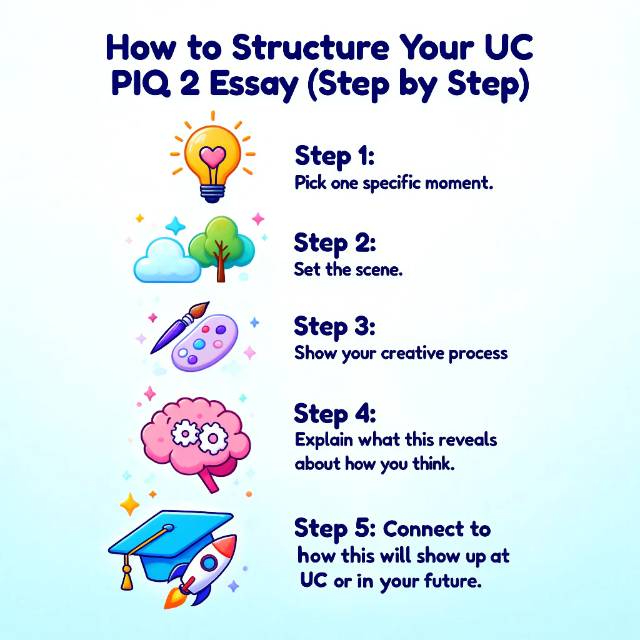
Step 1: Pick one specific moment
Don't describe a hobby in general. Pick one scene one afternoon, one problem, one project where your creative process was actually at work. "I love to cook" is a description. "I spent three weeks trying to recreate my grandmother's mole from memory, adjusting one ingredient at a time" is a story.
What if your creativity doesn't have a single defining moment?
Some students write daily, code constantly, compose music as a background state, or draw the way other people breathe. For them, creativity isn't episodic; it's ongoing, and "pick one specific moment" feels like being asked to choose one breath from a year of breathing.
If that's you, the fix is to find a moment that represents the practice, not one that defines it. You're not looking for the most important creative moment of your life. You're looking for a scene that makes your creative process visible, one afternoon, one problem, one iteration that shows how your mind works when it's doing what it does every day.
A daily writer might anchor their essay in the session where a character started making decisions that the writer hadn't planned. A musician might anchor in the afternoon, and they discovered a chord progression by playing something incorrectly and deciding to keep it. A programmer might anchor in the three hours they spent debugging something that turned out to be a creative breakthrough.
The practice is the context. The moment is the window into it. You need both, but the essay lives in the moment, not the practice summary. |
Step 2: Set the scene. What was the problem or context?
What made this moment call for creativity? What constraint, gap, or challenge were you working against? Even artistic creativity usually starts with a problem: a blank canvas, a deadline, or an emotion you were trying to get out.
Step 3: Show your creative process in action not just the result.
This is the most important step and the one most students skip. Don't tell us what you made. Show us how you thought through it. What did you try that didn't work? What unexpected insight got you unstuck? Where did your approach diverge from the obvious one?
Step 4: Explain what this reveals about how you think.
What does this story say about you beyond the activity itself? Are you someone who iterates obsessively? Who makes unexpected connections between fields? Who finds beauty in constraints? That's what UC readers are looking for.
One note on voice: this is one of the few UC prompts where a lighter tone works in your favour. Admissions readers go through hundreds of applications in sequence. A creativity essay that's written in flat, formal prose creates a small contradiction that the reader feels, even if they can't name it. You don't need to be funny. But you're allowed to sound like yourself, specific word choices, a dry observation, the way you'd actually describe this to someone you respect. That's not informality. That's evidence. |
Step 5: Connect to how this will show up at UC or in your future.
You don't need a neat bow here; one or two sentences is enough. The point is to show that your creative thinking isn't just a hobby. It's how you operate.
One more note on scope: 350 words is roughly three tight paragraphs. You can't cover your entire creative history. Pick the one story that shows your mind most clearly and go deep on that. If you're finding the word limit genuinely constraining, cutting substance just to hit 350, see our 350 word UC essay guide for a breakdown of what to protect and what to cut first. |
The most common Prompt 2 mistake: describing creativity rather than showing it. A sentence like "I express my creativity through music" tells UC nothing. A sentence that shows you mid-process what you tried, what failed, and what insight unlocked the solution gives UC readers what they're actually looking for.
UC PIQ 2 Example Essay (With Annotations)
Here's a strong 350-word model essay. Read it once straight through, then check the annotations below.
My grandmother never used a recipe. She'd taste, adjust, and know a pinch more cumin here, a longer simmer there. When she passed my junior year, I realized I'd spent years eating her food without understanding it. So I set out to reverse-engineer her mole. I started with the obvious: dark chocolate, dried chiles, chicken stock. The first batch tasted like everything and nothing at once. I kept a notebook. After twelve attempts over six weeks, I'd learned that the sequence mattered more than the proportions that you had to toast the chiles before hydrating them, or the bitterness never left. I'd also learned that some things can't be extracted from memory alone. I was solving for something I'd never been taught. That project changed how I approach problems in general. In my AP Chemistry class, I started keeping the same kind of iterative log for lab work documenting not just what happened but what I'd assumed and why. My teacher told me my write-ups read more like a research journal than a lab report. I thought that was the point. At UC, I want to study food science specifically the chemistry of fermentation and preservation. My grandmother didn't have the vocabulary for what she knew. I want to build that vocabulary, and then use it to preserve the techniques that get lost when people like her aren't here to teach them anymore. |
Annotations:
- The opening. Notice it doesn't start with "I am a creative person." It drops you into a scene, and a problem of lost knowledge, a person worth honoring, and immediately makes you want to know what happens next.
- Where the process lives. The second paragraph is almost entirely process. We see failed attempts, a notebook, a key insight (sequence over proportions), and a moment of honest reckoning. We never hear "I am creative." We just watched a creative mind work.
- The identity connection. The third paragraph shows that this isn't just about mole. The habit of thinking iteratively, documented, hypothesis-driven, transferred to a different domain entirely. That's the signal UC wants.
- The landing. The final paragraph connects to a future at UC in a way that feels earned, not tacked on. It also makes the whole essay larger: this is about cultural preservation, not just cooking.
Notice how the essay never says "I am creative," it just shows you a mind at work.
For complete examples across all 8 prompts, check out our UC PIQ examples page. |
If Prompt 2 is one of your four, you now know what UC actually wants from it, where to look for your creative angle, how to structure your 350 words, and it actually looks like. The work that's left is the part that most students underestimate, the time on drafting and redrafting, until the essay shows your mind at work rather than describing your hobbies. The CollegeEssay.org admission team can take the creative story you've decided on and return a structured 350-word draft within 24 hours that you can refine, rework, or send as-is.
What Are the Most Common Mistakes on UC PIQ Prompt 2?
- Mistake 1: Listing hobbies instead of showing one specific moment. What it looks like: "I express my creativity through music, cooking, and graphic design." The fix: pick one and go deep. A single specific story beats a five-item inventory every time.
- Mistake 2: Spending all 350 words on the result, not the process. What it looks like: "I painted a mural for my school. It took three months and everyone loved it." The fix: tell us what happened in your mind while you were making the thing. Results don't reveal character. Process does.
- Mistake 3: Choosing a topic because it sounds impressive. What it looks like: "I started a nonprofit that..." followed by a description of the nonprofit with no creative insight. The fix: ask yourself does this story actually show my creative process, or does it just sound good? If it's the latter, pick a different story.
- Mistake 4: Forgetting the "so what" connection to UC. What it looks like: An otherwise strong essay that ends at the activity. The fix: one or two sentences connecting your creative thinking to what you'll study, build, or contribute at UC.
- Mistake 5: Accidentally writing a Prompt 3 essay. Prompts 2 and 3 are the most commonly confused. Prompt 3 is about a talent or skill you've developed and what it's taught you. Prompt 2 is about how you think creatively. If your essay is mostly about how good you've gotten at something, that's Prompt 3 territory. Check out our UC PIQ Prompt 3 guide if your story fits there better.
- Mistake 6: Writing about creativity in uncreative prose. Two students can describe the same creative process. One uses flat, reportorial sentences. The other puts you in the room with a specific detail, an unexpected comparison, a sentence that sounds like a person and not a college application. The reader notices the difference even if they don't articulate it. You don't need to perform creativity. But the way you describe your process is itself part of the evidence. If you wouldn't use the word "enthralling" in conversation, don't use it here.
Admissions readers have seen a thousand "I express myself through music" essays. Give them the one essay that shows what music makes you think about.
Should You Choose PIQ Prompt 2? (A Quick Decision Framework)
Not every student should pick Prompt 2. Here's a quick way to decide.
It works well when:
- You have a specific story where your creative thinking changed something or solved a real problem
- You want to show intellectual curiosity or unconventional thinking that doesn't come through elsewhere in your application
- Your activity list is strong but doesn't capture how you think
Consider a different prompt when:
- You'd just be describing a hobby you enjoy without a deeper insight into your process
- You have a much stronger story about overcoming a challenge (Prompt 5) or leadership (Prompt 1) that would tell UC more about you
Pick Prompt 2 when you have a story that shows your mind at work, not just your hands.
By now, you know what makes Prompt 2 work: it's about how your mind solves problems, not what you make with your hands, and you've seen the structure, the categories, the mistakes, and a worked example up close. The work that's left is yours: finding the one creative moment from your life that shows your process and giving it 350 words. Send us the story you're considering and the context around it, and have a PIQ writer take it from here to a complete, structured draft within 24 hours, in your voice, ready for you to refine or submit.