You have 350 words. Your professor didn't prepare you for this. No one explained how to compress something real into three short paragraphs and make it sound like you.
This guide gives you a word-budget formula and a step by step editing process to get there not just a word count, but a complete, competitive PIQ response. If you already understand the general structure of UC Personal Insight Questions, this is the guide for the specific constraint of working within the limit.
If you already understand how to write UC Personal Insight Questions in general, this is the guide that gets into the specifics of the word limit itself.
Is 350 Words Really Enough for a UC Essay?
Yes, and the proof is in how the system was designed.
UC admissions readers review thousands of applications every cycle. They don't have time for long essays, and they don't need them. A 350-word answer forces you to get specific. Specific stories are more memorable than general ones. That's not a consolation prize, it's actually an advantage.
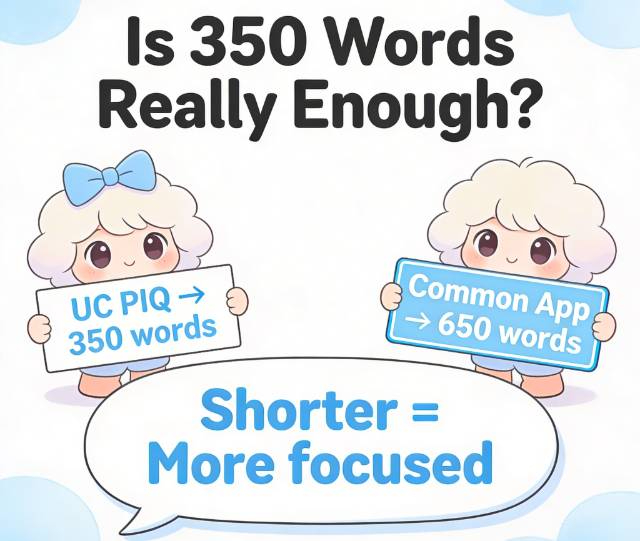
To put it in perspective: the Common App personal statement is 650 words. UC PIQs are intentionally half that length. They're not asking for a full memoir; they're asking for a focused moment with meaning.
350 words works out to about 28–32 sentences, or roughly three short paragraphs. That's enough to drop a reader into a scene, show them who you are, and stick with them after they close your application.
Zoom out for a second: you're writing four PIQs, not one. That's 1,400 words total, more than twice a Common App personal statement. Not every prompt needs all 350 words. A tightly written 300 word response to one prompt gives UC a cleaner picture than a padded 350 word one.
Think about your four essays as a set: the prompts where your story has the most texture deserve the most words. For help deciding which prompts to prioritize, see the guide on how to choose which 4 UC PIQs to answer. |
"350 words isn't a limitation, it's a filter that forces you to keep only what's actually important."
If your instinct is to panic about running out of space, flip it. The word limit is doing you a favor. |
The 350 Word Formula: How to Split Your Word Budget
The single biggest mistake students make is writing without a plan and then realizing they're at 500 words with no idea what to cut. Start with a budget.
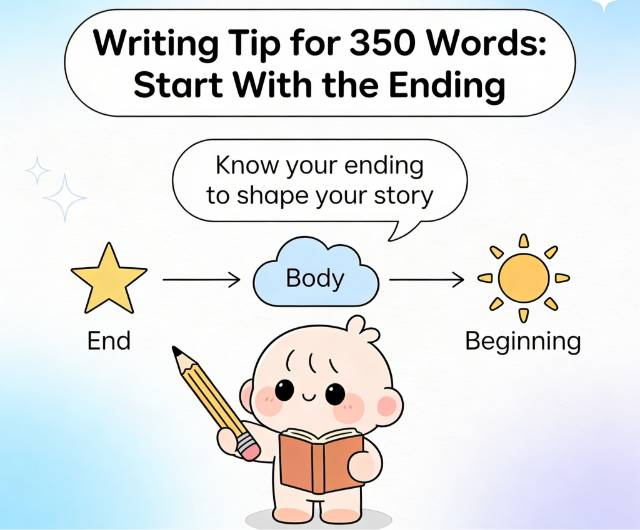
Here's a formula that works across almost every UC prompt:
- Hook / opening scene: 30–50 words. Drop the reader directly into a moment. No backstory, no setup just the scene itself.
- Context / setup: 60–80 words. Give just enough background for the scene to make sense. Who, what, when bare minimum.
- Body / development: 160–200 words. This is the heart of your essay. What you did, how you thought, what changed. This paragraph does the heavy lifting.
- Close / takeaway: 40–60 words. What you learned, and what it means going forward. Brief. Confident. Forward-looking.
Total: 290–390 words. You have room. Each prompt has its own version of this split. See the individual prompt guides for how the budget maps to that prompt's specific structure.
"If you know where your essay ends, you'll know what to cut from the middle."
What to Write in Each Paragraph (Structure Breakdown)
Three paragraphs. Here's how to think about each one.
Paragraph 1: Hook + Context
Start in the middle of a moment, not at the beginning of your life story. Don't open with your childhood or a summary of what you're about to say. Put the reader somewhere specific. Give just enough context to orient them the reader doesn't need your whole backstory, just enough to understand what's at stake.
Paragraph 2: Core of the Story
This is your longest paragraph and your most important one. Show what you did, how you thought, what shifted. The key word is what you did with it not what happened to you, but how you responded. Every sentence here should be earning its place by revealing character.
Paragraph 3: Reflection + Forward Look
Don't summarize. Don't list everything you want to do in college. Pick one specific, genuine thought about what this experience means for who you are now or what you're curious about next. Brief. Confident. Memorable.
If you want to see what this structure looks like in practice, see real UC PIQ examples that worked. The structure is easier to understand when you see it executed well. |
"Every paragraph should answer one question: why does this matter to the reader?"
You've got the formula for one PIQ. Three more prompts, each needing the same focused story, the same tight edit, the same 350-word discipline, are still waiting. If you'd rather spend the next few hours on something other than your application, UC essay writing support is available. Tell us your prompts, and we'll handle the drafts.
How to Edit Your UC Essay Down to 350 Words
Write the draft freely first. Don't count words while you're writing you'll tighten up your thinking and kill good sentences before they have a chance to be good. Get it all out. Then edit.
Here's a step by step process:
Step 1: Cut all setup that happens before your story actually starts. If your draft opens with "Since I was young, I've always..." that's the first thing to delete.
Step 2: Remove adjective and adverb pairs. Pick the stronger word, cut the modifier. "Incredibly difficult challenge" becomes "brutal challenge" or just "the hardest thing I'd done."
Step 3: Kill throat-clearing phrases. These are sentences that sound meaningful but don't add anything:
- "I realized that..."
- "It was at that moment that..."
- "I began to understand..."
- "Looking back, I can see..."
Cut these entirely. Just state the realization.
Step 4: Compress your backstory. If you have a paragraph of context, try writing it in one sentence. You'll be surprised how much you can say in a single well-built sentence.
Step 5: Read it out loud. Every sentence that makes you stumble is probably too long. Every sentence you're proud of that doesn't actually do anything cut it.
What Cutting Actually Looks Like
Here's what each editing step looks like on a real sentence:
| Before | After | What was cut |
|---|
| Since I was young, I've always been passionate about science and knew from an early age that I wanted to pursue it in college. | Science pulled me in early but I didn't know why until junior year. | Backstory throat-clearing (Step 1) |
| It was at that moment that I began to truly realize and understand the incredibly important role that community plays in people's lives. | Community shapes people in ways they don't notice until it's gone. | Throat clearing phrase + adjective pairs (Steps 2 & 3) |
| I was selected to be part of a team that was responsible for organizing a fundraiser that helped raise money for students in need at our school. | I organized a fundraiser that raised $800 for students who couldn't afford field trips. | Passive construction compressed + specifics added (Step 3) |
| I learned a lot from this experience, and it really changed the way that I think about leadership and what it means to be a good leader in any situation. | I learned that leadership is showing up before anyone asks you to. | Vague summary replaced with one specific insight (Step 4) |
"The first thing to cut is any sentence that could start with 'I should mention that...'"
Common 350 Word Mistakes (and How to Fix Them)
Even students who understand the structure still fall into a few predictable traps.
- Using most of your words to describe what happened instead of what it meant.
Fix: Give at least 80 words to the "so what." The facts of the story are just set up. The meaning is the point. - Padding to reach 350 when you're done at 280.
Fix: Stop. A clean, complete 280-word essay is better than a padded 350-word one. The word limit is a cap, not a floor.
These are the mistakes specific to working within 350 words. For the broader list of what goes wrong in UC essays, regardless of length, weak openings, vague reflections, and misread prompts, see the UC essay mistakes to avoid guide. |
"The most common 350-word mistake isn't going over it's using all the space on what happened instead of what it meant."
Does It Matter How Close to 350 Words You Are?
Not as much as you think.
The UC application system enforces a hard cap; anything over 350 words gets cut off before submission, so don't go over. But there's no minimum, and you won't be penalized for landing at 310 instead of 350.
Aim for 300–350. That range gives you enough room to develop your story without forcing you to pad. Under 250 is usually a sign you haven't gone deep enough; you're probably leaving something important on the table.
The real test is this: does every sentence serve the story? If yes, the word count will land where it needs to.
"A 310-word essay that's complete beats a 350-word essay with filler."
You now have a word budget, a three paragraph structure, a five step editing process, and a clear sense of what actually goes wrong in these essays. The only thing left is to write them. If you'd rather not spend the next week going draft by draft through four prompts, we can deliver complete, 350-word PIQ responses built around your actual experiences. Most students get their drafts back within 24 hours.
Turn Your Story Into Powerful UC Responses
Get help shaping your experiences into compelling PIQ answers
- Story development support
- Clear and concise writing
- Strong examples and details
- Professional feedback