First, the Good News: All 8 PIQ Prompts Are Equal
Here's the thing most students don't know: UC admissions has explicitly said there's no combination of prompts they prefer; the right 4 are the ones that best show who you are.
If you haven't already read the full overview of how to write UC personal insight questions, start there first. This article is specifically about choosing and brainstorming your 4.
No prompt carries more weight. No combination signals a stronger applicant. The UC application gives you 8 options so you have room to find the prompts that fit your specific stories not because some prompts are a shortcut to admission. Also, The 8 UC PIQ prompts are confirmed unchanged for the 2026–2027 application cycle. UC has maintained the same prompt set since 2016.
That means the anxiety you're feeling about picking the "right" prompts? You can let that go. The question isn't which prompts UC wants to see. It's which 4 give you the strongest, most distinct stories to tell.
Note for Transfer Applicants: The selection decision works differently for you. Transfer students answer one required prompt about preparation for your intended major and then choose 3 from the remaining 7 prompts, not 4 from 8. The framework in this guide applies to your 3 optional choices, but your required prompt has its own strategy entirely. For the full transfer specific breakdown, see the UC transfer personal insight questions guide. |
The 3 Step Framework for Choosing Your 4 UC PIQs
Your 4 essays should work like puzzle pieces, each one adds a side of you that the others don't cover. Here's how to figure out which prompts do that for you.
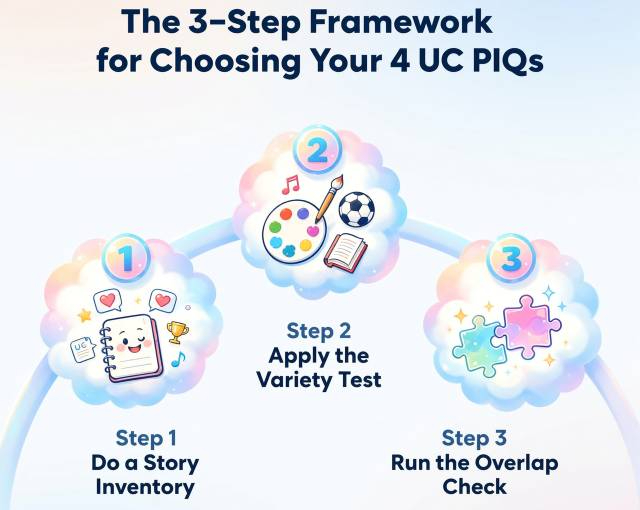
Step 1: What Stories Do You Have? Start With a Story Inventory
Read each of the 8 prompts and spend 2 minutes on each one. For every prompt, write down 1-2 stories that come to mind immediately. Don't overthink it, just write what surfaces.
If you're drawing a complete blank after 2 minutes, that's a signal. It doesn't mean you have nothing to say, but it does mean that prompt may not be where your best material lives right now. Move on and come back to it later.
Step 2: Are Your Four Essays Covering Different Ground? Apply the Variety Test
Once you've got a few candidate prompts with actual story ideas attached, look at your list and ask: Do these essays cover different parts of my life? Do they show different skills? Different sides of my personality?
Your 4 essays shouldn't all be about the same club, the same sport, or the same subject area. Even if those experiences are genuinely important to you, four essays that all circle back to the same thing will feel repetitive to a reader. You want your 4 essays to feel like you're showing an admissions officer different rooms of your life, not the same room from four different angles.
Step 3: Are Any Two Prompts Competing? Run the Overlap Check
Some prompts naturally pull toward similar territory. If you're choosing two from the same zone, make sure the stories are genuinely different.
UC PIQ Prompt Pairs Most Likely to Overlap:
Watch out for these three combinations
- Prompt 1 (Leadership) + Prompt 7 (Community) both involve group impact. If your leadership story is about a community organization and your community story is also about that same organization, that's one essay, not two.
- Prompt 2 (Creativity) + Prompt 3 (Talent/Skill), these can blend together easily. If your creative expression is your talent, pick one frame and find something different for the other.
- Prompt 4 (Educational Opportunity) + Prompt 5 (Significant Challenge) both can become "hard things that helped me grow" narratives. If the experience was primarily about access or opportunity, write it as Prompt 4. If it were primarily about overcoming hardship, write it as Prompt 5. But don't write it as both.
Looking at your topic-starter list across all 8 prompts and finding that several of the prompts you're leaning toward share the same story, same club, same role, same lesson learned is the most common stuck-point at this stage. Sometimes the fix is finding a different angle on a story you've already picked; sometimes it's swapping the prompt itself. If you'd rather work through which 4 actually fit your strongest material with someone who reads dozens of these a week, expert help picking and writing your PIQs is exactly that: a real conversation about your stories, not a generic checklist.
Still Stuck Between Two PIQ Prompts for One Story? Use This Decision Tool
If you've run the three steps and you're still deadlocked between two prompts for the same story, answer these four questions in order. Stop at the first one that produces a clear answer.
Question 1: Which prompt puts you and your actions and your reflection more at the center?
Read both prompt texts. One of them is more about what you did. The other may be more about what happened to you, or about a context around you. Pick the prompt where your specific choices and perspective are the subject of the essay, not the backdrop.
| If one prompt clearly centers your agency more than the other, choose that prompt. If both feel equal: move to Question 2. |
Question 2: Which prompt is harder to answer with a different story?
Imagine you couldn't use this story for one of the two prompts. For which prompt would it be harder to find an equally strong replacement? The prompt that's harder to replace with another story is the one that most needs this particular experience. Assign this story there and find a different experience for the other prompt.
| If one prompt is clearly harder to fill with a different story, assign your story to that prompt. If both feel replaceable: move to Question 3. |
Question 3: Which prompt leaves more room to show reflection in 350 words?
Some stories need more setup before the reflection can land. Assign the story to the prompt that lets you reach the "so what" fastest the prompt whose framing requires the least contextual setup before you can get to what the experience revealed about you.
| If one prompt gets you to reflection faster, choose that prompt. If both feel equal: move to Question 4. |
Question 4: Which prompt is already covered by a stronger story elsewhere in your four?
Look at your other three essays. Which of the two competing prompts is more similar in theme to something you're already writing? Assign this story to the prompt that's less covered by your other three responses. The goal is to have four different sides of yourself. Which assignment creates more variety across the full set is the right one.
Choose the prompt that adds the most variety to your four responses overall.
If you reach Question 4 and the answers still feel equal, the honest answer is that both choices are genuinely viable; pick either one and move forward. The students who struggle most with this decision are usually spending time optimising a choice that won't materially affect their application. A specific, well-written essay on either prompt will outperform an unfocused one on the "better" prompt every time.
Once you've passed all three steps, you have your 4 prompts. Now let's talk about how to use them well.
What the Full PIQ Selection Decision Looks Like in Practice
Here's the 3 step framework applied to a model student profile so you can see what the decision actually looks like from the inside.
Model student: Maya
Maya is a first-generation college applicant. She tutors younger students in math, spent a summer doing field research with a conservation nonprofit, leads her school's cultural heritage club, and has been managing family finances since her father was laid off two years ago. She has strong grades, no formal awards, and is applying to UC San Diego for Environmental Science.
Her story inventory (Step 1):
| Story | Candidate prompt(s) |
|---|
| Started tutoring program for first-gen students | Prompt 1 (Leadership), Prompt 7 (Community) |
| Conservation nonprofit field research summer | Prompt 4 (Educational Opportunity), Prompt 6 (Academic Subject) |
| Managing family finances since father's layoff | Prompt 4 (Barrier), Prompt 5 (Challenge) |
| Cultural heritage club leadership | Prompt 1 (Leadership), Prompt 7 (Community) |
| Self-taught data analysis for school equity project | Prompt 2 (Creativity), Prompt 3 (Skill) |
| First person in family navigating college applications | Prompt 8 (Wild Card) |
The variety test (Step 2): Maya's strongest stories span personal development (finance management), intellectual life (field research), community impact (tutoring), and a dimension not covered elsewhere (first-gen navigation). That's four different rooms. She avoids picking both the tutoring story and the cultural heritage story because both are community-facing leadership stories in the same room, different angles.
The overlap check (Step 3): The finance management story could fit Prompt 4 (barrier) or Prompt 5 (challenge). Since the primary story is about what she did with the system she built, the decisions she made, rather than the hardship itself, it fits Prompt 5 better and leaves Prompt 4 open for the field research opportunity.
Her final four:
- Prompt 1: Tutoring program (leadership through mentorship, not a title)
- Prompt 4: Conservation field research (educational opportunity seized independently)
- Prompt 5: Managing family finances (challenge with agency-driven response)
- Prompt 8: First-gen college navigation (dimension no other prompt covered)
What she cut and why: Cultural heritage club cut from Prompt 7, too similar in theme to the tutoring leadership story. Self-taught data analysis cut a strong story, but the field research essay already covers intellectual initiative, and adding a second academically driven essay would repeat a dimension already shown.
The final four cover: community impact, academic drive, personal resilience, and identity. Four different sides. No repeated theme. |
How to Use UC Prompt 8 (The Wild Card) Strategically
Prompt 8 asks what sets you apart from other applicants. It's the most open-ended of the 8 prompts, and for good reason. If you have a story, quality, or experience that doesn't fit cleanly into any of the other 7 prompts, this is where it goes.
The caution: don't pick Prompt 8 as a default because it feels more open. It still requires a specific, concrete story, and the more open the prompt, the more discipline it takes to write it well. If you're choosing Prompt 8, make sure you can complete this sentence before you commit: "This essay will show UC something about me that none of my other three responses could have shown." If you can't complete it yet, you don't have your Prompt 8 story yet.
You've got your four prompts. The selection decision is done. What most students hit next is the blank page. Knowing which prompt to answer is one thing; writing 350 words that actually reflect you is another. If you want expert guidance on the writing side, our UC essay strategy service covers all four responses: drafting, structuring, and revising until every essay reflects you accurately.
Which UC Prompt Fits Your Story? Topic Starters for Each PIQ
Use this section while you're making your selection decision, not after. The goal here is to help you quickly see which prompts your strongest stories fit, and which ones you're forcing. Each block gives you concrete starting points so you can match your experiences to the right prompt, plus a common trap to avoid.
These are not writing guides. Once you've chosen your prompts, the dedicated guide for each one covers how to actually write its structure, what to include, what to cut, and what UC readers are looking for. Those links are in each section below.
Prompt 1: Leadership
Leadership here doesn't mean titles; informal, behind-the-scenes leadership counts just as much.
Strong topic starters:
- Stepping up in a group project when no one else would
- Mentoring a younger student, teammate, or sibling
- Mediating a conflict between peers, team members, or family members
- Organizing a community effort, formal or informal
- Taking on a family responsibility that required you to lead
Topic to avoid: Being president of a club, unless you have a specific conflict-driven or failure story. "I was president and ran meetings" is one of the most common essays UC readers see. It has to go deeper than the title.
Prompt 2: Creativity
Creativity extends well beyond art. Problem-solving, unusual thinking, and innovation in any field all qualify.
Strong topic starters:
- An unconventional solution you found to a real problem
- A creative project that grew beyond what you originally planned
- How you applied creative thinking in a non-artistic field (engineering, science, business)
- An original work in writing, photography, design, music, coding, or film
Topic to avoid: "I play guitar" or "I love to draw" as a standalone identity statement. Prompt 2 needs a story how you created something, how creativity solved a problem, or how it shaped how you think.
Prompt 3: Greatest Talent or Skill
The how you developed it part of this prompt matters more than the talent itself.
Strong topic starters:
- A skill you had to fight for a comeback from injury, a late start, or teaching yourself
- Something you're uncommonly good at that people tend to underestimate
- A talent that has opened unexpected doors or changed the direction of something in your life
Topic to avoid: Abstract qualities like "I'm hardworking" or "I'm determined." You need a concrete, specific skill, something demonstrable. The reflection on how you developed it is where the essay lives.
Prompt 4: Educational Opportunity or Barrier
Choose your angle based on which gives you the stronger story: an opportunity you seized, or a barrier you navigated.
Strong topic starters "Opportunity": A specialized program, dual enrollment, research experience, or enrichment opportunity that meaningfully changed your trajectory.
Strong topic starters "Barrier": A school disruption, lack of resources or access, a language barrier, or a family responsibility that affected how you learned.
Topic to avoid: Don't force a barrier narrative if your educational experience was mostly one of opportunity. An inauthentic hardship essay is one of the easiest things for a reader to spot.
Prompt 5: Significant Challenge
The challenge matters less than what it reveals about how you think and respond.
Strong topic starters:
- A health challenge, yours or a family member's, that shifted your priorities
- An external obstacle: financial hardship, family instability, loss
- A personal failure or setback you had to work your way back from
- A mental health experience, if you can write about it with honesty rather than for sympathy
Topic to avoid: A sports injury comeback, unless the reflection goes well beyond "I worked hard and came back stronger." That version of the story is extremely common. If the real insight is something deeper about identity, about what the sport meant to you, about what you learned about yourself when it was gone, then it can work.
These topic starters are for choosing your prompt. For the full strategy on how to actually write Prompt 5, including what to spend your 350 words on and what to cut, see our UC PIQ prompt 5 challenge guide |
Prompt 6: Academic Subject You're Drawn To
This prompt should connect your academic passion to your future not just say "I love this subject."
Strong topic starters:
- The specific moment you fell in love with the subject (a class, a question, a project, a discovery)
- How a teacher, experience, or book ignited the interest
- How this passion connects to what you want to study at UC and what you want to do after
Topic to avoid: "I love math/science/history" without a specific story underneath it. Every applicant lists subjects they love. The prompt is asking you to show what that love looks like in practice.
These topic starters are for choosing your prompt. For the full strategy on how to actually write Prompt 6, including how to show obsession rather than interest, and what "outside the classroom" actually means to UC readers, see our UC PIQ prompt 6 academic subject guide. |
Prompt 7: Community Contribution
"Community" can be any group you belong to: school, neighborhood, team, online community, or family unit.
Strong topic starters:
- A problem you identified in your community and took specific action on
- Consistent, meaningful service is not a one-off event, but a pattern of contribution
- How your participation changed the community, and how it changed you in return
Topic to avoid: Generic volunteering with no reflection on your specific role or what changed as a result. "I volunteered at a food bank" is not an essay, it's a line on a resume.
Important: If you're writing both Prompt 1 and Prompt 7, make sure the stories are genuinely different. See the overlap check section above.
Prompt 8: What Sets You Apart (Wild Card)
This is your most open canvas, use it for the story that doesn't fit anywhere else.
Strong topic starters:
- A strong identity-level quality or value, anchored to one very specific story
- Something about your background or upbringing that shaped you and isn't covered in your other essays
- An experience, belief, or goal that makes you distinctly you and that you haven't had space to say elsewhere
See the full section above on how to use Prompt 8 strategically.
How to Make Sure Your 4 PIQ Essays Don't All Say the Same Thing
Here's a quick test you can run once you've drafted your 4 topic ideas: write one sentence summarizing what each essay reveals about you.
If any two sound like the same story, one of them needs to go.
For example: if your summary for Prompt 1 is "I'm someone who steps up when there's a problem," and your summary for Prompt 7 is also "I'm someone who steps up when there's a problem," those two essays are doing the same job. You're not showing two sides of yourself; you're showing one side twice.
One way to avoid this: think about the 8 prompts in loose categories. Some prompts are about academic and intellectual life (Prompts 4 and 6). Some are about personal strengths and development (Prompts 2, 3, and 5). Some are about your role in the world beyond yourself (Prompts 1, 7, and 8). Aim to pull from at least 3 different categories across your 4 essays.
You don't need to be well-rounded across every area of your life. You do need to show different sides of yourself. That's the goal.
You've used the 3-step framework, brainstormed topics across all eight prompts, and run the distinctness check on your final four. The choosing work is done, and that's the part that most students underestimate, the time savings. What's left is writing four 350-word essays that sound like you and not like every other applicant who picked the same four prompts. If you'd rather hand over the drafting and editing from a complete first version, CollegeEssay.org's UC PIQ writers work directly from your chosen prompts and the story inputs you provide. Most students get full drafts back within 24 hours.
What If You're Completely Stuck on UC PIQ Topics?
If you read all 8 prompts and nothing comes to mind, don't panic and don't assume you have nothing to write about. Most students have more material than they realize. The stories just need surfacing.
The most effective thing you can do when you're stuck: talk to people who know you well. Ask a parent, teacher, coach, or close friend: "What stories do you think of when you think of me?" You'll be surprised how often someone else remembers a moment you've completely forgotten, and sometimes that forgotten moment is exactly the right story. |
You can also try the "stories you tell" exercise. Think about the stories you find yourself telling when someone asks what you've been up to, what you've been through, or what matters to you. The stories that come out naturally in conversation are usually the ones worth writing about.
The prompts you struggle to answer most aren't always the wrong ones; sometimes they're the ones worth digging into.
What If You Have Too Many Stories and Can't Narrow Down for PIQ Essays?
The opposite problem is just as common, and often harder to solve. If you've done the story inventory and come out with 10 viable candidates across 6 or 7 prompts, the framework above still applies, but the decision feels heavier because every cut means leaving something real on the table.
When you have too much material, use this filter in order:
- First, cut any story that duplicates a theme already covered by a stronger story.
Two resilience stories, two leadership stories, two academic passion stories keep the one where your specific role is most central, and your reflection is most original. Cut the other regardless of how much the experience meant to you.
Second, cut any story that requires significant context to land.
In 350 words, you can't afford to spend 80 words explaining the background before the story starts. If a story needs that much setup, it's either too complex for this format or it's not the right entry point into that experience. A simpler story told with more depth will almost always outperform a complex story told at a surface level.
Third, if you're still deadlocked between two stories for the same prompt, ask which one only you could write.
A robotics conflict story and a theater tech story might both demonstrate leadership equally well on paper. The tiebreaker is specificity: which one has details, a moment, and a reflection that belong to no one but you?
After those three filters, if you're still genuinely stuck between two final candidates, pick the one that covers a dimension of yourself not already surfaced by your other three essays. The goal is always a complete picture across four responses, not four individually perfect essays. For a complete guide about transfer essays, check out our comprehensive transfer essay guide.
By this point, you have a method for choosing your four PIQs, topic starters for every prompt, and a check for making sure your final set doesn't repeat itself. The remaining hours of work are the actual writing, and for most students applying to UCs alongside Common App schools, the writing is where the calendar gets tight. Send your chosen four and the story moments you'd want to draw on, and let our writers handle the writing drafts come back within 24 hours, fully structured, in your voice, ready for you to refine or submit.