What Is UC PIQ Prompt 5? (The Full Prompt, Explained)
Here's the official prompt text from the University of California:
"Describe the most significant challenge you have faced and the steps you have taken to overcome this challenge. How has this challenge affected your academic achievement?" |

Break it down, and there are three things UC actually wants from you:
- What the challenge was, not in exhaustive detail, but enough to give context
- What you did about it is the most important part
- How it affected your academics and how you adapted
UC also includes "Things to Consider" notes alongside this prompt on the application. They're worth reading: UC explicitly tells applicants the challenge doesn't need to be unique or dramatic; it just needs to have genuinely affected you and your academic path. If you're asking whether your challenge is significant enough, UC's own guidance says that question is yours to answer, not theirs.
One thing worth noting: "academic achievement" doesn't only mean your GPA. UC uses it to mean your broader capacity to learn, stay focused, and grow as a student. A challenge that forced you to rethink your approach to school counts, even if your grades never dipped.
If you're already familiar with the prompts and wondering how to write UC personal insight questions, this guide focuses specifically on prompt 5. You'll also want to read a quick note below about how prompt 5 differs from prompt 4. It's a distinction that trips up a lot of applicants. |
"UC prompt 5 isn't asking how bad your challenge was it's asking what you did about it."
How Is Prompt 5 Different from Prompt 4?
This is one of the most common points of confusion in the whole PIQ process. Here's a clean comparison:
| Prompt 4 | Prompt 5 |
Focus | Educational barrier OR opportunity | Any significant personal challenge |
The challenge must be... | Directly tied to your education | Personal, family, community, or school related |
Best for... | Students with school specific obstacles | Students with broader life challenges |
The rule of thumb: if your challenge directly blocked your education no access to AP classes, a school closure, lack of resources prompt 4 is probably the better home. If your challenge is more personal in nature (illness, family crisis, mental health struggles, financial hardship), prompt 5 fits better.
"If the challenge could have happened outside of school, it probably belongs in prompt 5."
What Counts as a "Significant" Challenge?
Here's something a lot of applicants don't realize: you don't need the most dramatic challenge ever lived. You need one that genuinely affected you and that you actually responded to with effort and growth.
Strong challenge categories:
- Personal/health: An undiagnosed condition (anxiety, dyslexia, celiac disease) that affected focus or attendance before you got support; a serious injury that limited participation for a defined period; chronic pain or a disability that required you to build workarounds to keep up academically
- Family: Caring for a sick or elderly family member while managing school; financial hardship that required you to work during the school year; a parent's job loss or housing instability that disrupted your routine
- Community/social: Racial or cultural discrimination that affected your sense of belonging; navigating a language barrier as a first generation American student; social isolation that required deliberate effort to overcome
- Academic adjacent: A learning disability like dyslexia or ADHD that required you to find and adopt specific strategies, not just "work harder" but change how you studied entirely
For a full breakdown of which challenge topics rarely work and how to rescue them when they're your only option, see the next section.
The deciding factor isn't the size of the challenge. It's whether your response to it reveals something real about your character.
Note for transfer applicants: Prompt 5 often produces the strongest essays in transfer pools, because the challenges that brought you to community college and the responses you built during your time there are usually more developed than anything a high school senior can describe. Workplace responsibilities you took on after a family crisis, the year you spent caregiving before going back to school, navigating financial aid as a first generation student, completing coursework around a chronic health condition, the systems you built when you had to balance a full time job and a full course load all of these are legitimate Prompt 5 material, often with clearer growth arcs and more describable actions than typical high school challenge essays. The transfer applicant's advantage on Prompt 5 specifically is that your response had real stakes. You didn't recover from a dip in a chemistry grade; you kept the lights on, made rent, supported family, and earned a 3.7 anyway. That's not a footnote, it's the essay. For the full transfer PIQ strategy, see our UC transfer personal insight questions guide. |
What does "most significant" actually mean in PIQ 5?
The word "most" is the one that makes students freeze. They read it and immediately start comparing their challenge to other people's, wondering if theirs is serious enough, whether admissions readers will think they're exaggerating, or whether someone else's harder circumstances make their story less valid.
Here's what UC actually means by "most significant": the challenge that was most significant to you, not most significant objectively, not most dramatic by any external measure. UC is asking you to self define. A student who navigated a parent's job loss, a student who managed a serious mental health diagnosis, and a student who moved schools four times are all writing about their "most significant" challenge. None of those is more or less valid than the others.
The practical implication: stop asking whether your challenge was bad enough and start asking whether your response to it was real enough. Two things disqualify a Prompt 5 topic: the challenge was genuinely minor with no lasting impact, or you don't have specific describable steps you took in response. If neither of those is true, your challenge is significant enough. |
One more reassurance worth stating directly: UC does not rank challenges. A reader who has just finished an essay about immigration trauma doesn't then discount an essay about navigating a learning disability. Every application is read in its own context. Your challenge is evaluated against what you did with it, not against what someone else faced.
"The size of the challenge matters less than the size of your response to it."
What If You Have More Than One Significant Challenge?
Students with multiple real challenges run into a different problem from students who can't find one. The word "most" in the prompt makes them freeze, comparing one challenge against another, wondering which one is "most significant" by some external standard, second guessing whichever one they pick.
"Most significant" in this prompt doesn't mean objectively worst, most dramatic, or most sympathy inducing. It means the challenge where your response is most visible, most yours, and most useful to UC's understanding of who you'll be in college. Run your candidates through these four filters in order and stop at the first one that produces a clear winner:
Filter 1: Which challenge has the clearest growth arc?
The prompt asks what steps you took and what changed. The challenge with the most visible before and after, where you can name specifically how you operated differently after compared to before, gives you the most to write about. A bigger challenge with no nameable growth produces a weaker essay than a smaller challenge with a clear arc.
Filter 2: Which challenge produced the most concrete, describable actions?
Vague responses ("I worked hard," "I stayed positive") flatten an essay regardless of how serious the challenge was. The challenge where you can name 2-3 specific things you actually did, a system you built, a person you talked to, a routine you changed, a resource you found, is the one with the strongest essay material. If one candidate gives you a list of nameable actions and another gives you general statements about "pushing through," choose the first.
Filter 3: Which challenge is least visible elsewhere in your application?
Your four PIQs should collectively show different sides of you. If one of your candidate challenges is already implied by your transcript (a clear grade dip already visible to the reader), by your activities list (a caregiving role obvious from your hours), or by another PIQ, the response still needs explaining, but the challenge itself doesn't need to carry the essay. The challenge that adds the most new information to your application is usually the strongest choice.
Filter 4: Which challenge connects most naturally to how you'll operate as a college student?
Not required, but useful. When the steps you took during the challenge map cleanly to skills you'll keep using, time management, self advocacy, asking for help, and building systems under pressure, the closing paragraph writes itself. If a candidate's response naturally points toward how you'll handle college, that connection is worth weighing.
If you reach Filter 4 and two challenges still feel genuinely equal, pick the one where the response is more specific. A vivid, particular story about a smaller challenge will always outperform a vague, general story about a bigger one. UC's reader will remember the student who built a shared Google calendar and changed study locations long after they've forgotten the student who "stayed strong during a difficult time."
One more reassurance worth stating directly:
UC does not rank challenges. A reader who has just finished an essay about immigration trauma doesn't then discount an essay about navigating a learning disability. Filter for the strongest response, not the most dramatic situation. |
Reading an example essay probably did one of two things: either it gave you permission to write about something you'd been holding back, or it surfaced the next stuck point. If any of those are where you are, UC challenge essay writing experts on the CollegeEssay.org team write Prompt 5 essays every week, including the ones that are hard to start. Tell us the challenge, the rough shape of your response, and what you're worried about, and a writer will return a structured 350 word draft within 24 hours that you can refine, rewrite, or use as a starting point.
UC PIQ Prompt 5 Topics That Rarely Work (and Why)
These topics are not banned. But they show up in thousands of Prompt 5 essays every cycle, which means you need to do significantly more work to make them land. If one of these is your honest best topic, the advice below tells you exactly what makes them fail and what to do if you're going to write about one anyway.
"I got a bad grade / I failed a test / my GPA dropped." This is the most common weak topic. A bad grade is a momentary setback, not a "significant challenge," and writing about it usually makes the essay sound like it's apologizing for the transcript rather than revealing character. If the grade dip itself is what you want to write about, you're almost certainly looking at the wrong prompt; the cause of the grade dip (a health issue, a family crisis, a learning difference that went undiagnosed) is the Prompt 5 essay, and the grade dip is the academic impact moment inside it. If your only challenge is the bad grade itself, this is a Prompt 4 educational barrier essay at best.
"I didn't make the team / didn't get into the club / didn't win the competition." A rejection isn't a challenge unless your response to it is genuinely transformative. The standard arc I didn't make varsity, I trained harder, I made it the following year reads as a sports resilience essay every reader has seen hundreds of times. If you're going to write about a rejection, the challenge has to be the long term consequence (an identity shift, a redirection toward something you wouldn't have found otherwise) rather than the rejection event itself.
"My teacher disliked me / I had a conflict with someone." Interpersonal conflict essays almost always make the writer look worse than they intended, because the essay spends most of its words explaining what the other person did wrong. UC readers don't have a way to verify your account, and even sympathetic versions of these essays put the reader in the uncomfortable position of taking sides.
The exception: if you stayed in a situation where someone treated you badly and used the experience to develop a specific interpersonal skill (de-escalation, advocating for yourself, mediating in your own family or workplace), the essay can work, but only when the focus is on the skill you built, not on the conflict itself.
"I struggle with procrastination/time management/motivation." Self imposed challenges are the hardest to write about because the response is usually internal, and "I made a to do list and stuck to it this time" doesn't carry 350 words. If your honest answer to "what was your most significant challenge" is I have a hard time getting started, write a different prompt.
The exception: if the procrastination or motivation issue turns out to be a symptom of something larger (a mental health diagnosis, an attention disorder, an unrecognized circumstance), then the underlying issue is the actual Prompt 5 essay, and the procrastination is one of its surface effects.
The sports injury comeback. "I tore my ACL, I rehabbed, I played again, I learned about resilience." This story has the structure of a Prompt 5 essay: clear setback, clear response, clear outcome, which is why so many athletes write it. The problem is that admissions readers have seen this exact arc hundreds of times. If your injury story is the only Prompt 5 story you have, the response has to do work the standard injury essay doesn't: name a specific decision you made during recovery (changing how you trained, redefining your relationship to the sport, mentoring a teammate going through the same thing), and let the injury be the setup, not the point.
The "I went on a service trip/mission trip and grew as a person" essay. This isn't usually framed as a Prompt 5 by the student, but it sometimes drifts into Prompt 5 territory when the trip involved hardship or witnessing difficulty. If the "challenge" you faced was being temporarily uncomfortable in someone else's circumstances, this is the wrong prompt and arguably the wrong essay. Prompt 7 (community contribution) is a more honest home, and even there, the essay only works if you center your specific actions and acknowledge the limits of what a week long visit could meaningfully accomplish.
The breakup / unrequited crush / friendship falling out essay. Relationship dissolutions are real and can be genuinely difficult, but they rarely produce strong Prompt 5 essays because
(a) the reader has no investment in the relationship,
(b) the response is usually emotional rather than describable in concrete actions, and
(c) the academic impact connection is often forced. If a relationship loss is genuinely your most significant challenge, look for the secondary effects the academic year you had to restructure, the way you rebuilt a friend group, the routines you changed, and write the essay about those, not about the relationship itself.
The "I learned hard work" / "I learned perseverance" generic resilience essay. This isn't a topic so much as a failure mode that can attach to almost any topic. If the closing paragraph of your draft reads "I learned that with enough hard work and determination, I can overcome anything," the essay is generic regardless of what the challenge was.
The fix: replace the abstract takeaway with one specific operational change (a system you'll keep using, a particular thing you now do differently, a recalibrated relationship to risk or asking for help) that came out of the experience.
If your honest best topic falls into one of these categories and you can't make the rescue version work, the right move is usually to pick a different prompt rather than a different angle. Prompt 5 is one of four, and an excellent essay on Prompt 1, 4, 7, or 8 will outperform a workmanlike essay on Prompt 5 every time.
How to Structure Your UC PIQ 5 Response (350 Words)
This is where most guides stop at general advice like "focus on growth." That's true, but it doesn't tell you how to actually allocate your 350 words. Here's the framework:
Section | What to Cover | Suggested Word Range |
Opening (Hook) | Drop into a specific moment. Don't start with "My challenge was..." | 30–50 words |
The Challenge | Name it and give brief context no more | 60–80 words |
Steps You Took | 2–3 specific, concrete actions. This is the most important section. | 100–120 words |
Academic Impact | How it affected your learning or performance, and how you adapted | 60–80 words |
Growth / Forward Look | What you learned and how it shaped who you are | 30–50 words |
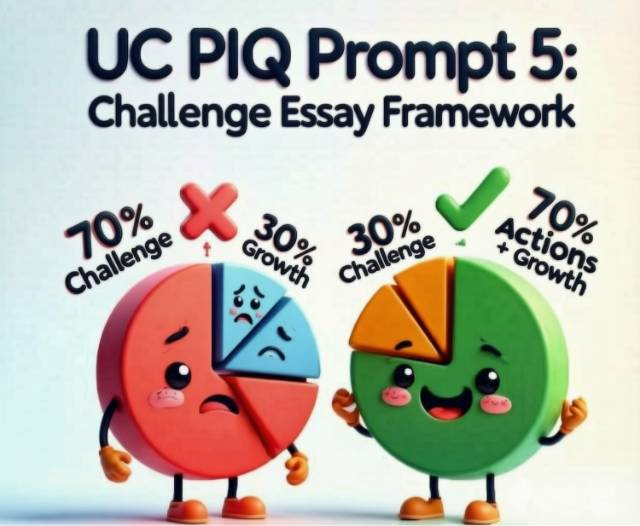
The key rule: at least two-thirds of your essay should cover your response and growth, not the challenge itself. Don't summarize the problem at the end. You already set it up at the top.
If you're finding the word allocation genuinely constraining once you start drafting, running over on the challenge description and cutting into the steps section, see our 350 word UC essay guide for a breakdown of what to protect and what to cut first. |
"Your response to the challenge is what the admissions reader actually wants to understand."
What Does a Strong UC PIQ Prompt 5 Essay Look Like? (Annotated)
Here's a modeled example 350 words using the structural framework above. The brackets show which section each passage is fulfilling.
My junior year, I learned to do my homework in a hospital waiting room. What the opening does: One sentence. Specific setting, specific time, immediate forward pull. The reader is in the situation before any explanation has been given exactly the right ratio of scene to context at the opening of a 350 word essay. My mom was diagnosed with a serious kidney condition in October of that year. Between medical appointments, insurance calls, and my dad working extra hours to cover costs, I became the default caregiver for my younger siblings most evenings. It wasn't something anyone asked of me it was just what the family needed. What the challenge paragraph does: Named clearly and briefly in under 80 words. No dramatisation, no dwelling. The phrase "it wasn't something anyone asked of me it was just what the family needed" does double duty: it explains the situation and reveals character at the same time. The reader understands the weight of it without being told to feel it. I didn't let it quietly derail my academics. I started using a shared Google calendar to block study windows into my schedule the same way I would a shift at work. I talked to three of my teachers about what was happening, not to ask for extensions by default, but so they'd understand if I occasionally needed one. I also shifted my study environment library during lunch, notebook in the waiting room, because I couldn't count on quiet evenings at home. What the steps paragraph does: Three specific, named actions: Google calendar, conversations with teachers, and changed study environment. None of them are vague. Each one shows a decision the student made. The phrase "not to ask for extensions by default, but so they'd understand if I occasionally needed one" is the most important sentence in the paragraph: it shows self awareness and maturity rather than a passive response to a hard situation. UC readers will notice this. My grades dipped slightly in November, but I pulled them back up by January. The bigger change was how I studied. I got faster at identifying what actually mattered in an assignment instead of trying to absorb everything equally. That skill stuck with me through senior year. What the academic impact paragraph does: Addresses the prompt's explicit "academic achievement" requirement directly and honestly. The grade dip is acknowledged without apology, it's evidence, not an excuse. The real academic impact isn't the grade recovery; it's the changed study approach. Naming a specific skill (prioritising what matters in an assignment) shows the change was cognitive, not just motivational. I've never thought of myself as someone who thrives under pressure, but this year showed me I can build systems when things fall apart. I came out of it with a clearer understanding of what I'm capable of when I stop waiting for conditions to be ideal. What the reflection does: Specific and honest it doesn't overclaim ("I discovered I'm resilient") or recycle a lesson ("I learned hard work pays off"). The phrase "build systems when things fall apart" is original and connects directly to the concrete actions shown in the steps paragraph. The closing sentence "when I stop waiting for conditions to be ideal" is quietly memorable and adds a forward looking dimension without forcing a college connection. |
This is a complete annotated Prompt 5 example covering an external family challenge. For additional Prompt 5 examples, including internal and identity based challenge stories, see our UC personal insight question examples guide.
If you've run the gut check and Prompt 5 is one of your four, you now know what UC is actually asking for, how to allocate your 350 words, and what a strong response sounds like at the sentence level. The work that's left is the part most Prompt 5 writers underestimate, sitting down with a challenge that matters and writing about it without slipping into either summary of the bad thing or overclaimed resilience. If you'd rather hand the drafting over and edit from a complete first version, our UC PIQ admission essay writers write Prompt 5 essays every week and turn around a structured 350 word draft within 24 hours written for your specific challenge, in your voice.
What Are the Most Common Mistakes on UC PIQ Prompt 5?
- Mistake 1: The challenge takes up 80% of the essay. Fix: Use the word allocation table above. If your "steps taken" section is shorter than your "description of the challenge" section, flip it.
- Mistake 2: Vague steps taken. "I worked hard and pushed through" tells the reader nothing. Fix: Name 2–3 specific, tangible actions you took. What exactly did you do? When? How?
- Mistake 3: Never addressing how it affected your academic achievement. The prompt asks this directly. Skipping it is a structural miss. Fix: Name one concrete academic consequence and describe how you adapted.
- Mistake 4: Ending on the problem instead of the growth. Your last 30–50 words should look forward, not backward. Don't close by restating how hard things were.
- Mistake 5: Choosing a challenge that makes you look bitter or blames others. The essay should center your character, not the unfairness of the situation. Even if someone else caused the challenge, your essay needs to be about what you did.
A Note on Challenges Involving Other People
Many of the strongest Prompt 5 topics involve a challenge caused by or centred on another person, a parent's illness or addiction, a difficult family dynamic, an abusive relationship, or a loss. These are valid and often powerful stories. But they come with a specific writing problem: how do you write honestly about what happened without the essay becoming about the other person?
The answer is a strict point of view discipline. Every sentence should be in your lane: what you felt, what you decided, what you did, what you learned. The moment a sentence is primarily describing the other person's behaviour, motivations, or failings, you've left your lane. That doesn't mean you can't name what happened. It means you name it once, briefly, and then the rest of the essay is yours.
A practical test: read each sentence of your draft and ask whose story this sentence is telling. If more than two or three sentences across the whole essay are primarily about someone else's actions or character, the essay needs reorientation. The challenge is the context. You are the subject.
Two specific things to avoid: naming the other person by name (keep it general, "my parent," "a family member," "someone close to me"), and writing with visible anger or bitterness toward them.
UC readers are not judging whether what happened to you was fair. They're evaluating how you handled it. An essay that reads as primarily an indictment of someone else, however justified, signals to the reader that you haven't yet moved past the event. That's the opposite of what Prompt 5 needs to show.
Should You Choose Prompt 5? (Quick Gut Check)
Ask yourself these three questions:
- Do I have a challenge that genuinely affected my life not just a temporary inconvenience?
- Did I take real, describable steps in response?
- Can I name a specific way it affected my learning or academic performance?
If yes to all three, prompt 5 is a strong candidate for you.
One thing worth knowing before you commit: Prompt 5 is one of the most commonly selected in the UC pool. That doesn't disqualify it, but it does mean vague responses are more costly here than on less travelled prompts. A generic "I faced hardship and grew stronger" essay will disappear in a crowded field. A specific one with named actions and a real academic consequence won't. If you're still deciding which four to answer, the full prompt by prompt strategy is in our guide on how to choose which 4 UC PIQs to answer. |
"If you can describe exactly what you did and why it mattered to your development as a student, prompt 5 is worth your time."
By now, you've got the prompt parsed, the Prompt 4/5 distinction sorted, a topic strength filter, a word allocation table down to the section level, a modeled essay pulled apart by structure, and the mistakes that sink otherwise strong responses. What remains is the writing itself, and Prompt 5 is the prompt where the writing is often the heaviest, because you're asking yourself to revisit something hard and turn it into 350 words that land. Send us the challenge you've chosen, what you did about it, and how it touched your academics, and we can write the PIQ essay draft for you, full structure, in your voice, back within 24 hours, ready for you to refine or submit.