What is UC PIQ Prompt 4, and What Does it Actually Ask?
Here's the exact prompt:
"Describe how you have taken advantage of a significant educational opportunity or worked to overcome an educational barrier you have faced." |
The keyword is "educational." This prompt isn't asking about personal struggles broadly; that's what prompt 5 is for. Your topic has to connect to learning, school, or your academic path in a direct way.
UC defines opportunities as programs, courses, or experiences that add value to your education and better prepare you for college. Barriers are anything related to school or your schoolwork that impede your ability to learn.
One more thing: pick ONE. Not both. You have 350 words. Trying to cover both will leave you with two thin, unconvincing halves instead of one strong essay. If you want help with all eight of your UC PIQs, start with our complete guide to UC personal insight questions writing. |
"The word 'educational' is doing a lot of work in this prompt. Your topic has to connect to learning, not just to personal growth."
Should You Write About an Opportunity or a Barrier in PIQ 4?
This is the decision most students get stuck on. Here's a clear framework to help you choose.
Write About an OPPORTUNITY if... | Write About a BARRIER if... |
You have a specific program, class, or experience that shaped your academic direction | Something outside your control interfered with your learning or performance |
You know your intended major and can connect the opportunity to it | You want to explain a gap, weak grade, or missing resource in your record |
You want to show initiative and intellectual curiosity | You want to show resilience, problem-solving, and adaptability |
You already wrote PIQ 5 about a personal challenge | You haven't written PIQ 5 yet, OR your barrier is clearly school-specific |
The PIQ 4 vs. PIQ 5 check: This is the question most articles skip over, but it matters. If your barrier could be described as a "significant personal challenge" and doesn't have a direct connection to school or learning it probably belongs in prompt 5, not here. Ask yourself: would the essay be about what happened to me (prompt 5 territory) or how a specific thing affected my ability to learn (prompt 4 territory)?
"If your barrier doesn't have a direct connection to school or learning, it probably belongs in prompt 5, not here."
What Counts as an Educational Opportunity in PIQ Prompt 4?
UC's language is broad: anything that has added value to your educational experience and better prepared you for college.
Before the list, one thing worth saying clearly: "educational" does not mean institutional. You don't need a program name, a university affiliation, or a formal internship.
That includes a lot more than you might think. Strong educational opportunity topics include:
- Summer research or STEM programs at a university
- Dual enrollment or community college courses
- An honors or AP class that changed your academic direction
- Academic competitions (Science Olympiad, Model UN, debate)
- An internship with a genuine learning component
- A mentorship with a professor, professional, or researcher
- Self-directed learning projects (teaching yourself a coding language, building something, publishing research)
- Study abroad or language immersion programs
- Online courses that took your knowledge beyond what your school offered
The test you should apply: Did you learn something you couldn't have learned otherwise? Can you connect it to where you're headed academically? If yes to both, it counts.
Watch out for the common trap: writing about a class you loved but spending 300 words saying "I love reading." Admissions readers want to know what you did with the opportunity, not just that you had it.
Note for transfer applicants: Prompt 4 is the prompt most directly connected to the required transfer essay, which asks how you've prepared for your intended major. If you're a transfer applicant choosing your optional three prompts, Prompt 4 on the opportunity path is one of your strongest options. It lets you show educational initiative that goes beyond your transcript and directly demonstrates major readiness. Dual enrollment, independent study, workplace learning, professional certifications, and online coursework all qualify as educational opportunities for transfer students. For the full transfer PIQ strategy, including the required prompt, see our UC transfer personal insight questions guide. |
What does "significant" actually mean?
"Significant" is the word that makes most students self-disqualify. They assume it means prestigious a named university program, a nationally competitive internship, something that looks impressive on paper. It doesn't.
UC uses "significant" to mean meaningful to your educational path, an experience that genuinely changed your direction, deepened your knowledge, or opened a door you couldn't have opened otherwise. A single AP class that reoriented your academic interests qualifies. A summer job with a genuine learning component qualifies. A mentorship with a local professional who changed what you want to study qualifies.
The test isn't prestigious. It's the depth of engagement. A student who attended a well-known summer program and wrote a surface-level essay about what they did there will lose to a student who took one community college course and wrote about exactly how it changed how they think. The "significant" is in what you made of it, not in what it was.
"If you walked away knowing something you didn't know before and it shaped where you're headed academically, that's an educational opportunity worth writing about."
What Counts as an Educational Barrier in PIQ Prompt 4?
UC's official definition: "any barriers or challenges related to school and/or your schoolwork."
The key phrase is "related to school." A barrier is something outside your control that interfered with your ability to learn or perform academically. That distinction matters. Choosing not to study isn't a barrier. Your school is not offering the courses you need. |
What makes a barrier "significant"?
The same principle applies to the barrier side. "Significant" doesn't mean catastrophic. It means the barrier genuinely and specifically affected your ability to learn, and that you can show a meaningful response to it.
If you find yourself adding details to make the barrier sound worse than it was, that's a signal that the experience might not be the right topic. If you're understating it because you're worried it sounds like an excuse, that's usually a signal that it is the right topic, and you just need to focus the essay on your response, not on the hardship itself. |
Strong educational barrier topics include:
- Your school lacked resources, programs, or advanced courses
- Financial limitations prevented you from participating in educational experiences
- A learning difference or disability that wasn't identified or supported
- Family obligations (caregiving, work) that significantly cut into study time
- A language barrier if English isn't your first language
- A health issue physical or mental that affected your academic performance
- Moving schools mid-year, disrupting continuity
- Pandemic-specific learning disruptions, if your situation was genuinely distinct
Topics that don't qualify: poor grades because you didn't prioritize school, general social struggles that didn't directly impact academics, or personal conflicts that are better suited to prompt 5.
One more important note: this isn't the place to make excuses. The essay should spend very little time describing the barrier and much more time on how you responded to it.
What Should a UC PIQ Prompt 4 Barrier Essay Focus On? A barrier essay is not about the bad thing that happened. It's about what you did when it happened. UC readers want to see your response, the specific steps you took, the resources you found, the alternatives you built, not a description of the hardship itself. The faster you move through the barrier in the essay, the more room you have to show what actually matters.
"A barrier essay isn't about the bad thing that happened, it's about what you did when it happened."
Two paths, two sets of pitfalls, one 350 word slot, and the most common stuck-point at this stage is realizing your story might be neither cleanly an opportunity nor cleanly a barrier, or that the line between Prompt 4 and Prompt 5 keeps shifting depending on which paragraph you're drafting. If you'd rather work the classification problem out with a writer who reads dozens of these every week, our UC admission essay writers can take your raw experience and decide with you whether it's a Prompt 4 opportunity, a Prompt 4 barrier, or something that fits better elsewhere, then deliver a structured draft within 24 hours.
How to Structure PIQ Prompt 4 Educational Opportunity Essay (350 Words)
Use this three part structure:
- Part 1 The hook and context (80 words) What was the opportunity? How did you access it? Ground the reader in specifics right away. Don't open with "I have always been passionate about science." Open with the moment, the program, or the thing that pulled you in.
- Part 2 What you did with it (150 words) This is where most essays fall flat. Don't just describe the program describe your actions inside it. What did you pursue that others might not have? What questions did you ask? What did you produce, create, or contribute? This is where you show initiative, not just attendance.
- Part 3 The growth and forward connection (120 words) What changed for you because of this opportunity? How does it connect to your academic direction or goals? This doesn't need to be a grand revelation. It just needs to show that something in you shifted a new direction, a deeper question, a clearer sense of where you're headed.
Mini-example (annotated):
"The summer I spent in UC San Diego's COSMOS program wasn't what I expected. I'd signed up to learn organic chemistry. What I actually learned was how to be wrong productively how to run a reaction, get a bad yield, and redesign the experiment before I even asked for help. By week three, I was staying late because I couldn't stop thinking about the mechanism. That's when I understood what it meant to actually want something academically."
What works here: Specific program name. A counter-intuitive insight (learned to be wrong). Concrete action detail (staying late). A genuine emotional/intellectual shift at the end. It's not about the program it's about what the program revealed.
If you're finding the 80/150/120 word allocation genuinely tight once you start drafting, see our 350 word UC essay guide for a breakdown of what to protect and what to cut first. |
"Anyone can list a program on their activities section. This essay is where you show what you did with it."
How to Structure PIQ Prompt 4 Educational Barrier Essay (350 Words)
Use this three-part structure:
- Part 1 The barrier (80 words) Name it clearly and briefly. One to three sentences. Don't dramatize it, and don't minimize it. Set the scene without spending half your essay on it. The faster you move through this part, the more room you have to show what actually matters.
- Part 2 How you responded (150 words) This is the heart of the essay. What steps did you take? What resources did you find on your own? What did you try that didn't work before you found what did? This section should reveal character persistence, creativity, self-advocacy, resourcefulness. Specific actions beat general statements every time.
- Part 3 The outcome and lesson (120 words) What changed? You don't have to have fully resolved the barrier. Showing you're actively navigating it and that you understand yourself better because of it is often more compelling than a tidy resolution. What did it teach you about how you learn, how you persist, or what you need to succeed in college?
Mini-example (annotated):
"My high school didn't offer AP Computer Science. I found out sophomore year, when every college I was researching listed it as a recommended course. So I enrolled in a community college CS course online, paid for by a scholarship I applied to after three rejections. By junior year I'd completed the equivalent of two AP-level courses and had a GitHub portfolio. The school didn't have the class. I built the path myself."
What works here: Specific, verifiable gap (no AP CS). Clear sequence of actions. Stakes made real (three rejections before getting funding). The final line is quotable and shows character without being dramatic.
"The best barrier essays aren't about winning they're about showing how you think when things get hard."
UC PIQ 4 Examples: What a Strong Essay Looks Like
Here is one complete modelled essay for each path opportunity and barrier written to the 350-word limit, with post-paragraph annotations explaining exactly what each section is doing and why it works.
Complete Example: Opportunity Path
[Modelled Example, Not a real student essay]
I signed up for COSMOS at UC San Diego expecting to learn organic chemistry. What I didn't expect was to spend the first week failing in front of a postdoctoral researcher who seemed genuinely unbothered by it. She'd hand back my lab reports with one question circled: "Why did you expect this result?" Not what went wrong. Why I'd expected something different. By day four I realised I'd been studying chemistry by memorising outcomes. She was asking me to study it by understanding mechanisms what each molecule was actually doing and why. What the opening does: Drops immediately into a specific person and a specific intellectual challenge not a description of the program. The reader knows within two sentences that something real happened here. The counter-intuitive framing (failing in public, a researcher who seemed unbothered) creates forward pull. I started staying late. Not because I was behind, but because the mechanism questions wouldn't leave me alone. I redesigned a failed reaction three times in one week each time not because my supervisor asked me to, but because I needed to know why it had worked on the fourth attempt. By week three I was reading papers that weren't on the syllabus. What the development paragraph does: Shows initiative through concrete, specific action staying late, redesigning the reaction three times, reading off-syllabus papers. None of these are listed as achievements. They're shown as behaviours driven by genuine curiosity. The reader can see the student's intellectual character without being told what it is. That summer changed how I study. I stopped treating chemistry as a set of facts to memorise and started treating it as a set of questions to work through. My AP Chemistry grade went up half a letter grade the following semester but more than the grade, I stopped dreading the parts I didn't understand yet. I started wanting them. I want to study biochemistry at UC. I know now that what I'm actually after isn't just the knowledge it's the moment right before the mechanism makes sense. What the reflection does: The grade improvement is mentioned specifically and briefly it's evidence, not the point. The real reflection is intellectual: a changed relationship with not-knowing. The final sentence is specific enough to be memorable and honest enough to feel earned. |
This is a modelled example, not real submitted applications. This page gives you one complete example per path. For additional annotated Prompt 4 examples alongside examples across all eight prompts, see our UC personal insight question examples guide.
"A strong UC PIQ 4 essay makes the reader feel like they know something about this student that they couldn't have learned from a transcript."
The work that remains is the part most students underestimate: matching the right path to your own life, picking the right 350 words from a much longer story, and keeping the essay clearly inside Prompt 4 instead of letting it drift toward Prompt 5. If you'd rather hand off the drafting and edit from there, UC PIQ writing help for educational barrier essays, whether your story is an opportunity or a barrier, comes back within 24 hours, fully structured, in your voice, ready for you to refine or submit.
Common UC PIQ 4 Mistakes to Avoid
Both writing paths have pitfalls. Here are the ones that show up most often and cost students the most.
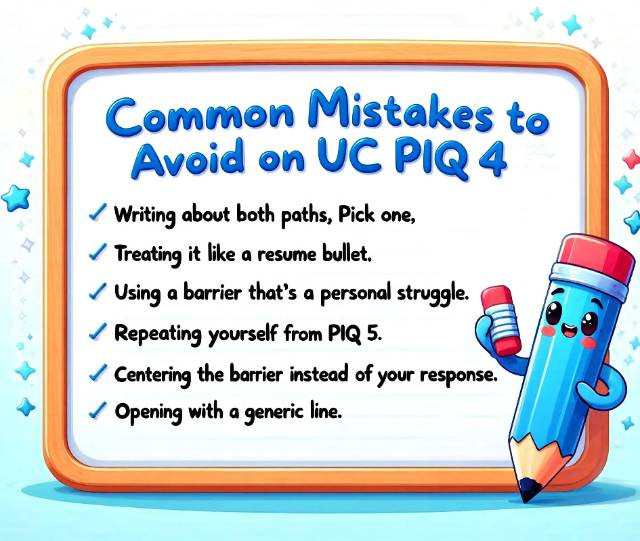
- Writing about both paths. Pick one. You don't have 700 words. Trying to cover an opportunity and a barrier in 350 words means neither gets the depth it needs.
- Treating it like a resume bullet. Listing what you did isn't the same as reflecting on what it meant. Admissions readers see thousands of "I did X and learned Y" essays. The ones they remember show genuine thinking.
- Using a barrier that's really a personal struggle. If your barrier is about a relationship, emotional difficulty, or personal loss ask whether it actually connects to your academic performance or schoolwork. If not, it belongs in a different prompt.
- Repeating yourself from PIQ 5. Each PIQ should reveal something new. Using overlapping material signals to readers that you didn't have enough to say about your own life. For more on avoiding common pitfalls across all your essays, check out our UC essay mistakes guide.
- Centering the barrier instead of your response. The essay is about you specifically, the version of you that showed up when something got hard or when an unusual door opened. Don't let the opportunity or barrier be the main character.
- Opening with a generic line. "I have always loved learning." "Education has always been important to me." These openers tell the reader nothing and waste words you don't have.
"Admissions readers have seen thousands of these essays; what they remember are the ones where they learn something specific and surprising about the student."
By now, you know whether your story belongs in Prompt 4 or Prompt 5, whether it's an opportunity or a barrier, what a strong version of each path looks like at the sentence level, and the mistakes that flatten otherwise-promising drafts. What's left is the drafting itself, and for a prompt with two viable structures and one 350-word slot, the hours add up fast. Send us the experience you've decided to write about, your rough sense of which path it fits, and your deadline, and a UC PIQ writer can take this off your plate. Most students get a complete, structured draft back within 24 hours, in their voice, ready to refine or submit.