You have UC PIQ Prompt 3 in front of you and one question: What do I actually write about? This guide walks you through picking a topic that works, structuring it into 350 words, and avoiding the mistakes that make most Prompt 3 essays sound the same. There's also a fully annotated 350-word example at the end. Read it before you draft anything.
Here's the thing: UC Prompt 3 isn't asking you to be the best at something. UC PIQ Prompt 3 is the University of California's invitation for you to walk admissions through the story of how you worked on something that matters to you, how you developed it, and where you've put it to use.
What Is UC PIQ Prompt 3 Actually Asking For?
The full prompt reads: "What would you say is your greatest talent or skill? How have you developed and demonstrated that talent over time?" |
Pay attention to the two action words in that second sentence: develop and demonstrate. Those aren't just filler. They're the essay's actual instructions.
- "Develop" means the admissions reader wants to see movement a before and an after. You weren't born with this skill fully formed. There was a point when you weren't very good, or when you were good but didn't know it yet, or when something pushed you to work harder at it.
- "Demonstrate" means they want evidence. Not a list of achievements, but a real-world moment or context where this talent showed up and did something.
What this prompt is not asking for: a resume in paragraph form. A brag list. A record of your awards. If your essay is just "I've won X competitions and placed Y times," you've missed the point. For a full walkthrough of all eight UC prompts, start with our guide to writing UC Personal Insight Questions. |
The strongest Prompt 3 essays are about how far you've come, not how high you've reached.
How to Pick Your Talent or Skill UC PIQ Prompt 3 Topic
Most students pick the wrong thing because they think "impressive" wins. It doesn't. "Specific and growth-driven" does.
If you're stuck on what to write about, try these three brainstorming questions:
- What's something you were genuinely bad at, then got better at? That gap between bad and better is your essay. A student who taught herself to read architectural blueprints over a summer has a better story than a student who's "always been good at design."
- What skill do you use across multiple parts of your life? A talent that shows up in different contexts, school, home, work, volunteering, proves it's actually part of who you are, not just something you do in one club.
- What would your closest friend say you're unexpectedly good at? Sometimes the most compelling topics are the ones you've stopped noticing. Ask someone who knows you well.
Once you have a topic, ask one more question before you commit: Am I about to write the most obvious version of this essay, or the most interesting one?
Every strong topic has a default version and a better version. The default version is what anyone who shares your talent would write. The better version is the specific, unexpected context where your skill showed up in a way only you could describe. A student who codes writes about building an app that is the default. The better version is the student who used those same coding skills to automate the scheduling system at her family's small business after her father got sick, because that is the story no one else is telling. Same skill. Completely different essay.
Before you draft anything, finish this sentence: "Most people with this talent would write about ___. I'm going to write about ___ instead." If you cannot find a second answer that is genuinely more specific and more yours, the topic is either too generic to save, or you haven't dug far enough yet. Keep asking where else this skill has shown up in your life — outside the obvious setting, outside the expected context — until you find the version of the story that could only be yours.
What if you have too many strong candidates and can't decide which one is your "greatest"?
High-achieving students with strong profiles often hit a different wall: not "I can't think of anything" but "I have four viable skills, and I don't know which one to call my greatest." The word "greatest" in the prompt makes this feel like a high-stakes declaration. It isn't.
"Greatest" in this prompt doesn't mean objectively most impressive or most decorated. It means the skill where your development arc is most visible and most yours. Run your candidates through these four filters in order and stop at the first one that produces a clear winner:
- Filter 1: Which skill has the clearest before-and-after? The prompt asks how you developed the talent over time. The skill with the most visible gap between where you started and where you are now gives you the most to write about. Raw talent with no struggle produces a weaker essay than modest talent with a compelling growth story.
- Filter 2: Which skill shows up in the most different contexts? A talent that appears across school, home, work, and community proves it's genuinely part of who you are not something you do in one setting. If one of your candidates clearly crosses more contexts than the others, it's probably your strongest Prompt 3 story.
- Filter 3: Which skill is least visible elsewhere in your application? Your four PIQs should collectively show different sides of you. If one of your candidate skills is already prominent in your activities list or another PIQ, save it for a context where it adds something new. The skill that adds the most new information to your application is the one to choose here.
- Filter 4: Which skill connects most naturally to what you want to study or do? Not required but when a talent connects to a future direction, the final paragraph writes itself. If a candidate's skill points clearly align with your intended major or career, that connection is worth weighing.
If you reach Filter 4 and two candidates still feel genuinely equal, pick the one where you have a more specific, concrete story to tell. A vivid, particular story about a lesser skill will always outperform a vague, general story about an impressive one.
The trick is finding your own development arc with a level of specificity when your talent isn't dramatic on its surface, if your skill is real. Still, the before-and-after isn't satisfactory, or you have a strong topic but can't tell which moments to include in 350 words, UC talent essay writing assistance from our PIQ team can take whatever development arc you do have and shape it into a complete first draft you can refine. Most students get drafts back within 24 hours.
One quick note on topic overlap: if you answered Prompt 2 about your creative side, don't choose the same subject here. You've got eight prompts to cover as much ground as possible; use them that way. Our UC PIQ Prompt 2 creativity guide walks through how to avoid this kind of overlap. |
What about sports? Sports essays aren't banned, but they're risky if you write about athleticism in a general sense. "I work hard and never give up" could describe half the applicants in California. If you write about a sport, zoom in: your ability to adapt your game plan mid-match, how you mentor freshmen on form, or the very specific moment you changed your mechanics after an injury. The narrow angle beats the broad one every time.
Soft skills, such as communication, empathy, problem solving, can absolutely work here, but only if you make them concrete. "I'm good at communication" is invisible. "I learned to translate my grandmother's medical conversations from Tagalog to English, which forced me to understand both the language and the fear behind it" That's a topic.
Note for transfer applicants: Workplace and trade skills are fully valid for Prompt 3 and often produce stronger essays than school based activities. A cook who spent two years mastering a regional cuisine, a construction worker who developed precision carpentry, a medical assistant who built clinical documentation skills, a freelancer who taught themselves a technical discipline, these are all legitimate "greatest talent" stories. The development arc is usually clearer in professional contexts than in high school extracurriculars because the stakes were real, the repetition was intensive, and the feedback was immediate. For the full transfer PIQ strategy, see our UC transfer personal insight questions guide. |
Your topic doesn't need to be impressive; it needs to be yours.
UC PIQ Prompt 3 Topics That Rarely Work (and Why)
These are not banned. But they show up in thousands of essays every cycle, which means you need to do significantly more work to make them land. If one of these is your honest best topic, the advice below tells you exactly how to rescue it.
- "I play [sport], and it taught me discipline." The discipline-through-sport essay is the single most common Prompt 3 submission UC readers see. It rarely works, not because sport is a bad topic, but because the insight is almost always the same: I worked hard, I lost, I learned perseverance. If you write about a sport, the topic cannot be the sport itself. It has to be something specific you developed within it the ability to read a defensive formation and adjust in real time, the way you learned to coach your own anxiety before a match, the mechanics change you made after an injury that required you to rethink how your body moves. The narrow angle is the only angle that works.
- "I've always been naturally good at X." This kills the essay before it starts. The prompt asks how you developed a talent over time. Natural ability with no struggle, no before-state, no growth arc gives the reader nothing to follow. If you catch yourself writing "I've always been good at..." stop and ask: when was I not good at this? Start there instead.
- "My greatest talent is working hard / being determined / never giving up." Abstract character traits without a concrete skill attached produce invisible essays. Hard work is not a talent it is how you develop one. Name the actual thing you got better at, then show the hard work as the mechanism.
- The talent that's already all over your application. If your activities list, another PIQ, and your recommendation letters all point to the same thing, using Prompt 3 to repeat it wastes a slot. Admissions readers evaluate four PIQs together. Each one should show a different dimension.
Ask yourself: Does my application already make this obvious? If yes, find a different angle. - The big performance / big competition. "The night of the recital / the finals / the competition, I was nervous, but I got through it." This structure puts the climax at the end of the essay and leaves no room for actual reflection on development. The performance is the demonstration moment, not the whole story. If your topic involves a high stakes event, start before it in the months of work that made it possible, and let the event appear briefly, not as the payoff.
How to Structure Your 350 Word UC PIQ Prompt 3 Essay
Most guides tell you to focus on growth and stop there. Here's the actual structure, with word counts, so you know exactly how to use your 350 words.
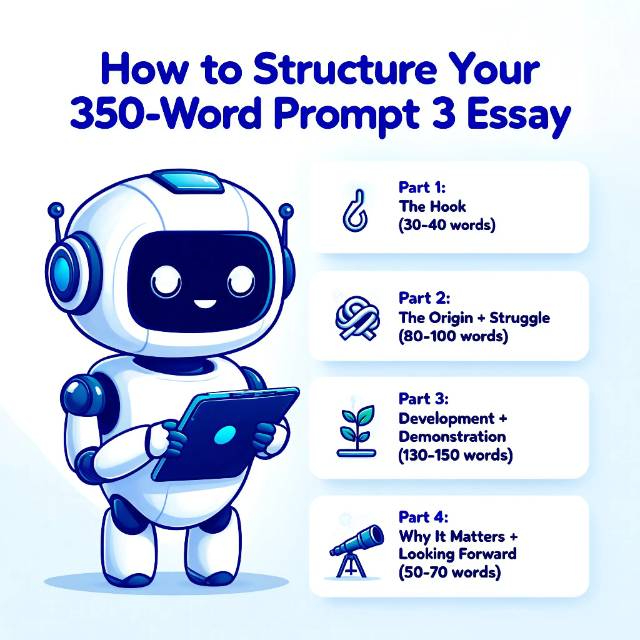
- Part 1 The Hook (30–40 words) Drop into a specific moment. Don't start with "I've always loved..." Start mid-scene: you're doing the thing, something is happening. The reader should be in the room with you before they know what the essay is about.
- Part 2 The Origin + Struggle (80–100 words) Where did this start? What was hard? This is your "before" state. Show the version of you that wasn't good yet, or the version that was just starting to figure it out. Specifics matter here a year, a place, a teacher's comment, a failure.
- Part 3 Development + Demonstration (130–150 words) This is the longest section because it's doing the most work. How did you improve? Be concrete: two or three specific steps, moments, or milestones. Then show where you actually used this skill a real situation, a real outcome. Don't just describe the process; show it landing somewhere.
- Part 4 Why It Matters + Looking Forward (50–70 words) Why does this skill matter to you beyond the activity itself? How does it connect to how you see the world, or what you want to study, or who you want to become? Keep this grounded one clear idea rather than three vague ones.
At 350 words, every sentence is doing a job either showing your journey, your character, or your direction.
If you're finding the 350-word limit genuinely constraining once you start drafting, see our 350 word UC essay guide for a breakdown of what to cut first without losing the substance that matters. |
You've got the framework, the filters, the structure, and next, you will read an annotated example pulled apart line by line, everything you need to write a Prompt 3 essay that sounds like you. The work that's left is the part most students underestimate: turning a real development arc into 350 words that don't sound like a résumé in paragraph form. If you'd rather hand the drafting over and edit from a complete first version, you can let a PIQ expert writer step in, tell us your topic, your development arc, and your deadline, and a writer on the UC PIQ team will deliver a structured 350-word draft back within 24 hours.
UC PIQ Prompt 3 Essay Example (Annotated)
The first time I opened my grandfather's broken radio, I had no idea what I was looking at. It had stopped working the year before, and we couldn't afford to replace it. He'd bought it in 1987 it still smelled like his workshop. I figured if I broke it worse, at least it was already broken. What the opening does: No résumé language, no "I've always been skilled at." The reader is placed in a specific memory with a specific object and a before-state clearly established no knowledge, just trying. The emotional stakes (the grandfather, the smell of the workshop) are present without being sentimental. For the next two years, I taught myself basic electronics repair from library books and YouTube videos, mostly failing. I fried a circuit board replacing a capacitor. I misread a wiring diagram and spent three weeks wondering why a speaker only worked upside down. But I started to understand what each component did, and why things failed not just how to fix them. What the development paragraph does: Two specific failures named, not vague "I worked hard." The shift from "how to fix" to "why things fail" is the intellectual growth moment it shows the student's understanding deepening, not just their technique improving. Concrete details (capacitor, wiring diagram, upside-down speaker) make the struggle feel real and specific. Eventually, I fixed the radio. Then I fixed a neighbor's blender, then my cousin's laptop speaker. By junior year, I had a small reputation on our block: if something broke, bring it to Dani. I started a free repair station at our school's STEM fair, and three teachers brought in broken classroom equipment. What the demonstration paragraph does: The skill moved out of private practice into the real world with real impact. The escalation radio, blender, laptop speaker, block reputation, STEM fair, and teacher equipment shows genuine reach without listing awards or competitions. The demonstration is social and community-facing, which adds a dimension beyond individual mastery. What I actually learned to repair wasn't electronics it was my own patience. I grew up believing that if something was hard, I probably wasn't built for it. Fixing things taught me that I just needed longer, different approaches, and more tolerance for being wrong. What the reflection does: The final paragraph doesn't say, "I learned persistence is important." It says something specific about how this student used to see herself and how that changed. The reframe ("it wasn't electronics, it was my own patience") is original and quotable. It makes the reader forget the topic and focus entirely on the person, which is exactly what the strongest Prompt 3 essays do. |
A great Prompt 3 essay makes the reader forget the talent and focus entirely on the person.
This page provides a modelled example of a self-taught technical skill. For additional annotated Prompt 3 examples, including academic and athletic skill stories, see our UC personal insight question examples guide. |
What Are the Most Common Mistakes on UC PIQ Prompt 3?
Knowing what to do is half the battle. Knowing what to avoid is the other half.
- Mistake 1: Writing a resume in paragraph form. If there's no struggle in your essay no before-state, no obstacle, no growth you've written a highlight reel, not a story. The quick fix: ask yourself "where was I worse at this?" and put that in the essay.
- Mistake 2: Choosing a talent that's already obvious from your application. If every other part of your application already says "I'm a swimmer," a Prompt 3 essay about swimming just repeats what they already know. Pick something that adds a new dimension.
- Mistake 3: Bragging without grounding. "I've always been naturally gifted at..." immediately raises a red flag. It signals no growth, no struggle, no self-awareness. Replace it with a specific moment where the talent was tested.
- Mistake 4: Picking the same topic as Prompt 2. Using two essay slots for the same story wastes the opportunity to show admissions a different side of yourself. If they overlap, cut one and start fresh. For more on avoiding common errors across all your UC essays, see our UC essay mistakes to avoid guide.
- Mistake 5: Forgetting to show "demonstration." Development (getting better) isn't enough on its own. You also need a moment where you actually used this skill in the world. School project, family situation, volunteer work, creative output, something outside the practice room.
Admissions readers see thousands of "I've always loved music" essays, but what they rarely see is a student explaining exactly what it took to get good.
By now, you know what Prompt 3 is actually asking: how to pick the right talent (and which topics rarely work), how to structure your 350 words, what a strong development arc looks like on the page, and how to spot the mistakes that flatten otherwise-strong essays. What's left is the writing, and for a prompt that asks for development and demonstration, the writing is where most of the rewriting hours go. Send CollegeEssay.org's PIQ specialists the talent you've picked, the rough development arc, and a few specifics about where the skill showed up in your life, and you'll get a complete, structured draft back within 24 hours, written in your voice, ready for you to refine or submit.