What Does UC PIQ Prompt 6 Actually Ask?
The full prompt is: "Think about an academic subject that inspires you. Describe how you have furthered this interest inside and/or outside of the classroom." |
For context on where PIQ 6 fits in the broader application, see our complete guide to UC personal insight questions.
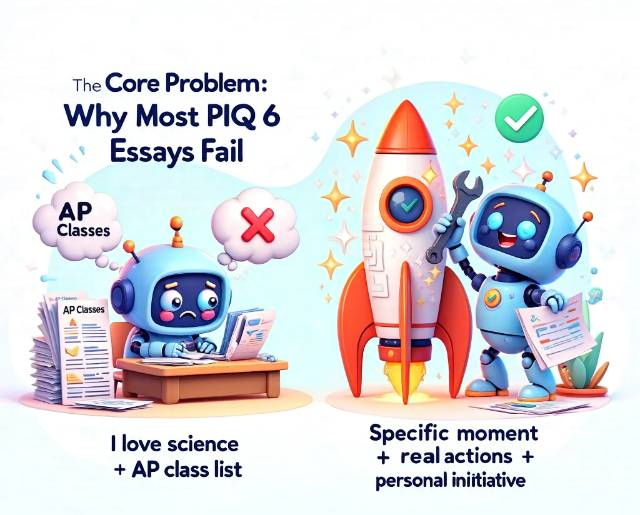
Two things are happening in that sentence. First, UC wants to know what subject genuinely moves you not what looks impressive, not what your intended major is, just what actually gets you thinking. Second, they want to know what you've done about it.
That second part is where most students get stuck.
The word "furthered" is the key to prompt 6 UC doesn't want to hear that you love chemistry; they want to know what you did because you love chemistry.
Notice the "inside and/or outside" language too. You don't have to have both. But outside-classroom experience carries more weight, because it shows the interest is yours not just something you did because it was assigned.
Should You Choose Prompt 6? How to Decide
PIQ 6 is a strong pick when you have one clear academic passion you've actually pursued beyond coursework. It's especially effective if you're applying to impacted programs like CS, engineering, or business this prompt is your chance to anchor your application to your intended major in a direct, personal way.
Prompt 6 vs. Prompt 3: a Quick Distinction
If your academic passion is also your greatest talent or skill (a mathematician who competes, a writer who has developed a serious craft), you may find yourself torn between Prompt 6 and Prompt 3. The distinction is the same as Prompt 2 vs. 3. Prompt 6 is about intellectual curiosity and what you've done to pursue a subject.
Prompt 3 is about skill development and mastery over time. If your essay would be primarily about how far you've come in developing an ability, that's Prompt 3. If your essay is primarily about a subject's ideas and what you've done to explore them, that's Prompt 6. When in doubt: is the story about getting better at something, or about wanting to understand something more deeply? That decides the prompt.
A word of caution: if your only evidence is "I took the AP class and got a 5," the essay will feel thin. Readers see thousands of those. You need something that happened because of your interest, not just alongside it.
What if you have multiple strong subjects and can't decide which one to write about?
Apply two filters in order. '
First: which subject has the most outside classroom evidence? The prompt explicitly asks how you've furthered your interest the subject where you have a self-directed project, sustained reading, an independent initiative, or real world application that gives you the most to write about. The subject where your evidence is mostly classroom-based is the weaker candidate, regardless of how much you love it.
Second: Which subject connects most naturally to what you want to study or do? A loose connection is fine, it doesn't have to be your declared major. But when the subject and the forward looking reflection feel like they're pointing in the same direction, the essay's final paragraph writes itself. If one of your candidates has both more outside-classroom evidence and a clearer forward connection, that's your subject.
| If both filters leave you genuinely deadlocked, write the opening paragraph of each and see which one produces a more specific, concrete first sentence. The subject where you can name a real moment, a question, a project, a discovery is the one to choose. |
What if you love a subject but haven't done much with it outside class?
This is more common than students admit, and it's fixable, but only if you're honest with yourself about it. First, check whether you're underestimating what counts as outside-classroom. Self-directed reading (even one book you chose yourself), a YouTube video series you followed out of curiosity, a conversation with a professional in the field, a personal project, however small, all of these count.
If you genuinely have none of these, ask whether this prompt is the right choice right now. A different prompt where your evidence is stronger will almost always produce a better essay than this one, where your evidence is thin.
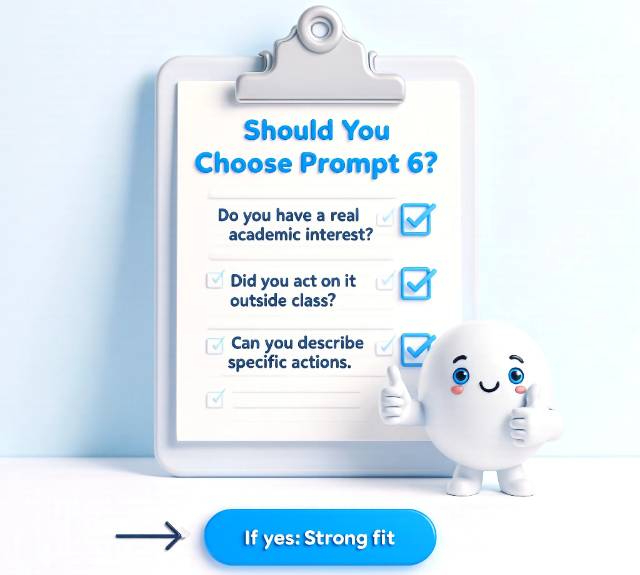
And here's the thing: you don't need to have done something extraordinary. Tutoring peers, watching documentaries, reading books in the field, following researchers on social media, and digging into their work all of these count. The key isn't how impressive the activity looks; it's whether the story is genuine.
PIQ 6 works best when you've done something with your interest, anything that happened outside a classroom assignment. The subject also doesn't have to match your intended major. But a natural connection, even a loose one, can strengthen the essay.
Note for transfer applicants: Prompt 6 is one of the strongest options in the transfer applicant pool. Transfer students have often engaged with their subject through actual college coursework, not just an AP class, but a real university course with a professor who pushed their thinking, a research project, a paper that went somewhere unexpected, or a field they've worked in professionally. That depth of engagement is exactly what this prompt is designed to surface, and it tends to be more developed in transfer applicants than in high school seniors. If you've taken college-level courses in your subject and pursued it beyond the syllabus in any way, Prompt 6 gives you more to work with than almost any other prompt. For the full transfer PIQ strategy, see our UC transfer personal insight questions guide. |
How to Write UC PIQ 6: The Passion-to-Action Framework
This is the structure that separates specific, believable essays from generic ones. The framework has three parts, and the most important one comes last.
Part 1: How Do You Open a UC PIQ Prompt 6 Essay? (1–2 sentences only)
Don't spend your whole essay on backstory. Pick one moment the thing that first made this subject click for you and name it specifically. "I've always loved math" is a dead end. "The day I ran my first regression model and the output didn't match what I expected" is a beginning.
One moment. One or two sentences. Then move on.
Part 2: What Classroom Evidence Should You Include? (2–3 sentences)
Yes, you can mention AP classes, research projects, competitions, or presentations that happened inside school. But name them specifically not "AP Bio" in isolation, but what you actually did in that class that pushed your thinking further. A research project you led. A paper you wrote that went beyond the assignment. A question you kept asking that your teacher couldn't answer.
Part 3: What Outside Classroom Evidence Makes UC PIQ Prompt 6 Stand Out? (majority of the essay)
This is where your essay lives. Self-directed reading. A YouTube channel you started explaining concepts to other students. An internship, a summer program, an online course you took out of pure curiosity. Teaching a younger sibling something you'd just learned. A personal project. A research rabbit hole that lasted three months.
Outside-the-classroom experience shows self-driven passion nobody assigned it to you, which is exactly why admissions readers notice it.
Replace vague language with action verbs: built, analyzed, published, taught, researched, created, designed. "I studied more" tells a reader nothing. "I built a spectrometer out of a cardboard box and a DVD to test light absorption at home" tells them everything. |
End with a line that connects the subject to your future. It doesn't have to be dramatic, just honest.
The final sentence of your PIQ 6 matters more than on most other prompts. UC readers are assessing fit-to-program they want evidence that your interest connects to what their specific system offers, not just to "college" in the abstract.
One sentence is enough. But it needs to be specific. "I hope to continue studying biology at UC" tells a reader nothing. "I want to work with Professor Ziv's lab at UC San Diego, which studies how microbiome shifts affect immune response in adolescents" tells them you've done the work.
Before you write the closing line, spend 20 minutes researching your subject at the UC campuses you're applying to. Look for:
- A specific course in the department that connects directly to what you've been pursuing
- A faculty member whose research overlaps with the question you've been exploring
- A research center, lab, or program that does work in your area
You don't need all three. One specific, accurate reference is more effective than two vague ones. And it signals something most applicants never bother to show: that you already know what you want to do there.
If you're finding the three part structure genuinely tight once you start drafting, running long on the origin section and cutting into the outside-classroom section, see our 350 word UC essay guide for a breakdown of what to protect and what to cut first. |
Most students hit the same wall at this point: they understand the framework, they know their subject, and they still can't get a first draft that sounds like themselves rather than a UC essay template. If that's where you are, share your subject and what you've done with it, and we will write academic PIQ response for you in a voice that actually sounds like you.
What Counts as Furthering Your Interest in UC PIQ 6?
This is the question most students get wrong. They assume "furthering" means something impressive, such as a published paper, a university internship, or a national competition. It doesn't. It means you did something with your interest that wasn't assigned to you.
Here is what that looks like across different subjects. Use this as a checklist; you likely have more qualifying evidence than you think.
If your subject is a science (biology, chemistry, environmental science, physics):
- Joined or started a science club at school
- Participated in citizen science programs (iNaturalist, CoCoRaHS, local water quality monitoring)
- Built something at home to test a concept you learned in class
- Completed a summer research program or internship at a lab, hospital, or environmental organization
- Took an online course outside of school (Coursera, MIT OpenCourseWare, Khan Academy at a level beyond your class)
- Entered a science fair with a self-designed project, not a class requirement
If your subject is a social science or humanities (history, economics, political science, psychology, literature):
- Read books in the field you chose yourself, not assigned
- Followed researchers, journalists, or scholars in the field and engaged with their actual work
- Wrote something, an analysis, an essay, a blog because you couldn't stop thinking about a question
- Tutored other students in the subject
- Participated in debate, Model UN, or mock trial as an extension of a political or legal interest
- Listened to academic podcasts or lectures and used them to form your own positions
If your subject is math or computer science:
- Built a personal project (app, tool, script, model) that solved a problem you actually had
- Competed in math olympiads, hackathons, or coding competitions
- Completed online courses beyond your school's curriculum
- Taught yourself a language, framework, or concept your school doesn't offer
- Contributed to open source or started a project others use
The key question to ask about any activity: Did I do this because I was assigned to, or because I wanted to? If the answer is the latter, regardless of how small the activity seems, it counts. |
What Does UC PIQ Prompt 6 Essay Look Like?
Complete Example: Humanities Subject[Modelled Example: Not a real student essay] The question that broke my relationship with high school history was this: Why do revolutions fail? My AP US History class had given me dates and outcomes. It hadn't given me mechanisms. I started reading outside the syllabus first Crane Brinton's Anatomy of Revolution*, then Hannah Arendt, then a collection of primary sources from the French National Convention I found through a university library's open access portal. I wasn't trying to get ahead. I genuinely couldn't stop thinking about the question.* What the opening does: One specific question anchors the entire essay before the subject is even named. The reader is pulled in by intellectual curiosity, not a subject announcement. The outside classroom action starts immediately with the library portal, primary sources, and names of actual texts, which signals that this is genuine engagement, not credential-padding. By junior year, I had started writing a personal comparative analysis not for a class, just to organize my thinking, tracking the structural similarities between the French Revolution, the Russian Revolution, and the Arab Spring. When my history teacher saw a draft, she asked if I wanted to submit it to a regional essay competition. I placed second. But the competition wasn't why I'd written it. What the development paragraph does: The essay shows the outside-classroom action first (self-directed analysis) and the formal recognition second, and explicitly deprioritises the recognition ("the competition wasn't why I'd written it"). This ordering signals intrinsic motivation, exactly what UC readers are looking for in a Prompt 6 essay. The teacher's response is used as evidence of the work's quality, not as the point of the story. At UC, I want to study political science with a focus on comparative politics. The question I started with, why do revolutions fail, still doesn't have a clean answer. That's the part I'm most interested in: the problems that don't resolve neatly, where reading more sources opens more questions rather than closing them. What the reflection does: Connects directly to an intended major without being formulaic. The phrase "reading more sources opens more questions rather than closing them" is specific and intellectually honest. It describes a way of thinking, not just a direction. The unresolved question at the centre of the essay ("why do revolutions fail") is deliberately left open, which signals the kind of intellectual temperament UC wants to see in a college student. |
For full 350-word examples across all 8 prompts, see our UC personal insight question examples guide.
What Are the Most Common Mistakes on UC PIQ Prompt 6?
- Mistake 1: Writing a love letter to the subject instead of an essay about you.
The subject is the backdrop. You're the main character. Most sentences should start with "I" or describe something you did, felt, or discovered. If a paragraph is entirely about how fascinating machine learning is, you've drifted. Bring it back to you. - Mistake 2: Listing accomplishments.
Awards and grades are already in your application. PIQ 6 isn't the place to restate them. Readers want to know what the experience meant to you what you thought about, what surprised you, what you'd keep doing even if no one was watching. - Mistake 3: Letting the essay live entirely inside the classroom.
AP class, AP class, AP class. If that's the whole essay, it's a transcript summary. You need at least one thing that happened because you chose it, not because a graduation requirement demanded it. - Mistake 4: Academic jargon overload.
Showing off vocabulary isn't showing passion. If a reader needs a dictionary to follow your essay, you've made it harder to connect not easier. Write like you're explaining the subject to someone smart who doesn't study it. - Mistake 5: Generic openers.
"I have always loved math." Every reader has seen this sentence 200 times today. Drop the reader into a specific moment instead.
If every sentence in your PIQ 6 could have been written by 5,000 other applicants, it needs another draft.
PIQ 6 and Your Intended Major: Does It Have to Match?
| Short answer: ideally, yes, but no, it doesn't have to. |
If you're applying to CS, engineering, or business UC's most impacted programs alignment is worth pursuing. Readers in those programs specifically look for academic evidence that you've engaged with the field. An essay about your obsession with distributed systems, a self-built project, and MIT OpenCourseWare is going to land harder for a CS applicant than a beautifully written essay about Renaissance poetry.
But if your genuine passion is history and you're applying pre-med, write about history. Authenticity beats strategic subject selection every time. Research from NACAC and college counselors consistently confirms that admissions readers are skilled at spotting essays that don't match the actual student and when they spot that mismatch, it works against you.
Genuine passion about an "unimpressive" subject beats manufactured enthusiasm about biology every time.
| What to avoid: choosing a subject because it sounds impressive when you have nothing real to say about it. That's the fastest way to write a forgettable essay. |
You now have a framework, a subject selection method, and a line-by-line example of what a strong PIQ 6 looks like. The next step is drafting your own version and finding out whether it actually sounds like you. If you want an expert review before it goes in your application, our team will turn around UC essay feedback and rewrites fast enough to hit most application deadlines.
Make Your UC Essays Stand Out
Create unique responses that highlight your individuality
- Unique idea generation
- Personalized writing approach
- Clear storytelling structure
- Expert guidance and edits