What Is UC PIQ Prompt 7 Asking?
The full prompt: "What have you done to make your school or your community a better place?" |
Check out the complete guide to UC personal insight questions if you want context on how this prompt fits with the others.
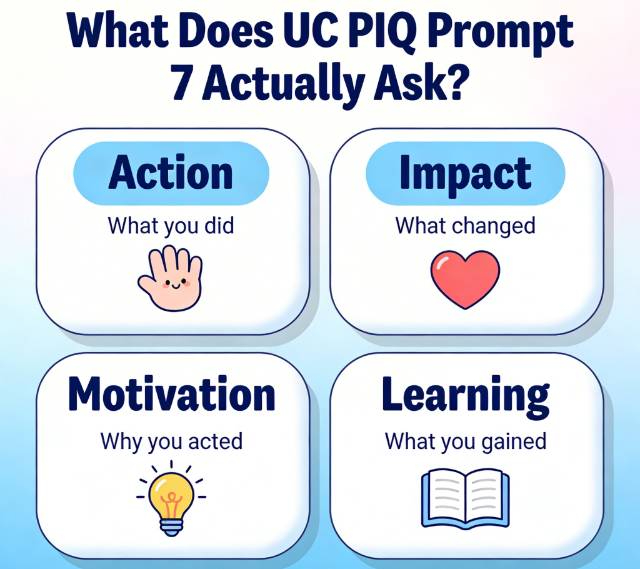
UC also gives you four sub-questions to guide your thinking: Did you contribute to positive change? What steps did you take? Why were you inspired? What did you learn?
Notice what those questions have in common: They're all about YOU. But they also map directly to essay structure. Sub-question 2: What steps did you take? is the spine of your essay and should take up the most space, roughly 80–120 words. Sub-question 4: What did you learn? is your closing. Sub-questions 1 and 3 (did you contribute to change, and why were you inspired?) are context useful to establish early, but not the point. Most weak prompt 7 essays spend too much space on inspiration and too little on the actual steps taken.
A strong UC PIQ 7 essay names a specific community, describes one concrete action with active verbs, points to a measurable outcome, and connects the experience to the writer's character, not the cause. |
"Community" is also broader than most students assume. Your school counts. So does your neighborhood, your family, a cultural group, a faith community, a club, or even an online space. If you've contributed meaningfully to it, it qualifies. You can read UC's Personal Insight Question guidelines for the official definition straight from UC.
"Your community contribution doesn't need to be world-changing it needs to be real, specific, and yours."
Should You Answer UC PIQ Prompt 7? (Topic Selection Guide)
Prompt 7 works best when you can point to a specific action you took and a visible result, even a small one. If you can clearly describe what you did, who it affected, and what changed, you've got a prompt 7 story.
It doesn't work well for things you cared about but didn't actually do. Witnessing a problem and feeling moved by it isn't an essay on its own.
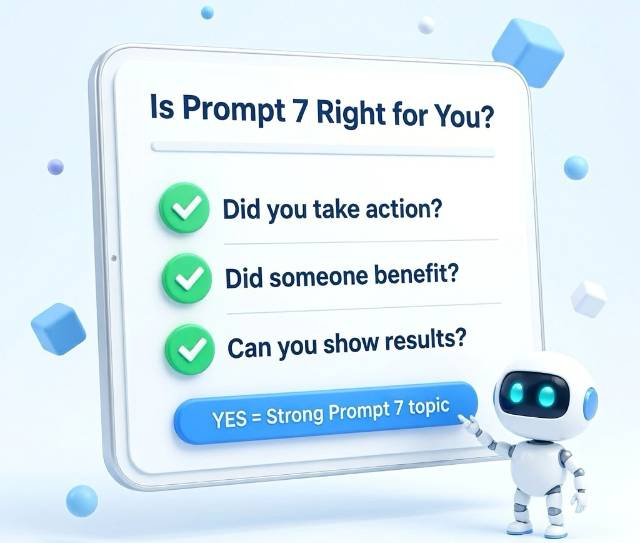
One thing that trips people up: you don't need formal volunteering. Some of the best Prompt 7 essays have nothing to do with organized service hours. Think about every type of community you belong to and what you've done within each one.
Brainstorm by community type:
- School: tutoring peers, organizing an event, changing a policy, starting a club, mediating conflict
- Neighborhood/local: community garden, food drive, supporting a small business, translating for neighbors
- Cultural/faith: mentoring younger members, organizing cultural events, bridging generational gaps
- Online/interest community: building a resource, moderating a community space, creating content that helped others
- Family: supporting a family member through illness, acting as an interpreter, stepping into a caregiving role
If your contribution is really more about leading people than serving a community, you might be writing a Prompt 1 essay in disguise.
"The best topic for prompt 7 is the one where you can clearly name what you did, who it helped, and what changed because of you."
How to Write UC PIQ Prompt 7: A Step by Step Framework
Step 1: Pick One Specific Story (Not a List)
You have 350 words. That's not enough space for two contributions, and trying to cram in multiple experiences is one of the most common ways this essay falls flat.
Pick your single strongest story. If you're torn between two, ask yourself: which one is easier for you to explain with specific details? That's usually the better choice. Depth beats breadth, and you can only get depth when you're focused on one thing.
Step 2: Define Your Community Clearly
Open with a specific moment, not a claim (40–60 words)
Name the community in the first paragraph. Don't make the admissions reader guess.
"My community" tells them nothing. "The ESL parents at my school who couldn't attend conferences because of the language barrier" tells them exactly who you're writing about and immediately signals that your essay will be specific.
The more precisely you define your community, the more concrete the rest of your essay will naturally become. |
Step 3: Show What You Actually Did: Action Over Intention (80–120 words)
This is where a lot of essays go wrong. Students write about how much they cared, how concerned they were, how much the issue meant to them but they never actually show the actions they took.
Use active verbs: organized, built, taught, created, launched, initiated, translated, fundraised, trained. Avoid passive constructions like "was selected to help," "was inspired to contribute," or "helped with the planning."
Your action is the spine of this essay. Make it visible. |
Step 4: Show the Impact: Connect Action to Outcome (40–60 words)
What changed because of what you did? It doesn't need to be large it needs to be real and specific.
"I raised awareness about the issue" reads as a red flag to admissions officers. It's what people write when they can't identify a concrete outcome. If you organized a food drive, say how many pounds were donated. If you tutored a student, say they passed their class. If you started a club, say how many members joined and what they did together.
Specifics signal that something real happened. |
Step 5: Make It About You: The Balance Problem (60–80 words)
Here's the balance problem most students don't catch until it's too late: if more than half your sentences are about the community, the cause, or other people, you've lost the thread. |
The most common mistake in this essay is spending 250 of 350 words describing the problem or the community, and only getting to the writer in the last paragraph. Admissions officers want to understand your values, your choices, and your character not just what happened around you.
"Write about your community to reveal yourself, not to document your community."
Step 6: End With a Forward Look (20–40 words)
Strong prompt 7 essays often close with a sentence or two connecting the experience to who you are now or what you'll bring to college. This doesn't need to be a dramatic statement about your future. It can be as simple as what you learned about yourself or what you'll carry forward.
Keep it brief. One or two sentences at most. Then stop.
Note: If you're a transfer applicant, Prompt 7 is on your list too; you'll choose 3 of 7 PIQs instead of 4 of 8. Everything in this guide applies equally. See the UC transfer personal insight questions guide for how the transfer selection works. |
You've got the framework. The harder part is writing a draft where the community story genuinely reveals something specific about you, not just what you did, but why it matters in 350 words. If you'd rather have a writer work through it with you, CollegeEssay.org's UC PIQ team can take it from there.
Weak Essay vs. Strong Essay: What's the Difference?
Here's an example of what most students actually submit vs. what a strong version looks like.
Weak version (fictionalized):
"I have always cared about hunger in my community. I saw that many people in my city didn't have enough food, and I wanted to do something to help. I organized a food drive at my school because I felt inspired to make a difference. Many students participated and we collected food for people in need. This experience taught me that one person can change the world if they put their mind to it. I plan to continue working on hunger-related issues in college and beyond."
What's wrong with it: It's full of general statements and no specifics. "Many students participated" and "collected food for people in need" tell the reader nothing. The essay is about the cause, not the person writing it. The closing line is a cliché that could appear in anyone's essay.
Strong version (fictionalized):
"My school's food pantry had been sitting empty since March because no one had a system for restocking it. I didn't start a club or launch an initiative I just made a spreadsheet. I tracked which local grocery stores had surplus produce on which days, built a rotation of twelve student volunteers, and within three weeks we'd restocked the pantry four times. The counselor told me it was the most consistent it had been in two years. I'm not sure what surprised me more: how easy it was to solve once someone mapped it out, or how long it had been unsolved just because no one tried."
What makes the strong version work: It opens on a specific problem. The action is concrete ("made a spreadsheet," "tracked," "built a rotation"). The impact is measurable ("restocked four times," "most consistent in two years"). And the closing lines reveal something real about the writer's personality they're observant, a little wry, and action-oriented.
"The gap between a good and great prompt 7 essay is almost always specificity."
What Are Common Mistakes on UC PIQ 7?
- Showing privilege without acknowledging it. The clearest version of this mistake: writing about travelling somewhere to "help" a community you'd never encountered before, spending a week, and leaving with a personal revelation while the people you helped stay exactly as they were. Admissions readers have seen thousands of mission-trip essays and construction-trip essays.
The problem isn't the experience, it's when the essay centres the writer's growth while the community serves as a backdrop. If your story involves contributing to a community you don't belong to, acknowledge your position explicitly: what didn't you understand going in, what were you wrong about, and what did the experience actually cost you (time, discomfort, a belief you had to let go)? That honesty is what separates a privilege essay from a self-awareness essay. - Spending more words on the community than on yourself. The prompt asks what YOU did and what it says about you. Keep the focus.
- Using the same story for both prompt 7 and prompt 1. If you write about a leadership experience that also happens to be community-focused, you're spending two of your four prompts on the same slice of who you are.
For the full list of mistakes that show up across all eight prompts, including how to fix a vague opening, a weak reflection, and a misread prompt, see the UC essay mistakes to avoid guide. |
How UC PIQ 7 Relates to UC PIQ 1 (Leadership): Knowing the Difference
These two prompts use similar raw material, leading people, driving change, and making an impact, but they frame it differently. Prompt 1 is about you as a leader: how you influenced others and what kind of leader you are. Prompt 7 is about your community: what you contributed, who it served, and what changed.
If you're writing both, make sure each one reveals a genuinely different dimension of you, not the same story retold with a different label. For the full breakdown of what Prompt 1 is looking for, see the UC PIQ Prompt 1 leadership guide. |
Self Check Before You Submit UC PIQ Prompt 7 Essay
Read your draft and answer these questions honestly:
- Can you name the specific community in one phrase?
- Is there at least one concrete action, expressed with an active verb?
- Can you point to a real, specific outcome?
- Does the essay reveal something about YOUR character, not just what happened?
- Are you under 350 words?
- Did you accidentally write a leadership essay that belongs in prompt 1?
"If your essay could be anyone's essay, it's not ready yet."
If you can't answer yes to all of them, you know where to revise. |
You now know what prompt 7 is actually asking for, how to find a story worth writing about, and how to keep the essay centred on you rather than the cause. The last step is turning that into a 350-word draft where every sentence earns its place. If you want a professional writer to write or refine your draft, tell us your prompt, your story, and your deadline, and we'll handle the rest.
Turn Ideas Into Compelling UC Essays
We help you organize and express your thoughts clearly
- Idea organization
- Clear and logical structure
- Strong transitions
- Editing for clarity