You've got UC Prompt 1 in front of you, 'describe a leadership experience,' and you're not sure whether what you have actually qualifies. Most students asking that question have never held a title, and most of them are sitting on a stronger story than they realise.
Most students who write strong responses for this prompt have never held an official role at all.
This guide covers what the prompt is actually asking for, how to pick the right experience, a paragraph by paragraph framework for writing your 350 words, and a full annotated example so you can see what good looks like.
What UC PIQ Prompt 1 Is Actually Asking For
This is one of eight prompts you'll choose from if you're still deciding which four to answer, our how to write UC personal insight questions guide walks through all of them.
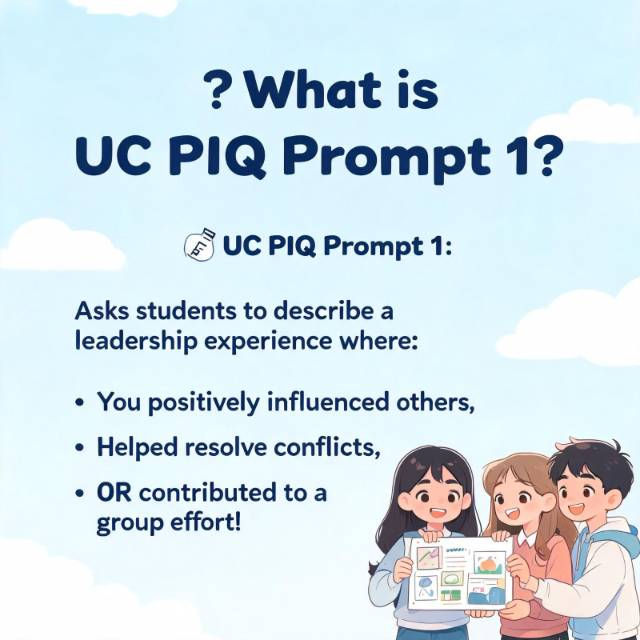
Here's the full prompt text:
"Describe an example of your leadership experience in which you have positively influenced others, helped resolve disputes or contributed to group efforts over time." |
Two phrases matter most. "Positively influenced others" means the story needs to show impact not just what you did, but how it changed something for the people around you. "Over time" is the other one. This isn't a one-time moment; UC wants to see ongoing involvement.
UC also publishes guidance underneath the prompt that makes this explicit: leadership can come from any context school, community, work, home. You don't need a title. You need a role you took on and sustained.
A note on "over time," the phrase that trips most students up.
"Over time" does not mean your story has to span months or years. It means your involvement wasn't a one-off. UC uses this language to filter out essays where a student did one thing on one afternoon and calls it leadership. What it's actually asking for is evidence of sustained commitment that you showed up more than once, that the responsibility was real and recurring, not performed. In practice, this means two things. First, a single intense event one night, one meeting, one crisis can anchor your essay, but you need to show that the role or responsibility existed before and after that event. The deli example at the end of this blog centers on one proposal meeting, but the essay makes clear the student had been observing the problem for two weeks and that the calendar system ran for three weeks afterward. The moment is specific; the arc is visible. Second, if your leadership genuinely was one concentrated moment with no arc before or after it a single conversation that changed a group's direction, for example, you can still write it as Prompt 1 if you show the impact extending beyond that moment. What happened after? Who was affected for how long? The reflection paragraph is where you make "over time" visible even when the story itself was brief. |
What UC is really testing is your decision making. Were you the person who stepped up when something needed to happen? Did you take ownership without being told to? That's the heart of it.
"UC isn't asking if you were elected, they're asking if you showed up, took ownership, and moved something forward."
If you'd rather skip the iteration loop and start from a complete first draft, you can edit instead of building from scratch, we can help you draft the PIQ essay. Tell us the leadership moment you're working with and a few details about the situation, and a writer will return a structured 350-word draft within 24 hours that you can refine, rewrite, or use as-is.
What Counts as Leadership in PIQ 1 (And What Doesn't)
Formal leadership, president, captain, chair, is a valid topic. But it comes with a real risk: it's easy to slide into résumé mode, listing activities instead of telling a story. Most strong essays come from informal leadership, where the stakes feel real, and the choices are yours.
Here's what that can look like:
- Family leadership. You took on responsibility at home managing siblings, stepping up during a crisis, holding things together when a parent couldn't. These essays often hit the hardest because the leadership was genuine and unasked for.
- Workplace leadership. You took initiative at a job without anyone handing you a title. You reorganized the schedule when the manager quit. You trained the new hire nobody else had time for.
- Peer leadership. You mediated a conflict in a friend group, mentored a struggling classmate through a hard semester, or got a group project back on track when it was falling apart.
- Community leadership. You started something, rallied people around a cause, or kept something running that would have collapsed without you.
What doesn't work: "I lead by example" with no actual story attached. Or an essay that's just a summary of club activities that are already in your extracurriculars list. The PIQ needs to go deeper than what the activity section already shows.
One important note: if your story is primarily about community service or giving back, it might belong in prompt 7 rather than here. More on that in the next section. |
Note for transfer applicants: Prompt 1 is one of the optional prompts available to transfer students, and transfer applicants often have stronger Prompt 1 material than they realise. Work-based leadership training colleagues, reorganising a team, stepping up when a manager left, counts fully here. So does family leadership: managing a household, translating for a parent, taking on responsibility that never had a title.
If you've been in the workforce or held a significant family responsibility, your leadership story is likely more concrete and more credible than a high school club president's. For the full transfer PIQ strategy, see our UC transfer personal insight questions guide.
"The strongest prompt 1 essays tend to come from moments no one else saw coming a quiet decision to step up, not a rehearsed role."
Prompt 1 vs. Prompt 7: Which One Should You Use?
This is a genuine confusion point, and most guides don't address it directly.
Both prompts involve influencing people and contributing to something beyond yourself. The difference is where the story is centered.
- Prompt 1 is about you as the driver. You initiated, organized, resolved, or moved something forward. The story centers on your decision-making and action.
- Prompt 7 is about you as a contributor to something larger. The story centers on the community itself the cause, the group, the place and your role within it.
A quick shortcut: if your story is about what you built, changed, or resolved, it's prompt 1. If your story is about belonging, giving back, and being shaped by a community, it's prompt 7. Check out our UC PIQ prompt 7 community guide if your experience leans that direction. |
One more thing: don't use the same experience for both prompts. UC reviewers read all four of your PIQs together, and overlap is noticeable.
"The question to ask: is the story about what you led, or about where you belonged and gave back? That decides the prompt."
3 Step Topic Qualification Test for UC PIQ 1
Before you write a word, run your topic through these three questions:
- Did you take initiative or ownership without being told to? If someone assigned you the role, the story needs to show what you did beyond the assignment.
- Did your action positively affect other people or a group's direction? Vague impact doesn't count. "Things got better" isn't enough. You need to be able to name specifically what changed.
- Did this happen over multiple moments, not just one afternoon? A single event can anchor the essay, but the involvement should stretch across time.
If you can answer yes to all three, you have a solid topic. If you're stretching on question 1 or 2, choose a different experience. If it's only question 3 that's weak, see if you can expand the story to show a longer arc.
"If you have to stretch to answer yes to all three, the topic probably isn't the right one."
How to Structure Your 350 Word in UC PIQ 1
This is where most essays go wrong. Students front-load the situation and run out of space for the reflection. Flip that instinct. Here's a framework that works naturally at 350 words.
- Paragraph 1 (60–70 words): Set the scene. Name the situation in one or two sentences. What was the problem, tension, or opportunity? Don't over-explain it. You're not writing a news article you're giving the reader just enough context to understand what you were walking into.
- Paragraph 2 (80–90 words): What YOU specifically did. This is the action paragraph. Use active verbs. Show your choices not just what you did, but why you did it. What did you decide? What did you push for? Don't list tasks. Show decision-making.
- Paragraph 3 (80–90 words): What changed as a result. How did others respond? What shifted in the group or situation? Be specific. Not "things improved" but how they improved, for whom, and what that looked like. This is where your impact becomes real.
- Paragraph 4 (80–90 words): What you learned and where it takes you. This is the reflection paragraph. Don't write "I learned that leadership is important." Write something genuine about yourself your values, your approach, how this changed what you'd do differently or what you know about yourself now. End with a connection to who you'd be on a UC campus.
|
Note: 4 paragraphs is the natural structure for 350 words. Five paragraphs gets tight. And prose almost always beats bullet points for this prompt you need to show voice, not just information.
If you're finding 350 words genuinely tight cutting substance to hit the limit, see our 350 word UC essay guide for a full breakdown of what to cut first without losing what matters. |
"Most essays front-load the situation and run out of space for the reflection flip that. The reflection is what the reader remembers."
Common PIQ Prompt 1 Mistakes to Avoid
- Writing about a title, not a moment. Opening with "As president of…" signals that you're about to describe the role, not the leadership. Start with the moment instead.
- Repeating your activities list. Your PIQ must reveal something that a bullet point can't. If your essay reads like a description of the club, rewrite it.
- Vague impact. "I made the team better" tells a reader nothing. Name the specific change.
- Generic reflection. "I learned that leadership takes courage" is forgettable. What did you learn about yourself specifically?
- Using prompts 1 and 7 for similar experiences. UC reviewers read all four responses. Overlap weakens both essays.
- Writing about a one-time event. The prompt says "over time." A single moment can anchor your essay, but the story needs to show an arc.
- Starting with "I have always been a natural leader." Just don't.
"If your opening sentence could be on anyone's essay, rewrite it."
You've seen the prompt parsed, the topic test, the 350-word structure, the common mistakes, and a worked example of what strong looks like. The work left is the work that decides whether your Prompt 1 lands or blends in, translating your specific leadership moment into 350 words that sound like a person, not a template. If you'd rather come at it with a complete first draft to react to, professional UC leadership essay writing from CollegeEssay.org's UC PIQ team turns your inputs into a structured draft within 24 hours, written for your specific moment, in your voice, ready for you to refine.
UC PIQ Prompt 1 Example + Annotation
Annotation:
[Modeled Example Not a real student essay]
The break room at Nico's Deli had a whiteboard with a two-week-old schedule that nobody trusted. Shifts got swapped in group chats, disputes ended in no-shows, and on three separate Sundays I showed up to find someone hadn't come in at all. I wasn't the manager. I was a part-time sandwich maker who'd been there eight months.
I started keeping a running log of who actually worked which shifts versus what was on the board. After two weeks, I had enough data to show my manager that the problem wasn't people it was the system. I proposed a shared Google Calendar with edit permissions for the full team, built a color-coded version as proof of concept, and walked him through it on a Tuesday afternoon. He said he'd been meaning to fix it for months.
Within three weeks, the Sunday no-shows stopped. Swap requests moved out of the group chat and into the calendar, where everyone could see conflicts before they happened. Three coworkers told me directly that they felt less anxious about their hours. My manager started calling me his "logistics person," which wasn't a real title, but felt like one.
What I learned is that I'm most useful in situations where I can see a problem clearly before others do. Not because I'm smarter but because I pay attention differently. I want to bring that same instinct to a UC campus, whether it's in a research lab that needs better systems or a club that's been running on chaos.
What made the opening work: No title-dropping, no résumé language. The reader is dropped into a specific, concrete situation a messy whiteboard and a pattern of no-shows. That's specific enough to be real.
Where the action is clear: Paragraph 2 is all verbs: kept, showed, proposed, built, walked. The decision-making is visible. You can see the student's choices, not just their tasks.
Why the reflection lands: The final paragraph doesn't say "I learned leadership is important." It says something specific about how this student thinks that they notice things before others do. It connects to values and ends with a forward-looking statement about college. That's what the reader remembers.
This page gives you one modelled example per leadership type. For two additional annotated Prompt 1 examples plus examples across all eight prompts, see our UC personal insight question examples guide. |
By now, you know what UC PIQ Prompt 1 is actually testing, how to distinguish it from Prompt 7, how to qualify a topic, how to structure your 350 words, and what a strong response looks like on the page. The work that remains is the writing itself, and for a prompt that asks for a moment of leadership, that work is the hardest part of the whole essay. Send our CollegeEssay.org UC essay team the leadership moment you're considering and the situation around it, and you'll get a complete, structured draft back within 24 hours, written in your voice, ready to refine or submit.