What Makes a Financial Need Scholarship Essay Sound Desperate (And How to Avoid It)
Most students who write a desperate-sounding financial need or financial hardship scholarship essay aren't exaggerating their situation. They're just framing it wrong. Understanding the two failure modes below helps you avoid both of them. For the full picture on every type of scholarship prompt, the scholarship essay writing guide breaks down the entire application strategy from format to submission.
Failure Mode 1: Too Vague
Sentences like "my family has always struggled financially" or "money has been tight my whole life" tell the committee almost nothing. Vagueness reads as either unprepared or emotionally manipulative. Neither is the impression you want.
Failure Mode 2: Too Dramatic
Graphic detail about hardship, every difficult thing that's happened, every financial blow your family has taken, with no bridge to your goals, reads as suffering without direction. It makes the reader feel helpless, not compelled.
The core principle that cuts through both: committees are asking, will this money matter? Your job is to answer that question with facts and purpose.
The "Facts + Future" Framework: A Step-by-Step Structure of a Financial Need Scholarship Essay
A financial need essay isn't a sad story. It's a funding case. Your job is to show that this money has a clear destination. You can use this three-part structure for any word count the prompt gives you.
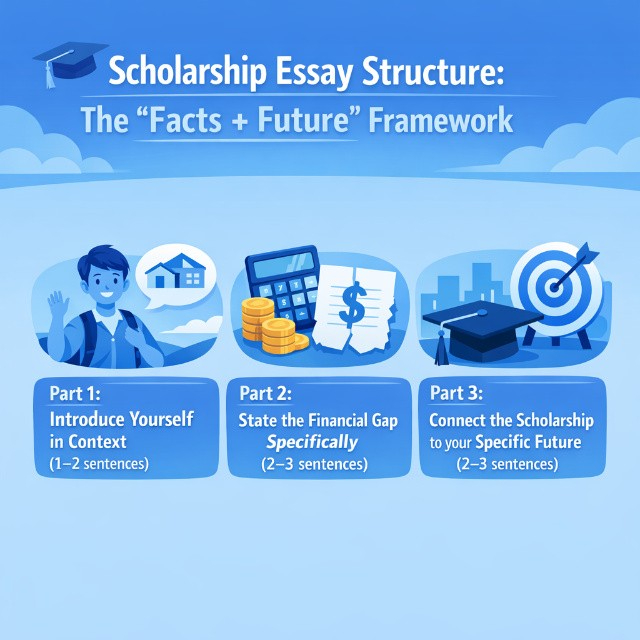
Part 1: Introduce Yourself in Context (1–2 sentences)
Open with who you are and one key circumstance that frames your need. You're not writing your full biography here. You're giving the reader the lens through which to understand everything else. Something like: I'm a first-generation college student raised in a single-parent household, and I've been working 20 hours a week since I was 16 to help contribute to our household income.
Part 2: State the Financial Gap Specifically (2–3 sentences)
This is the heart of the essay. What does your education cost? What do you currently have, and what's the gap? Specific numbers, a dollar figure, a grant amount, weekly work hours, make this section credible without being melodramatic. You're not proving you're poor. You're showing the committee exactly where their money would land.
An example: My annual cost of attendance is $18,500. Between my Pell Grant, work-study earnings, and part-time job, I've covered $10,500, leaving an $8,000 gap I'm currently planning to fill entirely with loans.
That's specific. That's honest. And it tells the committee precisely what they need to know.
Part 3: Connect the Scholarship to your Specific Future (2–3 sentences)
Don't end with this scholarship would help me afford college. That's true for everyone applying. End with what changes if you get this money: This award would allow me to reduce my work hours from 25 to 10 per week, so I can carry a full course load in my pre-med program and keep my GPA competitive for medical school.
That sentence makes the scholarship feel like an investment with a clear return. Specificity is your best tool: a precise financial gap and a concrete goal are more persuasive than any amount of emotional detail.
A Note on Prompt Wording
The prompt wording varies, but the framework doesn't. Whether you're asked to describe your financial need, explain your background, or tell us why you deserve this award, the same three parts apply: context, specific gap, and concrete future. A merit-leaning prompt leads with Part 3 and weaves the gap into Part 2. A background prompt leads with Part 1 and gives Part 2 more room. The logic is the same either way.
Financial Need Essay vs. Statement of Financial Need
Some scholarship applications ask for a statement of financial need rather than a full essay. This is typically a shorter format (100-200 words or a few bullet points) that leads directly with numbers and omits the narrative arc. If your application specifies statement, prioritize Part 2 and Part 3 of the framework above, and keep Part 1 to a single line. The Facts + Future logic still applies; the word count is just compressed.
How Specific Should Your Financial Need Scholarship Essay Be?
A lot of students wonder: do I need to share exact income figures? Tax documents? Monthly bills?
The short answer is no. The scholarship committee already has access to your FAFSA and financial aid verification documents; those cover the hard numbers. What they need from your essay is context: how does the financial reality you're living in affect your ability to pursue your education? Once you know what to include here, the scholarship essay format guide covers the submission requirements for the finished document: margins, spacing, word count conventions, and header format.
Focus on three things:
- What your education costs (annual cost of attendance or tuition is enough)
- What you currently have (grants, work-study, part-time income, family contribution)
- What the gap is (the specific number you're trying to fill)
Here's the line between useful specificity and over-sharing:
Useful | Over-sharing |
I face an $8,000 annual gap after Pell and work-study | A line-item breakdown of every bill and debt in the household |
I work 20 hours per week to cover living expenses | Monthly bank statements or exact family income figures |
My family of four lives on a single income below the federal poverty line | Medical bills, debt balances, legal or housing situations |
Don't prove your need. Contextualize it. The committee has the numbers; they need the story behind the gap.
Before and After: The Same Story, Two Approaches for a Financial Need Scholarship Essay
Here are two essays written for the same fictional student: Maya Chen, a first-generation college student whose father lost his income after a medical diagnosis last year. Same circumstances. Very different results.
Version A: What to Avoid
Growing up, my family always had a hard time with money. My dad got sick last year, and everything got worse. We've been struggling every single day just to keep up with basic expenses. I've had to work constantly, and I'm exhausted. I barely have time to study because I'm always at work. I don't know how I'm going to pay for college without help. My dream is to become a nurse, but I feel like the system makes it impossible for people like me to get ahead. I just need someone to believe in me and give me a chance to show what I can do. This scholarship would mean everything to me.
What went wrong: The essay is entirely focused on suffering with no specifics and no forward momentum. "Everything," "constantly," and "impossible" are emotional superlatives that make the writing feel reactive rather than purposeful. There's no financial detail, no concrete goal, and no clear answer to "will this money matter?" The committee is left feeling sad, but not compelled. |
Version B: What Works
I'm a first-generation college student studying pre-nursing at Riverside Community College. Last year, my father was diagnosed with a chronic illness that ended his ability to work full-time, which shifted significant financial responsibility onto my family. I currently work 22 hours per week at a local grocery store alongside a $4,500 Pell Grant, but I still face an annual gap of roughly $7,200 to cover tuition, fees, and textbooks.
Reducing that gap by even half would allow me to cut my work hours and carry a full-time course load this spring, which is a requirement for the nursing program's clinical track I'm hoping to enter next fall. I've maintained a 3.6 GPA while managing this schedule. With this scholarship, I'd have the bandwidth to keep it there and finish the prerequisites that put me on track to transfer to a four-year program in 2027.
What changed: same student. Same hardship. But Version B answers the committee's core question immediately: here's the gap, here's what I've done despite it, and here's exactly where your money goes. The goal is concrete and time-specific. The tone is confident without minimizing the real challenge. |
The goal isn't to minimize your hardship. It's to show that your hardship hasn't defined your direction.
For guidance on opening lines specifically, the how to start a scholarship essay guide covers hook strategies for every prompt type.
You've got the framework and three complete examples to work from. The part most students still find hard is translating their own specific circumstances, the actual numbers, the right tone, the balance between hardship and direction, into a draft that holds together. If that's where you're stuck, our financial need essay service delivers a complete, prompt-specific scholarship essay reviewed by a human writer who knows exactly how committees read these.
Financial Need Scholarship Essay Examples
The three sample essays below each use the Facts + Future framework. They vary in word count and student circumstance, but the structure is the same: context, specific gap, concrete future.
100-Word Example: Describe Your Financial Need Briefly
My name is Daniel Reyes, and I'm a sophomore studying computer science at Fresno City College. My mother works as a home health aide, our household's only income since my father passed away in 2022. After my Federal Pell Grant award and part-time cashier wages, I still face a $3,200 annual funding gap for tuition and course materials. This scholarship would close that gap and allow me to stop deferring the lab-based courses my degree requires. My goal is to complete my associate's degree by May 2027 and transfer into a software engineering program.
What makes it work: in under 100 words, Daniel gives the committee his context (single-income household, loss of a parent), the specific gap ($3,200), what blocking that gap costs him (deferred coursework), and where he's headed. No filler. No emotion for its own sake. |
For more examples of this length, the 100 word scholarship essay examples page has additional annotated samples.
250-Word Example: Explain Your Financial Need
I'm a first-generation college student from a Vietnamese immigrant family, and I'm currently completing my sophomore year in business administration at Sacramento State. My parents run a small alterations shop, and while they've always prioritized my education, their combined income sits below $38,000 annually, a figure that places us above the threshold for maximum Pell eligibility but far below what's needed to contribute meaningfully to my cost of attendance.
My annual cost of attendance is $22,100. Between my partial Pell Grant ($3,500), a campus work-study position (roughly $4,800 annually), and a weekend job at a local restaurant ($5,200), I cover about $13,500. That leaves an $8,600 gap I currently manage with subsidized loans, a burden I'm trying to reduce before my junior year, when I plan to take on an unpaid internship as part of my program's professional track.
This scholarship would allow me to accept that internship without taking on additional debt to compensate for lost work income. The internship connects directly to a supply chain analyst position I've been targeting since my freshman year. I've maintained a 3.8 GPA while managing my current schedule. This funding doesn't just help me stay enrolled. It gives me the runway to pursue the exact experience my career goal requires.
What makes it work: the essay explains why the student falls into a funding gap that isn't obvious (above max Pell, below comfortable contribution). The future section is specific to a career goal and a concrete program requirement, not just finish college. |
For more at this length, the 250 word scholarship essay examples page includes additional annotated samples with format notes.
You've got the framework, the before-and-after, and two of the three examples. The part most students still find hard is translating their own specific circumstances, the actual numbers, the right tone, the balance between hardship and direction, into a draft that holds together as a funding case. If that's where you're stuck, CollegeEssay.org's scholarship writers deliver a complete, prompt-specific scholarship essay reviewed by a human writer who knows exactly how committees read these.
500-Word Example: Describe Your Background and Financial Need
I've been working since I was fifteen. Not because I wanted to build my resume early, but because my family needed the help. My mother raised my younger sister and me on her own after my parents separated, working as a medical receptionist for most of my childhood. We weren't in crisis most of the time, but we were always careful. Careful with spending, careful with plans, careful about what we allow ourselves to hope for.
College was always the goal, but paying for it was never clear. When I enrolled at Merced College to study elementary education, I did it knowing I'd be working the whole way through. And I have. I currently work 25 hours per week at a daycare center while carrying a full course load, which is both fitting and exhausting, given that I want to spend my career in a classroom.
The numbers: my annual cost of attendance is $16,800. My Pell Grant covers $6,895. My work earnings cover roughly $6,500 after taxes. That leaves a gap of approximately $3,400 per year that I've been filling with a subsidized loan. I'm on track to graduate with around $10,000 in debt. It's manageable, but I'm applying for every opportunity to reduce it, because teacher salaries in California's Central Valley don't leave a lot of room for loan repayment pressure in the early years.
What I want the committee to understand is this: I'm not struggling in a way that's slowing me down academically. I have a 3.7 GPA. I've completed 52 units. I'm on the honors list. I tell you this not to deflect from my financial situation, but because it's part of the same story. I've learned to do a lot with limited resources, and I plan to keep doing that. What I can't do indefinitely is sustain this pace without some relief.
This scholarship would let me reduce my work hours from 25 to 15 per week during my final year. That's not a small thing. Fifteen hours frees up approximately ten additional hours each week for student teaching preparation, lesson planning practice, and the education capstone project my program requires in the spring. I've already secured my student teaching placement. I know what the next twelve months need to look like. I just need the financial breathing room to execute it.
I'll be a teacher. That's not a dream I'm still deciding on. It's a plan. This scholarship helps me get there with less debt and more capacity to finish strong.
What makes it work: the essay earns its 500 words. The longer format allows for genuine narrative voice without veering into desperation. The student's achievements are woven into the financial context, not separated from it. The future section is precise: a specific change in hours, a specific project, a specific placement. The closing sentence is confident, not pleading. |
For examples at this length with format guidance, the 500 word scholarship essay examples page covers structure and submission tips.
Common Mistakes That Undermine Your Financial Need Scholarship Essay
Even students who understand the Facts + Future framework can still stumble on execution. Watch for these:
- Focusing only on hardship, not on what you'll do with the opportunity. If you've finished writing and your goals are in one sentence at the end, the structural balance is off. The past and future halves of your essay should carry equal weight. Redistribute.
- Comparing your situation to others. Sentences like other people in my school have so much more than I do, or most of my classmates don't have to work, put the committee in an awkward position and make you sound resentful rather than resilient.
- Being vague about the actual financial situation. My family doesn't have a lot of money is not a financial need statement. Give the committee the gap, the context, and the numbers.
- Apologizing for your need. You don't owe the committee an apology for applying. Phrases like I'm sorry to burden you with my situation or I know there are others who need this more actively undermine your application.
- Writing a sad story instead of a funding case. If the emotion in your essay is coming from the framing and not the facts, rewrite it. Show your real situation clearly; let the weight of it land on its own.
- Forgetting to say what the money specifically enables. This scholarship would be a blessing is not an answer to will this money matter? Tell them what changes, specifically.
These overlap with broader patterns covered in the scholarship essay mistakes to avoid guide, worth reviewing before you submit. The committee isn't here to judge your circumstances. They're here to find the student whose future this money can accelerate.
Conclusion
You now have the framework, the failure modes, and three complete examples built on real student circumstances. What most applicants still find difficult is sitting down with their own numbers and their own story and making it read as an argument instead of a plea. Tell us your prompt, your word count, and your circumstances, and our scholarship essay writing support team will deliver a complete draft written for your specific situation, not a template, within 24 hours.