You did the volunteering. Now you have to explain why it mattered to a committee that will read hundreds of these essays, most of which sound exactly alike. The difference between the essays that win money and the ones that don't usually comes down to one thing: specificity. This page gives you the four-part structure that works at any word count, the mistakes that kill most applications, and two full annotated examples (250 words and 500 words) so you can see what the winning version actually looks like before you write yours.
> > >
Community Service Scholarship Essay: How to Write One That Wins
Community Service Scholarship Essay: How to Write One That Wins
What Committees Look for in a Community Service Scholarship Essay
Most students write their community service essay for the wrong audience. They write it like a college admissions essay, focused on personal growth and character. Scholarship reviewers are doing a different job. They're deciding where to allocate limited money, and they're thinking about return on investment.
The difference shows up in what the essay needs to prove.
A college admissions essay says: This experience shaped me. |
A scholarship essay needs to say: This experience shapes what I'll do with your funding. That forward-facing obligation changes how you frame everything. |
Scholarship committees score community service essays on three things:
Authenticity of Commitment
Depth beats hours. One program over two years looks more committed than a long list of one-time events. Committees can tell when service was resume-building, and it reads as hollow.
Evidence of Impact on Others
Specific, not vague. "I helped many families," tells a committee nothing. "The program went from 12 participants to 34 in one semester," tells them something real. The more concrete the outcome, the more credible the commitment.
Connection to Where You're Heading
Committees are funding your future. They need to see that this experience connects to what you're building toward, whether that's a career, a field of study, or continued service in college.
Expert Tip
One of the most common mistakes is writing this essay like a timesheet: "I volunteered 150 hours at the local food bank, where I sorted donations and assisted with distribution." That sentence tells a committee what you did. It doesn't tell them why it mattered.
For the full picture of how scholarship essays work across every prompt type, the scholarship essay writing guide covers the complete process from start to submission.
Choose the Right Experience to Write About in Your Community Service Scholarship Essay
If you've volunteered in multiple places, you might want to cover all of them. Don't. The strongest essays pick one experience and go deep.
Depth beats breadth every time. A committee reading 300 applications will remember the student who made a specific, meaningful impact in one place far more than the one who listed five organizations.
The right experience has three things:
- A clear role you played (not just "I helped")
- A visible impact on others
- A moment where something challenged you or changed your perspective
If your experience was entirely smooth, your essay might read as flat. The moments where something was harder than expected, or where you learned something you didn't anticipate, are usually where the best essays live.
Expert Tip
If you genuinely can't choose between two experiences, ask yourself: in which one did something unexpected happen? Which one pushed you somewhere uncomfortable? That's usually the right one to write about.
How to Structure a Community Service Scholarship Essay
Strong community service scholarship essays, at any word count, follow the same basic arc. Here's the four-part structure that works whether you have 250 words or 500.
One thing students get wrong with word count: using all of it isn't the goal. If your prompt says "up to 500 words," a sharp 350-word essay beats a padded 500-word one. The structure below scales: a 250-word essay compresses Parts 2 and 3 into tight, specific sentences; a 500-word essay expands them with more context and detail. The four parts stay the same; the depth adjusts.
Part 1: The Hook (First 1-2 Sentences)
Drop your reader into a specific scene. Not background. Not context. A moment.
Weak opening: "I have volunteered at a food bank for two years, and it has been a rewarding experience." |
Strong opening: "The man looked down at his shoes while I counted out the items he was allowed to take. I handed him an extra bag of rice and said it was a mistake in the inventory." |
The strong version puts the reader in a moment. They want to know what happens next. That's where you need them.
For a deeper look at opening lines, the guide on how to start a scholarship essay covers opening strategies across prompt types.
Part 2: The Work (What You Did and Why)
Describe your specific role, not the organization's mission. Committees don't need you to explain what a food bank does. They need to know what you did there.
Quantify where it adds meaning. Numbers work when they're attached to real outcomes.
Weak: "I helped many people at the food bank each week." |
Strong: "I helped distribute meals to 60 families every Saturday for eight months and trained four new volunteers on the intake process." |
The difference isn't just specificity. The strong version shows a role, not just presence.
Still not sure how to frame your specific experience? Tell our scholarship essay team at CollegeEssay.org what you did, who you helped, and what changed because of it, and we'll build the essay around the details that committees actually respond to, or write the full draft for you.
Part 3: The Impact (On Others, Then on You)
Lead with the impact on the people or community you served, then follow with how it shifted you. Most students do this in reverse and start with how they grew, which can read as self-centered. The order matters.
Weak: "I felt fulfilled knowing I had helped the community." |
Strong: "By the end of the semester, the pantry's monthly guest count had grown by 22%, and Donna asked me to take over training new volunteers." |
The first sentence is about your feelings. The second is about what changed in the world around you, which is what committees are actually funding.
Part 4: The Forward Look (Where This Leads)
Keep this short: one to two sentences connecting this experience to your future plans. Committees are funding your future; they need a reason to believe this experience points somewhere specific.
Common Community Service Scholarship Essay Cues (and How to Approach Each)
Most applications use a handful of standard scholarship essay prompts for this essay type. Here's what each one is really asking.
- Describe a meaningful volunteer experience and what you learned. Choose one experience and don't just describe what you did. Show the moment it meant something.
- How has your community service shaped who you are today? This is a before-and-after prompt. Keep the "before" brief and let the transformation carry the weight.
- What have you done to make your school or community a better place? The keyword is "better." You need to show a visible or measurable change, not just participation.
- Describe your outstanding achievement, including planning, leadership, and steps taken. This prompt blends community service with a leadership lens. The leadership scholarship essay guide covers this angle in detail.
- How do you plan to continue serving your community in college? Anchor your answer in what you've already done, then connect it directly to what comes next. If your application also asks you to address financial need separately, the financial need scholarship essay guide shows how to frame hardship without it overshadowing your impact story.
What to Avoid in a Community Service Scholarship Essay
Scholarship committees read hundreds of these essays per application cycle, and certain mistakes show up so often they've become automatic red flags.
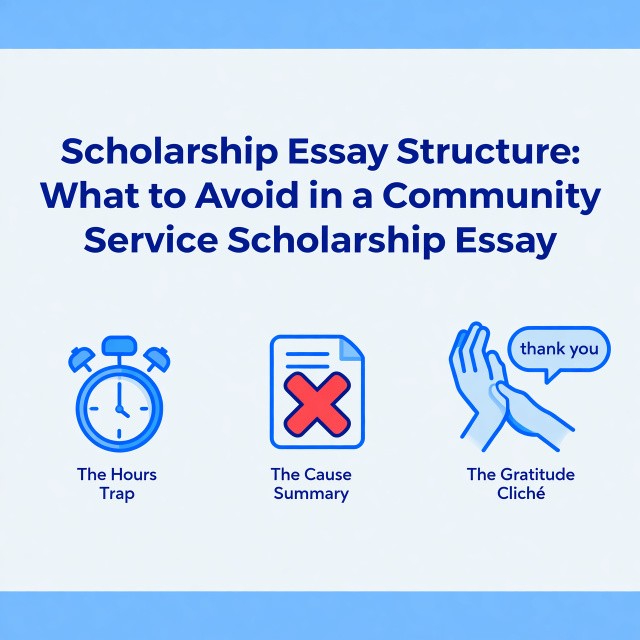
The Hours Trap
Opening with how many hours you volunteered signals that you're thinking about this as a quantitative achievement. Committees want a story, not a timesheet.
The Cause Summary
Describing what the organization does instead of what you did is a common filler. If you find yourself writing "The Red Cross is dedicated to..." cut it and replace it with something you personally witnessed or changed.
The Gratitude Cliché
"Community service taught me to be grateful for what I have" is one of the most overused lines in scholarship essay writing. Every committee has read it hundreds of times. If that's genuinely what you learned, dig until you find the specific moment that taught it to you. Then write that moment, not the conclusion.
Weak: "This experience taught me to be grateful and to appreciate what I have." |
Strong: "The week a regular guest didn't come in, I found out she'd been hospitalized. I'd never considered that our Tuesday distribution was the only reliable thing in someone's week." |
Covering Too Many Experiences
Five volunteer activities with two sentences each doesn't give any of them room to breathe. Pick one and give it the full essay.
Forgetting the Forward Look
An essay that ends with "it was an amazing experience" leaves committees with no reason to believe their funding leads anywhere. Always close with where this experience points.
For a complete checklist of errors that sink scholarship applications, the scholarship essay mistakes guide covers every category.
You've got the structure, and you know what to avoid. The part most students find hardest is sitting down and applying it to their own experience without the details going flat on the page. If you want a writer who works on community service scholarship essays every week to take it from here, you can get your community service scholarship essay written by sending us your experience, your target scholarship, and your deadline. Most students have a draft back within 24 hours.
Community Service Scholarship Essay Models
These two examples show the four-part structure in action at different word counts. Each is written for a fictional student, but the techniques (specific scene, measurable impact, forward connection) are the same ones committees respond to.
For the formatting rules that govern how your essay is submitted (fonts, spacing, margins), the scholarship essay format guide covers submission requirements before you finalize your draft.
250-Word Community Service Scholarship Essay Example
The first time I helped run the distribution at the Eastside Community Pantry, I handed a bag to a man who looked at me and asked, "This is for me?" It was his first visit after losing his job, and he'd spent 20 minutes in the parking lot before coming in.
I've been a shift coordinator at the pantry for 18 months. My role covers intake logistics and volunteer training: I manage the line, track inventory, and work with new volunteers on how to talk with guests rather than at them. After I helped redesign the intake process, our average wait time dropped from 25 minutes to 9, and repeat visits from first-time guests rose by 40% over six months.
What I didn't expect was how much the work would shift my thinking about public health. I watched people choose between food and medication week after week. I started reading about food insecurity policy on my own. Now I'm applying to study public health at a university where I've already reached out to a professor running food access research.
The pantry taught me that logistics and empathy aren't separate skills. I want to spend my career at exactly that intersection.
This essay opens in a specific moment, identifies a concrete outcome rather than just "helped people," and closes with a direct connection to the student's intended field, giving the committee a clear picture of where their investment leads. |
For more examples of this length, the 250 word scholarship essay examples guide includes additional annotated samples.
500-Word Community Service Scholarship Essay Example
I learned what the word "stigma" really means in a parking lot.
It was a Tuesday morning at the Eastside Community Pantry. I was training a new volunteer on the intake process when I noticed a woman sitting in her car across the lot. She'd been there for 35 minutes. Our coordinator, Donna (a retired social worker), walked over and knocked on the window. A minute later, the woman came inside and cried quietly while we helped her with her first order.
That moment is why I spent the next two years redesigning how the pantry talks to first-time guests.
I became a shift coordinator in my junior year. At the time, about 30% of first-time visitors didn't return for a second visit. Donna suspected it was the intake process: a long line, a clipboard with too many questions, and well-meaning volunteers who sometimes made guests feel processed rather than helped.
I spent two months shadowing the line and taking notes. I cut the intake form down to only the questions actually needed for operations. I worked with our volunteer trainer on a 20-minute onboarding focused entirely on conversation tone and body language. We piloted a warmer greeting script at the door.
Within six months, return visits from first-time guests rose from 70% to 91%. Wait time dropped to under 10 minutes. Monthly guest count grew by 22%.
What I didn't expect was how personal the work would become. I grew up watching my grandmother use community resources after my grandfather died, quietly and a little ashamed. I didn't fully understand that shame until I sat in the intake line for two years and watched it move through other people. The woman in the parking lot wasn't afraid of the food. She was afraid of what needing it said about her.
That shifted how I think about social services entirely. I started reading about healthcare access and food security policy on my own. I connected with a professor at the university I'm applying to who runs food access research. I want to study public health because I believe most access problems aren't about logistics. They're about whether a system makes people feel seen or diminished.
The pantry gave me more than a volunteer record. It gave me a question I want to spend my career answering.
The longer format gives this essay room to develop the impact section in depth: the specific data, the process change, the turning point, before moving into the forward look. The structure is the same as the 250-word version; the depth increases. |
For more examples of this length, the 500 word scholarship essay examples guide includes additional annotated samples.
You now have the structure, the mistakes to avoid, and two full examples to work from. The gap most students hit next is translating what they actually lived through into prose that earns a committee's attention: the difference between "I volunteered at a food bank," and an essay a reviewer remembers. Our community service scholarship essay writers handle that translation every day. Tell us your experience, your word count, and your scholarship deadline, and we'll send you a draft you can actually submit.
Frequently Asked Questions
How long should a community service scholarship essay be?
Follow the prompt's word limit exactly. If it says up to 500 words, aim for 350 to 500. If it says 250 words, don't pad to 260. When no limit is given, 300 to 500 words is the standard range for this essay type.
Can I write about multiple community service experiences in one scholarship essay?
Technically, yes, but you almost certainly shouldn't. One experience written with real depth and specific detail will outperform a survey of three experiences every time. If you have a genuinely compelling reason to reference a second experience, keep the reference to one sentence and keep the focus on your primary story.
What makes a community service scholarship essay different from a college admissions essay on the same topic?
A college admissions essay is about who you are now. A community service scholarship essay is about where you're going and why the committee's money will matter when you get there. The service experience is the evidence; the forward-looking claim is the argument.
How do I show the impact I have had in my community service scholarship essay without sounding like I'm bragging?
Lead with the impact on others before the impact on you. The program grew from 12 participants to 34 is a fact. I made the program grow is a brag. Let the numbers and the other people's outcomes carry the weight. Your role becomes clear without needing to be stated directly.
How do I write a community service scholarship essay if my experience wasn't with a formal organization?
Informal service counts: tutoring a neighbor's kid, organizing a neighborhood cleanup, helping an elderly relative manage daily tasks. The structure is identical. Name your role, describe what changed for the people you helped, and connect it to where you're heading. The absence of an org name doesn't weaken the essay; the absence of specific detail does.
Alexander W. Verified
Author
Alexander W. is a seasoned academic writer with deep expertise in essay structuring and in-depth research. With years of experience helping students navigate the competitive world of scholarship applications, he specializes in breaking down complex prompts into clear, compelling narratives that resonate with award committees. Alexander's writing philosophy centers on specificity and authenticity; he believes the strongest scholarship essays are built on real moments, honest voices, and a clear vision of where the student is headed. His work across the Scholarship Essay cluster at CollegeEssay.org covers everything from financial need and career goals to formatting standards and prompt-specific strategy, giving students both the examples and the framework they need to write with confidence.
Specializes in:
Academic Research
Scholarship Essay Writing
College Application Writing
Essay Formatting & Style
Read All Articles by Alexander W.
Keep Reading
Was This Blog Helpful?
On this Page