You have the prompt: Tell us about yourself. And a blank document. This page gives you three strategic angles to choose from, three full examples at 100, 250, and 500 words, and a checklist of what to include and what to cut. Pick your angle first. The framework below makes the decision straightforward, and everything else follows from that.
> > >
Tell Us About Yourself Scholarship Essay (Examples + Framework)
Tell Us About Yourself Scholarship Essay (Examples + Framework)
Why the Tell Us About Yourself Prompt Is Harder Than It Looks
Most scholarship essay prompts give you a constraint to work with. Describe a challenge you've overcome. Explain your career goals. Those prompts point you in a direction. The tell us about yourself prompt gives you nothing to push against.
That freedom is actually a trap. Without a constraint, most students default to listing facts: name, major, GPA, extracurriculars, vague goals. That's not an essay. It's a resume summary, and committees read hundreds of them. A generic essay isn't a long shot. It's a no-shot.
The real task is to show the committee a coherent, memorable picture of who you are through a focused narrative. You're not summarizing your life. You're giving them one clear image of you that sticks. The students who answer this prompt well have already made one decision before they start writing. They've figured out what lens to use. That's what the next section covers.
If you're working through the broader scholarship essay process from start to finish, our scholarship essay writing guide covers formatting, structure, and how to handle every common prompt type.
How to Choose Your Angle in Tell Us About Yourself Scholarship Essay
There are three strategic angles that work well for this prompt. Pick the one that matches your strongest material.
Angle 1: Goal-Driven
Best for students with a clear career direction. You structure your essay around where you're going and what's driving you there. This works when your goals are specific: not "I want to help people," but "I want to work in environmental litigation after seeing what the 2022 floods did to my city." The committee gets a clear sense of purpose and trajectory. If your prompt is specifically about your professional ambitions, see our dedicated guide on career goals scholarship essays.
Angle 2: Experience-Driven
Best for students with a defining experience that shaped them. A personal challenge, a community role, a project that changed how you see things. You structure around what happened, how it changed you, and where it's taken you. This angle works especially well at 250 words and above, because you need room for a before-and-after arc. Students writing for community-focused awards may also find our community service scholarship essay guide useful alongside this one.
Angle 3: Identity-Driven
Best for students with a strong sense of who they are: a cultural background, an unusual path, a belief that informs everything they do. You structure around what makes you, you. This angle can feel risky because it's personal, but when it lands, it's the most memorable of the three. Students writing from a first-generation background often find this angle the strongest fit; see our first-generation scholarship essay guide for examples specific to that identity.
How do you pick? Ask yourself: what does this scholarship committee care about? A STEM scholarship committee wants to see intellectual purpose, and if that's your context, our STEM scholarship essay guide covers that angle specifically. A community-service scholarship wants to see impact. A departmental award wants to see fit with the field. Match your strongest angle to their mission, and you're already ahead of most applicants.
One more rule: pick ONE angle and go deep. Students who try to cover all three in 250 to 500 words end up writing a forgettable list. The committee wants to know you, not a summary of you.
What to Include in a Tell Us About Yourself Scholarship Essay
Once you've picked your angle, here's what to build your essay around:
- Your current educational path and why you chose it. Not just your major. Why that major? What pulled you to it?
- Specific short- and long-term goals. "I want to work in environmental policy, developing water rights legislation in the Southwest" beats "I want to help people" every time.
- One defining experience or quality that connects your past to your goals. Not a resume item. The thing that made you who you are right now.
- A tie to the scholarship's mission. Don't force it, but if the scholarship funds first-generation students and you are one, say so.
- Something specific that makes you stand out. Something the committee won't read in anyone else's essay.
Not sure which angle fits your situation? Tell us your background, your goals, and what the scholarship is for, and our scholarship essay writers can draft this essay for you, starting from the angle that gives you the best shot.
What to Leave Out in a Tell Us About Yourself Scholarship Essay
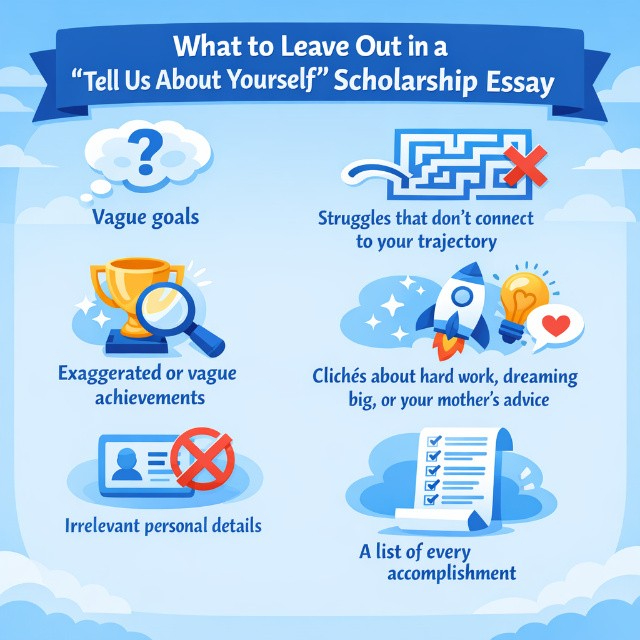
Being specific also means knowing what to cut. Leave out:
- Vague goals. "I want to make a difference" tells the committee nothing.
- Struggles that don't connect to your trajectory. A difficult story with no forward momentum doesn't serve you.
- Exaggerated or vague achievements. Committees read a lot of essays. They can tell when something doesn't add up.
- Clichés about hard work, dreaming big, or your mother's advice. Unless yours is genuinely original, skip it.
- Irrelevant personal details. Your pet, your relationship, your favorite show. None of these belong here unless they genuinely illuminate your angle.
- A list of every accomplishment. This is an essay, not a CV. One deep thread beats ten shallow bullets.
Tell Us About Yourself Scholarship Essay Examples
Three examples below, one for each strategic angle: a 100-word goal-driven essay, a 250-word experience-driven essay, and a 500-word identity-driven essay. Each includes a brief annotation explaining why the writer made the choices they did.
Tell Us About Yourself Scholarship Essay: 100-Word Example (Goal-Driven)
Short prompts give you space for one selling point. This example zeroes in on a specific goal and connects it to a concrete experience, leaving the committee with a clear image of who this student is and why they're worth investing in.
I grew up in a border town where half my classmates left school before 16. I stayed. I'm now a first-year pre-law student at the University of Texas El Paso, and I plan to become an immigration attorney. Not because it's a stable career. Because I've seen what happens when families can't afford one. This scholarship would let me focus on my studies instead of my second job. I know what I'm working toward. I just need the chance to get there.
Why it works: The goal-driven angle is grounded in a specific place and experience. The details make the goal feel real, not aspirational. The closing sentence is confident without tipping into arrogance. |
For more short-form examples like this one, see our guide to 100 word scholarship essay examples.
Tell Us About Yourself Scholarship Essay: 250-Word Example (Experience-Driven)
At 250 words, you have room for a past/present/future arc. This example uses a defining experience to connect a student's background to their current direction, showing growth rather than just achievement.
The summer I was fifteen, a wildfire burned through the valley where my family had farmed for three generations. We lost forty percent of our crop. My parents didn't tell us how bad it was until the insurance denial came in the mail. That summer taught me two things: how vulnerable small agricultural businesses are to climate events, and how little protection most rural families have when those events happen. I started researching what other countries do differently. I couldn't stop. I'm now a junior studying agricultural economics at Cal Poly, with a concentration in climate risk policy. My senior thesis is examining crop insurance reform in the context of California's water allocation changes. After graduation, I plan to work with a state agricultural agency before pursuing a master's in public policy. The Brighter Harvest Scholarship is named for the kind of resilience my family had to find that summer. I'd like to honor that name by using this opportunity to build policy solutions that other rural families won't have to figure out on their own.
Why it works: The writer opened with a scene rather than a biography. The past event connects directly to a specific academic path and a specific future goal. The final paragraph ties the essay to the scholarship's mission without feeling forced. |
If the experience-driven angle fits your material, our 250 word scholarship essay examples guide goes deeper on how to structure that arc.
Tell Us About Yourself Scholarship Essay: 500-Word Example (Identity-Driven)
At 500 words, you can build a full narrative. This example uses an identity-driven angle: not demographic identity, but a core belief that shapes how the student moves through the world.
I've always been the person who asks why one too many times.
In sixth grade, I asked my history teacher why we spent three weeks on World War II and two days on the Korean War. She said it was because of the textbook. I asked who wrote the textbook. She sent me to the office.
That question has followed me ever since. In high school, I started a student journalism club after noticing our local paper had closed, and nobody seemed to be covering the school board meetings where budget decisions got made. We published for three years. I'm not sure we changed anything. But we were there.
Now I'm a sophomore studying media studies and political science at Howard University. My goal isn't to be a journalist. I've figured out that the story I actually want to tell is about how information structures work and who controls them. I'm applying for graduate programs in communications policy. I want to work on legislation that keeps local news infrastructure alive, because I've seen what happens to communities when it disappears.
People sometimes ask me what my thing is, expecting an activity or an award. My thing is noticing what's missing and figuring out why. I'm not sure where that comes from. My parents are both accountants. They ask how and how much. I've always been more interested in why and according to whom.
I chose Howard because I wanted to be in a community where those questions have an urgent, specific history attached to them. I've found that. I've also found professors who take the questions seriously and peers who push back in ways that make me sharper.
The [Scholarship Name] funds students committed to public interest work in media and communications. That's exactly where I'm headed. This support would let me take an unpaid policy fellowship I've been offered this summer, something I can't do right now without help with living expenses. It's one of those situations where having the money would let me do the thing that makes the money less necessary later.
Why it works: The student's core thing, asking why, runs through the whole essay from sixth grade to now. Specific details make the essay credible without reading as a brag list. The committee finishes this essay knowing exactly who this person is. |
For more on building a full narrative at this length, see our 500 word scholarship essay examples guide.
You've got your angle, your examples, and a clear sense of what works and what doesn't. The hard part now is sitting down and translating your own story into that structure: knowing what to say but not quite how to say it in a way a committee remembers. If that's where you're stuck, the scholarship writing team at CollegeEssay.org works directly from your notes, your background, and your goals to write an essay that sounds like you at your best.
How to Start a Tell Us About Yourself Scholarship Essay
The opening line is where most students lose the committee. Here is the most common mistake and how to fix it.
What most students write: My name is Jordan, and I'm a junior studying communications at Howard University. |
That is the most forgettable possible opening. The committee already knows you're a student. Telling them your name and major is information they have from your application form.
What works instead: Drop them into a moment. |
The goal-driven example above opens with a place: I grew up in a border town where half my classmates left school before 16. The experience-driven example opens with a scene: The summer I was fifteen, a wildfire burned through the valley where my family has farmed for three generations. The identity-driven example opens with a behavior: I've always been the person who asks why one too many times.
All three create immediate forward momentum. The committee wants to know what comes next.
A few strong opening patterns to try:
- A specific place that shaped you: I grew up in [place], where [specific fact that matters to your angle].
- A moment that changed something: The [event] changed how I understood [thing].
- A behavior or tendency: I've always been the person who [specific, memorable thing].
- A contrast: My [family member] spent 30 years doing [X]. I'm spending my twenties figuring out why [X] still isn't working.
For more on this, see our full guide on how to start a scholarship essay.
Quick Tips to Strengthen Your Tell Us About Yourself Scholarship Essay Before You Submit
- Use specific numbers and details wherever you can. Led a team of 12 students over two academic years lands harder than was a leader. Specificity creates credibility.
- Read it aloud. If you stumble, the committee will too. If it sounds stiff, rewrite it conversationally. Your essay should sound like you at your most articulate, not like a formal document.
- Keep the scholarship's mission in mind throughout. Every paragraph should make the committee feel like you're the right person for this specific award. Generic essays rarely win.
- End with momentum, not a summary. Don't recap what you said. Close with where you're headed. Give the committee a reason to feel good about investing in you. For more on this, see our guide on how to end a scholarship essay.
- Make sure your formatting is clean. Length, margins, and structure matter more than most students think. Our scholarship essay format guide covers what committees expect.
Ready to Submit?
You've got the framework, the examples, and the checklist. The gap most students face at this point isn't knowledge. Its execution. You know your story, but getting it onto the page in a way that's specific enough to win, and matched closely enough to this scholarship's mission, is harder than it looks. If you'd rather hand that part off, share your prompt, your background, and your deadline, and we'll deliver a complete draft. That's what our scholarship essay writing assistance is here for.
Frequently Asked Questions
What should I write about in a tell us about yourself scholarship essay?
Choose one of three angles: goal-driven (where you're headed and why), experience-driven (a defining moment that shaped your path), or identity-driven (a core quality or belief that runs through everything you do). Pick the angle that matches your strongest material and the scholarship committee's mission.
How do I start a tell us about yourself scholarship essay?
Don't start with your name and major. Drop the committee into a specific moment, place, or behavior instead. See the How to Start section above for patterns and examples.
How long should a scholarship essay about yourself be?
Follow the prompt's word count exactly. The most common lengths are 100, 250, and 500 words. If no limit is given, aim for 250 to 500 words. Here's how to decide between them: 250 words is enough if your story is tight and your angle is clear. Go to 500 if you're using the experience-driven or identity-driven angle and need room for a before-and-after arc. Don't pad to hit a higher count. A focused 250-word essay beats a bloated 500-word one every time.
Can I reuse a tell us about yourself scholarship essay for multiple applications?
You can reuse the core angle and narrative, but the final paragraph should always be rewritten to match each scholarship's specific mission. A closing that references the wrong committee will cost you more than starting from scratch.
What makes scholarship committees reject tell us about yourself essays?
Vague goals, a list of accomplishments with no narrative thread, clichéd opening lines, and a closing that could apply to any scholarship. Specificity is what separates winning essays from the rest.
Alexander W. Verified
Author
Alexander W. is a seasoned academic writer with deep expertise in essay structuring and in-depth research. With years of experience helping students navigate the competitive world of scholarship applications, he specializes in breaking down complex prompts into clear, compelling narratives that resonate with award committees. Alexander's writing philosophy centers on specificity and authenticity; he believes the strongest scholarship essays are built on real moments, honest voices, and a clear vision of where the student is headed. His work across the Scholarship Essay cluster at CollegeEssay.org covers everything from financial need and career goals to formatting standards and prompt-specific strategy, giving students both the examples and the framework they need to write with confidence.
Specializes in:
Academic Research
Scholarship Essay Writing
College Application Writing
Essay Formatting & Style
Read All Articles by Alexander W.
Keep Reading
Was This Blog Helpful?
On this Page