Your scholarship prompt asks about leadership, and you have your experience. Now you need to know how to write it so a committee remembers it. This page gives you the PAR framework committees actually respond to, a before-and-after rewrite showing exactly what "specific" means in practice, and two full examples at 250 and 500 words you can use as direct models. You'll have everything you need to write a draft today.
Leadership Scholarship Essay Examples + Writing Tips
Does Your Experience Actually Count in a Leadership Scholarship Essay?
Yes. Here's why you should stop second-guessing it before you even start.
Scholarship committees define leadership far more broadly than most students assume. You don't need a title. You don't need an award. You need an experience where you took initiative, influenced others, or made something better than it was before you got involved.
There are four leadership archetypes that committees recognize, and you probably fit at least one:
- Positional leadership: You held a formal role: team captain, club president, class officer. This is the most obvious type, but it's also the most competitive. If this is you, your essay needs to go deeper than the title.
- Informal influence: You were the person others turned to, even without a title. You organized something, mediated a conflict, and kept the group on track. Committees love this archetype because it shows initiative rather than appointment.
- Crisis or problem-solving leadership: Something went wrong, and you stepped up. A project collapsed, a team fell apart, and a community needed something that didn't exist. You identified the gap and did something about it.
- Peer mentorship or coaching: You helped someone else get better. You tutored, guided, and mentored. The committee sees this as leadership because it takes patience, empathy, and genuine investment in another person's growth. If service to others is your story, you might also want to look at our community service scholarship essay guide, which covers a related but distinct angle.
If you influenced the outcome of a situation and other people were better off because of what you did, that's a leadership experience worth writing about. If you are still deciding whether to write a leadership essay at all or need help choosing between prompt types, the scholarship essay writing guide covers the full application picture.
Reframing Your Experience for a Leadership Scholarship Essay
This is where most students get stuck; they have an experience, but don't see the leadership in it. Here's what that reframe looks like in practice:
Your Experience | The Leadership Frame |
"I just helped a friend study" | Peer mentorship: You identified a gap, adapted your approach, and someone grew because of your investment |
"I organized our group project when no one else would" | Informal influence: You stepped into a vacuum, created structure, and kept the team moving without being asked |
"I stepped up when our coach got sick" | Crisis leadership: You held the group together under pressure when the usual authority wasn't there |
"I started a club, but it was small" | Positional + problem-solving: You built something from nothing, which is harder than maintaining what already exists |
"I convinced my team to change our approach" | Influence and decision-making: You identified a better path and brought others with you |
If any of these sound like you, you have a leadership essay. The story is already there; you just need the right frame to tell it.
You can also browse scholarship essay examples across all prompt types to see what strong execution looks like in practice.
Does Your Prompt Look Different from a Typical Leadership Essay?
Leadership scholarship prompts aren't always labeled "leadership." If your prompt says any of the following, this article applies directly to you:
- "Describe a challenge you overcame and what you learned."
- "Tell us about a time you made a positive difference."
- "What does leadership mean to you? Give an example."
- "Describe a situation where you took initiative."
- "Tell us about a time you influenced others."
All of these are asking for the same thing: a specific experience, a clear action you took, and what changed because of it. The framework below works for every one of them.
What Scholarship Committees Look for in a Leadership Scholarship Essay
Understanding what's being evaluated changes how you write. Committees aren't scoring you on how impressive your experience sounds; they're scoring you on how well you communicate it.
Three things consistently separate winning essays from forgettable ones:
Specificity. Did you describe a real moment, or did you write in vague generalities? "I helped my team succeed" tells a committee nothing. "I called an emergency meeting on a Tuesday night after our lead programmer quit and redistributed the project in 48 hours," tells them everything. |
Impact. What changed? Who was better off? Can you put a number on it? Committees respond to evidence. You don't need to cite a study; you need to show that your action had a visible result. |
Reflection. This is where most essays fail. Students describe what happened, but skip the so what. What did this experience teach you about yourself? How did it shape the way you think about leadership? A committee can read a list of events anywhere. They're funding a future leader; they want to see that you understand what you're becoming. |
A winning leadership essay shows what you did, what changed because of it, and what it taught you about yourself.
If your prompt leans toward a professional direction rather than a specific leadership moment, the career goals scholarship essay guide covers how to bridge past experience with future intent.
Still working out how to turn the framework into actual sentences? Tell us your experience, your prompt, and your word count. Our scholarship essay experts will draft the essay from your story and have it back to you before your deadline.
How to Write a Leadership Scholarship Essay (Step by Step)
There's a simple structure that works for almost every leadership prompt.
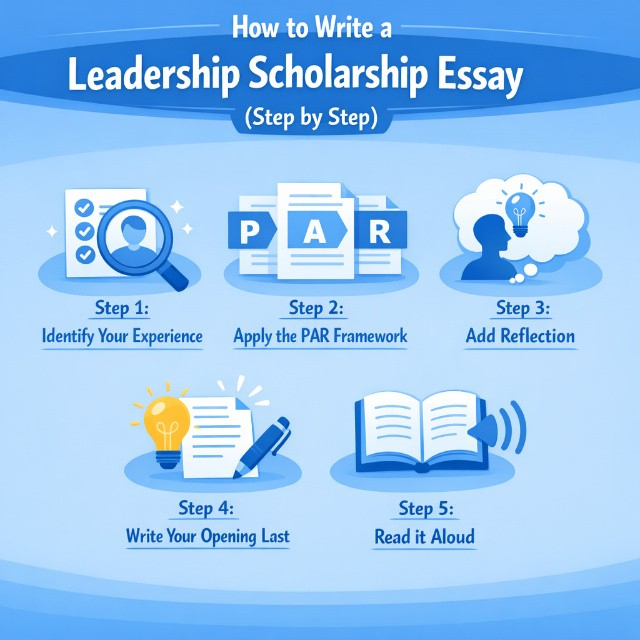
Step 1: Identify Your Experience
Use the four archetypes above. Pick one specific experience, not a summary of your "whole leadership journey." The more focused your story, the stronger your essay.
Step 2: Apply the PAR Framework
- Problem: What situation called for leadership? Set the scene: what was wrong, missing, or at risk?
- Action: What did you specifically do? Use "I," not "we." The committee wants to understand your contribution, not your team's.
- Result: What concretely changed? Win rates, grades, attendance numbers, people helped, use specifics wherever you can.
Step 3: Add Reflection
One or two sentences at the end that answer: what does this experience say about who I am, and how does it connect to where I'm going?
Step 4: Write Your Opening Last
Once you know the story, you can write an opening that pulls the reader in. Most students try to write the hook first and get stuck. Write the body, then circle back.
Step 5: Read it Aloud
Every sentence. If it sounds like a government form, rewrite the stiff parts. If you'd never say it out loud to a person, you shouldn't be writing it.
Before and After for a Leadership Scholarship Essay: Turning a Generic Sentence Into a Strong Paragraph
Here's the fastest way to understand what "being specific" actually means.
BEFORE (generic):
"I demonstrated leadership as the captain of my school's soccer team by leading practices and encouraging my teammates."
That sentence says nothing. It's the kind of sentence every committee has read five hundred times. It doesn't show a real moment, a real decision, or a real result.
AFTER (specific):
"When three of our starting players got injured in the same week before playoffs, I called an emergency team meeting, not to panic, but to redistribute roles. I asked each player where they felt most confident stepping up. Within 48 hours, we had a revised lineup and a practice plan built around it. We didn't win the championship, but we won two of our last three games with a team that had never played those positions before. That week taught me that leadership under pressure isn't about having answers, it's about asking the right questions."
The second version has a specific situation (the injury crisis), a specific action (I called the meeting, I asked), a concrete result (2 of 3 wins), and reflection (the lesson about asking the right questions). That's the difference between a passing essay and one that gets remembered.
Leadership Scholarship Essay Example (250 Words)
This example suits a prompt like "Describe a time you demonstrated leadership and the impact it had." It's an example of informal leadership through peer mentorship, no title, no official role, just a student who noticed a gap and filled it.
Junior year, I watched my friend Marcus fail his third AP Chemistry exam in a row. He wasn't struggling because he wasn't smart; he was struggling because he didn't have anyone to explain things to him in a way that made sense. His parents worked nights. The teacher moved fast. Tutoring was expensive.
I offered to study with him twice a week after school. I didn't have a plan at first. I'd read the chapter, then sit with him and figure out what wasn't clicking. I learned pretty quickly that Marcus understood concepts better when I connected them to things he already knew, cooking, car mechanics, things from his actual life. I started preparing differently. I'd think about the concept first, then think about him.
Over the next two months, his grade went from a 52 to a 74. He passed the AP exam in May with a 3.
But what I got from that experience surprised me. I realized I was better at breaking things down than I thought. I started wondering if other students were in the same position as Marcus, smart, but without the right person in their corner. The following year, I helped start a peer tutoring program at my school. It now serves 30 students each semester.
Leadership, I learned, doesn't start with authority. It starts with paying attention.
This essay works because it's specific about the problem (Marcus, third failed exam, no resources), personal about the action (I adapted my approach for him specifically), and quantifiable in its result (52 to 74, passed the AP exam). The reflection connects the experience forward, from one friendship to a program that outlasts the writer. |
For more models at this length, see our 250 word scholarship essay examples.
Leadership Scholarship Essay Example (500 Words)
When the prompt gives you more room, you can build a full narrative arc, not just a moment, but a story with context, action, result, and a look ahead. This example answers a longer prompt: "Tell us about a leadership experience that shaped who you are and how you'll contribute to your campus community." It demonstrates crisis and problem-solving leadership. The student identified a gap, acted without being asked, and built something lasting.
The summer before my senior year, I found out that our school's food pantry, a small closet near the main office stocked by a local church, had been shut down due to a funding gap. Most students didn't know it had existed. I only knew because a classmate had quietly mentioned it to me the year before, and I knew she wasn't the only one who'd used it.
I started asking questions. A few conversations with the school counselor confirmed what I suspected: seven families in our district were flagged as food insecure in the last school year alone. The resource was gone. No one had a plan to bring it back.
I didn't have the authority to fix this. I was seventeen. But I decided to try anyway.
I spent three weeks researching how other schools run their programs. I found two models that worked without requiring a permanent budget: one powered by monthly student donation drives, and one through a partnership with a regional food bank. I put together a one-page proposal and asked the principal for a meeting.
She gave me ten minutes. I got twenty. By the end, she agreed to let me pilot the program for one semester.
I recruited eight student volunteers, people I knew would actually show up. I reached out to the regional food bank and got us registered in two weeks. I set up a system: donations collected every other Friday, sorted on Saturday mornings, and available to families through the counselor's office without any paperwork or explanation required. No stigma, no questions asked.
By December, we'd served fourteen families. The program is still running. A sophomore is coordinating it now.
What I learned from that experience went beyond logistics. I learned that leadership without a title is actually harder in some ways, and more clarifying in others. When you're not assigned the role, you have to be genuinely motivated by the outcome. You have to build trust from scratch. You have to convince people to follow someone who has no formal authority over them.
I'm going to college to study public health. I want to work on access gaps, the places where resources exist somewhere, but don't reach the people who need them. What I built in that school hallway was small. But it taught me that the gap between "someone should do something" and "I'll do it" is the exact place where things either change or don't.
That gap is where I want to spend my career.
This essay uses the PAR framework throughout: the problem is immediate and human (a classmate, seven families, no backup plan), the action is specific and shows real effort (three weeks of research, two models evaluated, one proposal), and the result is concrete (fourteen families served, program ongoing). The final two paragraphs connect the experience directly to the student's stated future goals, which is exactly what committees want to see. |
For more models at this length, see our 500 word scholarship essay examples.
You have the framework, the examples, and a clear list of what sinks these essays. Most students who get to this point can write a draft. The harder part is writing one that sounds like them and not like everyone else who had the same experience. CollegeEssay.org's scholarship writers work directly from your story and return a draft that's specific enough to stand apart: formatted, ready to submit, usually within 24 hours.
Common Mistakes in Leadership Scholarship Essays
Knowing what not to do is half the battle. Here are the seven mistakes that sink otherwise decent essays:
- Writing about the title, not the experience. Opening with "As captain of the team, I..." immediately signals that you're going to describe your role rather than your actions. Your title is context. Your experience is the story.
- Using "we" instead of "I." Teams win together. Scholarship committees fund individuals. Use "I" consistently. What did you specifically do, decide, initiate, or change?
- Forgetting the reflection. Describing events without the "so what" leaves your essay unfinished. Committees want to see that you learned something. One or two sentences of genuine reflection can be the difference between a decent essay and one that sticks.
- Starting with a dictionary definition. "Leadership is defined as the ability to guide others." This opening appears in roughly a third of scholarship essays. It signals to the reader that you're stalling before you get to the real story. Skip it entirely.
- Picking the most impressive experience over the most specific one. The experience you can write about with concrete detail, honest reflection, and a clear result will always outperform the more "impressive" experience you can only describe in generalities.
- Choosing an experience that isn't actually leadership. Being the oldest sibling, being well-liked, or being a good teammate are valuable, but they're not leadership stories on their own. What makes it a leadership story is that you took a specific action, made a decision, or created a change. If you can't point to a moment where something shifted because of what you did, dig for a different experience.
- Writing about what you were given, not what you built. "I was selected as team captain" describes an honor. "After I was selected as team captain, here's what I changed and why" describes leadership. The committee isn't funding the title; they're funding what you do with it.
For a deeper look at what separates passing essays from winning ones across all scholarship prompts, see our full guide on scholarship essay mistakes to avoid.
Conclusion
Share your experience, your prompt, and your word count, and our scholarship essay team can write your leadership essay from scratch or restructure what you already have. Most students get their draft back within 24 hours.
Frequently Asked Questions
Can I submit the same leadership scholarship essay to multiple scholarships?
You can reuse the core story, but the framing needs to shift for each application. Different committees weigh different things: one might prioritize community impact, another academic trajectory, and another personal growth. A leadership scholarship essay that works for one prompt often needs its reflection paragraph and opening rewritten for the next. The body can stay largely the same; the lens changes.
How do I write the reflection in a leadership scholarship essay without it sounding forced?
The most common reason reflection sounds forced is that it is written as a lesson rather than a realization. Instead of stating what leadership means in general terms, describe what you understood about yourself specifically. The question to answer is not what is leadership but what did this experience reveal about how you think and what you want. One or two sentences written that way will always read more genuinely than a paragraph of abstract conclusions.
What tone works best for a leadership scholarship essay?
Direct and specific, not formal. These essays are read by people who review hundreds of submissions in a sitting. A leadership scholarship essay that reads like a person talking about something real will always hold attention longer than one that reads like a formal report. Use first person throughout, write short declarative sentences where possible, and avoid vocabulary you would not use in a normal conversation.
How specific do the results need to be in a leadership scholarship essay?
As specific as you can honestly make them. If you have a number, use it. Grade improvements, people helped, programs started, events organized: concrete figures are always stronger than approximations. If you genuinely do not have quantifiable data, describe the result in terms of observable change rather than general outcomes. Saying the team finished the project on time and presented without losing a single member is more credible than saying you succeeded despite the challenges.
What if the experience in my leadership scholarship essay did not go perfectly?
That is usually better material for a leadership scholarship essay. Committees are skeptical of essays where everything worked out smoothly. An experience where something went wrong, and you adapted, failed, and recovered, or led imperfectly and learned from it is more believable and more memorable.
Alexander W. Verified
Author
Alexander W. is a seasoned academic writer with deep expertise in essay structuring and in-depth research. With years of experience helping students navigate the competitive world of scholarship applications, he specializes in breaking down complex prompts into clear, compelling narratives that resonate with award committees. Alexander's writing philosophy centers on specificity and authenticity; he believes the strongest scholarship essays are built on real moments, honest voices, and a clear vision of where the student is headed. His work across the Scholarship Essay cluster at CollegeEssay.org covers everything from financial need and career goals to formatting standards and prompt-specific strategy, giving students both the examples and the framework they need to write with confidence.
Specializes in:
Academic Research
Scholarship Essay Writing
College Application Writing
Essay Formatting & Style
Read All Articles by Alexander W.
Keep Reading
Was This Blog Helpful?
On this Page