You have a scholarship prompt asking about your career goals, a deadline coming up, and no idea how to make your answer sound like anything other than "I want to help people someday." This page gives you the exact framework committees are looking for, three full annotated examples at 100, 250, and 500 words, and a breakdown of the four patterns that get these essays rejected.
Career Goals Scholarship Essay Examples + How to Write
What Scholarship Committees Actually Look for in a Career Goals Scholarship Essay
Here's the thing most students miss: committees don't want to know your dream job. They want to know why your education is the next logical step toward it.
That shift in framing changes everything. You're not writing a wish list. You're making a case.
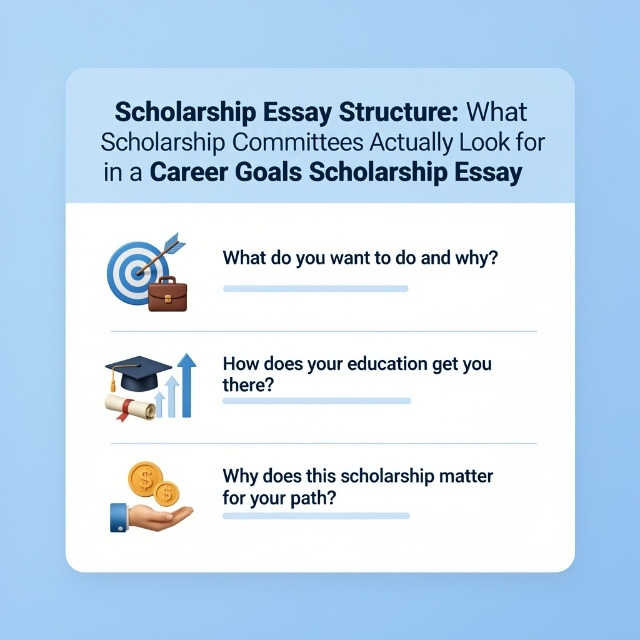
Every strong career goals essay answers three questions, whether it's 100 words or 500:
- What do you want to do and why? Not just the job title. The reason behind it. What experience, person, or moment pointed you in this direction?
- How does your education get you there? Your major, your program, the specific skills you're building. Connect them to the career explicitly.
- Why does this scholarship matter for your path? Not just "it will help with tuition." Show that you understand what this scholarship funds and why it fits where you're headed.
Specificity beats ambition every time. "I want to become a pediatric speech therapist working with children who have autism" is immediately more compelling than "I want to help people." Both students might be equally passionate, but only one of them sounds ready.
The scholarship connection isn't a polite add-on at the end. It's part of the core argument. If you can swap out the scholarship name and the essay still makes sense, you haven't written a scholarship essay. You've written a personal statement.
For a broader look at scholarship applications, see our scholarship essay writing guide.
The Structure Behind Every Strong Career Goals Scholarship Essay
The strongest career goals essays follow a simple arc: where you've been, where you're going, and why this scholarship bridges the two. That's not a formula. It's just good storytelling. And it works at every word count.
Here's the four-part framework:
- Origin moment or catalyst. One specific experience that pointed you toward this field. A class, a person, a problem you couldn't stop thinking about. One or two sentences are enough for shorter essays.
- Short-term goals. What you're studying now and why it's the right path. Your major, relevant coursework, or skills you're actively developing.
- Long-term career vision. Where you see yourself in 5 to 10 years. Be specific about the role, the setting, or the impact, not just the industry.
- Scholarship connection. Why this particular funding matters for your particular path. Not financial need in isolation, but what this scholarship enables that you couldn't do otherwise.
For a 100-word essay, you compress: the origin moment might be one sentence, and the scholarship connection might be the final two lines. For 500 words, you expand: more detail in the origin story, more specificity about your long-term vision, and a more developed scholarship connection.
If your goals aren't fully formed yet, this structure still works. More on that below.
Before you start writing, it also helps to have the scholarship essay format rules in hand. Length, spacing, and presentation requirements vary by scholarship.
Career Goals Scholarship Essay Examples at Every Length
If you want to see how other prompt types compare, our scholarship essay examples guide covers the full range.
100-Word Career Goals Scholarship Essay Example
At 100 words, there's no room for backstory. You need to land your core goal, connect it to your field, and tie it to the scholarship. Every sentence is load-bearing.
When I joined a local water quality monitoring project last summer, I realized that environmental science wasn't just a subject I was good at. It was the work I wanted to do long-term. I'm currently pursuing a B.S. in Environmental Science with a focus on water systems, and I plan to work in municipal water policy after graduation. The Hartwell Environmental Scholarship would allow me to pursue a summer research fellowship I'd otherwise have to turn down due to cost. That research directly supports my thesis and my career trajectory.
What makes this work:
|
For more examples of this length, see 100 word scholarship essay examples.
Still not sure how to apply any of this to your own story? Tell us your field, your goals, and the scholarship prompt, and professional help with your scholarship essay means we build the draft for you, from your specific background, for this specific award.
250-Word Career Goals Scholarship Essay Example
At 250 words, you get room for one origin story paragraph, a developed career vision, and a meaningful scholarship connection. The essay should feel like a coherent narrative, not a checklist.
I didn't know what nursing was until I watched it save my grandmother's life.
She had a stroke during a family visit when I was fourteen. What I remember most isn't the chaos. It's the night-shift nurse who stayed calm through all of it, translated everything the doctors said into words my family could understand, and checked in with my grandmother as a person, not just a patient. That nurse is why I'm pursuing a B.S.N. at Riverside State University.
My short-term goal is to graduate with my nursing license and gain clinical experience in acute care. Long-term, I want to work in ICU nursing and eventually move into nursing education, training the next generation of nurses who go into those high-pressure rooms and make families feel like someone is actually paying attention.
I'm applying for the Calloway First-Generation Nursing Scholarship because it's specifically designed to support first-generation nursing students, and I am one. The financial relief would allow me to cut back my work hours during my final clinical year, the year when I need to be fully present, not exhausted from a second job. This scholarship isn't just about money. It's about what I can do with more time to focus.
What makes this work:
|
For more examples of this length, see 250 word scholarship essay examples.
500-Word Career Goals Scholarship Essay Example
At 500 words, committees expect a full narrative arc. More specific detail in the origin story, a developed picture of your long-term vision, and a scholarship connection that feels earned rather than tacked on.
My interest in civil engineering started with a pothole.
I grew up in a neighborhood where the roads were genuinely bad, cracked, uneven, patched over so many times they looked like quilts. My dad complained about them constantly. But when I was about sixteen, I started asking a different question: why were some roads fine and ours weren't? That question sent me down a rabbit hole about infrastructure funding, municipal maintenance cycles, and the gap between what cities say they'll fix and what actually gets fixed. By the time I graduated high school, I knew I wanted to work in infrastructure, specifically the design and rehabilitation of transportation systems in underserved communities.
Right now, I'm in my second year of a B.S. in Civil Engineering at Mercer Valley University, focusing on structural analysis and materials science. I've maintained a 3.8 GPA while working part-time, and I recently joined a student research group studying asphalt deterioration patterns in low-income urban areas, work that connects directly to the career I'm building.
My short-term goal is to complete my degree and pass the Fundamentals of Engineering exam. After that, I plan to pursue my P.E. license and work for a mid-size infrastructure firm focused on public-sector projects. The Bureau of Labor Statistics projects steady growth in civil engineering employment over the next decade, particularly in transportation and environmental infrastructure, the exact sectors I'm aiming for.
Long-term, I want to specialize in transportation equity: designing road networks and public transit infrastructure with an explicit focus on the communities that infrastructure investment tends to skip. That's not a vague goal. I've already identified fellowship programs at the National Center for Education Statistics and federal transportation agencies that align with that path, and I've spoken with two engineers currently doing that work about what the career trajectory looks like.
The Delgado Infrastructure Fellowship would make a specific difference for me in my junior year, when my required coursework load peaks and part-time work becomes harder to manage without affecting my academic performance. This fellowship has supported students going into public infrastructure roles before. That alignment matters to me. I'm not applying because I need any scholarship. I'm applying because this one fits where I'm actually going.
The pothole that started all of this is still there. I drive past it every time I visit home. One day, I'll know exactly how to fix it, and more importantly, I'll know how to make sure a neighborhood like mine doesn't have to wait twenty years for someone to care.
What makes this work:
|
For more examples of this length, see 500 word scholarship essay examples.
You've got three models to work from at every word count. Translating any of them into your own story, with your specific goals and the specific scholarship you're applying for, is where most students get stuck. If that's the part you want off your plate, we can write your career goals scholarship essay for you. Tell us your field, your deadline, and the prompt, and most drafts are back the same day.
What Kills a Career Goals Scholarship Essay (Weak vs. Strong)
The most common reason career goals essays get rejected isn't bad writing. It's missing the scholarship connection. But there are a few other patterns that sink these essays before a committee even finishes reading. Here are the four most common ones, and a quick fix for each.
Vague Goals
Weak: I've always wanted to help people and make a difference in my community.
Strong: I want to work as a public defender in under-resourced counties, specifically on cases involving juveniles tried as adults.
Quick fix: Replace the feeling with a specific role, setting, or population. |
A Generic Essay with a Name Swap
Weak: An essay that could be submitted to any scholarship with the name changed, and nobody would notice.
Strong: An essay that references what the scholarship funds, who founded it, or what community it serves.
Quick fix: In one paragraph, show that you researched this scholarship specifically. |
Here's what that looks like in practice. Say you're applying for a scholarship created to support first-generation students going into public health careers.
Generic version: The Rosenberg Scholarship would help me fund my education and achieve my career goals in public health. |
Researched version: The Rosenberg Scholarship was established to support first-generation students who want to bring public health careers back to underserved communities. I grew up in one of those communities, and returning to work in one is not an aspiration for me. It's the whole point. Every dollar I spend on application fees, licensing exams, and conference attendance during school is a dollar I'm not spending on the career I'm actually trying to build. That's the gap this scholarship was designed to close, and it's exactly where I am right now. |
The second version shows you read the scholarship's mission, connected it to something real in your background, and explained the specific funding gap it fills. That takes one paragraph and maybe fifteen minutes of research. It's the difference between an essay that gets filed and one that gets funded.
A Resume in Paragraph Form
Weak: I have a 3.9 GPA, I'm the president of three clubs, and I've won two academic awards.
Strong: Accomplishments appear in the essay as context for your goals, not as a list of credentials.
Quick fix: Every achievement you mention should connect to where you're going, not just what you've done. |
Overpromising
Weak: I will revolutionize healthcare and eliminate health disparities in America.
Strong: I want to work in rural primary care, specifically in counties with a shortage of OB-GYN services.
Quick fix: Narrow your scope to something you can actually commit to. |
For a deeper breakdown of what sends these essays to the rejection pile, see scholarship essay mistakes to avoid.
How to Write a Career Goals Scholarship Essay When You're Not Sure of Your Long-Term Goals Yet
You don't need a perfectly mapped-out career plan. You need a direction and a reason.
That's a real distinction. Scholarship committees aren't expecting you to have your entire career figured out at 18 or 20. What they're evaluating is whether you're thinking seriously about your path. Vagueness is the problem, not uncertainty.
Here's a reframe that helps: instead of anchoring your essay to a specific job title, anchor it to your field of study and the kind of impact you want to have. You might not know if you want to be a corporate attorney or a public defender, but if you know you're going to law school because you've seen how inaccessible legal resources are for low-income families, that's a direction. Write from there. |
Something like this works: I'm pursuing a degree in political science because I want to work at the intersection of policy and public health. I haven't chosen a specific role yet, but I want to be in rooms where decisions about healthcare access are made, not just studying them from the outside. That's honest and specific at the same time. |
The one place to be careful: if your goals have genuinely shifted since you started your program, you can acknowledge that briefly. But commit to one thread for the essay. Committees don't need a full history of your changing interests. They need to see where you're headed now and why this scholarship fits that direction. |
Before you finalize your draft, also read through how to start a scholarship essay. The opening line carries more weight than most students give it.
Quick Tips Before You Submit Your Career Goals Scholarship Essay
Your career goals essay is 200 to 500 words. Every sentence needs to earn its place.
- Customize for each scholarship. Committees can tell when you changed the name and called it a revision. One paragraph of genuine scholarship-specific connection changes the impression entirely, and it doesn't take long to write.
- Cut anything that doesn't serve the three-question framework. If a sentence doesn't answer what you want, how you'll get there, or why this scholarship matters, it probably doesn't belong. Read it once just looking for sentences that don't pull their weight.
- Read it out loud. If it sounds stiff, it reads stiff. If you'd never say a sentence in conversation, rewrite it until you would. This catches more problems than a second read-through on screen.
- Have someone outside your field read it. If they're confused about what you do or why it matters, a committee member with a full inbox will be too. Ask them to flag anything they had to re-read.
- Proofread for specificity, not just grammar. Spell-check won't catch vague goals. Read each sentence and ask: is this specific enough that only I could have written it? If the answer is no, push a little further.
The last sentence carries more weight than most. See how to end a scholarship essay before you call the draft done.
You have the framework, the examples, and a checklist to catch the four patterns that get these essays rejected. What's left is putting your own career trajectory on the page with enough specificity that only you could have written it. If you'd rather hand that to someone who writes these daily, CollegeEssay.org's essay writing specialists need your prompt, your field, and your goals, and most drafts come back within 24 hours.
Frequently Asked Questions
How do I write a career goals scholarship essay?
Follow the four-part framework: open with a specific origin moment, state your short-term academic goals, describe your long-term career vision, and connect the scholarship to a concrete funding gap in your path. Specificity matters more than ambition. Committees want to see that your education is the logical next step toward a defined goal, not just a general desire to succeed.
How long should a career goals scholarship essay be?
Most scholarship prompts specify a length. The most common ranges are 100, 250, and 500 words. If the prompt doesn't specify, 250 to 500 words is the standard range. At every length, the structure is the same: compress or expand based on the word count, but all four parts (origin, short-term goals, long-term vision, scholarship connection) should be present.
How do you write a career goals scholarship essay when your goals are still unclear?
Anchor your essay to a direction and a reason rather than a specific job title. Name your field, describe the kind of impact you want to have, and connect the scholarship to that trajectory. Committees evaluate whether you're thinking seriously about your path, not whether you have every detail locked in. Uncertainty is fine. Vagueness isn't.
Should I mention how the scholarship will help me financially?
Yes, but make it specific. It will help with tuition is not a scholarship connection. Explain what the funding enables that you couldn't do otherwise: a research fellowship you'd have to turn down, the ability to reduce work hours during a demanding clinical year, or conference access that directly supports your career path. Specific financial barriers are persuasive. Generic ones aren't.
What makes a career goals scholarship essay different from a personal statement?
A personal statement is about who you are. A career goals scholarship essay is a funding argument. It has to show that your education is the logical next step toward a defined career, and that this specific scholarship closes a specific gap in that path. An essay that reads like a personal statement, heavy on identity and light on career trajectory, will not perform well against a career goals prompt even if the writing is strong.
Alexander W. Verified
Author
Alexander W. is a seasoned academic writer with deep expertise in essay structuring and in-depth research. With years of experience helping students navigate the competitive world of scholarship applications, he specializes in breaking down complex prompts into clear, compelling narratives that resonate with award committees. Alexander's writing philosophy centers on specificity and authenticity; he believes the strongest scholarship essays are built on real moments, honest voices, and a clear vision of where the student is headed. His work across the Scholarship Essay cluster at CollegeEssay.org covers everything from financial need and career goals to formatting standards and prompt-specific strategy, giving students both the examples and the framework they need to write with confidence.
Specializes in:
Academic Research
Scholarship Essay Writing
College Application Writing
Essay Formatting & Style
Read All Articles by Alexander W.
Keep Reading
Was This Blog Helpful?
On this Page