You've read the advice. You know the essay should be "authentic" and "specific" and show who you really are. But none of that tells you what a strong essay actually looks like written out. Below are seven examples, one for each Common App prompt, with a breakdown of what makes each one work and one technique you can use in your own draft.
Common App Essay Examples by Prompt: That Worked (2026–2027)
What Makes a Common App Essay Example "Work"?
Most students think a good essay means impressive content: a rare achievement, a dramatic challenge, an unusual story. But admissions officers don't read for impressiveness. They read for presence.
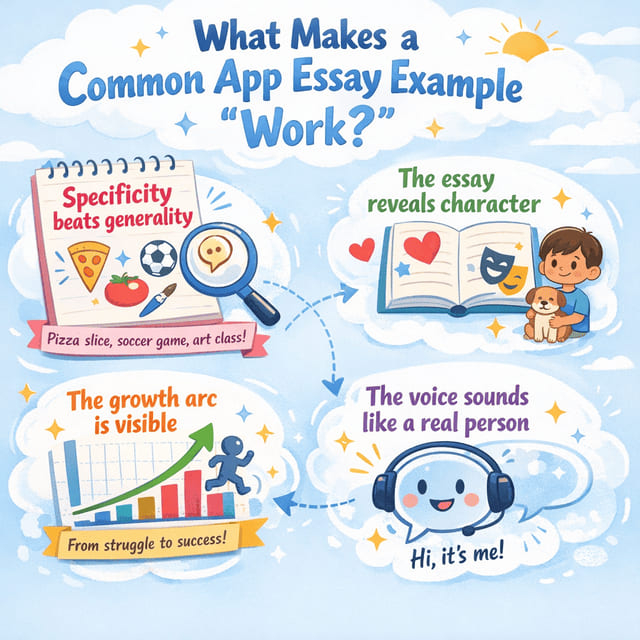
Four things separate the essays that work from the ones that don't:
- Specificity beats generality. The essays that stick use real names, real places, and real moments. Not "I learned to work with others" but "At 11 p.m. on a Tuesday in my high school's boiler room, our robotics team was arguing about whether to scrap six weeks of work."
- The essay reveals character, not just events. What happened matters less than how you moved through it. Admissions readers want to understand who you'll be in a seminar, on a team, in a residence hall.
- The growth arc is visible. Where you started versus where you ended doesn't need to be a dramatic transformation. A small but genuine shift in how you see something is enough.
- The voice sounds like a real person. If you'd never say it out loud, don't write it.
A Common App essay works when an admissions reader could pick it out of a pile and know exactly who wrote it. Still struggling to write the essay? For a full step-by-step walkthrough, check out our guide on how to write a common app essay. |
Common App Essay Examples by Prompt
Here are examples for all seven Common App prompts, each with analysis and one technique you can steal. These are original sample excerpts written to reflect the qualities of successful essays, not reproductions of any real student's work.
For a breakdown of all seven prompts with strategy for each, see our guide on all 7 common app essay prompts. |
Prompt 1 Essay Example:
Prompt: Some students have a background, identity, interest, or talent that is so meaningful they believe their application would be incomplete without it. If this sounds like you, please share your story. |
Sample Excerpt:
The first thing my grandmother taught me was how to hold a knife. Not a butter knife. A cleaver, the kind she used to split a winter melon in one clean motion. I was seven. She didn't ask if I was ready. She just put it in my hand and stood behind me, her fingers wrapped over mine, and said, "Feel where it wants to go."
I've been cooking with her every Sunday since. It started as something I did because she asked me to. At some point, I realized it was the place where I felt most like myself. Not because I'm particularly good at it (I've ruined more than a few dishes), but because it's where I learned that doing something carefully and without shortcuts actually means something.
Why It Worked: The writer opens mid-scene with a specific sensory detail (a cleaver, not a vague kitchen memory). By the second paragraph, we already understand what the student values (patience, craft, care) and where that value came from. The essay doesn't explain the lesson. It demonstrates it through the scene. The reader arrives at the insight alongside the writer, rather than being told what to think.
Steal This Technique: Open with a physical action in the middle of happening, not a reflection on it. The object in your hands becomes the entry point into your identity. The reflection follows naturally once the scene is established.
Most common Prompt 1 mistake: Writing about the identity category itself (e.g., "Being Chinese-American means...") instead of one specific moment that shows it.
For a full guide on writing Prompt 1, see our common app prompt 1 guide. |
Prompt 2 Essay Example:
Prompt: The lessons we take from obstacles we encounter can be fundamental to later success. Recount a situation where you faced a challenge, setback, or failure. How did it affect you, and what did you learn from the experience? |
Sample Excerpt:
I quit the swim team on a Wednesday afternoon in November, four weeks before regionals. I told my coach I had too much schoolwork. That was true, but it wasn't the real reason.
The real reason was that I'd been slipping for three months and couldn't admit it to myself. My times were getting worse, not better. I was training more hours than anyone on the team and getting slower. I kept waiting for it to turn around. It didn't.
What I learned wasn't what I expected. I thought quitting would feel like giving up. Instead, it felt like honesty. It took me another year to understand the difference between persistence and stubbornness, and to recognize that I'd spent those three months confusing the two.
Why It Worked: The problem-to-response ratio is exactly right. Most students spend 70% of their Prompt 2 essay describing the challenge and only 30% on what they learned. This writer flips it. The challenge is sketched quickly and honestly. The insight dominates. Admissions readers see someone capable of genuine self-assessment, not just someone who "overcame" something. The word "stubbornness" does a lot of work: specific enough to be credible, and it shows the writer is comfortable with self-criticism.
Steal This Technique: Write a draft where you spend more words on what you learned than on what happened. If the ratio is still 50/50, cut from the problem section until the insight section is clearly dominant.
Most common Prompt 2 mistake: Framing the lesson as "I learned to never give up," which is the opposite of what this example does.
For a full guide on writing Prompt 2, see our common app prompt 2 guide. |
Prompt 3 Essay Example:
Prompt: Reflect on a time when you questioned or challenged a belief or idea. What prompted your thinking? What was the outcome? |
Sample Excerpt:
I grew up believing that being helpful was always good. It seemed obvious. Help people when you can, don't make things harder for others, show up when you're needed. My parents modeled this. My school rewarded it. I never thought to question it.
Then I spent a summer volunteering at a community garden in my neighborhood, and I watched a well-meaning program systematically undermine the confidence of the people it was trying to serve. The volunteers, me included, made every decision. We showed up with plans. We left with completed projects. The residents we were "helping" stood mostly to the side.
I still believe in helping. But I'm no longer sure I know what it means.
Why It Worked: The intellectual humility here is the point. The writer doesn't arrive at a triumphant new belief. They arrive at uncertainty, which is actually more sophisticated. The essay shows a student capable of sitting with complexity rather than resolving it neatly for the reader's comfort. The belief being questioned is simple enough to be relatable, specific enough to feel genuine, and important enough to be worth examining.
Steal This Technique: End on a question or productive tension rather than a resolved answer. Uncertainty, expressed clearly, signals intellectual maturity. Admissions readers aren't looking for certainty. They're looking for the capacity to think carefully.
Most common Prompt 3 mistake: Picking a belief that's so easy to question (e.g., "I used to think failure was bad") that the essay feels performative rather than genuine.
For a full guide on writing Prompt 3, see our common app prompt 3 guide. |
Still not seeing a path to your own draft? Tell our CollegeEssay.org essay common app writers your prompt, your story, and your deadline, they'll write a complete personal statement that sounds like you, not like a template.
Prompt 4 Essay Example:
Prompt: Reflect on something that someone has done for you that has made you happy or thankful in a surprising way. How has this gratitude affected or motivated you? |
Sample Excerpt:
My ninth-grade history teacher gave me a zero on a paper I'd spent three weeks on. It wasn't for plagiarism or lateness. It was because, she told me, the paper was technically excellent but entirely dishonest.
I'd written what I thought she wanted to hear. I'd found the interpretation that fit the rubric and built a careful argument around it. The argument was airtight. I believed none of it.
She handed it back with one sentence in red at the top: "You're too smart to hide."
I was furious for about a month. Then I became grateful for the rest of high school.
Why It Worked: Prompt 4 has one of the lowest success rates of any Common App prompt. Most essays are sentimental and predictable. This one earns its gratitude because it earns its tension first. The gratitude is for something that felt like punishment at the time. The phrase "You're too smart to hide" is the pivot: short, memorable, and it delivers the essay's core insight without over-explaining. The writer lets it sit and trusts the reader.
Steal This Technique: Choose someone whose act of kindness didn't feel kind at first. The more the gratitude had to develop over time, the more interesting the essay.
Most common Prompt 4 mistake: Writing an essay that's more about the other person than about how the experience changed you.
For a full guide on writing Prompt 4, see our common app prompt 4 guide. |
Prompt 5 Essay Example:
Prompt: Discuss an accomplishment, event, or realization that sparked a period of personal growth and a new understanding of yourself or others. |
Sample Excerpt:
I used to think I was bad at math. This is a strange thing to say when you're about to tell someone that math changed your life, but bear with me.
In seventh grade, I failed my first algebra test. My teacher pulled me aside and said something I didn't expect: "You're not bad at math. You just haven't found the part of it that speaks to you yet." I didn't believe her. I started believing her three years later, sitting in the back of a public library, reading about the Monty Hall problem.
The Monty Hall problem broke my brain. Not because it was hard. It was simple. But the answer was completely wrong according to every instinct I had, and it was completely right according to the math. I stayed in that library for four hours. I've been there for the last two years, figuratively speaking.
What grew wasn't just my interest in probability. It was my understanding that being confused isn't a sign you're bad at something. It's often a sign you're about to understand something new.
Why It Worked: The growth in this essay isn't stated. It's shown through a sequence of events and a shift in how the writer interprets confusion. The "new understanding" at the end changes how the writer sees not just math, but themselves. That's the mark of genuine Prompt 5 growth: the insight reaches outward, not just inward. The specificity of "the Monty Hall problem" signals genuine engagement. It's the kind of detail that's almost impossible to fake.
Steal This Technique: Identify the moment your growth changed how you see other people, not just yourself. That outward reach, from "I learned something about me" to "I learned something about how learning works," is what elevates a Prompt 5 essay.
Most common Prompt 5 mistake: Describing what happened in detail and tagging on a growth statement at the end as if it's a moral. The growth needs to be woven into the narrative, not appended.
For a full guide on writing Prompt 5, see our common app prompt 5 guide. |
Prompt 6 Essay Example:
Prompt: Describe a topic, idea, or concept you find so engaging that it makes you lose all track of time. Why does it captivate you? What or who do you turn to when you want to learn more? |
Sample Excerpt:
I've spent more time than I'll admit thinking about why roundabouts make people so angry.
It's not a joke. Roundabouts are objectively safer and more efficient than four-way stops. The research is clear, the engineering is sound, and they've been common in Europe for decades. But in the United States, any city that proposes one reliably generates a small but furious opposition. People show up to town hall meetings. Letters get written. Signs get posted.
What I find genuinely fascinating isn't the traffic design. It's the gap between what data says should work and what people will actually accept. That gap shows up everywhere: in public health, in urban planning, in how schools adopt new curricula. Understanding it feels like the most practical thing I could study.
Why It Worked: Prompt 6 has a recurring problem: students write "I love science" essays that are really about enthusiasm rather than depth of engagement. This essay shows actual intellectual engagement by tracing a chain of reasoning: here's a specific thing that interests me, here's what it connects to, here's why that matters beyond the original thing. The roundabout is unexpected enough to be memorable. By the end, the writer has moved from traffic circles to the study of human behavior and institutional change. That's range.
Steal This Technique: Start with the most specific, almost embarrassingly niche version of what interests you. Then trace the intellectual thread that runs from that specific thing to the larger questions it connects to. The specificity earns trust; the thread shows depth.
Most common Prompt 6 mistake: Writing about a concept (e.g., "I love psychology") without demonstrating actual engagement with a specific idea or question within it.
For a full guide on writing Prompt 6, see our common app prompt 6 guide. |
Prompt 7 Essay Example:
Prompt: Share an essay on any topic of your choice. It can be one you've already written, one that responds to a different college's prompt, or one of your own design. |
Sample Excerpt:
I have a very specific relationship with silence. Not comfortable silence, not awkward silence. The silence in a room right after someone has said something true and everyone is deciding whether to acknowledge it.
I notice it in a way that I've come to think is a little unusual. I started noticing it in debates, where it happens a lot. Someone makes a point that lands, and for about half a second, the other side isn't responding. They're recalibrating. That pause is my favorite moment in any argument. It means something real just happened.
I became a better debater when I stopped trying to eliminate that silence and started trying to create it.
Why It Worked: About 28% of applicants choose Prompt 7, and most use it as a free pass to submit a pre-existing essay with minimal tailoring. This excerpt does something different: it introduces a concept (a specific kind of silence) that reveals a distinct way of seeing the world. The writer's mind is visible on the page. Prompt 7 isn't an escape hatch. It works best when you have a story that genuinely doesn't fit anywhere else. This essay would've been awkward forced into any other prompt. It belongs here.
Steal This Technique: Ask yourself: does this story require the open prompt, or am I choosing it because it feels easier? If a different prompt would fit just as well, use that one. Prompt 7 is strongest when it's the only option.
Most common Prompt 7 mistake: Submitting an essay written for a different school without revising it. Admissions readers notice when the voice, tone, or framing doesn't match the rest of the application.
For a full guide on writing Prompt 7, see our common app prompt 7 guide. |
You've now seen what a strong Common App essay looks like across all seven prompts, the specific details, the honest voice, the growth that shows rather than tells. The harder part is doing that for your own story. If you're sitting with a topic but struggling to make it land on the page, our writers can get your common app essay written, built around your prompt, your story, and your voice, with a draft back within 24 hours.
What These Common App Essay Examples Have in Common
Seven different prompts, seven different students, seven different stories. But read across all of them and the same patterns emerge.
- They open with a moment, not a thesis. None of these essays begins by explaining what it's going to be about. They begin in the middle of something happening, and the reader follows.
- They stay in the writer's point of view without over-explaining.The essays don't spend much time telling the reader what to think. They trust the scene to carry the meaning.
- The growth is visible in tone, not just stated.By the end of each essay, the writer sounds different from how they sounded at the beginning, even subtly. That tonal shift is how the reader knows something changed.
- They end without over-resolving. None of these essays closes with a triumphant summary of lessons learned. They end in a slightly open place: a question, an implication, a moment that lands and then lets the reader sit with it.
Every Common App essay that works makes an admissions officer feel like they've met someone, not read a document. |
Analyze Common App Essay Examples: What the Prompt Choice Tells Admissions Officers
Students often focus entirely on the essay itself and forget that the prompt they chose is also visible to the reader. Admissions officers do notice, not to judge the choice, but because the prompt gives them context for what they are about to read.
Here is what each prompt signals before the first word of your essay:
| Prompt Chosen | What It Signals to the Reader |
| Prompt 1: Background, identity, interest, or talent | This student has something central to who they are that would be invisible without this essay. The reader expects depth on identity, not a list of achievements. |
| Prompt 2: Challenge, setback, or failure | This student faced real difficulty and has thought carefully about what it meant. The reader will be watching for genuine growth, not just a resolved problem. |
| Prompt 3: Questioning a belief | This student has intellectual independence. Only 3% of applicants choose this prompt. The reader expects real complexity, not a safe or comfortable conclusion. |
| Prompt 4: Gratitude | This student has identified a specific, non-obvious act of generosity that changed them. The reader expects the essay to return the focus to the student, not remain on the person they are grateful to. |
| Prompt 5: Accomplishment, event, or realization | This student has a turning point worth writing about. The reader will be looking for a before-and-after that feels earned rather than announced. |
| Prompt 6: Intellectual curiosity | This student has a genuine intellectual obsession. Only 5% choose this prompt. The reader expects evidence of real depth questions pursued, not just interests named |
| Prompt 7: Topic of your choice | This student has a story that didn't fit any other frame. The reader applies no structural expectation. Everything depends on the essay itself. |
Conclusion
Understanding what your prompt signals helps you align the essay to what the reader is already prepared to see, and avoid the most common mismatch between prompt choice and essay content.
Reading examples is useful. But the real work is deciding what only you can write.
Every essay in this article works because the student committed to one specific story and told it honestly. Not the most impressive story. Not the most dramatic one. The one that actually showed who they were.
You've read seven examples. You know what good looks like now. The next step is doing it for your own story, and that's where most students get stuck, not because they don't have something worth writing about, but because they can't get out of their own way. If you'd rather hand your prompt and your story to someone who's done this before, let us write your common app essay. Tell us your prompt, what you want to write about, and your deadline , we'll take it from there.
Frequently Asked Questions
What is a good common app essay example?
A good common app essay example is one that tells a specific, personal story and shows who the writer is beyond their grades and test scores. The best examples are organized by prompt, include real sample text, and include analysis explaining why the writing worked, so you can apply the same techniques to your own essay.
What makes a Common App essay example stand out?
Specificity. The essays that stand out name real places, real moments, and real emotions. They don't describe growth in general terms. Admissions officers read thousands of essays; the ones they remember feel like a conversation with a specific person.
Can I see common app essay examples that actually worked?
Yes, all seven examples in this article are samples that reflect the qualities admissions officers consistently flag in successful essays: clear voice, specific detail, and a genuine growth arc. Each one includes a breakdown of what made it work.
What should I avoid including in my Common App essay examples?
Avoid including sports injury comebacks written without genuine reflection, mission trips that center the writer's feelings rather than the experience, and any opening that begins with a dictionary definition. The topic matters less than how honestly and specifically you write about it.
Can I use Common App essay examples as templates?
You can use them as structural models, but not as templates to fill in. The reason the examples in this article work is because they're specific to one person's experience. If you borrow the structure, open mid-scene, show growth through action, end without over-resolving, that's smart. If you borrow the framing or the subject matter, the essay will feel hollow, and admissions readers will notice.
How many Common App essay examples should I read before writing my own?
Read enough to understand what, good looks like, then stop. Most students benefit from reading 5 to 10 strong examples across different prompts. Reading more than that starts to work against you, you'll unconsciously start writing toward the examples instead of toward your own story. Read, identify the patterns, then close the tab and write from your own experience.
Do Common App essay examples work the same way for every school?
Yes. The Common App personal statement goes to every school on your list, so a strong example works universally. What changes school to school is the supplemental essays, the Why Us essays, activity descriptions, and short answers. The personal statement just needs to show who you are, and that doesn't change based on which school is reading it.
Meredith Lawson Verified
Author
Meredith Lawson has an MA in English Literature and extensive experience helping students craft compelling and authentic admission essays, especially Common App essays. Having completed over 920 orders, she knows how to help applicants stand out with their unique stories and qualifications for college and graduate programs.
Specializes in:
College Admissions
Personal Statements
Graduate School
Read All Articles by Meredith Lawson
Keep Reading
Was This Blog Helpful?
On this Page