You've done it. The hardest part is behind you, the story, the details, the awkward middle section you rewrote three times. And now you're staring at the last paragraph, cursor blinking, wondering how to stick the landing without ruining everything you just wrote.
Here's the direct answer: the best way to end your Common App essay is to use one of five strategies: Full Circle, Image of the Future, Naming Your Values, Reflection and Synthesis, or a Resonant Last Line, without summarizing what you already said. Your Common App essay conclusion, also called the common app essay last paragraph, is the final paragraph of your personal statement and the last thing the admissions officer reads before forming an impression of you.
There are five strategies that work, and the key is picking the right one for your essay. We'll also cover what not to do, because the wrong ending can quietly undercut an otherwise strong essay.
Why Your Conclusion Matters More Than You Think in Common App Essay
Admissions officers read hundreds of essays, sometimes thousands. By the time they reach your last paragraph, they've already formed a rough impression. Your conclusion is your chance to either confirm that impression or elevate it.
The thing is, a flat ending makes the whole essay feel flat. It doesn't matter how strong your opening was or how vivid your story was in the middle. If the conclusion just fizzles, that's what lingers. The last thing read is the first thing remembered.
Here's the good news: your conclusion doesn't need to be the most brilliant part of your essay. It just needs to feel complete, like the essay went somewhere intentional and arrived. |
It doesn't need to be profound. It just can't be the worst part.
If you're still working on the full writing process and haven't nailed down your structure, story, or opening yet, our guide on how to write a Common App essay covers all of that before you get to the conclusion. |
The 5 Strategies for Ending Your Common App Essay
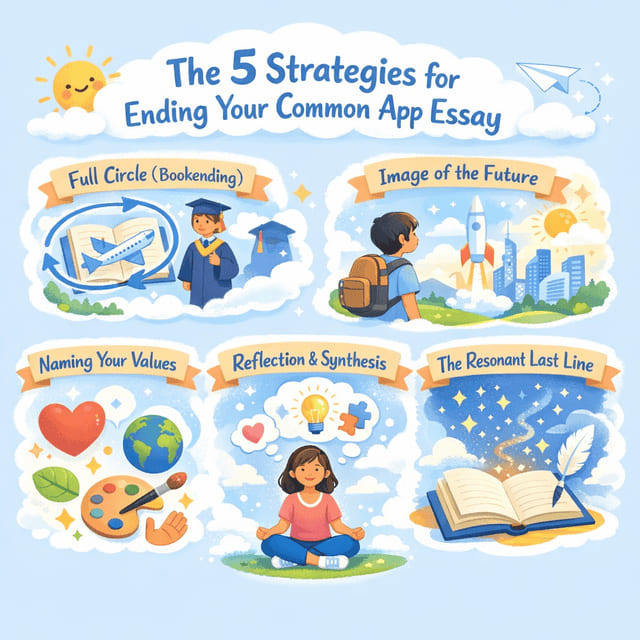
1. Full Circle (Bookending)
The full circle ending returns to your opening, the same image, object, scene, or moment you used to start the essay, but with new meaning.
If you opened with a broken guitar sitting in the corner of your bedroom, you end with that same guitar. Maybe it's been repaired. Maybe it's still broken, but now you understand what it represents. The point isn't that things have changed on the outside, it's that you have changed, and the reader sees that through the same image.
This works especially well for narrative essays built around a single scene or object.
The technical move is simple: re-enter the opening, then shift the meaning just enough to show growth.
Full circle endings work because they show the reader that your essay was intentionally constructed, not just strung together.
Best for: Narrative essays, anecdote-driven essays, essays built around a physical object or specific moment. |
2. Image of the Future
This strategy projects you forward, into college, into a career, into a version of yourself that exists because of what this experience taught you. You're showing the admissions officer not just who you are, but who you're becoming.
The key word here is specific. The Image of the Future falls apart when it turns into vague ambition ("I will change the world"). It works when it's grounded and earned: "I'll sit in that lecture hall and finally ask the question I was too afraid to ask before."
That's a future image the reader can picture. It's tied directly to the growth you showed in the essay. And it tells the admissions officer exactly the kind of student you'll be on their campus.
The Image of the Future works best when it's earned, when the reader has watched you grow into the person you're describing.
3. Naming Your Values
This ending doesn't tell the reader what you learned, it shows them what you now know about yourself. Your values. Your lens. The principles that guide how you move through the world.
The trap here is spelling it out. "I learned that perseverance matters" is too on the nose. Instead, let the value come through in a specific detail or final image that carries the meaning without announcing it. Show the admissions officer your character; let them name it themselves.
Naming your values in a conclusion tells admissions officers exactly who they'd be welcoming to campus.
4. Reflection and Synthesis
Sometimes the right move is to briefly pull back from the story and connect its meaning to the larger picture of who you are. Not a summary, a synthesis. There's a difference.
Summary says: "Here's what I did, and here's what it meant." Synthesis says: "Here's what this moment reveals about how I see everything." You're not replaying the essay, you're showing the reader the layer underneath it. One important caution: if you've been reflective and introspective throughout the essay, don't use this strategy for the ending. A second wave of reflection in the conclusion will feel repetitive. In that case, consider ending with an image or action instead.
|
Synthesis is not summary, it's showing the reader the meaning underneath the story.
Best for: Intellectual curiosity essays Common App Prompt 6, challenge essays, essays where the topic itself requires unpacking complexity. |
5. The Resonant Last Line
Sometimes the whole conclusion is one powerful sentence. A kicker line brief, specific, memorable that functions as a period at the end of everything you've built.
This works especially well for shorter narrative essays that don't need a full paragraph to wrap up. The essay has already done the work; the last line just needs to land.
What makes a kicker line work: brevity, specificity, and a beat of earned emotion or earned humor. "Earned" is the key word. The line has to feel like it grew from the essay, not like it was bolted on from outside.
A great closing line doesn't summarize, it echoes.
Best for: Shorter narrative essays, essays with a strong singular image or thread running through them. |
What Strategies Look Like in Practice When Writing Your Common App Essay Conclusion
You don't need to write a paragraph. Sometimes one sentence is enough. Here's what a strong closing sentence looks like for three of the strategies:
- Full Circle: "The guitar still has a crack running down the neck. I stopped noticing it months ago."
- Image of the Future: "I'll sit in that lecture hall and finally ask the question I was too afraid to ask at sixteen."
- Resonant Last Line: "I never did learn to fold a perfect dumpling. But I learned what my grandmother was really teaching me."
These aren't templates to copy, they're examples of the standard to aim for. If you can see which strategy fits your essay but aren't sure you can execute the closing to that level, the CollegeEssay.org common app essay writers can write the conclusion for you, or take on the full essay if you'd rather not wrestle with any of it.
How to Choose the Right Strategy for Your Common App Essay Conclusion
You don't need to use all five. You need to pick one and execute it well.
Here's a simple framework:
If your essay is… | Best ending strategy | Common App prompt it fits, and why |
Built around a single scene, object, or story | Full Circle | Prompt 1, 5, 7. Narrative essays with one clear thread benefit most from returning to the opening image with new meaning. The reader sees the before and after without being told what changed. |
About a challenge you overcame | Image of the Future | Prompt 2, Prompt 5. Growth essays earn a forward-looking ending because the arc is complete, you have changed, and the future image shows what that change made possible. Keep it specific and grounded, not a vague promise. |
About your identity, background, or heritage | Naming Your Values | Prompt 1, Prompt 4, Prompt 7. Identity essays close strongest when a final image or detail carries the value without stating it. Let the reader name the quality, do not announce it yourself. |
Driven by an idea, concept, or intellectual curiosity | Reflection and Synthesis | Prompt 3, Prompt 6. Intellectual essays work with synthesis, showing what this question revealed about how you think. Resist wrapping it too neatly. A conclusion that ends with a still-open question fits Prompt 6 especially well. |
Short, punchy, built around one strong image | Resonant Last Line | Any prompt. When the essay has already done the work, one carefully chosen closing sentence is enough. Use this as a closer, not a strategy for every essay. |
A gratitude essay where another person is central | Full Circle or Resonant Last Line | Prompt 4 specifically. Gratitude essays risk ending on the other person. Your conclusion must return the focus to you, what their action revealed about who you are, not who they are. Read your last sentence: if the subject is them, rewrite it so the subject is you. |
About a belief you questioned or changed | Reflection and Synthesis or Resonant Last Line | Prompt 3. Do not over explain the new belief. Show the shift through a detail or final image rather than stating it. The most common Prompt 3 mistake is a conclusion that labels the transformation, let the transformation speak. |
Read your essay draft and ask: what is the shape of this essay? An anecdote essay almost always benefits from bookending. A growth essay almost always benefits from the Image of the Future. The strategy should feel like the natural completion of what you already started, not an add-on from outside.
The best Common App essay conclusion is the one that grows naturally from the essay you already wrote.
If you want to see what strong essay structures look like in practice, browse some common app essay examples before you decide. |
What Not to Do When Writing Your Common App Essay Conclusion
This is the section most articles skip, and it's the one you actually need. Knowing what a weak ending looks like is just as useful as knowing what a strong one looks like.
The Summary Ending
"In conclusion, this experience taught me that hard work pays off." Admissions officers see this constantly, and it signals a lack of craft. The essay already made its point. A summary at the end doesn't reinforce it; it just repeats it while announcing that you've run out of ideas.
The fix: delete it entirely. Trust the essay to have made its case. |
The Explicit Moral
"That's when I realized that I am stronger than I thought." This tells the reader what to feel instead of letting them feel it. The realization should have been shown through the essay, the conclusion shouldn't need to label it.
The fix: replace the stated lesson with a final image or action that carries the same meaning without announcing it. |
Here's the same essay moment, written two ways:
The Explicit Moral (weak):
"That's when I realized that hard work always pays off."
Full Circle (strong):
"The guitar still has a crack running down the neck. I stopped noticing it months ago."
Same moment. Same growth. The second version lets the reader feel it instead of being told what to feel. That's the difference between an ending that lands and one that just closes.
The Overpromise
"At your university, I will use these skills to make a lasting impact on the world." This reads as generic and, more importantly, unearned. Admissions officers know you don't know what you'll do yet, and broad promises about changing the world feel hollow.
The fix: keep future projection specific and personal. Tie it directly to something concrete in the essay itself. |
The Trailing Off
The essay just... ends. No final paragraph. The last sentence isn't a conclusion, it's just where the writer stopped. This happens when someone runs out of steam right at the end. It leaves the admissions officer with a sense of incompleteness, which is the opposite of the impression you want.
The fix: write one deliberate closing sentence with clear intention. Even a single resonant line is better than trailing off. |
The Repetitive Reflection
You've been introspective throughout the whole essay, and then the conclusion reflects again. It makes the ending feel like a second opinion on your own story.
The fix: if you've been reflective throughout, don't end with more reflection. End with an image, an action, or a forward-looking moment instead. |
Prompt-Specific Conclusion Traps for Common App Essay
The general mistakes above apply to any essay. But each Common App prompt has one ending pattern that shows up consistently and quietly weakens an otherwise solid draft. Know the one that applies to yours before you finalize.
Prompt 2, Obstacle Or Challenge:
Endings that circle back to the difficulty instead of landing on the growth. The conclusion of a Prompt 2 essay should resolve the lesson, not revisit the hardship. If your last paragraph mentions the challenge again without showing what specifically changed in you as a result, cut it and replace it with the change itself.
Prompt 3, Questioning a Belief:
Endings that over explain the new position. If you find yourself writing 'and that is why I now believe X,' pull back. The conclusion should show the shift through a final image, action, or detail not announce it as a conclusion. The reader should feel the change; they do not need to be told what to call it.
Prompt 4, Gratitude:
Endings that close on the other person instead of returning to you. Prompt 4 is easy to write as a tribute, but the conclusion must bring the focus back to what this experience revealed about who you are. Read your last sentence. If the subject of that sentence is the person you are grateful to, rewrite it so the subject is you.
Prompt 5, Personal Growth:
Endings that summarize the growth rather than demonstrating it. If your last paragraph tells the reader you are now more confident, patient, or aware,without showing what that looks like, it will feel generic. Replace the stated quality with the action or image that proves it.
Prompt 6, Intellectual Curiosity:
Endings that wrap the idea up too neatly. A Prompt 6 essay about genuine curiosity should not resolve all the way. If your conclusion answers every question the essay raised, it undercuts the curiosity that made the essay worth reading. End with the next question, the thing you still want to understand, or the problem still unsolved.
Prompt 7, Topic Of Your Choice:
Endings that explain why the topic was worth writing about. If the essay did its job, the reader already knows. A last paragraph that justifies your topic choice signals that you are not confident the essay carried the point. Trust it. End clean.
How to Test Your Common App Essay Conclusion Before You Submit
Before you finalize the essay, run it through these quick tests:
- The back-to-back test. Read your intro and your conclusion back-to-back, skipping the middle entirely. Do they feel connected? Does the ending complete something the opening started? If they feel like they belong to different essays, something needs to shift.
- The read-aloud test. Read your last sentence out loud. Does it sound like something a human being would actually say? If it sounds stiff, formal, or like a graduation speech, rewrite it in the way you'd actually talk.
- The "so what?" test. After reading just the conclusion, can a reader feel why this essay mattered? Does it answer, even implicitly, why you wrote about this and not something else? If not, the ending isn't quite doing its job.
- The stranger test. Hand just the last paragraph to someone who hasn't read the essay. Does it feel complete? Does it have weight? Or does it feel like a fragment that needs context?
If your ending feels surprising to re-read, like it's saying something you almost didn't say, that's usually a good sign. It means it earned its place. |
You've got a strategy, you've run the tests, and you know what your conclusion needs to do. The harder part, for most students, is that the conclusion doesn't exist in isolation, it only lands if the 650 words before it earned it. If you're still building the full draft, or if the whole essay needs to get to the level your conclusion is reaching for, common app essay help that goes start to finish is available, human writers, delivered in 24 hours or less.
Your conclusion doesn't need to be perfect, it needs to be intentional. Pick one strategy that fits the essay you've already written, execute it cleanly, and trust the work you've done. Admissions officers can feel the difference between an ending that was thought through and one that just stopped. Yours should feel like the former.
If you're not sure which strategy fits, go back to your opening. The right ending is usually already hiding somewhere in the first paragraph.
You know how this essay ends now. The harder part is making sure the 650 words before that ending actually earn it. If you'd rather hand the whole draft to someone who does this every day, tell us your prompt, your story, and your deadline, and we'll write the common app essay for you. Most drafts come back in under 24 hours.