What Is Common App Prompt 7?
Prompt 7 has stayed the same across the 2025–26 and 2026–27 application cycles: write about any topic you'd like. That's the whole prompt. No built in frame around identity, challenge, accomplishment, or growth, just open space.
It exists because the Common App recognized that some applicants have stories worth telling that don't fit neatly into Prompts 1 through 6. If your most compelling narrative crosses multiple prompt categories, or if it's something entirely its own, Prompt 7 is where it belongs.
Here's something that surprises a lot of students: admissions officers generally don't check which prompt number you selected. They open your essay and read it. The prompt is almost incidental. "Admissions officers are reading the essay, not the prompt number, your story matters far more than which option you checked." |
That stat about 28% of applicants choosing Prompt 7 comes from recent application cycle data. It's the single most popular prompt by a wide margin. You won't stand out or blend in just because you picked it. What matters is the essay.
Should You Choose Common App Prompt 7? (A Decision Framework)
This is the question most guides skip over. They describe the prompt, toss you a few tips, and leave the decision entirely to you. That's not helpful.
Use this table to decide:
| Choose Prompt 7 IF... | Don't Choose Prompt 7 IF... |
| You have a story that genuinely doesn't fit Prompts 1–6 | You're picking it to avoid writing something new |
| Your essay uses an unconventional format (letter, montage, second-person) | Your story actually fits Prompt 1, 2, or 5, just use those |
| Your strongest story crosses multiple prompt categories | You don't yet have a clear narrative or central theme |
| You've brainstormed all six other prompts and none feel authentic | You're hoping a pre-written essay will "pass" as a personal statement |
One thing that can help: write your essay first, then figure out which prompt it fits. A lot of strong essays naturally match two or three prompts. If yours lines up cleanly with Prompt 1 or Common App Prompt 5, use that one, it gives readers a frame. Choose Prompt 7 when no other frame fits, not when Prompt 7 feels like the easiest option. |
The worst reason to choose Prompt 7 is convenience, the best reason is that you have a story worth telling that doesn't fit anywhere else.
The Biggest Mistake with Common App Prompt 7 (Don't Do This)
Prompt 7 specifically says you can use "one you've already written." Students read that sentence and immediately think: great, I'll submit my AP English paper.
Don't.
The college personal statement is a specific genre of writing. It's not an academic essay. It's not a scholarship essay. It's not a piece you wrote for your school paper or a summer program reflection. Those pieces were written for a different audience with a different goal. Submitting one as your Common App essay almost always lands flat, it reads like it was written for someone else, because it was.
A recycled essay rarely tells the admissions committee anything they couldn't learn from your transcript, teacher recommendations, or activities list. The personal statement's job is to reveal something new, the way you think, what you care about, who you actually are behind the GPA.
The second major trap is going too broad. Students hear "write about anything" and try to summarize their whole high school experience in 650 words. It doesn't work.
650 words is too short to summarize your life. It's exactly long enough to tell one story really well. Pick one specific moment. One conversation. One decision. One realization. The best Prompt 7 essays aren't surveys, they're close-up portraits.
|
Once you know what not to do, finding the right topic becomes a lot clearer.
How to Brainstorm for Common App Prompt 7
The open-ended nature of this prompt makes brainstorming both the most important step and the most skipped one. Here's how to approach it.
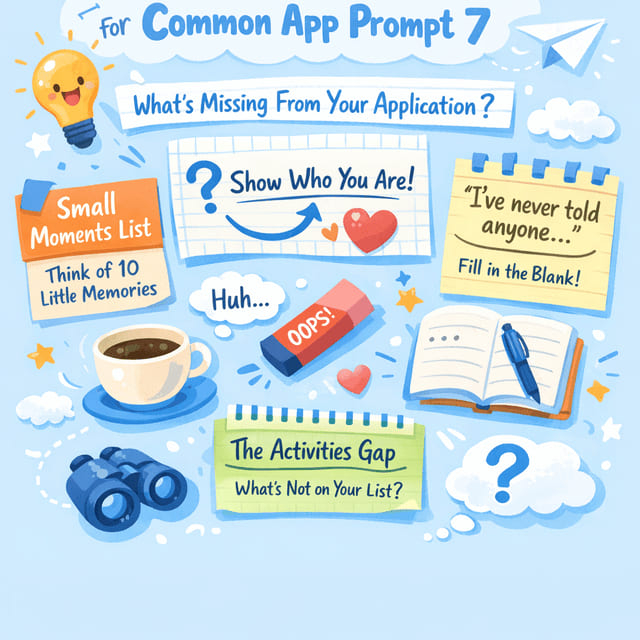
Start with the "missing piece" question. What does the rest of your application not show? Your transcript lists your grades. Your activities list shows what you did. Your essay's job is to show who you are. What's missing from that picture?
- Exercise 1: The small moments list. Write down 10 specific moments from the past three years. Not big events, not winning the championship or going on a mission trip. Moments. A conversation that shifted your thinking. A mistake that embarrassed you in the moment and taught you something you didn't expect. A quiet realization during an ordinary Tuesday.
- Exercise 2: The fill in the blank. Complete this sentence: "I've never told anyone that .. changed how I think about ...". Write the first thing that comes up. That's usually worth exploring.
- Exercise 3: The activities list gap. Look at your activities. What does the list tell a reader about you? Now: what does it not tell them? That gap is your essay.
The topic itself doesn't need to be dramatic or unusual. Essays about cooking eggs, subway rides, collecting old maps, teaching a grandparent to use a smartphone, the topic is almost never what makes an essay work. The reflection is.
How to Structure Your Common App Prompt 7 Essay
Once you have your story, you need a structure that carries it. Prompt 7 gives you three real options.
Option 1: The Narrative Arc (recommended for most students)
This is the standard personal statement format and the safest bet. You open in the middle of a scene, build through the story, and arrive at a reflection that reveals something about who you are. It's familiar, readable, and effective when done well.
Open in media res, drop the reader directly into the moment with sensory detail, dialogue, or action. Not "I have always loved swimming." Instead: "The water was 58 degrees. I knew before I touched it." Build through what happened, what you noticed, what shifted. Close with a forward-facing reflection that circles back to your opening.
Option 2: The Montage
Instead of one continuous scene, a montage strings together two to four short vignettes linked by a common theme. It works when no single story captures the full picture of what you want to convey, maybe you're trying to show how three seemingly unrelated things in your life actually speak to the same quality or belief.
It's harder to execute than a narrative arc. If the theme isn't tight, the essay feels scattered. Use this structure only if you've tried the narrative arc and it genuinely can't hold what you're trying to say.
Option 3: Unconventional Format
Some students write their Prompt 7 essay as a letter (to a younger version of themselves, to a person who shaped them), as a second-person narrative, or as a list. These formats can be powerful, but they're high-risk. The format needs to do real work in the essay. If you could strip out the format and tell the same story in a standard narrative with no loss, the format is a gimmick, not a choice.
Your opening should feel like the first scene of a movie, not the introduction to a book report.
How to Pace Your Essay (Where the Reflection Goes)
One question students get stuck on: how much of your 650 words should be story, and how much should be reflection?
A rough guide that works for most narrative arc essays:
- Opening scene: 100–150 words. Drop the reader into the moment. No setup, no backstory.
- The middle: 300–350 words. Build the story. What happened, what you noticed, what shifted.
- The reflection:150–200 words. Why it mattered. What it changed. Who you are now because of it.
Don't save all your reflection for the final paragraph. The best essays weave insight through the story as it unfolds, a line of reflection mid-scene, then the full landing at the end. Front-loading the reflection kills tension. Saving all of it for the end makes the story feel like a setup rather than the point.
For most students, the narrative arc delivers the best results. Start there.
You've got a framework for your essay now. The gap between knowing how to approach it and actually getting the draft done is where most students stall especially when the rest of the application is competing for the same hours. If you'd rather hand this one off, our writers can get your common app prompt 7 essay written and back to you within 24 hours, matched to your voice and story."
What Admissions Officers Look for in a Common App Prompt 7 Essay
You don't need the most dramatic story in the applicant pool. Admissions officers read thousands of essays, many of them about tragedies, sports victories, immigrant families, and mission trips abroad. Those topics aren't inherently good or bad. What matters is what the essay reveals.
Every strong Prompt 7 essay does three things:
1. Tells a specific, vivid story. A scene with detail, texture, and a sense of time and place, not a summary.
2. Reflects on why it mattered. What changed in how you think or act? What does it say about who you'll be on campus?
3. Reveals something the application doesn't already show. If your essay just illustrates something your transcript or activity list already communicates, it's a missed opportunity.
Admissions officers are not looking for a topic they've never seen before, perfect grammar, or evidence of a dramatic life. Admissions officers don't read your essay looking for the right topic, they're looking for the real you."
Common App Prompt 7 Examples (What Works and Why)
Reading examples is one of the fastest ways to understand what works. Below is one annotated example a real-feeling essay from a fictional student, followed by a breakdown of exactly what makes it land. For a full library of annotated essays across multiple prompt types, see our common app essay examples page.
Example: "The Binder" First-generation student, unexpected passion competitive cable needle-felting
The binder has forty-three tabs.
Tab 1: fiber suppliers, sorted by micron count and price per ounce. Tab 12: needle gauges, cross-referenced by puncture depth and the density of wool they work best with. Tab 31: a hand-drawn diagram of a merino sheep with arrows pointing to which part of the fleece produces the softest fiber for facial detail work.
My mom thinks it's a homework binder. I haven't corrected her.
I found needle-felting on a YouTube rabbit hole the summer before sophomore year a woman in rural Vermont was sculpting a barn owl out of wool, stabbing it into shape with a barbed needle, over and over, until the fibers locked together and the thing looked almost alive. I watched the video four times. I ordered supplies with my birthday money. I ruined approximately eleven pieces of felt before I made something I wasn't embarrassed by.
No one in my family does anything like this. My dad works concrete. My uncles work concrete. The running assumption was that I would too, eventually. The binder wasn't rebellion exactly, more like evidence that I'd found a room in myself nobody had mapped yet.
I've since placed third in a regional fiber arts competition (open category, mixed media). I am currently the only person in my school, and possibly my zip code, who knows what "wet-felting versus dry-felting" means. I'm fine with that. There's something clarifying about caring deeply about something that has no audience. You find out pretty quickly whether you actually love the thing, or whether you were just performing loving it.
The binder has forty-three tabs. I'll probably need a second one soon.
What this essay does well, and why
The opening image does real work. "The binder has forty-three tabs" is specific enough to be immediately visual and unusual enough to create a question: why does this person have a forty-three-tab binder? That question is what keeps the reader moving. Compare it to a generic opener like "I've always been passionate about creative pursuits", same student, zero tension.
The niche is the point, not the obstacle. A lot of students would apologize for writing about something obscure. This essay leans into the obscurity. The specificity (micron count, needle gauges, merino sheep diagram) signals genuine expertise and genuine care, two things admissions officers are always looking for, regardless of the topic.
The reflection earns its place. The essay doesn't arrive at "and this taught me perseverance." It arrives at something more specific and more honest: you find out whether you actually love the thing, or whether you were just performing loving it. That sentence reveals something about how this student thinks, which is exactly what Prompt 7 is supposed to do.
The first-generation context lands without being the whole essay. The line "The binder wasn't rebellion exactly, more like evidence that I'd found a room in myself nobody had mapped yet" acknowledges the student's background without turning the essay into a story about that background. It's present, it's earned, and it doesn't overwhelm the voice.
What to notice for your own essay: The topic is needle-felting. It could have been sourdough, competitive Scrabble, vintage watch repair, or anything else with real depth behind it. The topic is almost irrelevant. What carries the essay is the specificity of the details, the restraint of the reflection, and the consistency of the voice throughout. Those are choices, and they're choices you can make regardless of what your Prompt 7 story is about.
Conclusion
Prompt 7 is the most popular Common App option for a reason, it makes room for stories that don't fit anywhere else. But "write about anything" is only as useful as the plan behind it. Choose it when you have a story worth telling that genuinely doesn't fit the other six prompts, pick a structure that serves your narrative, and focus on the reflection over the topic. Do those three things, and Prompt 7 is one of the strongest options on the application.
You now know whether Prompt 7 is the right choice for your story, how to brainstorm a topic that actually works, and how to structure it for maximum impact. The next step is writing a draft worth submitting, and that's where most students run out of time or confidence. Tell us your story idea, your deadline, and your target schools, and we'll handle the common app essay writing from there.