Common App Prompt 2 is about what you did after things went wrong, not how bad things got. That's the frame you need to hold onto from the first sentence you write to the last.
Common App Prompt 2 reads: "The lessons we take from obstacles we encounter can be fundamental to later success. Recount a time when you faced a challenge, setback, or failure. How did it affect you, and what did you learn or are still learning from the experience?"
This guide covers how to pick your topic, how to structure the essay, and exactly how much word space to give each part. If you've been staring at this prompt wondering whether your story is "enough," you're in the right place.
What Common App Prompt 2 Is Actually Asking
The prompt has three moving parts: the obstacle, the effect it had on you, and the lesson you took from it. But notice where the prompt starts: "the lessons we take." That's not an accident. Admissions officers aren't reading this essay to understand your hardship. They're reading it to understand how you think.
The incident is the setup, not the subject. What matters is what comes after: What did you do differently? How did your perspective shift? How will you carry that lesson into college?
Prompt 2 isn't a story about your worst moment. It's a story about what that moment revealed about you. |
A lot of students get tripped up treating this as a sympathy prompt. They spend most of their words describing how hard the experience was, hoping the difficulty itself communicates character. It doesn't. What stands out is a student who can look back clearly, name what actually changed, and show (not just say) that the change was real.
The growth you describe doesn't have to be dramatic. It just has to be specific. "I learned to be more resilient" tells them nothing. "I started scheduling a weekly check-in with my project partners after I watched a group presentation fall apart because nobody wanted to say the work wasn't ready" tells them a lot.
How to Pick the Right Topic for Common App Prompt 2
Before you write a single word, you need to decide which type of story you have. There are two paths, and the structure of your essay follows from whichever one you pick.
Single defining moment: A failure, mistake, or setback with a clear before and after arc. Something happened, it affected you, you changed. The story has a specific turning point you can point to.
Recurring pattern: A repeated struggle (stuttering, being the new kid, losing to a rival team three seasons in a row) that built something in you over time. The change is cumulative, not tied to one moment.
Neither is better than the other. But you should know which you're writing before you start, because they're structured differently.
Smaller is almost always smarter on topic size. Students often assume their obstacle needs to be impressive. It doesn't. Botching a baking attempt for a school fundraiser, blanking during a debate round you'd prepared weeks for, misreading a teammate's needs at exactly the wrong time. These kinds of specific, human failures produce better essays than big dramatic ones. |
Topics that tend to underperform include the bad grade that made you study harder, the sports injury that taught you about teamwork, and the school move that forced you to make new friends. They're not disqualifying, but every admissions officer has read fifty versions of each. If your execution is specific and the growth is genuine, you can make them work. But you'll be swimming upstream.
Mental health struggles, chronic illness, abuse, and similar experiences belong in the Additional Information section, not your personal statement. That space exists precisely for explaining circumstances without requiring you to frame them as a growth narrative.
You're not required to turn your hardest experiences into a five-paragraph arc for a college application. |
Before you commit to a topic, run it through this quick test:
| Can you name a specific turning point? |
| Does the lesson feel genuine, not something you constructed after the fact? |
| Is this topic not already covered in your activities list or other essays? |
| Are you comfortable sharing it without feeling like you're asking for sympathy? |
If you can answer yes to all four, you've got your topic.
If you're still getting familiar with how the personal statement works before diving into a specific prompt, our guide on how to write a Common App essay covers all of that from the ground up. |
Not sure your topic passes the test? Tell us your story; what happened, what changed, and roughly how long ago, and CollegeEssay.org's challenge essay prompt 2 writers can tell you whether it works, or write the whole Prompt 2 essay for you from scratch.
How to Structure Your Common App Prompt 2 Essay
Here's the framework that separates the essays that work from the ones that don't: 20 / 30 / 50.
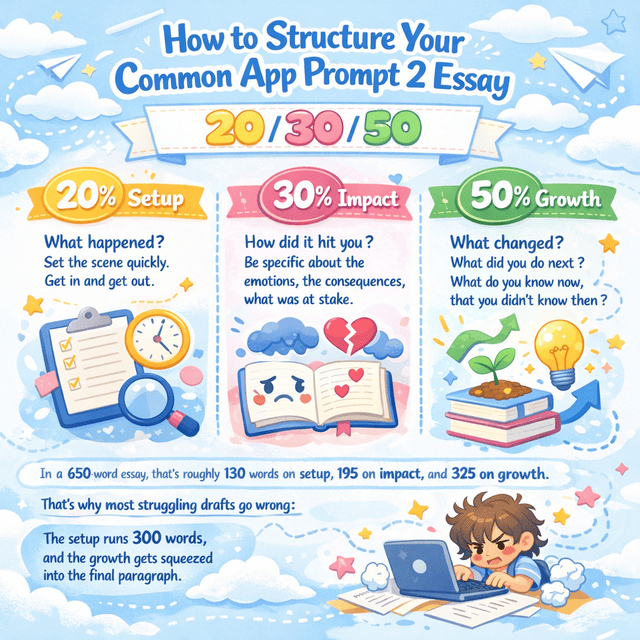
- 20% setup: What happened? Set the scene quickly. Get in and get out.
- 30% impact: How did it hit you? Be specific about the emotions, the consequences, what was at stake.
- 50% growth: What changed? What did you do next? What do you know now that you didn't know then?
In a 650-word essay, that's roughly 130 words on setup, 195 on impact, and 325 on growth. That's why most struggling drafts go wrong: the setup runs 300 words, and the growth gets squeezed into the final paragraph.
|
Start in the moment. Not "I always believed that hard work would be enough." Open with a specific detail, a line of dialogue, the thing that went wrong. Drop the reader into the scene before you explain what it means.
In the middle section, resist the urge to stay in the problem. Move toward the turning point as quickly as the story allows. Show the reader that this actually affected you, then pivot.
Your closing shouldn't be a moral. Don't end with "this experience taught me that I can overcome anything." Instead, show what the lesson looks like now: in a decision you made, a habit you built, or how you're approaching something differently as you head into college.
Two structural failures to watch for: spending the whole essay on setup because the situation feels like it needs context, and ending with a cliché pivot ("I learned to never give up") that undercuts everything specific you built before it. If half your essay is still describing the obstacle, the structure is off. |
Two Approaches That Work for Common App Prompt 2: Which One Is Yours?
Single-moment path: You tanked a mock trial round you'd spent three weeks preparing for. In the moment, you told yourself the judges were biased and moved on. Two weeks later, watching a teammate do exactly what your coach had been asking you to do, you realized you hadn't been listening. You spent the next month rebuilding your prep process: reading back through transcripts you'd dismissed, practicing cross-examination with a partner who'd been offering to help for months. You made it to regionals. More importantly, you stopped confusing preparation with certainty.
Recurring-pattern path: Three summers of failed leadership attempts in a community garden. The first year, you pushed a planting schedule nobody wanted. The second year, you introduced a work rotation that created more conflict than it solved. By the third year, you'd learned to ask before you decided: to spend the first two weeks just listening to what people actually needed from the space. The team you led that summer was the most engaged the program had seen. The lesson wasn't about leadership tactics. It was about the difference between being helpful and being useful.
Both work because the growth is specific and the arc is clear. The single-moment story has a sharp pivot. The recurring-pattern story has accumulated change.
Here's how to decide: if your story happened once and there's a clear before-and-after, go single moment. If it took three or four tries before something actually shifted, the recurring pattern probably feels more true. |
You've got your path, single moment or recurring pattern, and you know what the growth arc needs to look like. Turning that into a 650-word draft that's specific enough to work is where most students lose an afternoon. If your deadline is closer than you'd like, we'll write the common app essay for you, just send us your story, which path fits, and your deadline.
What Not to Write About, in Common App Prompt 2 Essay
Some topics don't work, not because the experiences weren't real, but because they make it harder to show what admissions officers are actually looking for.
Overused topics:
The sports injury that taught you perseverance. The bad grade that made you take school more seriously. Moving to a new school and having to make friends. These topics aren't disqualifying, but they've been written so many times that you're starting from a deficit. Your execution needs to be specific enough to make the reader forget they've seen this before.
Heavy trauma:
Mental health struggles, chronic illness, abuse, and similar experiences are hard to frame as growth narratives without flattening them. The Additional Information section exists for a reason. You can use it to give context without having to shape your hardest experiences into a tidy arc.
Topics where you're the villain:
Writing about a time you genuinely hurt someone can work, but only if the growth is unmistakable. Without it, the essay leaves readers uncomfortable in a way that doesn't help you.
The humble-brag fail:
Choosing a "failure" that's obviously a success in disguise signals a lack of self-awareness. Getting a B+ instead of an A, losing a competition you still placed highly in, being "too dedicated" to a project. These read as evasions, not honesty. Admissions officers will notice.
A note on cliché topics: they can work if the execution is specific and the growth is real. But it's a harder road. If you have a choice between a more unusual topic with a strong arc and a common topic with a strong arc, go unusual. |
You have a topic, a structure, and a clear sense of what admissions officers are actually looking for. The part most students find hardest comes next: turning that understanding into a draft that's specific, honest, and 650 words. If your application deadline is close and you'd rather have a writer handle the draft, our Common App overcoming challenges essay help gets you a complete, human-written Prompt 2 essay, built around your actual story
Prompt 2 vs. the Other Common App Prompts
Once you've got a strong draft, one question worth asking: is Prompt 2 actually the best home for this story?
Prompt 2 is the right choice when you have a clear story arc, a genuine turning point, and a lesson you can name specifically. It rewards students who are good at narrative and can drop you into a scene and walk you through a change.
When might a different prompt serve you better? If your challenge story is really about identity or personal values, Common App Prompt 1 or Common App Prompt 7 (the open prompt) might give you more room without forcing it into an "and then I overcame it" shape.
If your story is more about character and what drives you, Common App Prompt 5 covers personal growth and may be a better fit. |
Not sure whether to use Prompt 2 or Prompt 1? Common App Prompt 1 is about identity and background. If your story is more about who you are than what you learned, that's the one to look at first. |
You've got the structure, the topic test, and both paths mapped out. The part that takes real time is the draft itself, making it specific, honest, and exactly 650 words. If your deadline is in the next few days and you want it done right, our Common App Prompt 2 Challenge Essay Writing Service delivers a complete, human-written Prompt 2 essay built around your actual story, most students get their draft back within 24 hours.