Prompt 3 is still in your head after reading through all seven, that usually means you have a story for it.
This guide tells you whether it's actually the right call, how to structure the essay so the reflection lands, which topics work and which ones backfire, and the specific traps that kill drafts that had everything else going for them. Use the structure in Part 3 and you'll have a workable outline before you finish reading.
What Is Common App Prompt 3? (The Prompt, Explained)
Here's the full prompt text from the Common App essay prompts page:
Reflect on a time when you questioned or challenged a belief or idea. What prompted your thinking? What was the outcome? |
Before you start writing, slow down on each piece of what the prompt is actually asking, because students who skim it tend to miss the target.
- "A belief or idea"means something specific you personally held, not a vague social topic, not an abstract issue. A real value or assumption that was genuinely yours.
- "Questioned or challenged"is the moment of tension. Something disrupted what you thought was true. That friction is what drives the essay.
- "What prompted your thinking" is your catalyst. What happened, who you met, what you read or witnessed that created the shift?
- "What was the outcome"is your landing point. How did you change? What do you understand or do differently now?
A small proportion of applicants choose this prompt, which tells you it's specific enough to require a real story, not a generic one. The prompt isn't asking you to win an argument. It's asking you to show how you think when your own assumptions get tested.
The Strategic Risk of Choosing Common App Prompt 3
Before you start drafting, there's a strategic question worth answering first, and it's one most students don't think about until it's too late.
Prompt 3 overlaps heavily with school-specific supplement prompts at selective colleges. Harvard, Yale, Stanford, and others often ask some version of "describe a challenge to your thinking" or "what changed your perspective?" If you use your best "challenged a belief" story here, you can't reuse it in those supplements. That's not a disqualifying problem, but it's a real tradeoff you should make consciously.
Before you commit to Prompt 3, check whether the same story appears in your supplement prompts. Using your best material twice is wasted space.
Prompt 3 is a strong choice if:
- You have a clear, specific, personal story where a belief genuinely shifted
- You've already identified other compelling stories for your supplement essays
- Your story doesn't work cleanly under any of the other prompts
When Choosing Prompt 3, Think Twice if:
- This is your only strong "growth" story and you have multiple top-school supplements to fill
- You're drawn to it because of a political or social issue you feel strongly about (more on why that's risky below)
- You'd be stretching to fit a story that would land better under Prompt 1 or Prompt 2
- You're an international applicant whose strongest story involves a belief tied to cultural or religious identity, these essays can work beautifully, but they require extra care to avoid misreading by officers unfamiliar with your context
If you're still deciding, take a few minutes to review all 7 Common App essay prompts before committing. You might find a better match. |
How to Structure Your Common App Prompt 3 Essay
Good news: this prompt has a natural structure built into it. Three questions in the prompt (what you believed, what challenged it, what happened) map almost perfectly onto a 3-part essay arc.
Part 1: The "Before" (Your Original Belief)
Open by dropping the reader into a specific moment, not a summary. Establish the belief clearly and concretely before anything challenges it.
Vague looks like: "I used to think people who grew up differently than I did had little in common with me." Specific looks like: "Every Sunday growing up, the choice was clear: Olive Garden, no debate. Trying somewhere new felt almost rude." Same belief, but rooted in a real moment. Don't over-explain or apologize for it. Keep this section to no more than 20–25% of the essay. |
Part 2: The Challenge or Shift
Here's where the essay earns its place. Show the specific moment your belief got tested: what you saw, heard, or experienced. Be precise. "I met someone who showed me a new perspective" is a gap; "she told me she'd been cooking that recipe since she was six, and suddenly I felt the weight of how much I'd been missing" is the essay.
Keep the focus on your thought process, not on the issue itself.
Part 3: The Outcome or Growth
An essay only fully works if something changes. You don't need a dramatic transformation. Arriving at a new question you didn't know to ask is enough. But "I learned that people are different" doesn't land.
Be specific: what do you now do, think, notice, or ask differently? End with a forward-looking line that signals who you're bringing into college. |
The structure is simple: what you used to believe, what challenged it, and what you did with that realization.
Putting It Together: A Quick Example:
Before: I grew up assuming the fastest route was always the right one, in driving, in decisions, in everything. My dad called it efficiency. I called it common sense. Challenge: My AP History teacher spent an entire class on a single primary source. Forty minutes on one paragraph. I thought it was a waste. After: It wasn't. What I'd been calling efficiency was actually impatience, and I'd been applying it to people the same way I applied it to routes. |
Still unsure whether you can pull off the topic you've landed on? Tell us your story in a few sentences, what you believed, what shifted, and what changed, and Common App prompt 3 writing help from our team means you get a full draft built from your actual experience, not a template with your name swapped in.
Topic Ideas That Work for Common App Prompt 3
Not all topics are equal for this prompt. Here are the categories with the highest success rates. Here are a few to avoid as well.
Small-Scale Personal Beliefs (highest success rate)
- A belief about what someone from a different background was "probably like," then actually getting to know them
- A family tradition or habit you followed without thinking, until the moment you finally asked why
- An assumption about your own abilities ("I'm not a math person," "I'm not athletic") that got genuinely tested
These work because the stakes feel real and personal. The smaller the world the story lives in, the more specific and honest the writing tends to be.
Intellectual and Academic Beliefs
- A scientific or historical claim you accepted uncritically until a class, book, or documentary made you stop
- A belief about what success looks like, reshaped by a mentor, an internship, or watching someone you admired make a different choice
Social and Community Beliefs (handle carefully)
- A stereotype you'd absorbed without realizing it, encountered when you had to confront it directly
- A belief about who belongs in a certain space (a team, a subject, a social group) that turned out to be wrong
For a full list of Common App essay topic ideas, that guide goes much deeper on brainstorming across all prompts. |
Topics to Avoid:
- Hot-button political issues (gun control, abortion, immigration, LGBTQ+ rights). Not because your thinking isn't valid, but because admissions officers have their own beliefs, and you have no control over what you're walking into
- Issues you "challenged" without any real personal cost or discomfort. Essays that feel performative read as performative
- Topics where you never actually believed the thing you claim to have challenged
The Pitfalls You Need to Avoid in Common App Prompt 3
Four traps take down more Prompt 3 essays than anything else.
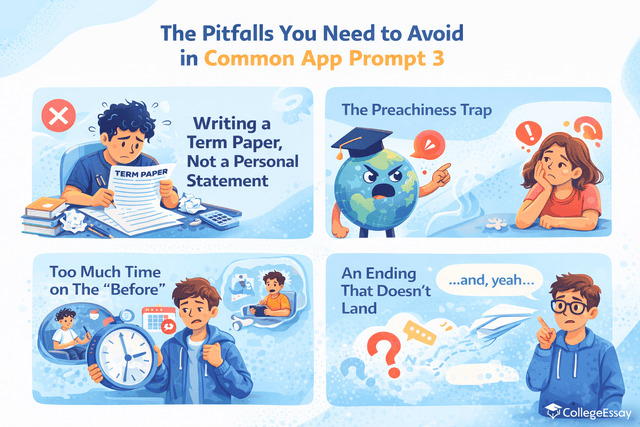
Trap 1: Writing a Term Paper, Not a Personal Statement
Question marks are in this prompt for a reason. It's asking about your thinking, not asking you to build a case. If your draft reads like a debate brief (here's the issue, here are the arguments, here's my conclusion), you've written the wrong essay. Shift everything to first-person reflection. "I believed" and "I started to notice" and "for the first time I understood" are the gears this essay runs on.
Trap 2: The Preachiness Trap
Scan your draft for sentences that sound like this: "everyone should," "society needs to," "people need to understand." If those phrases are in there, you've drifted from reflection into lecture. Reframe toward yourself: what did you realize, what did you start doing differently, what do you now carry with you?
If your draft sounds like an argument you're trying to win, it's the wrong essay. Prompt 3 wants reflection, not rhetoric.
Trap 3: Too Much Time on The "Before"
Students often over-explain their original belief out of guilt or thoroughness. Don't. Keep the "before" to no more than 20–25% of your word count. It exists to give the challenge somewhere to land, not to carry the essay.
Trap 4: An Ending That Doesn't Land
Vague resolutions like "I now know that things are complicated" or "I'm more open-minded" don't do the work. What do you specifically do, ask, or think differently now? What's the one thing you're carrying into college from this experience?
You now have the structure, and the topic approach, and the traps to avoid. The next step is a draft that captures the before, the shift, and the landing in your voice, specific enough that it could only be yours. If you'd rather not spend your next three hours staring at a blank document, the Common App essay writers at CollegeEssay.org build the draft from your real story: you share the experience, they write the essay, and you revise until it sounds exactly right.
What Admissions Officers Are Actually Looking For in Common App Propmt 3 Essay
Admissions readers aren't evaluating your position on the issue. They're evaluating what kind of thinker and learner you are.
What they want to see: that you can hold a belief, have it tested, and think carefully about what that means. You'll be in seminars, discussions, and environments that challenge your assumptions constantly. This essay is your audition for that. |
Intellectual humility is a feature here, not a weakness. Showing that you changed your mind, genuinely and specifically, can be more compelling than an essay where you stayed the course. It signals self-awareness, curiosity, and the ability to handle disagreement without shutting down.
Staying focused on your own growth, and away from relitigating the issue itself, makes the essay both safer and stronger.
For a sense of what the best essays in this category look like, browse Common App essay examples. Seeing the range of what works can help you calibrate your own story. |
Admissions officers aren't grading your position. They're evaluating how you think when something you believed turns out to be more complicated than you thought.
Conclusion
Prompt 3 isn't for everyone, but if you have the right story, it's one of the more memorable essays you can write. Keep it personal, keep it specific, and let the reflection do the work.
You have the prompt, the structure, and a topic that's actually yours. What's left is writing a draft that doesn't flatten the story into a formula. Tell us the belief, the moment it got tested, and your deadline, hand it off to our Common App essay team and you'll have a complete draft within 24 hours, built from your experience and ready to revise.