Prompt 5 has a deadline attached to it and you need a framework, a topic, and a reason to trust the one you pick. This guide gives you all three. The Before After Forward Frame below will structure your 650 words. The topic bank will help you find a moment worth writing about. And the self-test at the end will tell you whether you're ready to draft.
How to Write Common App Prompt 5: The Personal Growth Essay
What Is Common App Prompt 5 Really Asking?
The prompt gives you three trigger types: an accomplishment, an event, or a realization. Each one is a different kind of doorway, and each comes with its own trap.
An accomplishment is something you worked hard to achieve. Maybe you mastered a difficult skill, led a project to completion, or reached a goal that took months. The trap here is writing about the achievement itself. A list of what you did isn't a personal statement. The essay has to be about what achieving it revealed about you.
An event is something that happened to you, often something you didn't fully control. You might have been relatively passive in the moment. The trap is describing the event in vivid detail while treating the growth as an afterthought. Spending 600 words on what happened and 50 on what changed isn't a growth essay. It's a story.
A realization is an internal shift, an "aha" moment, often with no external drama at all. This is often the strongest trigger type because it's inherently reflective. You're not describing action. You're describing a change in how you see.
What all three trigger types share is this: they're not the point. The transformation is the point. You can look at all 7 common app essay prompts to see how Prompt 5 fits within the broader options, but this prompt has a specific demand the others don't: it asks you to demonstrate that you changed. |
Admissions officers want to see self awareness, emotional maturity, and evidence that you'll keep growing in college. "The accomplishment, event, or realization is just the doorway. What admissions officers actually want to see is who you became once you walked through it."
If you want a full overview of the writing process, check out our guide on how to write a common app essay. |
The Before After Forward Frame: A Writing Framework for Common App Prompt 5
The most common reason Prompt 5 essays fall flat isn't a weak story. It's a missing structure. Here's a framework that fixes that: the Before After Forward Frame.
Before is who you were before this moment. What did you believe? What assumptions were you operating with? What behavior or habit did you have? This section anchors the reader in your starting point, but it shouldn't dominate your essay. Keep it tight, around 100 to 150 words of your 650 word limit. |
After is where the essay lives. How did the moment change you? This needs to be specific, not general. Not "I learned to be more empathetic" but "I stopped assuming my lab partner's silence meant she agreed with me." The After section should take up the most space in your essay, roughly 200 to 250 words. |
Forward closes the loop. What does this growth mean for who you're becoming? How does it connect to your values, your goals, or how you'll show up in a college community? This section is shorter, around 100 to 150 words, but it's what separates an essay that tells a story from one that tells a story about you. |
That ratio matters. The triggering moment (Before) should take no more than 25 to 30% of your essay. The majority of your words belong to the After and Forward sections.
Phase | Purpose | Word Count (of 650) | What Goes Here |
Before | Anchor the reader in who you were | 150 words (23%) | A specific belief, habit, or assumption you held before the moment |
After | Show the transformation | 300 words (46%) | Exactly what changed, behavior, perspective, or understanding, with concrete specifics |
Forward | Close the loop | 150 words (23%) | How this growth connects to your values, goals, or how you'll show up in college |
Transitions | Connective tissue | 50 words (8%) | Movement between phases, don't let the essay feel like three separate blocks |
Total | 650 words |
If your essay spends most of its words describing what happened instead of what changed, you've written about the event. Not the growth. |
20+ Common App Prompt 5 Topic Ideas (By Category)
Choosing a topic is where students either get momentum or spin out. Here's a categorized bank of ideas, organized by what works and what to watch out for.
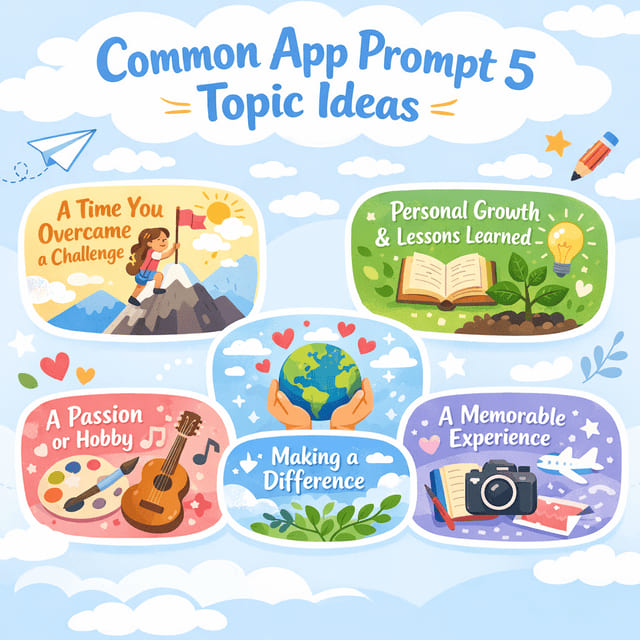
Small scale everyday moments are often the strongest Prompt 5 topics. These are moments most people would overlook, which means they require you to do real reflective work rather than letting a dramatic event carry the essay.
- Teaching a younger sibling something they'd been struggling with
- A conversation with a grandparent that shifted how you see family
- Failing a test you were certain you'd pass
- A job, chore, or responsibility you resented, then came to value
- Being wrong about someone you'd judged quickly
Accomplishment based topics work, but only when the focus stays on the internal shift, not the trophy.
- Finishing a long term creative project that almost defeated you
- Learning a skill from scratch in a field you were a complete beginner in
- Leading a team through failure instead of success
- A competition or audition you didn't win, and what you did with that
If you're still searching for your angle, it helps to brainstorm your Common App essay topic before committing. |
Realization based topics are often the most distinctive essays in any pile. There's no external event to describe, so the reflection has to do all the work.
- Reading a book or watching a film that reframed something in your life
- A moment you realized a belief you held wasn't actually yours
- Discovering a piece of family history that changed your self understanding
- Noticing that what you thought you valued wasn't actually what mattered to you
Relational topics pull from relationships, which means the growth is about how you relate to other people and what you're capable of in those situations.
- A friendship that ended and what it taught you
- Meeting someone whose life was very different from yours
- Supporting someone through something hard and learning what you were capable of
Cliché Warning: The most overused Prompt 5 topics are sports injury comebacks, short term mission trips, moving to a new school, and getting a first job. These topics aren't automatically disqualifying. They can work. But they require a genuinely fresh angle that goes well beyond the typical narrative. If your story sounds like everyone else's version of that story, it needs reframing before it's ready. |
"The best Prompt 5 topics are often the smallest ones, because small moments force you to do the reflective work instead of letting a dramatic event carry the essay."
The ideas above are specific to Prompt 5's growth requirement. For topic ideas across all seven prompts, see our guide on common app essay topics. |
Still haven't landed on one? That's the most common place students stall. Tell us your prompt, your grade level, and any topic directions your counselor gave, CollegeEssay.org prompt 5 writers, will either help you find the right angle or write the full essay around a topic that fits you.
What Admissions Officers Actually Want to See in Common App Prompt 5 Specific Essays
Admissions officers read thousands of growth essays. They've seen the arc: hardship, struggle, triumph, gratitude. After a while, that structure becomes noise.
What makes an essay stand out in that context is three things.
Emotional honesty. That includes acknowledging who you were before, including the parts that weren't flattering. Students who write about how great they already were before the moment happened miss the whole point of the prompt. Growth requires a starting point that needed to change.
Specificity in the transformation. "I became more open minded" tells an admissions officer nothing. "I stopped cutting off my debate partner mid sentence because I assumed I already knew her argument" tells them something real. Behavioral specificity is what separates a memorable essay from a forgettable one.
Forward looking reflection. How does this growth connect to your goals, your values, or how you'll function in a college community? The essay shouldn't just describe a past version of you. It should hint at who you're becoming.
The essays that backfire are the ones that portray a perfect arc. Something bad happened, you handled it perfectly, and now you're wiser. Real growth is messier. Admitting that makes you believable.
Admissions officers read thousands of growth essays. The ones they remember show a student who grew in a specific, believable way, not one who discovered they were already great. |
Two Example Summaries: One That Worked, One That Needed Fixing for Common App Prompt 5
Seeing the framework in action is more useful than reading about it. Here are two examples showing both sides, with the Before-After-Forward frame mapped onto each one so you can see exactly where the essay earns its strength or loses it.
Example A: Strong
The setup: A student who ran an outreach club for refugee students was challenged mid-session by a younger student who objected to being called a "refugee." The exchange lasted about three lines.
Before (~100 words):
For two years, I'd built the club around a simple premise: we were there to help. We called it refugee outreach because that's what it was, students from resettlement programs, paired with volunteers who could help them navigate a school that hadn't been designed with them in mind. I was proud of that framing. It felt accurate and purposeful. What I hadn't considered was that "refugee" wasn't a label my club members had chosen for themselves. It was one we'd assigned. I didn't know that until a twelve-year-old told me, in front of the whole room, that he wasn't a refugee, he was a person.
After (~250 words):
I didn't handle it well in the moment. I said something like "of course you are" — meaning of course you're a person, not the other thing — and moved on with the session. But I couldn't stop thinking about it on the drive home. The word "refugee" had always felt neutral to me, even compassionate. It described a real situation. What I hadn't understood was that a label applied by outsiders, however well-intentioned, can flatten the person it's attached to. My club member didn't want to be categorized. He wanted to be known.
Over the next two weeks I went back through everything we'd built — the flyers, the session structure, the way we introduced the program to new volunteers. The word "outreach" was everywhere, and underneath it was always the assumption that we were doing something for someone, not with them. We changed the club's name. We restructured the first session so returning members introduced the program to new ones instead of me doing it. The shift was small logistically. It felt enormous in the room.
What changed wasn't just the language. It was my understanding of what it means to help someone. Helping that centers the helper's comfort, their need to feel useful, their framework for what the other person needs, isn't really help. It's a performance of it.
Forward (~100 words):
I think about that session whenever I'm in a position to represent someone else's experience, in a group project, in a conversation where I'm the one with more context, in any room where I'm tempted to speak on behalf of people who are present and could speak for themselves. The instinct to label and categorize doesn't go away. But I know now to notice it, and to ask before I assume. That's the shift I'm bringing to college, not a fixed answer about how to help, but a better habit of asking who gets to define the terms.
Why it worked:
The triggering event was a single exchange. The Before establishes a specific belief (the framing was accurate and purposeful) rather than a vague personality trait. The After shows a concrete behavioral change, not "I became more aware" but "we restructured the first session." The Forward connects the growth to a transferable habit, not a conclusion. Admissions officers reading this see a student who can change behavior based on feedback and articulate why the change mattered.
You've got the framework and you know what admissions officers are looking for. The hard part now is sitting down and getting 650 honest, specific words onto a page, especially under application pressure. If you'd rather hand the writing to someone who does this every day, our writers can take the common app prompt 5 from here and deliver a complete draft built around your actual story.
Example B: Needed Fixing
The setup: A student wrote 500 words about her soccer team's state championship run. In the final 150 words, she mentioned "learning to trust the process."
Before (as written, 450 words):
The essay opened with the team's first practice of the season and moved chronologically through every significant match. There were vivid details, the mud on the field in October, the coach's halftime speech before the semifinal, the moment the final whistle blew. The writing was genuinely good. Anyone who read it would feel like they'd watched the season.
After (as written,150 words):
In the final section, the student reflected that the season taught her to "trust the process" and believe in her teammates even when results weren't coming. She noted that she'd become "more resilient" and "a better leader."
Forward: None. The essay ended after the reflection.
Why it needed fixing:
The ratio is inverted. The accomplishment takes up 70% of the essay and the growth takes up 30% and the growth section uses exactly the language admissions officers have read thousands of times. "Trust the process" and "more resilient" aren't transformations they're placeholders for a transformation that was never written. There is no Before belief to anchor against. There is no specific behavioral change in the After. There is no Forward connecting the growth to who she's becoming.
The structural fix:
Phase | Current word count | Target word count | What needs to change |
Before | 0 (implicit) | 100 words | Name a specific belief about winning, pressure, or team dynamics she held before the season |
After | 150 words | 300 words | Replace "trust the process" with a specific moment her behavior changed, a decision she made differently in the final than she would have made in October |
Forward | 0 words | 100 words | Connect the growth to how she handles pressure, leadership, or uncertainty in any context, not just soccer |
Event recap | 450 words | 100 words | Keep only what's necessary to make the Before believable, one or two vivid details, not the full season |
The fix isn't to find a better story. The story is good. The fix is to stop telling it as a sports story and start telling it as a growth story that happens to involve sports.
A Quick Self Test Before You Start Writing on Common App Prompt 5
Before you start drafting, it's worth running your topic through a quick filter.
Before you commit to a topic, run it through these four questions.
Can you clearly describe who you were before this moment in two or three sentences? Can you name a specific belief, behavior, or assumption that changed? Is the growth more interesting than the event itself? Does this topic reveal something about you that admissions officers can't find anywhere else in your application? |
If you answered no to any of these, your topic may need to be reconsidered or reframed. Reframing usually beats discarding. A cliché topic with a genuinely fresh angle can work. A seemingly original topic with no real reflection can't.
If Prompt 5 doesn't feel right after all this, Common App Prompt 7 gives you complete flexibility to write about whatever matters most to you. |
If you can't describe who you were before the event, you haven't found your essay yet. You've only found your story.
Conclusion
Prompt 5 isn't asking what happened to you. It's asking who you became because of it. Pick a moment where you can clearly describe a before and an after, use the Before After Forward Frame to structure your 650 words, and make sure the reflection takes up more space than the event. Small moments with honest, specific reflection will always outperform dramatic stories with thin takeaways. You've got the framework. Now write the essay.
You've got a framework, a topic filter, and a self-test. What's left is the writing. If Prompt 5 still feels stuck once you've picked your moment, our personal growth essay writing service takes your story and delivers a structured, deadline-ready draft, usually within 12 hours.
Frequently Asked Questions
What is Common App Prompt 5 about?
Common App Prompt 5 asks you to write about an accomplishment, event, or realization that sparked a period of personal growth and a new understanding of yourself or others. The key is that it's not about the event itself. It's about the transformation that followed.
Is Common App Prompt 5 hard to write?
It can be, because many students focus too much on describing what happened and not enough on explaining how they changed. The fix is using a clear before-and-after structure. If you're still deciding between prompts, see how Common App Prompt 1 compares before committing.
How do I pick a topic for Common App Prompt 5?
Look for a moment when you clearly believed or behaved one way before and another way after. The best topics are often small: a conversation, a failure, a realization. If your story requires a lot of scene-setting just to make sense, it might be too event-heavy for this prompt.
What are cliché topics for Common App Prompt 5?
The most overused topics include sports injury comebacks, short-term mission trips, moving to a new school, and winning a competition. These can still work, but only if you bring a genuinely fresh and specific angle that goes beyond the typical narrative.
How long should the event description be in my Common App Prompt 5 essay?
The triggering moment should take no more than about 25 to 30% of your word count. The majority of your 650 words should be devoted to explaining what changed and why it matters.
Can my Common App Prompt 5 topic be something small or everyday?
Yes, and it's often better that way. Small moments require more reflective work, which is exactly what admissions officers want to see. A three-line conversation can carry a stronger essay than a year-long challenge if the reflection is honest and specific.
Meredith Lawson Verified
Author
Meredith Lawson has an MA in English Literature and extensive experience helping students craft compelling and authentic admission essays, especially Common App essays. Having completed over 920 orders, she knows how to help applicants stand out with their unique stories and qualifications for college and graduate programs.
Specializes in:
College Admissions
Personal Statements
Graduate School
Read All Articles by Meredith Lawson
Keep Reading
Was This Blog Helpful?
On this Page