Why the Speech Introduction Does More Work Than You Think
Everything that follows depends on what happens in the first minute. If the audience is curious by the end of your opener, the rest of your content gets a fair hearing. If they're bored, no amount of solid evidence in the body will recover the room.
Research by UC Irvine's Gloria Mark has tracked the average screen based attention span dropping from 150 seconds in 2004 to around 47 seconds today. In a live speech, the window is even tighter; most audiences decide within the first thirty seconds whether to listen or mentally check out.
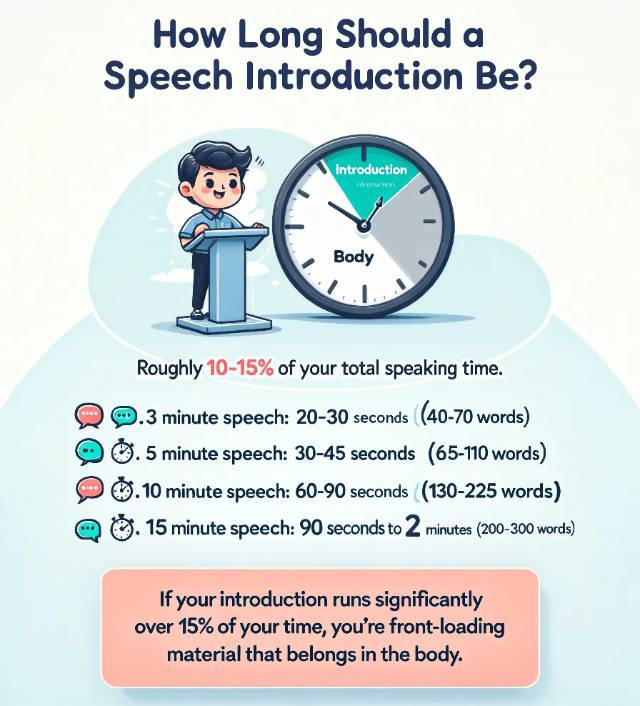
A speech introduction is the opening 10-15% of a speech that earns the audience's attention, previews what's coming, and establishes the speaker's credibility. This guide focuses on opening; the complete speech writing process covers the full arc from topic to delivery.
A good introduction does three jobs at once: it makes the audience want to listen, tells them what you're going to talk about, and establishes that you're worth trusting on the topic. Most weak introductions only announce the topic and skip the rest. That's why they feel flat. |
The Five Components of a Strong Speech Introduction
Every effective introduction contains the same five elements, in roughly this order.
- The hook. The first sentence or two that earns attention, not your name, not the topic, is a deliberate opening move.
- Connection to the audience (the "so what"). A beat that signals you know who you're talking to and why this matters to them specifically. One sentence naming the stakes for the people in the room. Example for a speech on sleep: "If you're pulling two all-nighters a week like most students on this campus, the next five minutes will tell you what that's actually costing you."
- Credibility signal. A brief indication of why you're the right person to speak on this topic.
- The thesis. The central claim or purpose of the speech is stated plainly.
- The preview. A signpost telling the audience what's coming, in order.
Miss any one, and the introduction feels incomplete. Together, they take about 10-15% of your speaking time.
How to Write a Speech Introduction: Complete Process
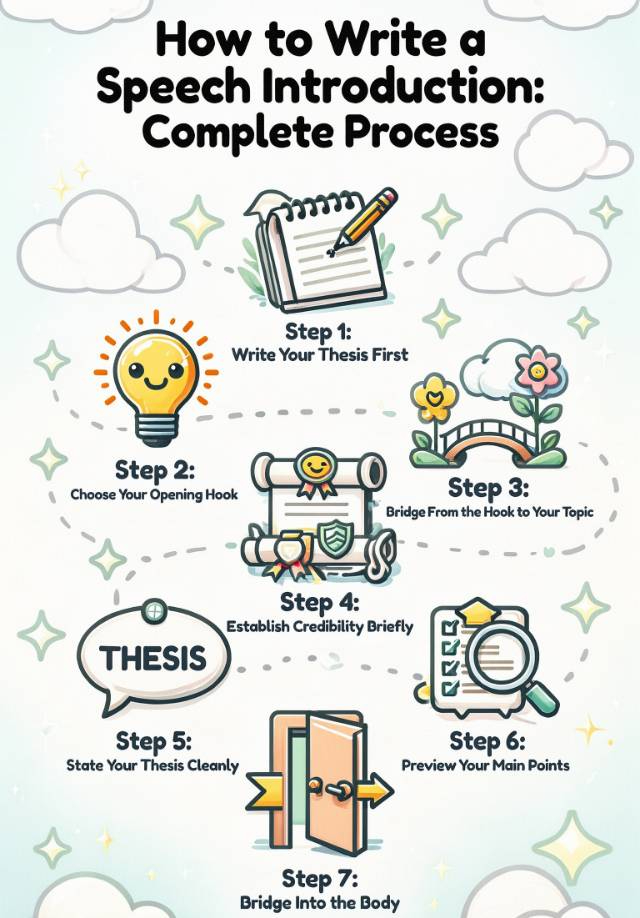
Step 1: Write Your Thesis First
Draft your thesis in one sentence. Plain language, no filler. "Social media is making it harder for teenagers to develop a sense of identity." Once you can state it cleanly, write your body, then come back for the rest of the introduction.
Step 2: Choose Your Opening Hook
Eight reliable openers. One of them will fit your topic.
- The startling statistic. A specific, unexpected number that reframes the topic. "Forty percent of American college students report going hungry during the semester."
- The short story. Two to four sentences dropping the audience into a specific moment. Works for almost any topic because stories bypass resistance.
- The provocative question. A question the audience hasn't considered but now can't stop thinking about. Avoid yes/no questions; they're easy to dismiss.
- The bold claim. A statement so strong it demands a response. "Most of what you were taught about nutrition in elementary school is wrong."
- The quotation. A short, memorable line from a credible source. Use sparingly; the audience is there to hear you, not someone else.
- The contrast or paradox. Two facts placed side by side that shouldn't both be true. "We spend more on college than any country on earth. We rank twenty-fourth in student outcomes."
- The direct address. Naming the audience's exact situation. Works when the audience shares a specific experience with the topic.
- Reference to the occasion. Naming the specific event, date, or reason everyone is gathered. Essential for commemorative speeches, toasts, dedications, and acceptance speeches, awkward for academic or persuasive speeches where the occasion is just 'class.'
- The strategic pause. Walk to your spot, look at the audience, say nothing for three to five seconds. Then begin. The silence creates tension and signals you're in control of the room, not the other way around. Hard to pull off if you're nervous, powerful if you can.
- The prop or demonstration. Hold up an object, show a single image, or perform a brief action before speaking. Works when a physical object makes the topic concrete faster than words can, a jar of beach plastic for a pollution speech, a resume covered in red ink for a speech on hiring bias.
Pick one. Write a version. If it feels weak, try a different type. Hooks are disposable at the drafting stage.
Which Hook Fits Which Speech Type
Not every hook works for every speech. A joke opens a toast beautifully and ruins a commemorative address. Match the hook to the purpose: For a full breakdown of each format, see the guide to different types of speeches.
Speech type | Best hooks | Avoid |
Informative | Startling statistic, bold claim, contrast | Reference to occasion (no emotional stakes) |
Persuasive | Statistic, story, provocative question, contrast | Quotation alone (borrowed authority, not yours) |
Commemorative/ceremonial | Story, reference to occasion, quotation | Bold claim, provocative question (wrong tone) |
Motivational/inspirational | Story, direct address, provocative question | Statistic heavy openers (too clinical) |
Impromptu | Direct address, reference to the occasion | Story Openers |
When in doubt, default to the short story or the startling statistic. Both work across the widest range of speech types and audiences, though for impromptu speeches, the direct-address opener usually wins because you don't have setup time for a story.
Step 3: Bridge From the Hook to Your Topic
The hook earned attention. Now connect it to what you're actually going to talk about, usually one or two sentences. If your hook were a statistic, explain why the number matters. If it were a story, tell the audience what the story illustrates.
Step 4: Establish Credibility Briefly
One sentence. "I spent the last three weeks interviewing twelve students about this." Or: "I've been looking at the data on this since my statistics class last semester." Don't overstate, don't apologize.
Step 5: State Your Thesis Cleanly
No hedging, no filler. If your audience can't repeat your thesis back after hearing your introduction, you've buried it.
Step 6: Preview Your Main Points
Tell the audience what you're going to cover, in order. "I'm going to cover three things: what's driving this, why the usual solutions haven't worked, and what a better approach would look like." For a speech under three minutes, this can be compressed into a single phrase attached to the thesis.
Optional: add an empowerment promise. For persuasive and informative speeches, one sentence naming what the audience will walk away with sharpens the preview. Not "I'll cover three things" but "By the end of this, you'll know exactly which of those three fixes to try first." Tell them what they'll be able to do, decide, or understand that they couldn't before. |
Step 7: Bridge Into the Body
One sentence to close the introduction and open the first main point. "Let's start with what's actually happening to the teenage brain after midnight." Or simply: "Here's where it starts." Without this bridge, the transition feels abrupt. The audience hears the preview, and then you're mid topic with no handoff.
Still stuck on how the introduction connects to the rest? The whole speech is only as strong as its weakest part, and the introduction sets the tone for everything that follows. If the deadline is close and you'd rather hand the whole thing off, and just ask, can you have my speech written by CollegeEssay.org from my brief? Most drafts come back in under 24 hours. |
Write the Speech Introduction Last (Yes, Really)
This is the single most useful piece of advice on speech writing you haven't heard, and every major university writing center recommends it: draft your introduction after the body is finished, not before.
Here's why. The introduction sets expectations for the rest of the speech. If you write it first, you're promising the audience something before you know what you're actually going to deliver. You'll either write a generic intro that fits any version of the speech, or you'll write a specific intro and then contort the body to match.
Write the body first. Let your main points settle. Then come back and write an introduction that accurately previews what's already there. Your hooks will be sharper, your thesis will be tighter, and your preview will match the speech you actually give.
The one exception: draft your thesis first, before the body. A one sentence thesis keeps the body focused. Save the hook, the credibility beat, and the preview for after.
Speech Introduction Examples
Example 1: Sleep Deprivation
"Last week, I fell asleep in a lecture hall with a hundred and twenty other students. Three of them fell asleep with me. This isn't a story about a boring professor; it's a story about what happens when an entire generation stops sleeping. I'm going to cover what sleep deprivation actually does to the brain, why college students have become the worst-affected group in the country, and the three things that work to fix it." |
What works: Specific scene, relatable, mildly funny. The second line reframes the story as a bigger issue. Thesis and preview combined in the last sentence with clear signposting.
Example 2: Campus Food Insecurity
"Forty percent of students at this university have gone hungry at some point during the semester. Not busy, not skipping meals, actually hungry because they couldn't afford food. I spent the last month talking to people in the financial aid office and to students who've lived this. I'm here to argue for one specific fix: a no questions asked meal bank on this campus, within the next academic year." |
What works: Statistics create immediate stakes. Bridge clarifies what the number actually means. Credibility comes from direct research. The thesis is specific and actionable.
Example 3: Commemorative speech at a retirement
"Twenty six years ago, Ms. Patel walked into Room 204 for the first time. She was twenty four, had exactly one week of teaching experience, and she was terrified. I know this because she told our class the story on the last day of junior year. Today I want to talk about what Ms. Patel gave to the thousand plus students who sat in that room after her and why the school is going to feel different without her in it. |
What works: The story opener puts the audience inside a specific scene. Concrete details make it real. The thesis names exactly what the speech will celebrate.
Example 4: How NOT to Open
"Hi, my name is Alex, and today I'll be talking to you about the importance of recycling. Recycling is very important in today's world. I hope you enjoy my speech." |
What's broken: Label opener, vague claim, filler phrase ("in today's world"), meta-comment instead of a thesis. No hook, no credibility, no specific preview.
Watch a Weak Introduction Get Fixed
Recognizing a strong introduction is easier than writing one. Here's a real student draft for a 5-minute persuasive speech on student mental health, revised in three passes.
Draft 1 (the starting point): "Hi, my name is Jordan, and today I want to talk about mental health on college campuses. Mental health is a really important issue in today's world, especially for students. A lot of students are struggling, and I think we should do something about it. I'm going to talk about the problem, the causes, and some solutions." What's broken: Label opener. "Really important in today's world" is filler that could describe any topic. "A lot of students" has no specificity. The thesis is vague; "do something about it" commits to nothing. The preview is a generic structure, not actual content. Pass 1: replace the opener, sharpen the thesis: "One in three students at this university will experience a mental health crisis before they graduate. Most of them will never walk into the counseling center. I want to argue that the problem isn't awareness, it's that we've built a system that asks struggling students to do the hardest possible thing at their lowest possible moment." Better: specific statistic, bridge that reframes the issue, thesis with an actual argument. But credibility and preview are missing. Pass 2: add credibility and a real preview "One in three students at this university will experience a mental health crisis before they graduate. Most of them will never walk into the counseling center. I've spent the last month talking to six students who didn't get help when they needed it, and to two counselors about why. The problem isn't awareness it's that we've built a system that asks struggling students to do the hardest possible thing at their lowest possible moment. I'm going to show you what that moment actually looks like, why the current system fails at it, and one specific change that would fix it." |
Now all five components are present: hook, bridge, credibility, thesis, and preview. The thesis commits to a real argument, and the preview promises specific content, not generic structure.
Time to revise this pass: roughly 20 minutes. Most weak introductions are two passes away from strong ones; the components are usually missing, not broken.
You've got the introduction. The harder parts are writing the body, hitting your time limit, and landing the close is where most students get stuck on the day of. If the deadline is close and you'd rather not draft the rest from scratch, our speech introduction writing service covers the full speech, not just the opener. Tell us your topic, your time limit, and your audience, and we'll have a complete draft back within 24 hours. |
Common Mistakes in Speech Introductions
- Starting with "Hi, my name is..." Unless the context requires a formal self introduction, this burns your opener on a label. Introduce yourself after the hook, not before.
- Apologizing in advance. "I'm not really a good speaker," "Sorry if this is boring." Every one of these tells the audience to lower their expectations. Cut them.
- Meta comments about the speech. "I'm going to talk about..." The audience already knows you're speaking. Open with content, not commentary.
- Burying the thesis. Read your introduction aloud and underline the sentence stating your main point. If there isn't one, add it. If it's buried, move it forward.
- Overloaded openers. Three statistics, a quote, a story, and a question all in the first minute. Pick one type of hook and let it breathe.
- Generic bridges. Any sentence that would work in an introduction to any topic isn't doing work. Rewrite until it's specific.
- Forgetting the preview. Skipping the preview leaves your audience without a map. Even a short speech needs one sentence of signposting.
- Mismatched tone. A joke opener on a serious topic. A somber story for a lighthearted speech. The hook must match the mood of what follows.
- Talking before you're set. Don't start speaking as you walk to the lectern. Reach your spot, plant your feet, make eye contact, then begin. The opener loses power if it competes with your footsteps.
- Cliché hooks. "Webster's dictionary defines X as..." "They say that..." "In today's world..." These signal a speaker who didn't find a specific opener and defaulted to a generic one. If your hook would work for anyone else's speech on any other topic, rewrite it.
Bookending: How the Speech Introduction Sets Up the Conclusion
Strong introductions don't just open the speech they set up the ending. The best closings call back to something specific from the opener: the story resolves, the statistic gets answered, the question posed at the start gets addressed.
This is why the introduction and conclusion should be drafted together, after the body is written. If you open with "Three of my classmates fell asleep with me last Tuesday," your closing line can be "The next time three of us fall asleep in a lecture hall together, I'd like it to actually be because the professor was boring." The callback makes the speech feel whole rather than merely finished.
When you draft your introduction, note the specific image, phrase, or number you're opening with. That becomes the thread you'll pick up at the end.
Delivering the Introduction You Just Wrote
The opening thirty seconds are where nerves peak and where most speakers rush. A few delivery notes specific to the introduction:
- Memorize the first minute word for word. Even if you're delivering the rest from notes or bullets, know the introduction cold. It lets you make eye contact from the first sentence instead of reading, and it removes the moment most speakers fumble.
- Pause after the hook. One full beat of silence after your opening line. It gives the audience a moment to register the statistic, the story, or the claim and it signals that you're in control of the pace rather than racing through.
- Slow the thesis down. The thesis is the one sentence you most need the audience to hear clearly. Deliver it slightly slower than the surrounding sentences and make eye contact with someone when you say it.
- Adjust for the room you actually get. If the room is smaller, more casual, or more distracted than you prepared for, tighten the introduction in real time, cut the credibility sentence, shorten the bridge, and get to the thesis faster. The five components are a structure, not a script.
- For virtual or recorded speeches, look directly at the camera during the hook and the thesis, not at your slides or your own preview window. The opening is the only point in a virtual speech where you can establish presence before the audience's attention fragments, so the camera contact matters most here.
A well written introduction that's rushed or read off a page lands worse than a mediocre introduction delivered with composure. Practice the opening out loud at least three times before you deliver it.
Quick Speech Introduction Checklist: Before You Move On
Run through these six questions before the introduction is done.
- Does the first sentence do something other than announce your name or topic?
- Can you state your thesis in one sentence, and is that sentence actually in the introduction?
- Does your introduction tell the audience what's coming in order?
- Would a stranger know why you specifically are giving this speech?
- Is there a moment where someone in the audience would nod or lean in?
- When you read it aloud, does any sentence feel like filler?
Six yeses and you're ready. Any no and it isn't done yet.
What Comes After the Speech Introduction?
A strong introduction sets up the speech, but it doesn't deliver the whole thing. The work shifts to structuring the body, writing transitions, and building a conclusion that earns the silence.
You've got your opener. Writing a speech introduction is the hardest single minute of speech writing; once it's done, the body usually falls into place. If you've spent an hour on the opening and still aren't happy with it, or the whole speech is due soon and you'd rather not draft the rest from scratch, you can get a speech written start to finish by our writers. Tell us your topic, your time limit, and your audience, and we'll have a complete draft back within 24 hours.