Before You Start Speech: 5 Things to Do in the 24 Hours Before
If your speech isn't written yet, or the draft isn't flowing, start with our complete guide to speech writing first.
1. Rehearse out loud at least three times, not in your head
Reading through your speech silently feels like practice. It isn't. Silent rehearsal uses a different part of your brain than speaking out loud does, and it completely hides the places where a sentence sounds fine on the page but trips your tongue when you say it. You will not discover those landmines until you're at the podium unless you rehearse out loud.
Three times is the minimum:
- First read: stumble through, notice what's awkward, revise.
- Second read: time yourself.
- Third read: time yourself again and see if you're within 10 seconds of the first time.
If you are, your pacing is stable. If you're wildly different, you don't know your own speech yet.
2. Record yourself once and watch it back
This is unpleasant. Everyone hates watching themselves on video. Do it anyway. You will notice five things in one viewing that no amount of mental rehearsal will ever surface: a filler word you say constantly, a habit of looking at the ceiling when you think, a place where your voice drops so much the back of the room won't hear you, a section where you're clearly reading versus clearly talking, and your actual pace which is almost always faster than you think.
You don't need to fix all five. Fix the two that bother you most and leave the rest.
3. Memorize your opening and closing word for word
Not the whole speech memorizing the whole thing is a trap that makes you sound like a recording when you succeed and panic when you forget a word. But the first 30 seconds and the last 30 seconds carry the most weight and are the most vulnerable to nerves. Your hands will shake at the start. Your brain will fog at the end. Memorizing those two sections means you'll be on autopilot exactly when autopilot saves you.
4. Pick your outfit the night before and make sure it passes the arm test
Raise both arms above your head. If anything rides up, pulls tight, shows skin you didn't plan to show, or feels restrictive, change it. You will gesture. You will move. A shirt that's fine while you're standing still is a disaster when you point at a slide.
Also: no bright whites or deep blacks if you'll be on video. They blow out the camera exposure. Mid-tones photograph best.
5. Walk the room if you can, or look up the layout
If the room is accessible, go stand in it. Stand at the spot you'll speak from. Look at where the back wall is, that's where you'll direct your voice. Find the exits, the light switches, and the clock you'll want to glance at. If the room isn't accessible, at least find a photo online. Not knowing the physical space is a solvable problem that too many students solve in the worst possible way: by being caught off guard.
Got the prep work sorted, but realising your speech itself isn't ready? If you're running out of time to polish the script, our professional speech writing and delivery service can deliver a structured, rehearsal-ready speech within 24 hours, written to be spoken aloud, not just read. You focus on showing up prepared. |
The First 30 Seconds of Speech: How to Open Without Dying
The opening is the single highest leverage moment in your entire speech. Nail the first 30 seconds, and the audience is with you for the next 5 minutes. Flub them, and you'll spend the whole speech trying to climb back.
6. Pause for three seconds before you start
This is the single most counterintuitive tip in this guide, and the one most worth trusting. When you step up to the podium, do not start speaking. Look up. Take a breath. Make eye contact with two or three people in the room. Count to three silently. Then start.
Three seconds feel like an eternity when you're standing there. To the audience, it feels like poise. This pause does three things: it gets the room quiet without you having to ask, it signals that you're in control, and it steadies your own breathing so the first sentence comes out at the right volume and pace. Skipping this pause is the number one rookie mistake. They rush to the mic and launch straight into "Hi uh so today I'm going to talk about…" at double speed.
7. Do not start with "Hi, my name is…" or "Today I'm going to talk about…"
These openings are dead on arrival. Everyone in the room already knows who you are and why you're there. Your name is on the assignment list, and the topic is on the slide behind you. Using those 10 seconds to state the obvious is the fastest way to signal that you have nothing interesting to say.
Open instead with one of: a specific number or statistic, a one sentence story, a direct question to the audience, or a single vivid image. |
8. Speak 15% slower than feels natural
Nerves compress time. What feels like a normal pace when you're standing at the front of a room is almost always too fast for the people listening. The single most common feedback instructors give on student speeches is: "Slow down."
Rule of thumb: if you feel like you're talking slightly slower than a podcast host, you're at the right speed. If you feel like you're talking at a normal conversational pace, you're going too fast.
9. Find three faces and speak to them in rotation
"Make eye contact with the audience" is useless advice. You cannot make eye contact with 30 people. You can make eye contact with three ones on the left, one in the middle, and one on the right, and rotate between them every 15 seconds or so. To the audience, this reads as engagement with the whole room. To you, it reads as having a conversation with three specific humans, which is far less terrifying than addressing a crowd.
Pick the three faces in your opening pause. Confirm they look engaged and friendly. Those are your anchors for the rest of the speech.
During the Speech: Keeping the Audience With You
10. Pause after every key point. Silence is a weapon
Students are terrified of silence and fill it with "um," "uh," "like," and "so." Experienced speakers know that a deliberate 2 second pause after an important point does more work than any word they could have said instead. It gives the audience a beat to absorb. It signals that what you just said mattered. And it resets your own breathing.
Practice this by marking your script: draw a // after every sentence you want to land. When you hit one, stop. Count two. Then continue. |
11. Vary your pace and pitch. Monotone delivery is monotone regardless of content
A speech delivered at a single consistent pace is a lullaby. The most engaging speakers systematically vary: fast during build up and excitement, slow during key points, a slight acceleration when telling a story, and a deliberate slowdown before a conclusion. You don't have to plan this out in detail, just be aware of it and let the content guide you.
The same goes for pitch. A voice that sits at one note the entire time reads as nervous or bored, even when the content is strong. Let your voice rise slightly on questions, drop on serious points, and stay in the middle for most of the speech. This happens naturally in casual conversation, the trick is not suppressing it when you get nervous.
One concrete move: for the single most important sentence in your speech, say it at about 70% of your normal speed, with a pause before and after. That's the sentence your audience will remember. This is especially important for extemporaneous speech delivery, where you're speaking from an outline rather than a full script. The pace variation keeps the outline feeling spontaneous rather than hesitant. |
12. Project to the back wall, not the front row
Most students speak at the volume they'd use when talking to the person directly in front of them. In a room of 30 people, that means rows 4 through 6 can't hear you, and the moment the audience strains to listen, they tune out.
Pick a spot on the back wall of the room. Aim your voice at that spot. This forces you to open your chest, breathe deeper, and push more air behind each sentence without shouting. The front row won't think you're loud, they'll think you sound confident. If you're miked, the same principle applies mentally; projection is as much about posture and breath as it is about volume.
Diaphragmatic breathing helps here. Before you start, put one hand on your stomach and take three slow breaths where your stomach (not your chest) expands. That's the breathing you want to keep doing throughout the speech. Shallow chest breathing is what makes voices shake.
13. Use your hands, but keep them above the waist
Gestures aren't optional. Hands glued to the podium or clasped in front of you read as stiff and nervous, no matter how confident the rest of you looks. Gesture naturally, the way you do in conversation, but keep them above your waist. Gestures below the waist are invisible to anyone past the second row and look fidgety on camera.
If you genuinely don't know what to do with your hands, try this: rest them lightly on either side of the podium, and lift one when you want to emphasize something. That's the default. Everything else builds from there.
14. Move with purpose, never pace
Walking around while you speak is fine. Pacing while you speak is not. The difference: moving with purpose means walking to a new spot, stopping, and speaking from there. Pacing means drifting back and forth continuously in a 3 foot box.
If you have room to move, pick two or three spots. Speak from spot A for the opening. Walk to spot B for the middle section, the movement itself acts as a transition. Walk to spot C for the conclusion. The audience follows your movement as a visual cue that the speech is progressing.
If you're stuck at a podium, forget this tip entirely. Stand still, use your upper body and hands, and don't rock.
15. Cut "um," "uh," and "like" with silence, not effort
Trying to stop saying filler words by thinking "don't say um" while you're speaking is impossible. The word slips out before the thought registers. The only thing that works: when you feel a filler word coming, close your mouth instead. The half second of silence that replaces it will feel jarring to you and completely normal to the audience.
Filler words come from the gap between finishing a thought and starting the next one. Your brain hates that gap and fills it with noise. Train yourself to let the gap exist; that's where pauses live, and pauses are good.
16. Use verbal signposts so the audience knows where you are
In writing, readers can flick their eyes back to the previous paragraph if they lose the thread. In speech, they can't. Once a sentence has been said, it's gone, and if the audience loses the structure, they tune out for good.
Fix this with verbal signposts: short phrases that tell listeners where they are in the speech. "First," "second," "third." "The key point here is…" "Now here's what most people miss." "Before I get to the main argument, there's one thing worth noting." These feel obvious when you're writing, but they're what stop an audience from getting lost. Mark them into your script deliberately at every transition between major sections; there should be a phrase that tells the listener a transition is happening. |
Engaging the Audience: Techniques That Turn Listeners into Speech Participants
This is the part of the guide most "speech delivery tips" articles skip. Delivery is not just how you stand and talk, it's how you pull the audience in so they stop being spectators and start being part of what's happening in the room. These four moves do the heavy lifting.
17. Ask direct questions and actually wait for answers
A rhetorical question is fine. A real question, one where you pause and wait for the audience to respond, even nonverbally, is far more powerful. "By a show of hands, how many of you have given a speech in the last month?" forces every person in the room to engage physically with your topic. They're no longer audience members. They're participants.
Two rules make this work.
- First, only ask questions that most of the room can realistically answer. "Who here has had to give an impromptu speech?" is accessible; "What's the best speech you've ever heard?" puts people on the spot.
- Second, signal clearly whether the question is real or rhetorical. "By a show of hands" signals real. "Think for a moment…" signals rhetorical. Audiences get confused when they can't tell, and confusion kills engagement.
18. Tell one specific story, not a general example
Audiences forget statistics. They forget arguments. They remember stories. This is not a preference, it's how human memory works. If you want one thing from your speech to stick, put it in a story.
The rule: specific beats general every time. "A student I know was terrified of public speaking" is weak. "My roommate Sarah threw up three times before her sophomore year communications final" is strong. Specific details, names, places, moments, and numbers are what make a story land. A 30 second story with three concrete details will outperform a three minute general argument in audience recall every time. |
Put the story early in the speech. Opening with a specific moment is one of the strongest hooks available.
19. Reference the room, the moment, or something that just happened
Nothing breaks the fourth wall faster than acknowledging where you and the audience actually are. "I know it's 9 AM on a Friday and you'd rather be anywhere else" is doing more work than the next three sentences of your speech. "The speaker before me just made the case for X I want to push back on that" instantly signals that you're present, listening, and not just reciting a canned script.
This works because most speeches are delivered as if they could be given to any audience in any room. The moment you acknowledge this specific audience in this specific moment, the audience wakes up. You are talking to them, not at them.
One specific move: if you can name something that happened in the last 24 hours a campus event, a news story, something the previous speaker said do it. It takes 10 seconds and signals preparation that no amount of rehearsal can fake. If you specifically struggle with speaking under pressure and no prep time, practice with our list of impromptu speech topics. Regular practice with random prompts is the fastest way to build adrenaline tolerance. |
20. Use "we" and "us," not "you" and "I," when it's honest to do so
Pronoun choice changes the relationship between speaker and audience more than people realise. "You need to understand this problem," puts the audience on one side and you on the other. "We need to figure this out together," puts you on the same side. The second one builds a sense of shared purpose that the first one actively dismantles.
This doesn't mean that use "I" personal stories require it, and trying to use "we" when the content is clearly about your own experience reads as slippery. Use "we" when the problem, stake, or conclusion genuinely applies to both you and the audience. Use "I" when the story is yours. Most student speeches massively under use "we" and massively over use "you," which is why they land as lectures instead of conversations.
When Things Go Wrong: Recovery Moves That Save the Speech
21. If you lose your place, pause and take a sip of water
Every speaker's worst fear: your mind goes blank, you forget what comes next, you stare at your notes, and none of it makes sense. This is going to happen to you at some point in your speaking life. It's especially common in impromptu speech delivery situations where you haven't had time to over-rehearse. Here is how to handle it.
Pause. Reach for water. Take a sip. This buys you 5–10 seconds without any sign of panic. People pause for water all the time; it's invisible. During those seconds, look at your notes, find where you are, take a breath, and continue. Ninety percent of the time, the audience didn't even notice you froze.
If you don't have water, use your notes. Pause, glance down, find your place, look up, keep going. A 3 second pause reads as thoughtful. A 10 second pause reads as trouble. The sooner you accept the pause and use it, the shorter it gets.
22. If you stumble on a word, don't apologize, just continue
Tripping over a word mid sentence is fine. Everyone does it. The move that turns a minor stumble into a disaster is apologizing: "Sorry, let me try that again." Now you've drawn attention to something nobody noticed and primed the room to watch for your next mistake.
Just say the word correctly and move on. If you completely mangled the sentence, say the whole sentence again, starting from the beginning without comment. The audience processes it as emphasis, not as a mistake.
23. If you go over time, skip, don't rush
Running out of time is common. The worst thing you can do is try to cram your remaining five minutes into two by speaking at triple speed. The audience shuts off, your delivery collapses, and your strong closing gets lost.
The right move: identify the two or three sections you can cut in real time. Jump straight to your conclusion. A speech that ends 30 seconds short at full strength beats a speech that ends on time but sounds like an auctioneer for the last two minutes. Rehearsing out loud (tip #1) is what makes this possible. You need to know your speech well enough to drop sections on the fly. |
24. If your nerves spike mid speech, rename what's happening
Adrenaline feels identical to excitement. The only thing that separates "I'm about to throw up" from "I'm fired up and ready" is what you tell yourself in the moment. Research on performance anxiety consistently finds that speakers who mentally reframe nerves as excitement perform measurably better than those who try to calm themselves down.
If your heart is pounding and your hands are shaking mid speech, don't tell yourself to relax, tell yourself you're energised. Take one slow breath, let the sentence land, and keep going. The physical symptoms don't have to disappear for you to perform well. They just have to be doing something other than making you quit.
Using Slides and Visual Aids Without Killing Your Speech Delivery
If your speech involves slides, a prop, or a visual aid, the single rule is: the visual serves you, not the other way around.
Three tactics that make the difference;
- First: never read from your slides. If the words on the slide and the words from your mouth match, one of them is redundant, and you can bet the audience is reading faster than you're talking. Slides should have minimal text (5–7 words per line, max), and you provide the substance.
- Second: don't face the screen when you're talking about what's on it. Glance at the slide, turn back to the audience, then talk. Your voice goes with you if you face the screen; you're projecting your voice at the wall.
- Third: when a slide changes, pause for a beat before speaking. Give the audience a second to absorb what they're now seeing. If you talk over the transition, the slide becomes visual noise.
For props: hold them up once, clearly, and then put them down. Students often cling to a prop for the entire speech, which turns it from a visual aid into a distraction. |
Delivering a Speech on Zoom, Teams, or Camera
Virtual delivery breaks about half of the advice above. You can't project to a back wall, walk to a new spot, or pick three faces in the room. Here's what replaces those moves when you're speaking through a screen.
- Look at the camera lens, not the screen. This is the single biggest virtual delivery mistake. Looking at your audience's faces on screen means you appear to be looking down or sideways to them. Put a small sticker or arrow next to your camera lens and talk to that. It feels weird. It looks like eye contact.
- Frame yourself from mid chest up, camera at eye level. Laptop cameras sitting on a desk point up your nose. Stack books under the laptop until the lens is level with your eyes. Leave a small gap of space above your head in the frame, not too much, not too little.
- Light your face from the front, not behind. A window behind you turns you into a silhouette. A lamp or window in front of you, even a cheap ring light, instantly makes you look more professional than 90% of virtual speakers.
- Gesture inside the frame. Hand gestures still matter on camera, but they have to happen in the visible area, roughly from your collarbone to just below your chin. Gestures below the desk are invisible.
- Pause longer than feels natural. Video calls have a slight audio delay, and audiences process virtual speakers slightly slower than in person ones. The two-second pause from tip #10 becomes a three second pause on Zoom.
- Mute notifications, close tabs, and have a backup plan. Nothing destroys a virtual speech faster than a Slack ping mid sentence or your internet dropping. Close everything. Have your phone ready as a hotspot.
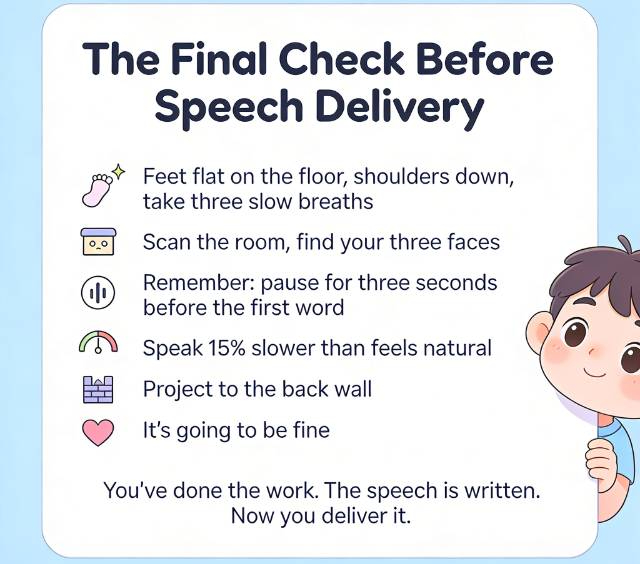
The tips above aren't magic; they're just the specific moves that separate a speech that lands from one that doesn't. Pick five, use them, and the rest of your next 5 minutes will be better than the last speech you gave.
If the problem isn't how you'll deliver the speech but that the speech itself isn't written yet, or the draft you have reads fine on paper but falls apart the moment you try to say it out loud, you can get a speech written before the deadline, with short sentences, natural rhythm, built-in pauses, and an opening that earns the first 30 seconds. Send us your topic, audience, and time limit. You get a delivery-ready draft back in under 24 hours.
A 60 Second Vocal Warm Up (Do This in the Bathroom Before You Walk In)
Cold voices crack, run out of breath, and sit in a higher, thinner register than warm ones. Sixty seconds of warm up fixes all three.
- Lip trills (15 seconds): Blow air through loosely closed lips so they vibrate like a horse. Hum a note while doing it. This loosens your lips and warms your breath.
- Tongue twister x3 (20 seconds): "Red leather, yellow leather" say it three times, fast. Then "unique New York" three times. This wakes up your articulation.
- Humming scale (15 seconds): Hum from your lowest comfortable note up to your highest and back down. Twice.
- One full yawn (10 seconds): A real one. It opens your throat and relaxes your jaw more than any other exercise.
Skip this, and your first two sentences will come out thin and tight. Do it, and you'll hit the podium with your full voice already online.
When the Script Itself Is Fighting You
Here's the thing most delivery guides won't tell you. If you've read this far and every single tip feels hard to apply to your specific speech, the problem probably isn't you. It's the script. Speeches that read clean on paper often collapse when spoken aloud because they were written for silent reading, not for breath, rhythm, and audience attention.
The Next Speech is Already Easier Than This One
Every speech you give teaches you something specific about yourself as a speaker. The first one teaches you that you talk too fast. The second teaches you what your hands do when you're nervous. The third teaches you how your voice actually sounds in a big room. By the fifth speech, you're a different speaker than the one who started this guide, not because you memorized 24 tips, but because you stopped being afraid of the physical act of speaking in public.
So: notice what happens this time.
- What tip actually worked?
- What didn't?
- What would you do differently next time?
Write it down tomorrow while it's fresh. That's how delivery gets better, not from reading guides, but from one speech teaching the next.
Your Speech Is Tomorrow. Where Are You Right Now?
You now have 24 specific delivery moves that work, plus answers to the eight questions every speaker asks the night before. If your speech is already written and you just need to rehearse, close this tab and start practicing out loud. You're set.
You've now got 24 specific delivery moves that work, plus answers to the eight questions every speaker asks the night before they go up. If your speech is already written and you just need to rehearse, close this tab and start practicing out loud; you're set.
If the speech itself is still a pile of bullet points or a first draft that doesn't flow, that's the real problem, and no amount of delivery practice will fix a speech that wasn't built to be spoken. Tell us your topic, your audience, and your time limit, and have delivery speech written by CollegeEssay.org structured for delivery, paced for breath, with an opening that earns the first 30 seconds. Most students get a draft back in under 12 hours.