UCLA Transfer Essay at a Glance
|
|
|---|
| Transfer acceptance rate | 24% overall; significantly lower for impacted majors (CS, Engineering 10–12%) |
| Minimum GPA | 3.2 overall; 3.8-4.0 competitive for impacted programs |
| Application deadline | November 30 (fall enrollment only, UCLA does not admit spring transfers) |
| Application platform | UC Application is not Common App |
| TAG eligible? | No UCLA does not participate in the Transfer Admission Guarantee program |
| Transferable units | 60 semester / 90 quarter units recommended by time of enrollment |
| CC transfers | 93% of admitted UCLA transfers come from California community colleges |
UCLA transfer applicants write four Personal Insight Questions, not a personal statement. One is required. Three are your choice from seven optional prompts. Each is capped at 350 words.
The UC Application renders plain text only. No bold, no bullets, no headers. Write and proofread your responses in plain text before submitting; whatever formatting you see in your word processor will not carry over.
For a full step-by-step walkthrough of the transfer essay process, including how the PIQ fits into your overall application, check out our complete guide to writing a transfer essay.
The Required UCLA Question: How to Answer the Major Prep PIQ
Every UCLA transfer applicant writes this one:
"Please describe how you have prepared for your intended major, including your readiness to succeed in your upper-division courses once you enroll at the university." |
The major prep question is UCLA's way of asking: "Why should we trust you in upper-division coursework?" Your answer needs evidence, not enthusiasm.
What UCLA wants to see isn't passion for the subject they assume you have that. They want to see specific coursework, relevant projects, transferable skills, and concrete proof you can handle what comes next.
What to avoid: "I've always loved psychology" or "Biology has fascinated me since I was young." These are passion claims, not evidence. They don't tell admissions anything about your readiness.
How to structure your answer: - Name specific courses you've completed
- Describe a relevant project or experience
- Identify skills you've built
- Connect directly to upper-division work at UCLA
|
Example Major Prep PIQ (Biology With Analysis)
Taking Cell Biology and Organic Chemistry in the same semester wasn't easy, but it was intentional. I wanted to know if I could handle the pace before committing to a four-year university. I could and I learned more about how I study under pressure than in any other semester.
In my Cell Bio lab, I ran gel electrophoresis for the first time without a step-by-step handout. My partner and I had to troubleshoot a failed separation, work backward through our protocol, and figure out we'd under-dyed the sample. That kind of iterative problem-solving is exactly what research labs expect. It's also what I want to keep doing.
I've since completed IGETC and added a statistics course specifically because I want to do quantitative research. I've talked to two UCLA biology professors about their labs one working on protein folding, one on cellular aging and I know which upper-division courses I'm taking first: Molecular Biology and Biochemistry of Gene Expression.
I'm not coming to UCLA to figure out if I can do this. I already know I can. I'm coming to do it at a higher level.
What this does well:
- Line 2 names a specific decision ("intentional") rather than just a fact it shows agency
- The troubleshooting moment is concrete proof of the kind of thinking upper-division courses require
- Specific course names at UCLA show genuine research, not generic enthusiasm
- The closing line reframes readiness as settled fact, not aspiration confident without being arrogant
Notice how the example never says "I'm passionate" or "I've always loved science." It shows readiness through action.
If you've got your three prompts mapped out, but four blank documents is where things stop, we can handle the transfer essay writing for you, send us your major, your CC, and a few bullet points on each story, and the team delivers polished PIQ responses within 24 hours.
Which 3 Optional PIQs Should UCLA Transfer Students Choose?
The seven optional prompts and the full framework for choosing your three are covered in our UC transfer PIQ guide. For UCLA specifically, three prompts tend to give CC transfer students the strongest material:
- Prompt #4 (Educational opportunity/barrier) is the single best option for many CC students it gives you direct space to frame your community college path as intentional, especially if cost, proximity, or IGETC planning drove your decision.
- Prompt #5 (Significant challenge) works well if you worked while attending school, managed family obligations, or recovered from an academic setback with documented improvement.
- Prompt #7 (Community contribution) fits students with meaningful CC involvement, tutoring, student government, clubs, or advocacy. See Example 3 for what this looks like in practice.
The constellation rule applies across all four: your combined essays should reveal four different sides of you. If your major prep essay already covers academic grit, don't use Prompt #5 for more of the same.
UCLA Transfer Essay Examples That Worked (With Breakdown)
These are instructional models written to show what strong PIQ responses look like, not claimed as submitted essays.
Example 1: Prompt #4 Educational Opportunity
My high school didn't offer AP classes. There were five of us on the academic track in a school of 400, and the guidance counselor had two other schools to cover. College wasn't something people planned it was something that happened or didn't.
I found out about community college through a flier at the public library. I enrolled in English 1A the summer after graduation, mostly to prove to myself I could do it. I ended up with a 4.0 and signed up for three more courses in the fall.
What I didn't expect was how much I'd use the resources: the tutoring center, office hours, the honors program. I became a regular. My biology professor connected me with a research opportunity through a partnership with a local environmental organization. I spent a semester sampling water quality in three creek systems, learning to use lab instruments I'd never touched, and writing a report that got presented at a county meeting.
That experience changed what I thought was possible for me. Community college wasn't a backup it turned out to be exactly the right environment to build the foundation I needed. I'm applying to UCLA because I've been building toward it deliberately, not because it's the only option I have left.
What this does well:
- The opening is grounded in a specific reality no fluff, immediate context
- "Mostly to prove to myself" is honest and human it doesn't perform ambition
- The research opportunity is concrete: creek sampling, instruments, a report, a county meeting not "I did research"
- The final paragraph reframes CC as intentional rather than remedial this is exactly what UCLA wants to see from transfer applicants
- No apology for the CC path it's framed as a deliberate choice with a clear outcome
Example 2: Prompt #5 Significant Challenge
In my first semester, I was working 28 hours a week at a warehouse and taking 12 units. My financial aid didn't cover everything, and my family needed help with rent. I missed two weeks of Calculus after a family emergency and had to decide whether to withdraw or catch up on my own.
I didn't withdraw. I went to office hours every week for a month. My professor let me redo one assignment for partial credit. I got a B+ not the grade I wanted, but proof that I could navigate a semester where everything went wrong.
I adjusted the next semester: I cut my hours at work by six and took 15 units instead of 12. I learned that managing school like a job means protecting it like one. I started treating study time as non-negotiable same as a shift.
The challenge didn't end. I've been working through every semester. But I've also maintained a 3.7 GPA across 60 units and completed IGETC. I'm not applying to UCLA despite those circumstances. I'm applying because of what I learned to do inside them.
What this does well:
- Specific numbers throughout: 28 hours, 12 units, two weeks, a B+, six hours cut, 15 units, 3.7 GPA, 60 units this is what credibility looks like
- The decision moment is clear: withdraw or catch up and the reader knows exactly what choice was made and why
- "Managing school like a job means protecting it like one" is the quotable sentence it's a real insight, not a platitude
- The final line turns the challenge into an asset without being performative about it
Example 3: Prompt #7 Community Contribution (CC Student)
Here's what Prompt #7 looks like when it's written by a CC student with a genuine community story:
The tutoring center at my CC was open until 7pm. Most of the students who needed it most worked until 6.
I noticed this during my second semester when a classmate in my Statistics study group kept showing up unprepared not because she didn't care, but because she couldn't get there in time. I started running an informal study session in the library on Tuesday nights no official title, no school funding, just a recurring Google Calendar invite I sent to twelve people in our Stats class.
By the end of the semester, we had 23 regulars. I recruited three other students to lead sessions for Calculus and English Composition. The library staff gave us a standing reservation for Room 114 after they noticed we kept filling it. When I left for transfer applications, I handed the whole thing over to two incoming sophomores who'd been regulars since week three.
I didn't build something impressive. I filled a gap that was in front of me. At UCLA, I want to keep doing that. Specifically, I've been looking at the Community Programs Office and Bruin Consent Coalition's peer educator program as places where the same kind of gap-filling applies at a larger scale.
What this does well:
- The opening sets a specific constraint on tutoring center hours vs. work hours before any person or emotion is introduced. The problem is structural, not sentimental
- "No official title, no school funding" signals initiative without bragging about it
- Concrete growth numbers (12 people = 23 regulars, 3 subjects covered) give the story credibility without overstating scale
- The handoff detail ("handed the whole thing over to two incoming sophomores") shows this wasn't performance for an application, it was real
- The closing names specific UCLA programs, Community Programs Office, Bruin Consent Coalition not "I want to give back to the community"
- "I didn't build something impressive. I filled a gap." this line reframes the story honestly, which is more persuasive than inflated self-presentation
What the generic version looks like: "I've always cared about helping others succeed academically. I volunteered as a tutor at my school's tutoring center and helped many students improve their grades. This experience taught me the importance of community, and I look forward to contributing to UCLA's vibrant campus."
The best UCLA PIQ examples don't try to impress; they commit to one specific story and follow it all the way through. Want examples across more schools and formats? Check out more transfer essay examples that worked. |
You've now seen what strong PIQs look like across the required question and two of the highest-yield optional prompts. The harder part is writing four responses that work as a set, each one showing a different side of you, none repeating a story you've already told. If the drafting is where you're stuck, UCLA transfer essay writing help is available through CollegeEssay.org, the team works specifically with transfer applicants and can turn a brief or rough draft into polished responses within 24 hours.
How UCLA Transfer Essays Work (What You're Actually Writing)
UCLA uses the UC Application, not the Common App, and submits your PIQs through that portal by November 30. One detail worth knowing: the UC application renders plain text only. No bold, no bullets, no formatting. Whatever you see in your word processor won't carry over, so draft in plain text or paste into a plain text editor before submitting.
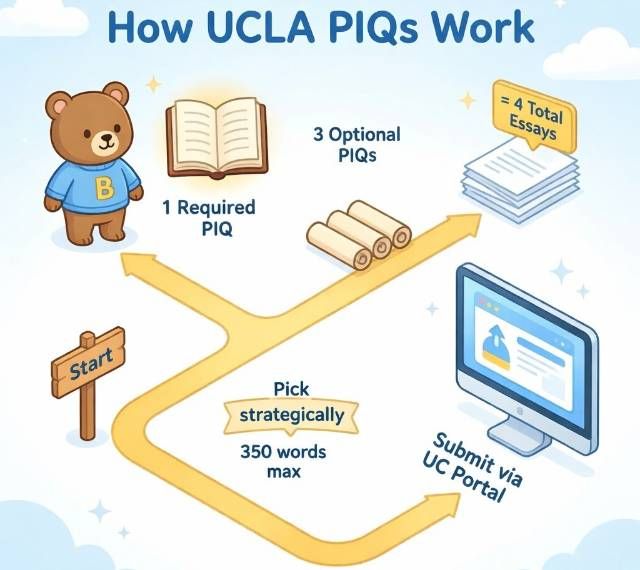
You get 350 words per question, which is roughly the length of a solid paragraph. Every sentence has to earn its place.
How to Write 350 Words That Actually Hit Hard for UCLA Transfer Essay
350 words isn't a limitation, it's a filter. It forces you to find the one story that matters most.
Most students try to squeeze in too much. They want to show their whole journey, explain context, give background, and still get to the point and then they run out of space before they ever say anything memorable.
Here's how to avoid that:
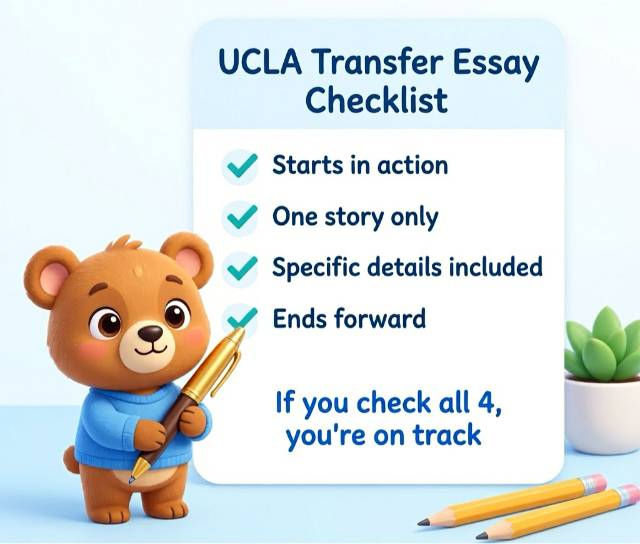
Start in the Scene
Don't waste your first 50 words on setup. Open in a moment something specific that's already happening. "I was standing in the tutoring center at 9pm on a Tuesday" is more compelling than "I've always valued education."
Pick One Story, Go Deep
CC students especially tend to stack experiences: "I balanced work, school, and family while also doing X, Y, and Z." That breadth doesn't fit in 350 words. One story with real detail beats three stories with none.
Cut Sentences that Only Carry Information
Every line should do two things: give a fact AND reveal something about how you think, what you value, or how you act. If a sentence is just information cut it or fuse it with another line that reveals something.
End Forward
Your last two or three sentences should point toward UCLA and what comes next not just summarize what you've already said. Admissions is making a bet on your future. Give them a reason to.
Practical editing check: Read your draft out loud. Find every sentence that you'd cut from a text message because it's just filler. Cut it from the essay, too.
For the full word economy framework, including a step by step editing process and a before/after sentence transformation table see our guide on how to write a 350-word UC essay. |
CC Specific Tips for UCLA Transfer Essays
UCLA doesn't see community college as a consolation path. It's where 9 out of 10 UCLA transfers come from. Here's what that means for how you write:
Don't Explain Away Your CC Choice
Frame it as intentional cost, proximity, family, a career pivot, a deliberate decision to build a foundation before a four-year school. The framing matters.
TAP Students: Mention It
If you're enrolled in the Transfer Alliance Program, note relevant honors coursework or TAP completion in your major prep essay. It signals UCLA-awareness.
TAG vs TAP know the difference. TAG (Transfer Admission Guarantee) is a UC-wide program that guarantees admission to six UC campuses if you meet specific GPA and coursework requirements. UCLA does not participate in TAG neither does UC Berkeley. If you're at a California CC hoping to use TAG, it applies to UC Davis, UC Irvine, UC Merced, UC Riverside, UC Santa Barbara, and UC Santa Cruz only.
TAP (Transfer Alliance Program) is UCLA-specific: it's an honors-pathway program at participating CCs that gives students access to UCLA application workshops and signals strong preparation, but it does not guarantee admission. If you're enrolled in TAP, note it in your major prep essay it demonstrates intentionality about the UCLA path. If you're not enrolled in TAP, it doesn't hurt your application.
IGETC Completion is Worth Including
If you've completed or nearly completed IGETC, mention it in your major prep PIQ. It shows academic planning, not just class-taking.
First gen Framing Belongs in Prompt #4 or #5
If you're the first in your family to attend university, that context is relevant and those two prompts give you the most natural space to use it without forcing it.
Know the GPA Benchmarks
UCLA requires a minimum 3.2 GPA for transfer consideration. Competitive applicants for impacted majors (engineering, computer science, business economics) typically come in at 3.8–4.0. In borderline cases, your essays carry more weight not less.
One more section worth knowing about: the UC Application Additional Comments field. This is a separate 550-word space, not a PIQ where you can provide context that doesn't fit anywhere else. If you have a gap semester, a medical leave, a withdrawn course, or a family circumstance that affected your record, this is where it goes. Don't bury it in a PIQ description, and don't leave it unexplained if it's visible on your transcript. The formula: one sentence of context, one sentence of what you did next, one sentence confirming your current trajectory. Keep it factual. Admissions doesn't penalise the circumstance; they penalise unexplained anomalies. |
Common UCLA Transfer Essay Mistakes (And How to Avoid Them)
- Writing a personal statement instead of a PIQ. These are not the same format. A personal statement has narrative arc and emotional depth over 650 words. A PIQ is 350 words of focused, specific response to a direct question. Don't blend the two.
- Choosing prompts based on prestige, not honesty. Leadership sounds impressive but if your best story isn't about leadership, forcing it produces a generic answer. Pick the prompts where you have something real and specific to say.
- Using all 350 words on backstory. If you spend 200 words explaining context and only 150 on the actual insight or outcome, you've lost the essay. Trim the setup.
- Answering the same theme in multiple prompts. Admissions reads all four responses together. If three of them are about academic resilience, they're not learning anything new about you after the first one.
- Submitting with formatting. Bullet points, bold text, and headers don't render in the UC Application they show up as cluttered plain text. Write and review your essays as plain text from the start.
- Not taking the required question seriously. The major prep PIQ isn't a formality. It carries as much weight as your optional three. Don't polish your optional essays and rush the required one.
The most common UCLA transfer essay mistake is writing what you think they want to hear instead of what only you could say. For general mistakes, visit our transfer essay mistakes blog. |
You've read the examples, the strategy, and the mistakes. What most CC transfer applicants find hardest is not understanding what a good PIQ looks like; it's sitting down and writing four responses that don't overlap, don't undersell, and don't read like a resume. If you'd rather work with someone who does this every application cycle, CollegeEssay.org's UCLA transfer specialists can write all four PIQs from scratch or workshop drafts you already have. Most students get their responses back within 24 hours.