UMich Transfer Acceptance Rate: What You're Up Against
Michigan's transfer acceptance rate hovers around 40%, which sounds reassuring. But 6,832 people applied for about 2,358 spots last fall.
The GPA floor is 3.0, but competitive applicants are at 3.5 or above for most programs. The freshman acceptance rate is around 18%, transfers have a meaningfully better shot. But UMich uses holistic review, and a strong GPA gets you in the door. The essays determine whether you walk through it
If you're still working out the basics of transfer essays in general, start with our how to write a transfer essay guide first, then come back here for the UMich specific playbook.
Here's what you're working with:
|
|
|---|
| Fall 2024 applications | 6,832 applicants, 2,358 accepted |
| Transfer acceptance rate | 40% |
| Stated GPA minimum | 3.0 |
| Competitive GPA | 3.5+ for most programs |
| Fall deadline | February 1 |
| Winter deadline | October 1 |
| Essays required | 4 required + 1 optional challenge essay |
| Application platform | Common App (Transfer) |
| Ross applicants | Separate admissions process, check Ross directly |
| Marsal Education applicants | 2 additional essays required |
Winter transfer: UMich admits a small number of transfer students for winter (January) entry. The same four essays apply, and the October 1 deadline is firm. Winter admission is less common than fall admission in most colleges, but not all, and the pool is smaller.
If you're targeting Ross, winter entry is generally not available. For everything else, verify your specific school's winter availability on UMich's transfer admissions page before applying. If you're considering winter as a backup plan, it's a legitimate path, but don't assume it's less competitive by volume alone.
UMich isn't just looking at your numbers. They want to understand who you are, why you're leaving where you are, and why Michigan specifically. That's exactly what four essays give you the room to show.
The Four UMich Transfer Essays: An Overview
Unlike most schools, Michigan doesn't give you one transfer essay. It gives you four, each with a distinct purpose and a specific character limit.
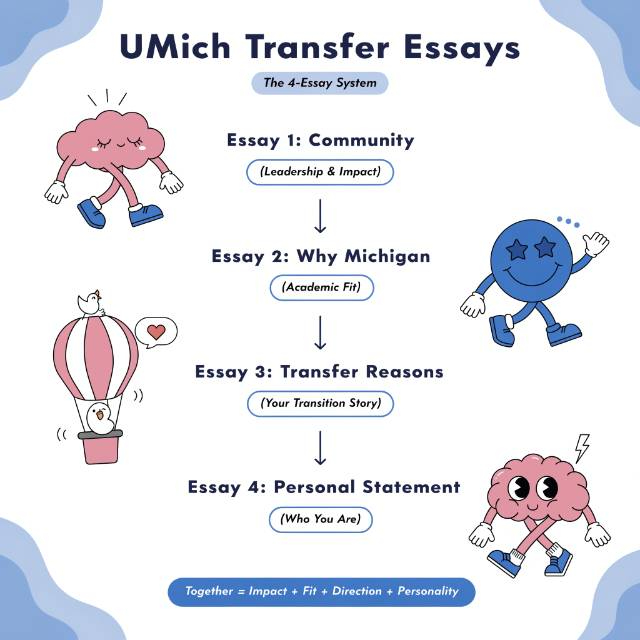
This is important to understand before you write a single word. These aren't four versions of the same question. Each essay has a lane, and you'll do yourself real damage if you let them overlap.
Here's the complete set:
Essay | Topic | Limit |
Essay 1 | Community leadership & citizenship | 1,500 characters (250 words) |
Essay 2 | Why Michigan + why this curriculum | 2,750 characters (380 to 460 words) |
Essay 3 | Reasons for transferring + objectives | 1,500 characters (250 words) |
Essay 4 | Common App personal statement | 650 words |
Optional | Challenge essay | Varies |
The most important thing to understand before you start writing: Michigan reads all four essays together. Each essay must reveal something different about you. If the same experience or the same quality appears in two essays, one of them needs a different story.
The Four-Lane Portfolio Map
| Essay | What it reveals | Your story (fill in before you draft) |
|---|
| Essay 1: Community (1,500 chars) | How you lead and show up for others |
|
| Essay 2: Why Michigan (2,750 chars) | Your academic trajectory and specific fit |
|
| Essay 3: Transfer reasons (1,500 chars) | What you've built, outgrown, and are moving toward |
|
| Essay 4: Personal statement (650 words) | Something personal not already covered in 1 to 3 |
|
The rule before you start: No two essays should reveal the same thing about you. If the same experience or the same quality appears in two different essays, one of them needs a different story. Identify that conflict now before you've spent hours writing the wrong essay for the wrong prompt.
If your strongest leadership story also explains why you're transferring, decide which essay owns it. The other essay needs a different angle on a different story.
UMich Transfer Essay 1: The Community Essay (1,500 Characters)
Prompt: "Share with us how you are prepared to contribute to these goals [developing leaders and citizens who challenge the present and enrich the future]." |
This isn't a traditional community essay. Michigan isn't asking you to connect your neighborhood or background to their campus. They're asking how you'll show up as a leader and citizen once you're there.
The 1,500-character limit isn't just a constraint. It's a filter. It forces you to choose your most compelling story and tell it without padding.
What strong looks like: Opens mid-scene. Something happened. A decision was made, a conflict was navigated, something changed. The reader immediately understands what you did and why it mattered. The leadership role might be unexpected a part-time job, a campus organization, a community initiative but the impact is specific and real. Strong excerpt example: "When our tutoring center lost half its volunteers mid-semester, I didn't wait for someone to reorganize the schedule. I mapped every student's needs, reassigned sessions, and personally covered three weekly slots until we had coverage again. Enrollment held steady. Three students passed who hadn't expected to." Notice what that does: it's a scene, it shows initiative, it quantifies impact, all inside 250 words. What weak looks like: "As president of the honors society, I organized multiple events that brought students together and raised awareness about academic achievement." That tells us a title and a vague outcome. It doesn't show what you actually did, what was hard about it, or what changed because of you. |
Don't pick your most obvious leadership role. Pick the one that reveals something unexpected about how you think and act.
Still not sure which story to lead with, or how to fit it into 1,500 characters without it feeling compressed? Tell us the story you're working with, and our transfer essay writers can take it from here, shaping it into a tight, specific Essay 1 that holds up, with most drafts back within 24 hours.
UMich Transfer Essay 2: Why Michigan + Why This Curriculum (2,750 Characters)
Prompt: "Describe the unique qualities that attract you to the specific undergraduate College or School to which you are applying. How would that curriculum support your interests?" |
This is your longest essay. 2,750 characters is roughly 380–460 words, depending on average word length, and it's the one most applicants get wrong in the same predictable way.
A strong "Why Michigan" essay makes the admissions reader think: this student could only write this essay about this school.
The essay has two parts that need to work together: - Part 1 Why this college or school: Not "why Michigan broadly." Why this specific unit within Michigan. The College of LSA has different offerings than the School of Engineering, which is different from Ross. Name the specific programs, research opportunities, faculty, or academic features that connect to your goals.
- Part 2 How the curriculum supports your interests: This isn't a "Michigan is great because" section. It's a "here's the path I'm planning to take, and here's why Michigan's curriculum makes that path possible in a way my current school can't."
The Name Plug-In Test: Read your Essay 2 back and replace "Michigan" with another school. If nothing else changes, the whole thing would still work for UCLA or UVA without editing a word you need to rewrite. A great Why Michigan curriculum essay can only be written about Michigan. If yours could be anyone's, it isn't done yet. |
What to avoid:
"Michigan's Ross program is one of the best in the country and I know it will challenge me and help me grow as a future business leader."
That sentence could appear in 5,000 different applications. It tells the reader nothing about you and nothing specific about Ross.
What works:
"Ross's Multidisciplinary Action Projects give second-year students the chance to consult for real companies on real problems. My current program has no applied component. I've been learning frameworks with no place to use them. MAP is specifically what I need to test whether my thinking actually works."
That's specific. That connects curriculum to a real gap. That's a sentence only this applicant could write about this program.
Important: Don't bleed your "reasons for transferring" narrative into this essay. If you spend paragraphs explaining why your current school isn't working, you're using up real estate that belongs in Essay 3, and you're weakening both essays in the process.
For deeper help on building the forward looking narrative, check out our Common App transfer essay guide.
UMich Transfer Essay 3: Your Reasons for Transferring (1,500 Characters)
Prompt: "Please provide a statement that addresses your reasons for transferring and the objectives you hope to achieve." |
This is the essay most transfer students get wrong, and the most common mistake is letting it overlap with Essay 2.
Essay 3 isn't about why Michigan is great. Essay 2 already covered that. It's about why you're ready to leave where you are and what you're going to do about it.
Here's the distinction that makes this essay work:
- Essay 2 looks forward: what Michigan offers and how the curriculum serves your goals
- Essay 3 looks backward and forward: what you've outgrown, what's missing, what you're moving toward
The "leaving" framing: You don't need to bash your current school. You shouldn't. What you need to do is explain honestly what you've hit: a ceiling in available courses, a gap between program offerings and your goals, a mismatch between the research opportunities available and the work you want to do. Frame it as growth, not escape. "I came to [School] planning to major in environmental policy, but after two years, I've completed every relevant course they offer at the undergraduate level. My advisor has been supportive, but there's nowhere left for me to go here." That's honest. It doesn't throw anyone under the bus. And it sets up the forward looking second half of the essay. The "objectives" anchor: The prompt asks for both reasons and objectives. Don't forget the second half. The objectives piece is where you pivot forward: specifically, what you're going to accomplish at Michigan. Not aspirational mush ("I want to make a difference in sustainability"). Something grounded, a research lab you want to join, a concentration you plan to pursue, a skill gap you're going to close. Our how to explain why you're leaving guide has a full framework for building this narrative if you need more depth. |
UMich Transfer Essay 4: The Common App Personal Statement
Prompt: Standard Common App prompts, same options available to freshman applicants, approximately 650 words. |
The personal statement is your chance to be a person, not just an applicant. Don't use it to repeat what your other three essays already covered.
Michigan reads all four essays together. An admissions officer who's just finished reading your community essay, your why Michigan essay, and your transfer reasons essay is now reading your personal statement. If the themes overlap, you've wasted an opportunity to show them something new.
A few specific notes for transfer applicants:
- Don't reuse your old Common App essay. If you applied to Michigan or anywhere else before, your instinct might be to grab your existing personal statement. Don't. Your context has changed, your story has developed, and Michigan will notice if your essay reads like it was written two years ago.
- Choose a topic not covered elsewhere. Your community essay has your leadership story. Your transfer essay has your academic journey. Your personal statement should reveal something about who you are outside those two things: a formative experience, a perspective, a part of your background that doesn't fit anywhere else in the application.
- This should feel the most personal. The other three essays are all somewhat structured around Michigan's questions. The personal statement is yours to shape. Use that.
School Specific Extras: Ross and Marsal Education
If you're applying to Ross or the School of Education, you're not writing four essays. You're writing five or six.
Ross School of Business has its own admissions process separate from the general transfer application. Check their admissions page directly before you plan your application, as requirements, deadlines, and essay prompts are managed independently.
Marsal Family School of Education requires two additional essays on top of the standard four:
- Essay A: How your experience and career goals prepare you to fulfill the School of Education's program mission (~500 words, 4,000 characters)
- Essay B: Your experiences engaging with youth (~250 words, 2,000 characters)
Other colleges and schools within Michigan may have their own additional requirements. Always check the specific school's admissions page, not just the general transfer page.
You now have a clear picture of what works across all four prompts. Writing four essays that each hold up independently, different stories, different angles, no overlap, is where most applicants lose time they don't have
. If you'd rather work with someone who has written these essays before, Michigan transfer essay help is available through our transfer essay team, with most drafts returned within 24 to 48 hours.
What Makes a UMich Transfer Essay Work
The biggest UMich transfer essay mistake isn't bad writing. It's saying the same thing in multiple essays when you had four chances to show four different dimensions of yourself.
Here's what consistently separates strong applications from forgettable ones:
- Each essay has a lane and stays in it.
Community essay = your leadership story.
Curriculum essay = your academic fit.
Transfer essay = your journey.
Personal statement = your person.
- 1,500 characters is not a lot. That's roughly 250 words. Draft long, cut ruthlessly. Every sentence needs to do real work.
- Specificity is the difference. A professor's name, a research group, a program feature that only Michigan has, these details are what make the essay unswappable.
- The optional challenge essay is not optional if your transcript has anything unusual. One sentence of context, one sentence on what changed, one sentence confirming your current trajectory. Short and forward-looking.
You've seen what strong UMich transfer essays look like across all four prompts. The next step is writing four of your own that don't overlap, don't repeat, and each pull their weight. If that's the part you're dreading, tell us your major, your target college within Michigan, and what you're transferring from. CollegeEssay.org for your Michigan transfer application handles all four essays, returned within 24 to 48 hours.