How Competitive Is Cornell Transfer Admissions?
Cornell has a reputation as the "most accessible" Ivy League school for transfers. The numbers tell a more complicated story:
|
|
|---|
| Fall 2025 acceptance rate | 9.3% (670 admitted from 7,218 applicants) |
| Typical competitive GPA | 3.75+; official floor is 3.0 |
| GPA floor by program | Dyson, Biology in A&S, select Engineering concentrations: 3.5+ |
| Test scores | Not required for transfer applicants |
| Application deadline | March 15 (fall); spring varies by college check current cycle |
| Application platform | Common App (Transfer version) |
| Essays required | 3 Common App statement + community essay + college specific supplemental |
| College Report | Required must be requested from your institution's registrar several weeks before the deadline |
For fall 2025, Cornell received 7,218 transfer applications and admitted 670 students a 9.3% acceptance rate. That's down from 18.4% in 2020. The pool is getting bigger, the spots aren't growing proportionally, and the essays matter more than ever.
The GPA floor is a 3.0 officially, but competitive applicants are typically coming in at 3.75 or higher. Specific programs set their own bar: Dyson School of Applied Economics and Business, Biology within Arts & Sciences, and a few engineering concentrations commonly look for 3.5 minimum. No SAT or ACT is required for transfer applicants which is one less variable and puts even more weight on your written materials.
One thing that surprises a lot of applicants: Cornell evaluates you at the college level, not the university level. You're not applying to "Cornell" in the abstract you're applying to one of its eight undergraduate colleges (College of Arts & Sciences, Engineering, CALS, ILR, Hotel, Dyson, Architecture, and Human Ecology). Each college has its own admissions office, its own standards, and its own essay prompts. Which college you apply to isn't just a preference it determines which admissions office reviews your file, what GPA you need, and what essay prompts you're required to answer. |
Choose your target college carefully. Transferring between Cornell colleges once you're admitted is not guaranteed and often not easy.
Cornell's Transfer Essay Requirements: What You Actually Have to Write
A lot of applicants go into this thinking Cornell has one supplemental essay. It's actually three pieces of writing, each with a different purpose.
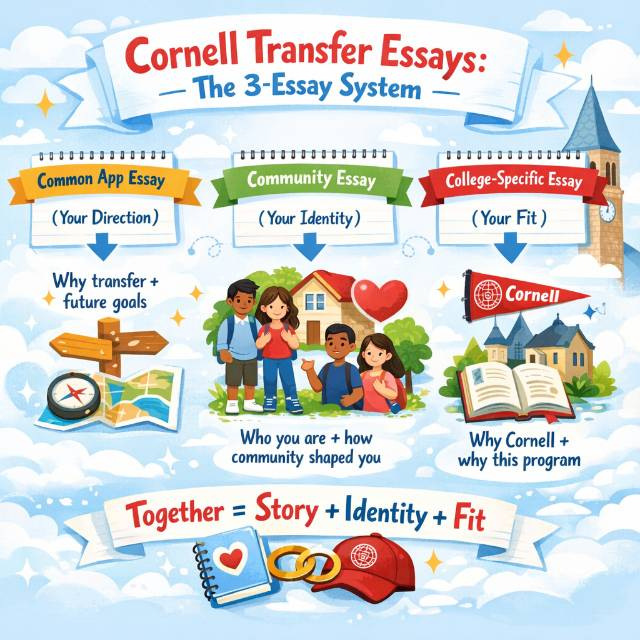
Common App Transfer Essay (250-650 words)
The prompt: "How does continuing your education at a new institution help you achieve your future goals?"
This is your forward looking essay. It's about the trajectory where you're headed and why Cornell gets you there faster or better than staying where you are. This one goes to every school you're applying to on the Common App, not just Cornell. |
Cornell Community Essay for Transfer Applicants (2,000 characters / 350 words)
This is universal for all Cornell transfer applicants, regardless of which college you're applying to.
The prompt: "Share how you've been shaped by one of the communities you belong to."
The purpose here is to identify who you are and how you show up for others. |
College Specific Supplemental Essay for Transfer Applicants (350-650+ words, varies by college)
This is your "why Cornell, why this program" essay, and the prompts differ significantly by college. Arts & Sciences asks about your academic interests. Engineering asks about your engineering purpose and contributions. ILR asks about issues you care about that connect to their mission. You only write one of these for the college you're applying to.
Cornell's transfer essays work as a system: the personal statement explains your "why transfer," the community essay reveals your identity, and the college specific essay shows you belong in that particular program. If you're looking for a deep dive on the Common App piece specifically, the Common App transfer essay guide covers that prompt in full.
A few logistical notes worth knowing: the application deadline is March 15 for fall entry. Spring transfer admission availability varies significantly by college. Historically, the College of Arts & Sciences and ILR have occasionally offered spring entry; Engineering, CALS, and the professional schools (Hotel, Dyson) rarely do. Cornell's availability changes year to year. |
If spring admission is available for your target college, the essays and requirements are identical to the fall application. You'll also need at least one academic recommendation and a College Report confirming you're in good standing at your current institution.
How to Write the Cornell Community Essay as a Transfer Applicant (With Examples)
The community essay trips up more transfer applicants than any other prompt. It reads like a diversity essay. It's not.
The prompt "Share how you've been shaped by one of the communities you belong to" is really asking: Who are you, and what do you give to the groups you're part of? The word "shaped" is doing heavy lifting here. Cornell wants to see a student who's been genuinely changed by their community and who contributes actively, not someone who just belongs to something.
What counts as a "community"? Broadly more than most applicants realize. A competitive academic team. A restaurant kitchen where you've worked for three years. An online forum for people with a shared chronic illness. A neighborhood where you grew up. A religious community. A first-gen student group at your college. You don't need to reach for the most "impressive" community. You need to find the one where your story is clearest.
One rule: don't write about a community you've left. If you're describing a high school club you graduated out of or a job you quit, the reader can't see who you are right now. The community needs to be current and active in your life.
The structure that works: Start with a specific scene, an actual moment, not a general description. Then zoom out to what that community taught you or how it changed how you think. From there, show your active role: what you do, what you've contributed, how you've shaped others in return. Close by connecting this version of you, the person your community made, to what you'll bring to Cornell.
What an effective community essay looks like: A student applying to ILR writes about their community of immigrant coworkers at a meatpacking plant where they worked summers. They open with a specific moment, a near miss safety incident, and how their coworkers reacted. They describe how that community taught them to see labor not as an economic abstraction but as something physical and personal.
They write about translating documents for coworkers and organizing an informal peer support circle. The closing connects directly to ILR's focus on worker advocacy, not in a generic "I love ILR's mission" way, but through a specific research project they want to join.
What doesn't work: A student describing their college's honor society in general terms, what the organization does, how many members it has, and what events they attend. The writer is nowhere in the essay. There's no specific moment, no transformation, no active role. It reads like a Wikipedia entry about the club. |
The community essay isn't about the community, it's about who you became because of it. That's the frame to write from.
How to Write the Cornell College Specific Transfer Essay
If the community essay is about identity, the college specific essay is about fit. And fit, at Cornell, means specificity.
Each college's prompt reflects its mission, which is exactly why you need to know which college you're applying to before you start writing. Here's what the prompts look like for the most common transfer destinations:
- College of Arts & Sciences (650 words): Describe your intellectual interests, what you plan to study, and how Cornell A&S specifically supports those goals.
- College of Engineering: Two longer essays plus short responses. Covers your reasons for engineering, what you'll contribute, and what draws you to Cornell's specific programs.
- CALS: Why this major at Cornell CALS? Connecting your academic and professional goals to CALS's particular approach and resources.
- Dyson School of Applied Economics and Business: Career goals, why Dyson, and what you'll contribute to the school community.
- ILR (650 words): Topics or issues you care deeply about and why they connect to ILR's focus on work, labor, and employment.
Engineering applicants: your workload is different. Cornell Engineering requires two longer essays plus several short response questions, significantly more writing than any other Cornell college's supplemental essays. The first essay asks about your reasons for pursuing engineering and what you'll contribute to the program. The second covers what draws you to Cornell's specific engineering concentrations and resources. Before you start writing, verify that the current prompt set and word limits can shift between cycles. Budget at least twice the time you'd allocate for A&S or ILR. If you're targeting Hotel Administration or Human Ecology, those colleges also have distinct prompts worth confirming before you draft anything. |
The strategic core for all of these is the same: be specific. Not "Cornell has incredible research opportunities" name the research center. Not "I admire Cornell's faculty" name the professor whose lab you want to join and why their work connects to yours. Not "I love ILR's approach to labor issues" name the specific course or clinic or publication that reflects the intersection of your interests and their curriculum.
Before you write this essay, spend at least two hours on Cornell's program pages, faculty bios, course catalog, and student organization directory. Find three to five things that are genuinely specific to that college, things you could only say about Cornell, not any other school with a similar program.
Here's the transfer specific advantage most applicants miss: you're not starting from scratch. You've been in college. You have actual academic experiences, research interests, or professional work that connects to what Cornell offers. Show that trajectory. The college specific essay should feel like the natural next chapter of a story that's already in motion not a wish list from someone who hasn't started yet.
The college specific essay is a "why us" essay disguised as an academic statement, and the admissions readers can tell in one paragraph whether you've actually done your research.
Cornell Transfer Essay Examples: What Works and Why
Good Cornell transfer essays aren't easy to find; most publicly available examples are for freshman applicants. Here's a breakdown of what strong transfer essays actually look like, based on structure and strategy.
Example 1: Community Essay What Works
Student background: Applying to ILR. Worked as a home health aide during community college. Applying from a healthcare administration program.
What they did well: - Opened with a specific scene: a conversation with an elderly client who couldn't afford a medication copay and had to choose between it and groceries
- Made themselves the active protagonist they started asking questions, kept notes, and eventually brought a pattern of issues to a supervisor
- Connected the community (home care workers and patients navigating a broken reimbursement system) to their evolving academic interest in labor policy
- Closed by naming ILR's Worker Institute and a specific faculty member studying healthcare labor, not as name dropping, but as a natural extension of their trajectory
|
Why it worked: Every paragraph had the student in it. The community wasn't a backdrop it was the engine of their development.
Still not sure if your own community essay has that same forward motion? If you'd rather have a specialist build it from your notes, Cornell transfer essay writing help is available with 24 hour turnaround. Tell us your community, your story, and your target college, and our writers take it from there.
Example 2: College Specific Essay What Works
Student background: Applying to Arts & Sciences. Economics major at a state school. Interested in behavioral economics and policy.
What they did well: - Named two specific Cornell A&S professors whose work intersects behavioral economics and public health policy
- Referenced a Cornell undergraduate research program they'd identified through the department website
- Connected their current senior thesis topic to a gap they wanted to explore further and explained why Cornell's specific curriculum (naming two upper level courses) gave them resources their current school didn't
- Showed a clear transition: not "I want to leave" but "I've built a foundation that Cornell can help me extend"
|
Why it worked: The research was obvious and specific. You could feel that this student had actually spent time on Cornell's website and that they'd found things that genuinely excited them.
The anti pattern to avoid (both essay types): Generic praise with no specifics. "Cornell's commitment to academic excellence and interdisciplinary learning aligns perfectly with my goals." This sentence could be pasted into 200 different application essays without changing a word. It tells the reader nothing about you and nothing about why Cornell specifically. Cut it. Replace it with something that can only be true about your application.
The strongest Cornell transfer essays aren't written by students who want Cornell, they're written by students who can show exactly what they'll do once they're there.
Example 3: Common App Transfer Statement What Works
Student background: Applying to Cornell College of Arts & Sciences (Economics). Transferring from a large state university after two years. Interest in development economics and policy.
Here's what the Common App statement looks like when it's built for a Cornell application specifically:
Two years ago, I chose [State University] because it offered an economics program I could afford and a research assistantship in my first semester. I took it seriously. I've since completed 58 credits, maintained a 3.82 GPA in my major, and co-authored a policy brief on agricultural subsidy reform that my current advisor submitted to a state legislative committee.
What this does right: Opens with the honest reason for the first college choice no apology, no implication of mistake. The specific numbers (58 credits, 3.82 GPA, a co-authored policy brief) establish credibility before any ask is made. The legislative committee detail shows the work had real stakes, not just academic exercise.
What I can't do where I am is continue it. The economics department at [State University] has no faculty working on international development my policy brief pointed me toward questions about food security in sub-Saharan Africa that I'm now trying to pursue through independent reading because there's no course or faculty home for it. Cornell's A&S Economics department has three faculty whose active research sits at exactly this intersection: Professor [Name] on agricultural market failures, Professor [Name] on aid effectiveness, and Professor [Name] whose work on rural credit markets in Kenya maps directly onto the subsidy questions I've been developing.
What this does right: The reason for transferring is forward looking not "my current school is bad" but "I've built something here that now requires more than this school can give." The three faculty names with their research areas show genuine engagement, not brochure-reading. Naming three specific Cornell professors makes it impossible to paste this essay into any other application.
At Cornell, I want to join Professor [Name]'s lab in the first semester and enroll in Development Economics and Agricultural Markets in my first year. After Cornell, I'm planning on a policy fellowship the Cornell Policy Initiative's alumni network and the A&S Economics department's placement record in federal and international organizations makes this a realistic path that I can't build toward from where I am.
What this does right: Near-future objectives are specific (a named lab, two specific courses, a named fellowship pathway) rather than vague ("I want to make a difference in development"). The closing sentence connects Cornell to a concrete post-graduation path without being grandiose. The comparison to "where I am" is forward-looking, not critical.
What the generic version looks like: "Cornell's world class economics program and its commitment to interdisciplinary learning would allow me to grow as a scholar and pursue my passion for development economics in an intellectually stimulating environment."
Why Example 3 is structured differently from Examples 1 and 2: The community essay and college specific essay examples are strategy breakdowns that describe what a hypothetical student did well without reproducing full essay text. Example 3 uses an annotated excerpt format (as on the NYU and USC pages) because the Common App statement requires students to see the prose itself, not just a description of what it should contain. The format switch is intentional. Check out more complete examples on our transfer essay examples page. |
You've seen the structure now. The harder part is doing it for your own story, finding the scene that opens the community essay, building the faculty connections that make the college-specific essay feel researched rather than rehearsed, and framing your transfer reasons in a way that reads as forward motion rather than retreat.
If you're working against a deadline or want a specialist to either review your draft or write it from scratch, CollegeEssay.org's Cornell transfer writers work with Cornell applicants specifically and can turn around a complete draft within 24 hours.
5 Tips to Make Your Cornell Transfer Essays Stand Out
1. Apply to the right college and mean it. Your college-specific essay only works if you've genuinely researched that program. Applying to a Cornell college because it "seems easier to get into" is usually transparent in the writing. You can't fake specificity.
2. Name specific things. One specific professor's name does more for your Cornell essay than three paragraphs of generic praise. Use the Cornell course catalog. Browse faculty research pages. Look up student organizations within your target college. Find three to five things you can only say about Cornell, not any school with a similar program, and weave them in naturally.
3. Let each essay show a different side of you. Your community essay, college-specific essay, and Common App statement each reach a different part of who you are. If all three revolve around the same project or the same community, the reader only sees one dimension of your candidacy.
4. Treat the 2,000-character community essay limit as tight. It's about 350 words. That's not much space to establish a scene, show your role, and connect to Cornell. Every sentence needs to earn its place. Don't open with "I have always been passionate about..." — you'll burn 10 characters before you've said anything.
5. Build from what you've already done. You've been in college. You have actual academic work, research interests, or professional experience the essays should draw on. The college-specific essay should feel like the natural next chapter of a story already in motion, not a wish list from someone who hasn't started yet.
Cornell Transfer Essay Mistakes to Avoid
Using the same "Why Cornell" every applicant uses.
- Mentioning "world class research," "top ranked programs," or "diverse student body" without specifics is the fastest way to sound like everyone else. These phrases are filler. Replace them with the names of real things you found during your research.
Applying to a college you haven't researched.
- If you're applying to ILR but your essay doesn't mention a single thing specific to ILR a faculty member, a course, a clinic, a journal the application reads as misdirected. It signals you picked the college for strategic reasons, not genuine fit.
Writing a community essay about what the community does, not what it did to you.
- Describing the history, size, and activities of your community in detail isn't a community essay it's a summary. The reader needs to see your transformation, your role, your growth.
Treating the 2,000-character limit as generous. It's about 350 words.
- That's not a lot of space to establish a scene, show your role, and connect to Cornell. Every sentence needs to earn its spot. Don't waste characters on throat-clearing openers or vague statements.
Repeating the same information across all three essays.
- If your community essay, college-specific essay, and Common App essay all revolve around the same academic project or the same community, you've given admissions only one dimension of who you are. Diversify. Each essay is a different window into your candidacy.
For the full list of mistakes that appear across all transfer applications, not just Cornell, see our transfer essay mistakes to avoid. If you're also looking at other competitive schools, the NYU transfer essay guide covers a similar level of institutional specificity. |
To Wrap Up!
You've got a clear picture of what Cornell's admissions readers are looking for in each essay type. The work now is putting it on the page, your scene, your faculty connections, your specific version of fit. If you'd rather have a specialist draft it or sharpen what you've already written, our transfer essay writers can take it from here with fast turnaround before your deadline.