Why Changing Majors in a Transfer Essay Is Actually a Strength
Here's the thing most students don't realize: admissions officers aren't surprised when applicants want to switch majors. They expect it. Up to one-third of students change their major at least once during college it's one of the most normal parts of the undergraduate experience.
So the question isn't whether changing your major looks bad. It doesn't not inherently. The question is how you explain it.
If your essay makes it sound like you're still figuring things out, that raises a flag. If it shows that you've reflected deeply, identified what wasn't working, and found a clearer direction, that's maturity. That's exactly what admissions wants to see.
Changing your major doesn't raise a red flag; explaining it without clarity does.
The students who struggle with this essay try to minimize or apologize for the switch. The ones who succeed own it and trace the journey. Those are two very different approaches, and the difference shows up in whether you get in. |
If you haven't read our transfer essay guide yet, start there; this article builds on it.
Identify Which Type of Major Change You're Explaining in Transfer Essay
Not all major change transfer essays are the same. The right narrative structure depends on your specific situation, so before you write a word, figure out which scenario applies to you.
Scenario A: Your New Major isn't Offered (or isn't Strong Enough) at Your Current School
This is the cleanest narrative. You're not abandoning your field your school just can't take you where you need to go. If your current school doesn't have the program you want, or their version of it is weak compared to your target school's, that's a legitimate, easy-to-explain reason to transfer. The essay practically writes itself: I came here for X, I discovered I need Y, your school has Y.
Scenario B: You Genuinely Changed Your Mind About What You Want to Study
This is the most common scenario, and it needs the most careful framing. You declared one major, got into it, and realized it wasn't right. This is completely valid. But your essay needs to show the process: what made you choose the original major, what experience or insight shifted your thinking, and what you now know about your direction. The key is specificity. Vague realizations don't convince anyone.
Scenario C: Your Old Major wasn't Working Out Academically or Personally, and You're Pivoting.
This is the hardest to frame, and it sometimes overlaps with a weaker academic record. If your transcript tells part of this story already, you'll need to address it honestly rather than hoping the reader doesn't notice. A brief acknowledgment of the struggle plus a clear upward trajectory is almost always better than silence. For more on handling a difficult academic record, see our low GPA transfer essay guide for the framing structure.
One decision to make before you start: declared or undeclared? Some schools ask you to apply under your intended new major; others let you apply undeclared. This choice affects what your essay needs to do. If you apply to your new major, your essay should make a strong case that you've already started moving in that direction, such as coursework, a project, a conversation with someone in the field, or independent research. Declaring without evidence of commitment raises a flag. If you apply undeclared, your essay can frame a set of questions you're pursuing rather than a fixed destination, but it still needs intellectual specificity, not vagueness.
A practical note on credits: Many students switching majors worry that their existing coursework will count for nothing at the new school in the new major. This is worth addressing before you apply not in your essay, but in your research. Most schools have a transfer credit evaluation process; some credits from your old major will likely count as electives even if they don't apply to your new major's requirements. Check your target school's transfer credit policy and use their articulation tools (for California schools, ASSIST.org maps CC courses to UC/CSU requirements; other schools typically have their own transfer equivalency databases). |
Before you write a word, get clear on whether you're chasing something new or walking away from something that wasn't right your essay structure depends on it.
Not sure you can frame your specific scenario convincingly on your own? Tell us your situation and our changing majors transfer essay writing help team will handle the framing, picking the right arc for your scenario and writing the essay around it. |
The Narrative Framework: 4 Parts Every Major Change Transfer Essay Needs
Once you know your scenario, you can build the essay. The most effective major-change transfer essays follow a four-part arc. These aren't necessarily four separate paragraphs; they're four beats the essay needs to hit, in roughly this order.
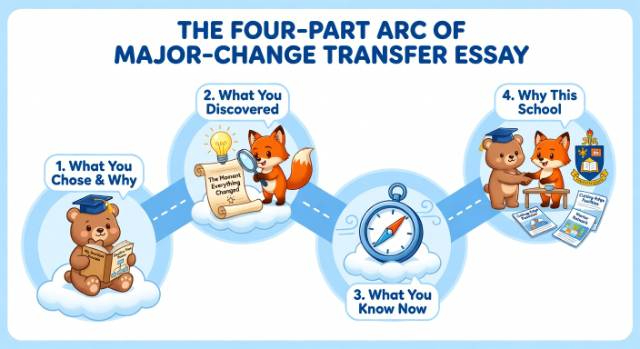
Part 1: What You Chose and Why
Start by showing that your original major wasn't random. You had a reason for it a genuine one. Maybe you'd always been drawn to science, or someone in your family was in the field, or a class in high school made you think it was right. This matters because it establishes that you're a thoughtful person who makes decisions for real reasons. It also sets up the turn.
Part 2: What You Discovered
This is the pivot point, and it needs to be specific. Not "I realized it wasn't the right fit" tells the reader nothing. What was the moment, course, project, conversation, or experience that shifted your understanding? The more concrete you are here, the more convincing the essay becomes. A single well-chosen detail does more work than three vague paragraphs.
Part 3: What You Know Now
Articulate your new direction clearly. What's the new major? What do you want to do with it? Why does this feel right in a way the old path didn't? This section is where you prove you're not just running away from something, you're moving toward something specific.
Part 4: Why This School
Connect your new direction to the specific school you're applying to. Name a program, a professor, a research opportunity, a course sequence something that shows you've done your homework and that this particular school is the right place for this particular version of your goals.
Transfer Essay Changing Majors Example:
I declared business because I could see the practical path and because the people in my family who built stable careers had done it that way. Two semesters in, I was performing adequately, but I kept noticing what I was actually paying attention to: not the marketing models, but the people responding to them.
(Part 1: why the original choice specific and honest, not embarrassing. Sets up the turn without undermining the original decision.)
A consumer behaviour module changed things. I spent three weeks reading psychology research to understand one case study and realised I'd found the underlying discipline I actually wanted, not the applied version of it.
(Part 2: specific moment of discovery one course, one realisation. Not "I gradually realised" a concrete turning point.)
Psychology isn't a detour. It's the field where the questions I care about actually live. I want to study decision-making, specifically how people make choices under uncertainty and what that means for public policy.
(Part 3: new direction stated with clarity and a specific focus area not "I'm passionate about psychology" but what within it and why.)
Professor [Name]'s work on risk perception and behavioural economics at [School] is directly relevant to the thesis I want to write. That research environment doesn't exist at my current institution.
(Part 4: school specific names a professor and research area, explains why this school and not another.)
Notice what's absent throughout: apology, hedging, and backward-looking critique of the original major. The essay spends one sentence on what went wrong and the rest on what came next.
UC transfer applicants face one additional constraint: The UC application requires you to declare an intended major, and all UC transfer applicants who are switching fields must write the required major preparation essay about their new major, not the old one.
If you've spent two years studying chemistry but are applying to UCLA as a political science major, your major prep essay needs to demonstrate preparation in political science, not chemistry. This means any coursework, reading, or experience in your new direction needs to be front and centre.
If your preparation in the new field is thin, address this in your major prep essay honestly and show what you're doing to close the gap. For the full UC transfer PIQ guide, including the required major prep essay, see UC transfer personal insight questions. |
The best major-change essays don't apologize for switching; they trace the journey that made the switch inevitable.
How to Connect Your Old Coursework to Your New Direction
One of the things students worry about most: "My old major has nothing to do with my new one. What do I do?"
Almost always, there's a thread to pull you just have to look for it. The connection doesn't have to be obvious. It can be a skill, an insight, a way of thinking, or even a moment of contrast that clarified what you needed.
Here's how that looks in practice:
Business to Psychology: "Managing a student organization taught me more about human behavior than any marketing class I took. I kept finding myself more interested in why people made decisions than in how to influence those decisions. That's when I realized I needed to go deeper into the field, not around it."
Biology to Environmental Studies: "I came to biology because I wanted to understand environmental systems well enough to fix them. But what I actually discovered is that the problems I care about aren't primarily scientific they're social, political, and organizational. Environmental studies gives me the framework to work on them at that level."
Notice what both of these do: they don't trash the old major. They show that the experience in the old major produced the insight that pointed toward the new one. That's a coherent story.
What if the connection really is thin? Be honest about the pivot. Don't invent a connection that isn't there admissions officers can tell. Instead, focus on what concrete steps you've taken toward the new direction: a class you took on your own, a project, a conversation with someone in the field, or research you've done. Show that the new major isn't just an idea you've already started moving toward.
Admissions officers don't expect a straight line; they expect you to explain the map.
What NOT to Say in a Transfer Essay When Explaining a Major Change
Some approaches sound reasonable, but actually undermine your essay. Here's what to avoid.
- Don't say "I realized I wasn't passionate about [old major]" and stop there. Passionate language is everywhere in college essays, and without anything behind it, it's meaningless. What did you actually experience? What specifically made you realize this wasn't it?
- Don't say "I always knew [new major] was right for me." If that were true, why did you choose something else? This creates an inconsistency you don't want the reader sitting with. If you always suspected you'd end up in this direction, say that and explain what confirmed it.
- Don't apologize. Over-explaining and over-qualifying makes you sound uncertain. If you write "I know it might seem like I don't have a clear plan, but..." stop. Delete it. State your direction clearly and let it stand.
- Don't make it sound like you're running away. Focus forward. The essay should spend more time on where you're going than on what went wrong. If half your essay is about why your current school or major failed you, rebalance it.
The biggest mistake in a major-change transfer essay is spending more words on what went wrong than on where you're going.
If your GPA in your old major is part of the picture, don't ignore it but don't dwell on it in this essay either. A brief, honest acknowledgment works better than hoping no one notices. For a full guide on handling this, see our article on "why transfer essay" explaining your reasons for transferring. |
You've got the arc, the scenario, and the list of traps to avoid. What's left is sitting down and writing it for your specific situation, your original major, your pivot, and your target schools. If that's the part you'd rather hand off, our transfer writers can frame the narrative for you, give them your scenario and your deadline, and they'll handle the drafting.
Framing Language You Can Use in a Changing Major Transfer Essay
These aren't scripts; every essay should be specific to your situation. But these sentence structures give you a starting point for each part of the narrative.
For Part 1 (your original choice):
- "I came into college as a [X] major because..."
- "My decision to study [X] came from a long-standing interest in..."
- "When I declared [X], I genuinely believed..."
For Part 2 (the discovery/pivot):
- "It wasn't until [specific experience] that I understood..."
- "A [course/project/internship/conversation] changed how I thought about what I actually wanted to do."
- "What I kept coming back to, semester after semester, was..."
For Part 3 (your new direction):
- "What I'm looking for now is [specific goal/field/type of work]."
- "Studying [new major] would let me [specific outcome]."
- "I'm not just switching fields I'm moving toward a specific problem I want to spend my career working on: [problem]."
For Part 4 (school fit):
- "[School]'s [specific program/lab/professor/course] aligns directly with where I want to take this."
- "What drew me to [school] is [specific resource] something my current institution can't offer."
- "I've been following [professor's] research on [topic], and the opportunity to work in that environment is a significant part of why I'm applying."
Specificity is what separates a compelling major-change essay from a vague one. Name the course, the moment, the professor, the project.
For real examples of how students have successfully framed transfer essays, take a look at our collection of real transfer essay examples that worked. |
Wrapping Up!
You have everything you need to write this essay. You know your scenario, you know the four beats, and you have the language to make the switch read as clarity rather than confusion. What remains is writing a draft that does all of that for your specific situation, within whatever word limit you're working against. That's what CollegeEssay.org's major change essay writing team is built for. Tell them your scenario, your schools, and your deadline. Most students get a complete draft back within 24 hours.