Should You Even Bring Up Your Low GPA in a Transfer Essay? (The Decision)
Not every applicant with a low GPA needs to write about it. The decision depends on your specific situation, and getting this wrong in either direction can hurt you.
Address it in your main essay when:
- Your GPA is significantly below the school's stated minimum
- A specific, explainable event caused the drop (illness, family crisis, wrong major)
- Your GPA trend is clearly upward. Recent semesters are stronger than your overall number
- There's a meaningful gap between your overall GPA and your recent or major-specific GPA
Address it in the Additional Information section (not the main essay) when:
- Your GPA is borderline not dramatically low, just imperfect
- The cause is brief and factual (one bad semester, one medical withdrawal)
- Your main essay has a stronger story to tell, and GPA context would compete for space
You probably don't need to address it when:
- Your GPA falls within the typical range for that school
- There's no specific cause it just drifted without a clear turning point
- Bringing it up would read as preemptive apologizing for something that doesn't actually need defending
The hardest case: when there's no specific cause. If your GPA drifted downward without a crisis or turning point, you were disengaged, the major wasn't right, the habits weren't there, you still have options. Don't fabricate a cause. Don't over-explain what you don't fully understand.
Instead, do two things: take brief ownership without drama ("I didn't build the habits early enough" is honest and forward-looking) and let your upward trend carry the weight. A 2.6 overall with a 3.4 in your most recent two semesters tells a recovery story without requiring a dramatic explanation.
The trend is the argument. If your transcript has no upward trend to point to, address the GPA minimally and focus your essay on your academic direction. The essay's job is to show who you are now, not to explain every number in your file.
The rule of thumb: address it when silence is more suspicious than explanation. If your transcript has a semester where your GPA dropped from a 3.5 to a 1.8 and then climbed back up, leaving that unexplained raises more questions than explaining it would. If your GPA is a steady 2.8, you may not need to say anything at all.
Admissions officers don't expect a perfect transcript; they expect an honest one.
One practical note before you decide: some institutions recalculate your GPA using their own formula rather than accepting your reported number at face value. UC campuses, for example, recalculate transfer GPA based on specific academic courses only, excluding remedial coursework and sometimes physical education. If you're applying to a school that recalculates, your effective GPA for admissions purposes may be higher or lower than what appears on your transcript. Check each target school's transfer admissions page for their GPA calculation method before deciding whether your number actually needs addressing. You may be in a stronger position than you think or a different one. |
Context vs. Excuse: The Difference That Determines Everything in a Transfer Essay
This is the most important thing to understand before you write a single sentence about your grades.
Context says: "Here's what happened and how it shaped me." An excuse says: "Here's why it wasn't my fault." The facts can be identical the tone is completely different.
The test is simple: does your explanation show what you learned, or does it just explain what happened? One moves the reader forward. The other leaves them waiting.
Here's the same situation written both ways:
Excuse version: "I failed two classes because my parents got divorced and I was going through a really hard time emotionally. It was hard to focus on school when everything at home was falling apart."
Context version: "During my parents' divorce sophomore year, managing responsibilities at home left little bandwidth for academic recovery. What I learned and what I've applied since is that I need structure to perform at my best. Since building that into my schedule, I've earned a 3.6 across my last two semesters."
Same facts. Completely different impression.
Notice what's absent in the context version: apology language. No "I'm sorry," no "unfortunately," no "I regret." Apology language signals that you don't fully believe you can overcome the thing you're apologizing for. You can.
Also absent: No mention of a specific professor, a flawed grading system, or a school that wasn't "the right fit." Blame shifts responsibility outward. Admissions officers want to see what you did with what happened not what happened to you.
Context explains what happened. An excuse asks for a pass. Admissions officers can tell the difference in the first sentence.
How to Write a Low GPA Transfer Essay: 4 Situations and What to Say
The framing changes depending on why your GPA dropped. Here are the four most common scenarios and how to handle each one.
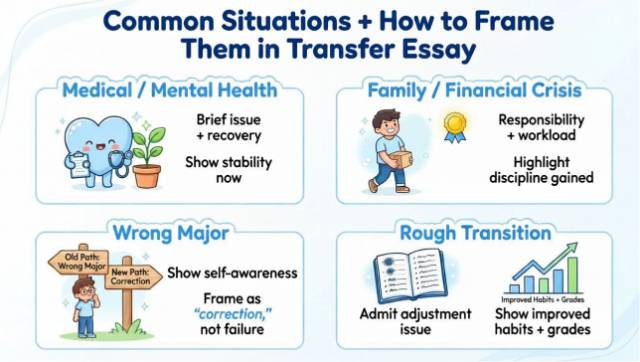
Situation 1: Medical or Mental Health Issue
What to include: A brief, factual description of what you dealt with, how it was addressed or managed, and most importantly, what the outcome shows about your current capacity and approach.
What to leave out: Medical details beyond what's necessary to establish context. You don't need a diagnosis. You need the reader to understand the impact, see that it's been addressed, and move on.
Example language: "A health issue in my first year required several weeks away from campus and a reduced course load for the following semester. Once I had the right support in place, I returned to full-time coursework and finished the year with a 3.4. That experience taught me a lot about managing my workload proactively, something I've applied consistently since." |
Situation 2: Family Hardship or Financial Crisis
What to include: Brief context (caretaking responsibilities, working significant hours, a family relocation), what that demonstrates about your character, and the change or trend since.
Example language: "During my sophomore year, I took on significant hours at work to help my family through a period of financial instability. My grades dropped, but my ability to manage pressure, meet real deadlines, and keep commitments grew substantially. Since stabilizing that situation, my GPA has climbed each semester, currently at 3.2 for my most recent term." |
Situation 3: Wrong Major or Academic Mismatch
What to include: Genuine self-awareness about the mismatch, and the GPA's connection to it, your performance in courses outside your interest area versus courses within it. If you have a GPA split (strong in certain subjects, weak in others), name it explicitly: "My overall GPA reflects a year in a major that wasn't right for me. My coursework in [new field] over the past two semesters has been my strongest academic work." That split is evidence of fit, not of inconsistency.
Example language: "I enrolled in a pre-engineering track that, within a year, I recognised wasn't a match for how I think or what I want to do. My performance reflected that disconnect honestly. In the two semesters since adjusting my direction, I've earned a 3.5, my strongest academic work to date." For the full strategic narrative around explaining a major switch in your transfer essay, see our transfer essay changing majors guide. |
Situation 4: Academic Unpreparedness or Rough Adjustment Period
What to include: What you underestimated coming in, what changed in your approach, and your GPA trajectory since.
What to avoid: Don't be so specific that you undermine yourself. You don't need to write "I partied too much freshman year." You can acknowledge poor time management or underestimating the academic intensity without oversharing.
Example language: "My first year was a harder transition than I anticipated. I underestimated the pace and didn't build the habits I needed early enough. By sophomore year, I had restructured how I approached studying, and deadlines and my grades show that. I've improved my GPA each semester since." The best low GPA transfer essays share one thing: they end looking forward, not backward. |
Still not sure which situation fits yours, or how to word it without it reading as an excuse? Tell us your GPA, what caused the drop, and where your grades have gone since. Our low GPA transfer essay writing service can draft that section for you, or write the full essay start to finish.
The Formula: How to Structure Your Low GPA Explanation
Regardless of which situation applies to you, the structure is the same. Three parts, each doing a specific job:
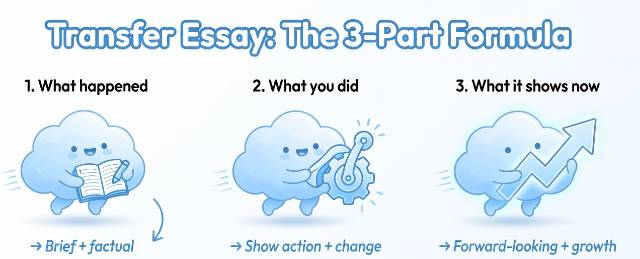
- Part 1: What happened (1–2 sentences, factual, no apology) State the context briefly. Don't editorialize, don't apologize. Just give the reader what they need to understand the next sentence.
- Part 2: What changed or how you responded (1–2 sentences, show agency) This is the most important part. What did you do? What shifted? This is where the story moves from past to present.
- Part 3: What it shows about who you are now (1–2 sentences, forward-looking) Connect it to where you're going. This is how you close the loop not by wrapping it up neatly, but by pointing forward.
Build Your Transfer Essay Draft: Fill-In Template
Use this to get your first version down before you start editing. Replace the brackets with your specifics. It won't sound perfect it's a starting point, not a finished sentence.
"During [brief context: what happened and when], [brief description of impact on coursework/GPA]. What I [learned / built / figured out] from that period was [specific insight, habit, or change in approach]. Since [what changed: resolved situation, adjusted schedule, new approach], my performance has reflected that: [specific evidence GPA in recent semesters, grade trend, completed coursework]." Example filled in: "During my mother's hospitalisation in my second semester, managing caregiving responsibilities alongside full-time enrollment left little capacity for academic recovery. What I built from that period was a clearer understanding of how I work best under pressure and what I need to protect to perform consistently. Since establishing a structured study schedule and reducing my work hours, my last two semesters have been my strongest: a 3.2 and a 3.5." Three sentences. Under 100 words. Factual, forward-looking, no apology. That's the target. |
This isn't your finished essay. It's a draft paragraph you can react to, which is always faster than starting from nothing.
Keep this to under 150 words in most cases. This is a section of your essay, not the full essay. It does its job in three sentences done well, not three paragraphs of over-explaining.
Placement matters too: this doesn't open your essay. Write your genuine reason for transferring and your forward-looking vision first, if you haven't built that part yet, our how to write a transfer essay guide covers the full structure. The GPA context comes after as supporting information, not as the headline.
UC transfer applicants: The UC application has an Additional Comments field (up to 550 words) that functions similarly to Common App's Additional Information section this is where brief GPA context belongs if you're not addressing it in your main PIQs. Your four Personal Insight Questions are not the place to lead with GPA explanation; use them to show momentum and direction. For how the UC transfer application works overall, see the UC transfer PIQ guide. |
Three sentences done right will do more than three paragraphs of over explaining.
Low GPA Transfer Essay Mistakes to Avoid
- Don't lead with your GPA number. "My GPA is 2.6, but..." is not an opening it's an apology. Start with something that establishes who you are and where you're going. The GPA is context, not the headline.
- Don't over-explain. Every additional sentence of explanation adds doubt. If you find yourself on a fourth sentence trying to justify the same situation, cut back to two. Brevity signals confidence.
- Don't blame. Professors, course structures, your current school, academic departments all off limits. Even if some of this is true, it reads as deflection. The reader wants to know what you did.
- Don't apologize. Words like "unfortunately," "I regret," and "I'm sorry" signal that you've already decided the GPA is disqualifying. It isn't. Write like someone who has moved past it.
- Don't make it your central essay topic unless it genuinely is your story. If your transfer reason is unrelated to your GPA, don't let the GPA explanation take over. It's one paragraph, not the whole piece.
- Don't speculate. "I think I would have done better if the professor had..." or "I believe my grades would be higher in a different environment" none of this helps. Forward, not backward.
Every word of your GPA explanation should either explain, show growth, or look forward. If a sentence doesn't do one of those three things, cut it.
Writing the actual paragraph, one that frames your specific numbers, your specific turning point, and your specific trajectory without tipping into apology, is where most applicants get stuck, even after reading every framework on this page. CollegeEssay.org specialises in low-GPA transfer narratives and can turn your situation into a section that adds to your application rather than just explaining it away.
How Much GPA Context Is Too Much?
This is a question almost nobody answers directly, so here's the answer:
- In the Additional Information section: 100–150 words maximum. One focused paragraph. State what happened, what changed, and what your recent performance shows. Then stop.
- In the main essay: Under 150 words within the larger essay, unless your academic journey genuinely is the central story of your transfer. There are cases where it is a medical withdrawal and recovery narrative, or a genuine academic rock bottom followed by a turnaround and in those cases, the GPA explanation can be the full essay. But it has to be earned. The story has to be real, specific, and forward-pointing.
For most applicants, the GPA is a background. The main essay is about where you're going and why this school gets you there.
One thing that matters more than your overall GPA number: If you had a 2.4 sophomore year and 3.4 and 3.6 the past two semesters, say that explicitly. Your recent performance is what admissions officers are actually trying to predict, and a clear upward trajectory is the strongest evidence you can give them.
A 2.4 overall GPA with a 3.7 in your last two semesters tells a completely different story than a 2.4 going flat.
One more tool worth knowing about: a well-placed letter of recommendation can corroborate your GPA narrative in a way no essay can. If a professor witnessed your recovery firsthand, saw you go from a difficult semester to consistent strong performance in their subsequent course, their letter adds third-party credibility to what your essay and transcript are already showing. When you're requesting recommendations, consider whether one of your recommenders is positioned to speak specifically to your academic trajectory, not just your general qualities. You don't need to ask them to address your GPA directly; a letter that reflects on your growth over time will do that work without being defensive.
Quick Low GPA Transfer Essay Example: Before and After
The scenario: A student whose parent lost their job at the end of freshman year. They picked up part-time work to help the family, their grades dropped significantly in their sophomore year, and they've been on an upward path since.
BEFORE (excuse mode): "My GPA suffered a lot during sophomore year because my dad lost his job and things were really hard at home. I had to work to help my family and it was impossible to keep up with everything at school. I feel really bad about how my grades look and I want the admissions committee to know that I'm actually a much better student than my transcript shows. I think if I didn't have all that going on I would have done better."
What's wrong: Apologetic throughout. Passive ("things were really hard"). Speculative at the end. No forward movement. Nothing that shows growth or agency.
AFTER (context mode): "When my father was laid off at the start of my sophomore year, I took on part-time work to help cover household expenses averaging about 20 hours a week alongside full-time coursework. My grades that year reflect the reality of those competing demands. What that period built was a discipline and sense of priority that I've applied directly to my academic work since. My last two semesters a 3.3 and a 3.5 represent what I'm actually capable of when circumstances allow it."
What changed: Specific and factual (no vague "hard time"). Shows what they did, not just what happened. No apology, no blame. Ends with concrete performance data. Moves the reader forward.
The framework is here, the template is here, and the before/after shows exactly what the difference looks like in practice. What's left is writing it for your situation specifically, your numbers, your turning point, your trajectory. If you'd rather not do that alone, our transfer essay writers can frame your story, tell us what happened, what changed, and what your recent grades show, and we'll handle the rest.