What Does "Essay" Actually Mean?
The word essay comes from the French essai, meaning "attempt" or "trial." Michel de Montaigne, a 16th-century French writer, is widely credited with inventing the essay as a literary form. His Essais were personal, exploratory pieces, short meditations on topics as varied as friendship and the nature of experience. The form caught on because it gave writers a flexible structure to think on the page.
Today, the word is used almost exclusively for academic writing. But the spirit of the original form survives: an essay is still a focused attempt to say something meaningful about a topic. |
The keyword is "attempt." An essay doesn't need to be the final word on a subject. It needs to make a clear, supported claim and follow through on it.
What Makes Something an Essay?
Not everything written is an essay. Here's what separates an essay from other writing:
Every essay exists to do something, argue a point, explain a process, describe an experience, or analyze a topic. If you can't state in one sentence what your essay is trying to accomplish, it's not ready.
- A central argument (thesis)
Every essay revolves around one main idea stated explicitly, usually at the end of the introduction, as the thesis statement. The thesis is the spine of the essay. Every paragraph connects back to it.
- A recognizable structure.
Essays follow a pattern: introduction, body, conclusion. This structure exists to make your argument easy to follow. Readers know where they are and what to expect at each stage.
An essay isn't just your opinion; it's your opinion backed up. You support your thesis with facts, examples, quotes, data, or logical reasoning. The quality of your evidence is what makes the argument convincing.
Essays are written to be read. They're addressed to a specific reader, which means they need to be clear, organized, and purposeful, not just complete.
A journal entry is writing. A text message is written. An essay is written with a structure and a point. |
What Is an Essay Made Of?
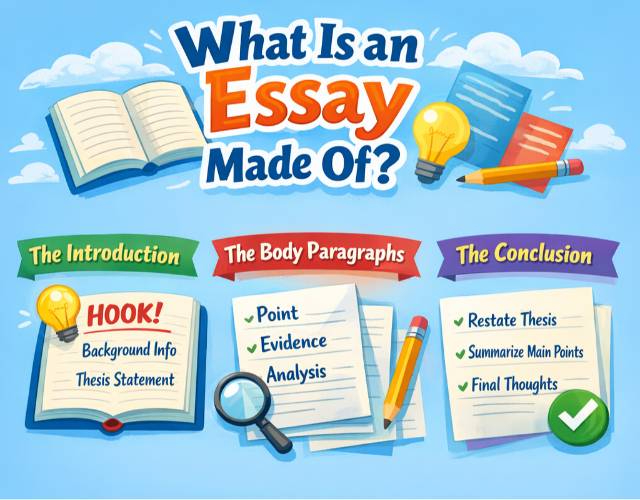
Every essay, regardless of type or length, is built from the same three components.
The Introduction
The introduction is your opening move. It does three things: grabs the reader's attention, provides context for your topic, and delivers your thesis statement.
A strong introduction doesn't bury the lead. It gets to the point quickly and gives the reader a reason to keep reading. For most essays, one paragraph is enough. Longer academic papers may have two, but brevity is a virtue in introductions.
The most important sentence in your introduction is the thesis. It tells the reader exactly what you're arguing and sets up everything that follows. For a full structural breakdown of how essay introductions work, see our guide to how to write an essay introduction.
The Body Paragraphs
Body paragraphs are where your argument is built, one point at a time. Each paragraph covers a single supporting idea. A well-structured body paragraph has three parts:
- A topic sentence that states what this paragraph is about
- Evidence: facts, quotes, examples, data, that support the point
- Analysis that explains why the evidence matters and how it connects to your thesis
Most school essays have three body paragraphs. Longer or more complex essays can have five, seven, or more. The number isn't fixed; it depends on how many distinct, well-supported points your argument needs to make.
The Conclusion
The conclusion closes the loop. It restates your thesis in fresh language (not a copy-paste), summarizes your key supporting points, and ends with a broader thought about why your argument matters.
A good conclusion doesn't just repeat what you already said. It elevates the argument. It answers the reader's unspoken question: so what? Why does this argument matter beyond this particular essay?
Struggling to wrap up your paper? Check out our essay conclusion guide to learn how to end your essay with a clear and impactful final statement.
Why Do Essays Matter?
Schools assign essays constantly, and there's a real reason for it beyond generating grades.
- Essays teach you to think systematically.
When you write one, you have to take a position, anticipate counterarguments, gather evidence, and build a case. That cognitive process isn't just academic; it's the same process used in law, medicine, business, and journalism.
- Essays teach you to communicate with precision.
Making one point at a time, in order, with evidence, that's what clear writing looks like. It's a skill that transfers well beyond school.
- Essays create a verifiable record of understanding.
Unlike a verbal answer, an essay is permanent. It can be reviewed and revised. That permanence forces a level of rigor that verbal communication doesn't demand.
For academic purposes specifically, essays are how instructors assess whether you understand material, not just whether you remember it. A well-written essay shows you can apply, analyze, and argue with what you've learned. |
The Main Types of Essays
The type of essay you write determines its purpose, tone, and structure. Your instructor will usually specify which type, but knowing what each one does helps you understand what's expected.
Argumentative Essay
An argumentative essay (sometimes called a persuasive essay) takes a clear stance on a debatable topic and defends it with evidence. The goal is to convince the reader that your position is correct, or at least reasonable.
Strong argumentative essays don't ignore the other side. They address counterarguments directly and explain why those arguments don't hold up. Engaging the opposition actually strengthens your case.
Common in: high school, college, law, policy writing
Example prompt: "Should the drinking age be lowered to 18?" |
Expository Essay
An expository essay explains a topic clearly and objectively. There's no personal opinion; your job is to inform, not to persuade. You present facts, data, and analysis in a logical order so the reader comes away with a solid understanding of the subject.
Common in: science classes, social studies, journalism
Example prompt: "Explain how the electoral college works." |
Descriptive Essay
A descriptive essay uses vivid, precise language to paint a picture in the reader's mind. The subject can be a person, place, object, experience, or emotion. Your goal is to make the reader feel present, not just understand the topic abstractly.
Descriptive essays give you more creative freedom than other types. The structure is more flexible, and the writing tends to be more literary.
Common in: creative writing courses, personal statements
Example prompt: "Describe a place that has shaped who you are." |
Narrative Essay
A narrative essay tells a story, usually from your own life. But unlike a memoir or journal entry, it makes a point. You're using personal experience as evidence for a broader lesson or argument.
Narrative essays are often the most engaging to write because they draw on real events. They're also common in college application contexts, though that's a separate genre from standard academic essays.
Common in: English classes, personal writing
Example prompt: "Write about a challenge you overcame and what it taught you." |
Analytical Essay
An analytical essay breaks a subject down into its components and examines how they work together. You might analyze a piece of literature, a historical event, a film, a policy, or a scientific finding. The goal is to interpret, not just describe.
Common in: literature, history, film studies, philosophy
Example prompt: "Analyze the role of ambition in Macbeth." |
For a full breakdown of every essay type with examples, see our complete guide to types of essays.
Let our expert writers take one off your plate.
Essay vs. Other Types of Academic Writing
Students regularly confuse essays with research papers, reports, and dissertations. Here's how they actually differ.
| Format | Typical Length | Core Focus | Structure |
|---|
| Essay | 500 to 5,000 words | One central argument | Intro, body, conclusion |
| Research Paper | 3,000 to 10,000+ words | Original research + sources | Abstract, lit review, methodology, findings |
| Report | Varies | Facts, findings, recommendations | Headings, tables, sections |
| Case Study | 1,500 to 5,000 words | In-depth analysis of one subject | Background, analysis, conclusions |
| Dissertation | 10,000 to 100,000 words | Original academic contribution | Chapters, methodology, references |
Essay vs. research paper: The main difference is scope and original contribution. A research paper requires you to conduct or synthesize research and add something new to academic knowledge. An essay argues a point using existing sources, it's shorter and more tightly focused.
Essay vs. report: Reports are descriptive and factual. They present findings without arguing a position. Essays take a stance and defend it.
Essay vs. dissertation: A dissertation is a multi-year, book-length original research project. An essay is a focused argument, usually written in hours or days.
How Long Is an Essay?
There's no universal answer, it depends on the level, the assignment, and the subject. But here are the most common ranges:
| Level | Typical Length |
|---|
| Middle School | 300–500 words |
| High School | 500–1,000 words |
| Undergraduate | 1,000–3,000 words |
| Graduate | 2,500–6,000 words |
| Extended / Thesis Essay | 6,000–10,000+ words |
If your instructor gives you a word count, hit it within 10%. Going significantly under suggests you haven't developed your argument enough. Going significantly over usually means you haven't been selective enough about what to include.
What Makes a Good Essay?
Knowing what an essay is matters less than understanding what a good one does. Here's what separates strong essays from weak ones.
- A thesis that takes a real position.
"Social media has pros and cons" is an observation, not a thesis. "Social media companies should be regulated to reduce misinformation" is a thesis; it makes a claim that can be argued. A good thesis takes a stand.
- Evidence that earns its place.
Every piece of evidence should work. Don't include a quote just to fill space; include it because it proves something. Then explain why it proves something.
- Paragraphs that stay on task.
Each body paragraph should cover one idea only. If a paragraph is trying to do three things at once, split it. If a paragraph doesn't clearly support your thesis, cut it.
- Transitions that guide the reader.
The jump between paragraphs should feel logical, not jarring. Transitions show the reader how your ideas connect; they're not decorative, they're part of the argument's structure.
- A format that matches the assignment.
Essays follow formatting rules, citation style, font, margins, and line spacing. Ignoring these costs makes your writing harder to read. For everything you need to know about formatting, see our essay format guide.
To Wrap Up!
Understanding what an essay is helps you approach any assignment with clarity and purpose. From defining an idea to building a structured argument, essays play a key role in academic writing across subjects.
Once you understand the basic components, types, and purpose of an essay, you can plan your writing more effectively and communicate your ideas with confidence.
Use this foundation to move on to more advanced writing techniques and craft essays that are clear, focused, and academically strong.
Got an Essay Due?
You don't have to write it alone.
- Expert writers across every subject
- 100% human, no AI, ever
- Rush delivery when you need it fast
- Rush delivery available for tight deadlines
Get expert help today and submit a polished, well-structured essay without the stress.
Get Expert Essay Help