What Makes a Place Essay Different from Other Descriptive Writing
Most students approach a place essay the same way they'd write a travel review: describe what you see, left to right, top to bottom. That's the version that gets a B-minus.
A strong descriptive essay about a place does something different. It captures what it feels like to be there, the atmosphere, the weight of the air, the way the light hits. The reader should feel transported, not just informed.
The distinction matters because your professor isn't grading whether you can list details. They're grading whether your writing creates an experience. For the full breakdown of how descriptive essays are graded and structured, our descriptive essay guide covers the form from start to finish.
The 5 Core Techniques for Describing a Place in Descriptive Essay
1. Anchor with a Dominant Impression
Before you write a single sentence, decide on the one feeling or quality you want the reader to come away with. A cluttered attic. A beachside town that's seen better days. A hospital corridor that never fully wakes up.
Every detail you include should reinforce that dominant impression. If your impression is "peaceful," a car alarm in paragraph two kills the essay. If it's "chaotic," a quiet corner might work, but only if it's framed as the exception that proves the rule.
This is the single most important technique. Essays that feel scattered usually lack a clear dominant impression. Essays that feel powerful almost always have one.
2. Use All Five Senses: but not Equally
Every place essay you've been taught to write says "use your five senses." What nobody tells you is that most places have one or two senses that define them. A bakery is about smell. A construction site is about sound. A crowded subway car is about touch, the press of strangers, the metal pole, the lurch of the train.
Find the dominant sense for your place. Lead with it. Bring in the others as support, not as a checklist.
Weak (checklist approach): The market smelled like fish. It was loud with vendors calling out. The ground felt slippery under my feet. The stalls were brightly colored.
Strong (dominant sense, others in support): The market announced itself before you saw it, a wall of brine and grilled meat that hit you half a block away. By the time you were inside, the smell had become noise: hundreds of voices layered over sizzling pans, a vendor's monotone chant somewhere to the left, the dull thud of a cleaver on a chopping block.
3. Be Specific About Physical Detail
Vague writing loses the reader. The specifics are where the essay lives.
Vague | Specific |
a big tree | a jacaranda that had split the sidewalk with its roots |
an old building | a brick building with windows painted shut and a fire escape that listed to one side |
a busy street | a four-lane road where taxis cut across each other without signaling |
a small room | a room where the only window faced a wall and the overhead light had a pull-chain that grazed your forehead |
The specific version takes more words. It's worth it every time.
4. Move Through the Space Deliberately
Your reader doesn't know this place. You need to move them through it in a way that builds a coherent picture. There are two main options:
Spatial movement: you walk the reader through the place as you move through it yourself (entrance: main area: corners :exit). Works well for outdoor spaces, streets, buildings.
Zooming: you start wide (the whole scene), then pull in to a specific corner or object that captures the dominant impression. Works well for complex, crowded, or emotionally loaded spaces.
Pick one and commit. Switching between the two without purpose is what makes place essays feel disorganized.
5. Don't Explain the Emotion: Generate it
The most common place-essay mistake: telling the reader how to feel instead of giving them the details that produce the feeling.
Tells: The cemetery was peaceful and made me feel a quiet sadness.
Generates: The cemetery's main path was so narrow that the grass on either side had never been trimmed back. The headstones nearest the entrance were the oldest, the inscriptions worn almost to nothing, the names barely legible if you tilted your head. A single crow sat on one of them and didn't move as I walked past.
In the second version, you never named the emotion. You didn't need to.
Structure of a Descriptive Essay About a Place
A place essay doesn't need the same thesis-driven structure as an argumentative essay. But it still needs shape. Here's a structure that works:
Introduction (1–2 paragraphs)
Establish the dominant impression immediately. Drop the reader into the space. Orient them — where is this place, when are you there, why does it matter. The last sentence of the introduction can be a quiet thesis: the one-sentence version of what this place is about.
Body (3–5 paragraphs)
Each paragraph covers one aspect of the place or moves through one section of it. Each paragraph reinforces the dominant impression, directly or by contrast.
A useful test for each body paragraph: if you removed it, would the dominant impression weaken? If no, cut it or rework it.
Conclusion (1 paragraph)
Don't summarize. That kills place essays. Instead: pull back. Return to the dominant impression one more time, but from a slightly different angle, the place as you leave it, or the place in memory, or what the place says about the world it sits in.
Still not sure how to open yours, or what structure fits your specific place? Tell us the place and your deadline, and get a place descriptive essay written for you structured, sensory, and ready to submit.
Descriptive Essay About a Place: Examples
The techniques above are clearer once you see them in action. Three full examples below, each with notes on what makes it work.
Place Descriptove Essay Example 1: My Grandmother's Kitchen (Personal / Childhood Setting)

Every house on the block had the same layout, but my grandmother's kitchen felt like its own country. The ceiling was lower than it should have been, or maybe the shelves were just stacked too high, towers of stainless steel containers, each one labeled in her handwriting that looked like urgency, like she'd always been about to run out of time. The window above the sink faced the back wall of the building next door, close enough that she kept the light on during the day. The light was the yellow of old lamp shades, and it made everyone who stood under it look like they were in a photograph from twenty years ago.
She cooked in a narrow strip of floor space between the counter and the gas stove. The stove had four burners and she used all four of them at once, always, a pot on each one doing something different. The kitchen smelled like cumin and something browning in butter and the metallic edge of the pressure cooker releasing its steam. When she lifted a lid, the smell changed: thickened, sweetened, and then came back to base.
It was not a comfortable kitchen to stand in. There was nowhere to be that wasn't in her way. But she never once asked anyone to leave.
What this example does well:
The dominant impression is warmth that doesn't announce itself, never named, always felt. Physical details are specific (towers of labeled containers, four burners always running). The senses arrive naturally rather than in a checklist. The final line generates emotion without naming it. Notice also that the essay uses the zooming structure: it starts with the overall feel of the kitchen and pulls in, paragraph by paragraph, to smaller and smaller details until it lands on a single behavioural observation.
Place Descriptive Essay Example 2: The Town Center, Off-Season (Public Space Setting)
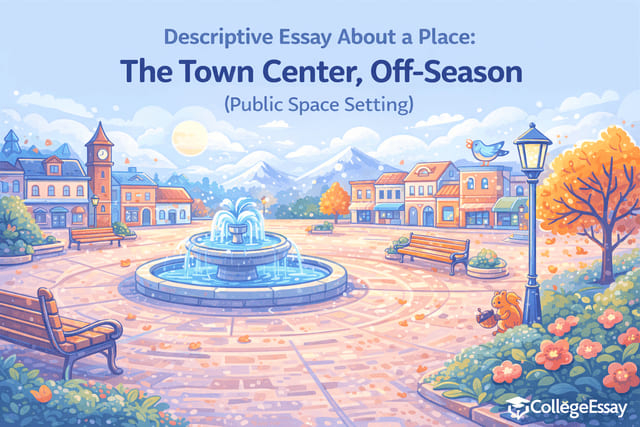
By November the boardwalk was theirs again. The cotton-candy stand had its metal shutters down, padlocked, a rust line where the rain collected at the seam. The arcades were still open, one of them, anyway; and from inside came the mechanical heartbeat of machines running their attract cycles for no one. The sky was the color of old concrete and stayed that way from morning to dark.
Locals walked their dogs along the strip without stopping. They had the look of people who had made a private peace with the place, with the closed things, with the wind off the water, with being known in a town that spent half the year being known by strangers. A man in an orange vest swept the area in front of a shuttered restaurant and nobody came out to thank him.
The ocean was louder in November. Without the crowds the sound had nowhere to go but up the street. You could hear it from the parking lot, from the gas station two blocks in. It was the same sound it made in July. The town, by November, had finally stopped pretending it was anything other than the ocean's.
What this example does well:
The dominant impression, off-season as a kind of reclamation, is established in the first four words and never abandoned. The essay uses spatial movement, walking through the strip and then pulling back to the sound of the ocean. Sound builds through the piece as a structural device and lands the conclusion. The people in the essay (dog walkers, the man in the orange vest) are part of the place's atmosphere rather than distractions from it.
Place Descriptive Essay Example 3: A College Library at Midnight (Academic Setting)

The library didn't close until two, but by midnight the floor nearest the entrance had almost entirely emptied. The overhead lights had gone into their dimmed mode, energy-saving, technically, but it made the room feel like something that was winding down, like the last hour of a party. The few people still there sat in the kind of stillness that meant they were either very focused or had stopped focusing and were just sitting.
The reference section was the quietest part. Nobody went there anymore, the reference books were mostly decorative at this point, their spines unbroken, their call numbers beginning to fade. One of them, a world atlas from 1987, had a sticky note on its cover that said "ask at the desk" in blue ballpoint. Nobody had moved the note in years. The atlas still showed the USSR.
At the study tables by the window, a student had fallen asleep with her head on her laptop. Her coffee cup was empty and tipped on its side on the table. The person at the next table had arranged a half-circle of textbooks around themselves like a fort and was working inside it with the focus of someone trying to disappear.
Outside, through the tall windows, the campus was dark. The path lights made small orange pools on the pavement. Nobody was on the path. The library, for another two hours, was the only lit thing.
What this example does well:
The dominant impression: late-night endurance is carried through specific objects rather than stated directly: the dimmed lights, the 1987 atlas, the tipped coffee cup, the textbook fort. Paragraphs move spatially from entrance: reference section: study tables: window and outside. No explicit emotion is named anywhere; it accumulates. This is also a good model for a 5-paragraph place essay structure, each paragraph is a contained scene within the same location.
How to Choose Your Place for Descriptive Essay
If your professor gave you a free choice and you're stuck, here are the places that tend to produce the strongest essays:

- Places you know well but rarely think about: your childhood home, a relative's house, a neighborhood you grew up in. Familiarity gives you the specific details. Distance gives you the perspective to see what was strange about what felt normal.
- Places with a strong sensory identity: a kitchen, a market, a workshop, a locker room, a hospital. These places have a dominant sense built in. You don't have to search for what to lead with.
- Places in a specific condition: not "the beach" but "the beach at 6am in October." The specific condition gives you a dominant impression automatically.
- Places that changed: a place you knew as a child that you've returned to as an adult, a place before and after something happened to it. The change is the dominant impression.
Avoid: vague large-scale places (New York City, the ocean) unless you anchor them to one very specific corner of them. The Bronx apartment at the corner of Tremont and Valentine, that you can write. "New York City", you can't, not in 600 words.
Note: if you're writing about a person rather than a place, a relative, a teacher, someone who shaped you, the techniques shift considerably. The descriptive essay about a person guide covers that version in full.
|
You've read the techniques, worked through the structure, and studied three annotated examples. If you've got your place in mind but the draft isn't coming, our descriptive essay writers can describe the place for you. Give us the location, your word count, and your deadline; you'll have a complete, structured draft back within 24 hours.
Common Mistakes in Descriptive Place Essays (and How to Fix Them)
- Starting with "Since the beginning of time" or any sweeping universal statement. Start in the place. First sentence, you're there.
- Describing the place in a vacuum. A place essay is also, always, about the person observing it. You don't need to be the protagonist of the essay, but your presence, your eye, your ear, your position in the space, shapes what the reader sees. Let them know where you are.
- Using "beautiful," "peaceful," "amazing," or "unique" without earning them. These words are promissory notes. If you use them, you owe the reader the specific detail that justifies them. If you don't have the specific detail, cut the word.
- Ending with a lesson or moral. Place essays don't have morals. The conclusion should return to the place, not reach for meaning above it. The meaning, if you've written it well, is already in the details.
- Treating the structure like a tour guide script. "First you see X. Then to the left is Y. Further back you'll notice Z." This is a brochure, not an essay. Move through the space with intention, not narration.
Checklist Before You Submit Your Descriptive Essay About Place
Run your draft against this before you hand it in:
- Have I named my dominant impression to myself, and does every paragraph I kept serve it?
- Did I find the dominant sense for this place and lead with it, or am I working through the senses like a checklist?
- Is every significant detail specific? (No "big tree," "old building," "nice light", the exact thing, described exactly)
- Am I moving spatially or zooming, and have I committed to one throughout?
- Does my conclusion return to the place rather than reach for a lesson or a meaning above it?
- Have I cut every sentence where I told the reader how to feel instead of showing them the detail that produces the feeling?
If you want to explore descriptive essay topics more broadly, across places, people, objects, and events, descriptive essay topics has 80+ options organized by assignment type. |
You've got the techniques, the structure, and three annotated examples to model from. The one thing left is writing it. If you know the place but don't have the time, the CollegeEssay.org descriptive writing team handles place essays at every level, middle school through college. Tell us your place, your word count, and your deadline. We'll do the rest.