What Makes a Descriptive Essay About a Person Different
Most essays ask you to explain or argue. A descriptive essay about a person asks you to recreate, to put your reader inside a specific moment with a specific individual so they feel what you felt or see what you saw.
That means the usual rules flip. Showing beats telling specific sensory detail beats general statements. "He had kind eyes" loses to "The corners of his eyes folded into deep creases when he laughed, like someone had pressed two thumbs gently into warm dough."
The essays below demonstrate this at every level; from the opening sentence to the final line.
Example 1: A Descriptive Essay About a Real Person (Teacher)
Subject: A high school teacher
Setting: Classroom
Technique: Physical detail + behavior to reveal character
Every classroom has a smell. Mr. Okafor's room smelled like old paper and the particular brand of whiteboard marker he ordered in bulk every August, a slightly sweet, chemical smell that I now associate entirely with the feeling of being understood.
He was not an impressive-looking man. Medium height, reading glasses he was always losing on top of his head, a wardrobe that rotated through five variations of the same beige cardigan. What made you stop and pay attention was his stillness. While other teachers moved constantly; pacing, gesturing, filling every silence, Mr. Okafor stood at the front of the room like he had decided to be there and wasn't going anywhere. He would ask a question, then wait. Not the impatient wait of someone who already knows the answer. A real wait. The kind that made you think your answer might actually matter.
He graded papers with a red pen so fine-tipped it looked like surgery. Comments ran down the margins in a tiny, careful hand, not corrections, really, more like a conversation. "What are you afraid to say here?" he once wrote beside a paragraph I had deliberately kept vague. I've been asking myself that question ever since.
The last day of class, he handed back our final essays without a word and pointed to the door. That was it. No speech, no life advice. Just the implication that we had somewhere to be. I walked out into a hallway that felt slightly different than it had in September.
What this essay does well:
- Opens with sensory detail (smell) that immediately grounds the reader in a specific place.
- Uses physical description sparingly, only the details that reveal character (the stillness, the wait, the surgical red pen).
- Ends on an effect rather than a summary. The reader feels the change without being told "Mr. Okafor changed my life."
Example 2: A Descriptive Essay About a Family Member (Grandmother)
Subject: A grandmother
Setting: Her kitchen
Technique: Routine as character, showing who someone is through what they do every day

My grandmother woke at five. This was not a habit she had chosen in the ordinary sense, it was more like a physical fact about her, the way some people are left-handed. By the time anyone else in the house was awake, she had already made tea, already stood at the kitchen window watching the street below become a street again after the night, already started whatever she was going to cook that day.
The kitchen was her domain in a way that had nothing to do with authority and everything to do with attention. She knew that pot by the faint soot ring on its base. She knew her cutting board by its grain. She held vegetables under the tap and dried them with a cloth the way you'd dry something important slowly, deliberately, like the water mattered.
She spoke very little while she cooked. If you sat at the kitchen table, she might set a cup of something in front of you without asking if you wanted it. If you asked her questions, she answered them in full sentences, but she didn't look up. Her hands kept moving. This wasn't rudeness. It was the opposite, she was letting you be there without requiring you to perform being there.
She died on a Tuesday in November, which is a bad month for dying because the light is already going anyway. The kitchen passed to someone else who reorganized it. The cutting board is gone. The tea is a different brand. I still cannot tell you exactly what made the smell of that kitchen what it was, something with onions and something with warmth and something that had been accumulating in those walls for decades. But I know I would recognize it anywhere.
What this essay does well:
- The five AM detail tells you everything about the character without stating any of it directly.
- "Letting you be there without requiring you to perform being there", this kind of specific observation is what separates a descriptive essay from a biography.
- The final paragraph uses loss without sentimentality. The detail of the changed cutting board does more than a paragraph of grief would.
Example 3: A Descriptive Essay About a Fictional Character
Subject: A fictional character (original)
Setting: A small post office
Technique: Observation from outside, the writer as a stranger watching

The woman behind the post office counter had worked there long enough that she had stopped noticing the ceiling. You could tell by the way she moved; efficient, unhurried, with the particular economy of motion of someone who has done the same sequence of tasks so many times that her hands complete them slightly ahead of her attention. She was already peeling the next stamp before the previous customer had reached the door.
She wore her hair pinned at the back in a shape that suggested it had once been a more specific style and had gradually simplified into this. Her name tag said HELEN. The H was slightly higher than the other letters, a consequence of an old label maker and a floor that was never quite level.
When she looked at you, she looked at your package, not your face. This was not impersonal, she simply knew that the package was why you were there and that attention was a limited resource best directed at the relevant object. If the package was complicated, oddly sized, improperly addressed, manifestly the result of someone's first attempt at international shipping, she would set it on the counter and examine it the way a doctor examines something they're not yet sure about. Unhurried. No verdict until the evidence was in.
I came in three times that winter for reasons that were nominally about shipping. Helen processed each package with the same careful attention. On the third visit, without looking up, she said: "You want the flat-rate box. It's cheaper." She had noticed. She always had. The noticing just wasn't for display.
What this essay does well:
- The fictional frame removes the need for biographical context and lets the essay focus entirely on observed behavior.
- Small specific details (the label maker, the H slightly higher) make a character who does not exist feel real.
- The reveal in the final sentence recontextualizes everything that came before it.
Example 4: A Descriptive Essay About a Historical Figure
Subject: Marie Curie
Setting: Her laboratory
Technique: Documented detail + physical description to ground an iconic figure in an actual moment

The laboratory she shared with Pierre on the Rue Vauquelin was a converted shed leaking roof, dirt floor, a stove that provided warmth only in the immediate vicinity of the stove. Visiting scientists described it as the worst laboratory they had ever seen. Marie described it as where she was happiest.
Photographs from this period show a small woman with light-colored eyes set wide apart, hair drawn back with the practicality of someone who considered it irrelevant. She did not photograph as though she were aware of being photographed, she looked past the camera or slightly below it, as though the camera were a minor interruption in a longer train of thought.
She worked standing. The notebooks from this period, some still radioactive, stored now in lead-lined boxes at the Bibliothèque nationale, readable only with protective equipment, show pages of dense, precise notation in her hand. The handwriting does not change across years. There is no visible excitement in it, no scrawl, even as the experiments that would eventually yield two Nobel Prizes filled page after page.
What her colleagues consistently described was not brilliance as a performance, the dramatic gestures, the visible strain of thinking that some scientists affect, but something quieter. An attentiveness that came from caring about the outcome more than the appearance of caring. The shed was cold. The results were what mattered. She knew it before anyone told her.
What this essay does well:
- Grounds an icon in a physical, sensory reality (leaking roof, dirt floor) rather than treating her as a symbol.
- The radioactive notebooks detail is specific enough to feel verifiable, it earns the reader's trust.
- Uses documented observations from colleagues rather than invented drama. This matters for historical subjects, stick to what is on record.
Still can't get the essay started? If you know who you're writing about but the blank page isn't moving, tell our writers the subject, the setting you want to use, and any specific details or memories you want included , and our writers can write your descriptive essay about the person from scratch, or give you a working draft to edit from.
If you have a subject in mind but are still choosing your angle or scene, descriptive essay topics has options sorted by subject type. |
How to Write a Descriptive Essay About a Person: The Short Version
You've seen four examples. Here are the steps you should follow to write a wining descriptive essay about a person.
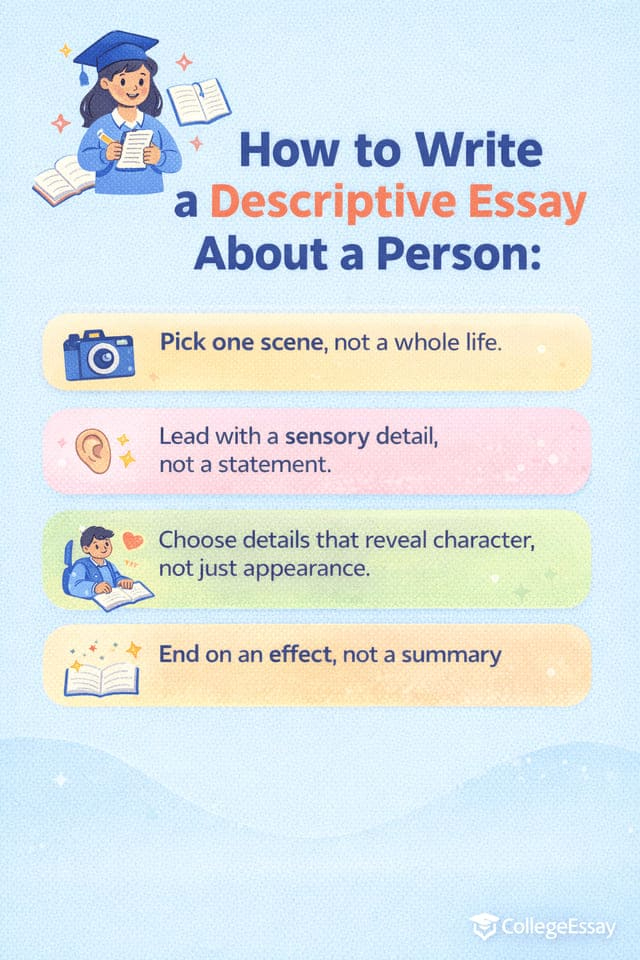
Step 1: Pick one scene, not a whole life.
Every essay above takes place in a specific location at a specific time. Not "who my grandmother was" but "my grandmother in her kitchen at five in the morning." The narrower the frame, the more specific you can be — and specificity is the entire game.
Step 2: Lead with a sensory detail, not a statement.
"Mr. Okafor's room smelled like old paper" works. "Mr. Okafor was a memorable teacher" does not. The first puts the reader somewhere. The second tells the reader how to feel. Let the details do the persuading.
Step 3: Choose details that reveal character, not just appearance.
Hair color is rarely interesting. What someone does with their hands while they listen is interesting. What someone notices and what they don't notice is interesting. Look for behavior, not description.
Step 4: End on an effect, not a summary.
Do not end with "this is why she mattered to me" or "that is the kind of person he was." End with the last specific thing, the changed kitchen, the question written in the margin, and let the reader feel the conclusion rather than read it.
Looking for more examples across different styles and formats? The descriptive essay examples page has annotated samples for academic, personal, and creative contexts. |
You've got the examples and the framework. If you're writing about someone specific: a teacher, a family member, a person from history, and you want a polished draft rather than a first attempt, the CollegeEssay.org writers who specialise in descriptive work can turn your subject and key details into a complete essay within 24 hours.
Common Mistakes in Descriptive Essays About People (And How the Examples Above Avoid Them)
- Telling instead of showing.
"She was a warm and caring person" tells. "She set a cup of tea in front of you without asking if you wanted it" shows. Every example above earns its impressions through behavior, not declaration.
- Too much physical description, not enough observation.
Paragraphs about someone's appearance: eye color, height, what they were wearing, can work when the detail reveals something. They fail when they are inventory. Ask: does this detail tell the reader something about who this person is? If not, cut it.
- Summarizing the relationship instead of showing it.
"My grandmother and I were very close" is a summary. It does not give the reader anything to hold. The kitchen essay does not use the word "close" anywhere. It doesn't need to.
- An ending that explains the beginning.
The weakest version of a descriptive essay ends by restating the introduction. "In conclusion, Mr. Okafor was the kind of teacher who..."no. End in the scene. End on the last specific thing.
You've got four full examples and a working framework. The next step is the draft, and the hardest part is usually the opening sentence. If you want a professional version written to your exact subject, deadline, and word count, a custom descriptive essay about a person from our team comes back formatted and ready to submit, most orders within 24 hours.