Descriptive Essay Examples: Grade 6 Through University Across Every Format
The strongest descriptive essay examples range from a personal-experience piece at Grade 6 to a philosophical observation essay at university level, with each one demonstrating a technique appropriate to that stage. The 13 examples below cover every grade level and every major format: 5-paragraph, short, objective, subjective, and narrative. Each has an annotation explaining what makes it work.
5-Paragraph Descriptive Essay Example
The 5-paragraph format is the most commonly assigned structure in middle school, high school, and introductory college courses. It follows a straightforward arc: an introduction with a thesis, three body paragraphs each built around one sensory or descriptive focus, and a conclusion that pulls the impression together.
This example shows how to anchor each paragraph to a distinct detail rather than cramming everything into one block of description.
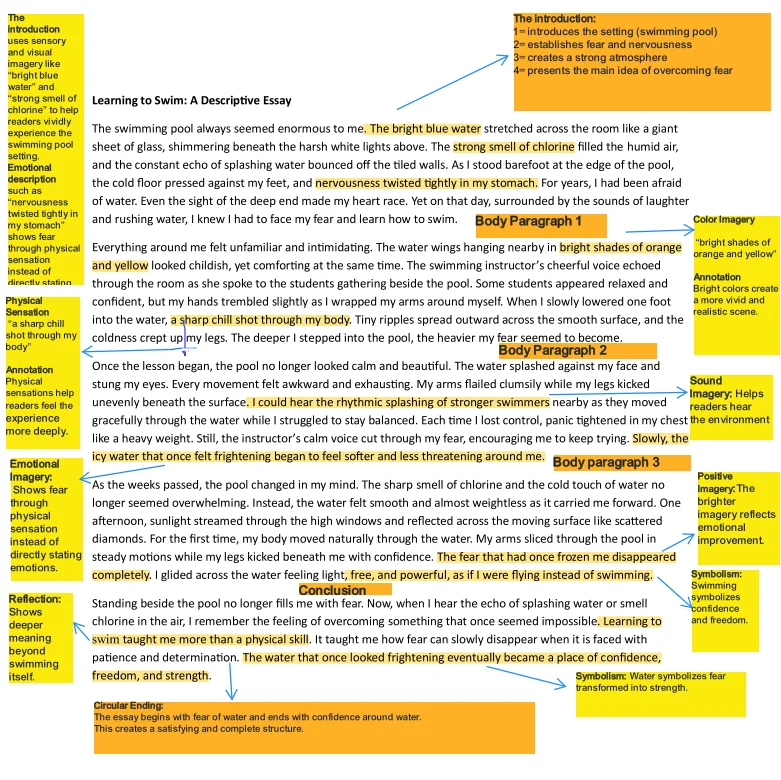
This essay earns its grade by doing one thing exceptionally well: it earns its lesson. The opening promises that learning to swim "would also make me a more confident person" but it doesn't tell you that immediately. It makes you watch it happen.
Notice three specific moves worth stealing:
- The opening does double work. “Learning to swim would also make me a more confident person” is both the hook and the thesis. It sets up a promise the rest of the essay has to deliver.
- Details are chosen, not dumped. Brightly colored water wings. May with her kickboard. Jerry crossing the pool “at a fast clip.” These aren’t decorative each one shows the writer’s anxiety by contrast (everyone else seems to be managing; I’m not).
- The closing earns its generalization. Most five-paragraph essays state a broad lesson in the conclusion that feels bolted on. This one works because the body paragraphs did the work first. “Now when I am faced with a new situation, I am not so nervous” lands because we watched that change happen in real time.
What Does a Good Descriptive Essay Look Like at Each Grade Level?
A good descriptive essay at Grade 6 uses personal experience as evidence. By Grade 9 it sustains a controlling metaphor across all paragraphs. At university level it opens a genuine problem and refuses to resolve it neatly. What counts as strong writing changes significantly at each stage.
Grade 6 Descriptive Essay Example: What Makes It Work at This Level
A strong Grade 6 descriptive essay uses personal experience as evidence and defends a genuine controlling idea in the writer’s own voice.
- It has a real argument. “Teenagers have the job to study very hard. Parents have the job to make money.” That’s a clear thesis, stated in the writer’s own voice, not borrowed from a template. A lot of Grade 6 essays have a thesis that sounds good but means nothing. This one means something to the person writing it.
- Personal context does the work of evidence. The writer brings in the war, the culture, the competition for university places, not as decoration but as the actual reason behind the argument. At Grade 6, using your own world as evidence is exactly the right move.
- Don’t mistake simplicity for weakness. The sentences are short and sometimes repetitive. That’s a Grade 6 writer working at the edge of their ability, and doing it honestly. What you’re looking for at this level isn’t sophistication. It’s: does the writer have something to say and do they say it? This one does.
Grade 7 Descriptive Essay Example: How to Build a Journey Essay
A strong Grade 7 descriptive essay earns its ending by making the details change as the journey changes rather than describing the whole trip in the same register.
- The details change as the geography changes. South Carolina gets soft leaves and fire-ant-free grass. Virginia and Pennsylvania get majestic hills and checkerboard farmlands. Upstate New York gets tiger lilies pushing toward the car and a sign reading “Waverly, 18 miles.” The writer doesn’t describe the whole trip in the same register; the description earns its way forward just like the journey does. This is what separates a descriptive essay from a travel log.
- Anticipation is built structurally, not just stated. Each paragraph ends slightly closer to home. “Home seems closer all the time.” “Home is now very close: we are almost there.” “Our vacation in New York is about to begin.” The reader feels the accumulation of those sentences the same way a child feels the last hour of a long drive. That’s pacing and it’s a Grade 7 writer using it deliberately.
- The ending earns its arrival. “We are home” is two words. The whole essay has been building for them. Notice the writer doesn’t explain what home means or why it matters the tiger lilies, the cattle fields, Grandma’s apple pie, the smoke stack, the essay already told you. The best descriptive essay endings trust the images to carry the emotion. This one does.
Grade 8 Descriptive Essay Example: How to Reframe an Argument Mid-Essay
A strong Grade 8 descriptive essay can redefine its central idea halfway through by building two competing versions of the same scene before the reversal lands.
- The setup earns the twist. The first two paragraphs spend real time establishing that home is chaos and outside is safety, the sled rides, the neighbors, the one rule being “home before dark.” That setup isn’t background. It’s the essay’s entire argument in reverse. Without it, the ending is just a scary story. With it, the ending is a realization about what safety actually means. A Grade 8 writer building a reversal this deliberately is doing something most adults don’t manage.
- The phone call is handled with restraint. The writer doesn’t tell us what happened, we hear it through the mother’s side of the conversation. “When did they find her? Oh, poor Connie, how will she handle this?” We piece it together the same way the children at the table did. That’s a sophisticated narrative choice: withhold the information, let the reader experience the confusion of not knowing, then land the revelation; “Margaret was found murdered”, in one flat, devastating sentence.
- The closing image does the essay’s real work. “Home really was a haven, and real danger could be as close as the other side of that locked door.” The whole essay has been building two competing definitions of danger, the danger inside the house, and the danger outside it. That final line holds both of them at once without resolving the tension. That’s not a student wrapping up an essay. That’s a writer finishing a thought.
Not finding an example that matches your assignment, different topic, specific word count, or a format your professor outlined? Our descriptive essay writing help team can either point you toward the right model or write the essay to your exact requirements.
Grade 9, 10, and ICSE Descriptive Essay Example
A strong Grade 9 or 10 descriptive essay sustains a single extended metaphor across every paragraph without letting it collapse that structural consistency is what separates a good essay from a memorable one.
- The extended metaphor is sustained with discipline. Carnival rides become mythical beasts. The Ferris wheel is a dragon with “exhaust-pipe nostrils.” Passengers are “sacrificial virgins.” The engine drones like a roar. Most student essays introduce a metaphor in the opening and abandon it by paragraph two. This writer carries it through the entire essay without letting it collapse. At this level, that kind of structural consistency is the difference between a good essay and a memorable one.
- Physical sensation is rendered precisely. “A lump in my throat pulsed like a dislodged heart ready to walk the plank.” “The resistance to gravity built up against my body until I was unable to move.” These aren’t vague descriptions of being scared, they’re specific, physiological, moment-by-moment. The writer slows time down during the ride the same way the body slows time down during fear. That’s not accidental craft. That’s a writer who understands that description lives in the body, not in adjectives.
- The opening earns its humor. “Eagerly trade in the serenity of the ground for the chance to be tossed through the air like vegetables in a food processor.” That’s a confident, funny opening line, and it works because it immediately establishes a voice. At Grades 9/10, voice is what separates competent writing from writing worth reading. This writer has one from the first sentence.
One honest limitation to note: The third paragraph, the actual ride description, is the essay’s strongest section, and the closing paragraph is its weakest. “I am becoming older and have less time, or less inclination, to play” is a retreat into vague reflection after three paragraphs of vivid specificity. A stronger closing would have returned to a concrete image, the dragon, the exhaust-pipe nostrils, the metal steps, instead of stepping back to summarize. This is worth showing students precisely because the gap between the strong middle and the weak ending illustrates what a closing paragraph actually needs to do: not wrap up, but land.
Grade 11, 12, and ISC Descriptive Essay Examples: What Examiners Look For
A strong Grade 12 ISC descriptive essay uses a specific ordinary scene to carry an idea larger than the scene itself; the thesis never appears as a sentence but accumulates through images. The ISC format typically requires 300–400 words on a topic drawn from the immediate environment or personal experience. The essay below is calibrated to this word range and follows the structure ISC examiners expect.
Grade 11 and 12 Descriptive Essay Example (PDF)This essay does what the best personal-descriptive writing at this level should do: it uses a specific, ordinary scene to carry an idea that is larger than the scene itself. The grocery store is not a backdrop. It is the argument.
Five things worth studying in this essay:
- The controlling image does the essay’s thinking. The grandmother mapping the store with her body the shelf edge found without looking, the bakery pause, the deli counter greeting is not decoration. It is the essay’s central idea rendered as behavior rather than stated as a conclusion. At Grade 11/12, the most important shift a writer can make is learning to show their thesis rather than announce it. This essay’s thesis that a person’s intimate knowledge of an ordinary place is a kind of irreplaceable intelligence never appears as a sentence. It accumulates through images.
- The turn is earned, not announced. “Then last spring she forgot where we had parked the car.” One sentence. No buildup, no foreshadowing, no “little did I know.” The essay pivots on that line because everything before it has been laid carefully enough that the line lands with weight. This is structural control knowing exactly where to place the moment that changes everything, and trusting it to do its work without commentary.
- The narrator’s interiority is rationed. The writer tells us what they felt (“I used to find this unbearable”) but spends most of the essay on observation rather than emotion. This is a Grade 11/12 skill: understanding that restraint creates more feeling than expression. “I never asked her what she was thinking in that moment. I still don’t. Some things are not mine to know” three sentences that do more emotional work than three paragraphs of reflection would.
- The short paragraph is used as punctuation. “I used to find this unbearable.” “The grocery store has not changed. I have.” These one and two-sentence paragraphs are not accidents. They are deployed at moments where the essay needs to pause and let a realization land. At this level, paragraph length is a tool, not a default. Learning to use white space the way this essay does to give weight to a single sentence by isolating it is one of the clearest markers of a maturing writer.
- The closing earns its abstraction. The final paragraph moves to metaphor “some maps only exist while someone is still walking them”, but it earns the right to do so because the entire essay has been grounded in physical, specific, observed detail. The rule at Grade 11/12 is: you can go abstract in the closing only if you have been concrete everywhere else. Abstraction without grounding is vagueness. Abstraction after grounding is resonance. This closing is the latter.
College Descriptive Essay Example: What Makes College-Level Work
A college-level descriptive essay uses a specific physical scene to think through an idea that cannot be arrived at any other way. The description and the argument are not separate things.
- The central image is doing philosophical work. The unfinished proof with a green question mark is not a mood-setter. It is the essay’s actual argument that education means sitting with open problems, not accumulating solved ones. At college level, every descriptive detail should be load-bearing. Nothing in this essay is decoration.
- The abstract idea is earned through the concrete. Wittgenstein’s theory of language limits appears in paragraph five but only after four paragraphs of specific, grounded observation. The rule at college level: you have to build the ground before you can go up. The classroom, the smell of dry-erase marker, the half-finished coffee these are not atmosphere. They are the foundation that makes the abstract argument credible when it arrives.
- The narrator’s thinking is visible. “I said one thing I had not known I believed until I heard myself say it.” This is college-level self-awareness the writer catching themselves in the act of thinking, and reporting it accurately. At this level, the essay should not just describe what happened but what it meant to be the person it happened to. Not reflection added at the end, but thinking woven through.
- The prose is controlled at the sentence level. Short sentences land observations. Longer sentences carry ideas. “The loneliness I mean is the loneliness of sitting in a room full of people who are each, privately, staring at their own unfinished proof” that sentence does what a paragraph of explanation would do less efficiently. At college level, sentence rhythm is not an accident. It is a decision.
- The closing earns its meaning without explaining it. “I still have it.” Three words. The essay does not tell you what the photograph means, what lesson was learned, what the writer plans to carry forward. It trusts the reader to hold the weight of that final line, because everything before it has done the work. College-level writing ends on an image, not a summary. It gives the reader something to think with, not a conclusion to agree with.
University Descriptive Essay Example: What Separates University from College
A university-level descriptive essay uses a specific observed scene to open a genuine ethical or philosophical problem. It refuses to resolve that problem neatly. That refusal is the point.
- The essay thinks in public. The reference to Iris Murdoch’s concept of moral vision is not name-dropping it is the writer reaching for a framework precise enough to name what they are experiencing. At university level, descriptive writing is in conversation with ideas. The physical scene and the intellectual apparatus are not separate the essay moves between them fluidly because that is how serious thinking actually works.
- The central observation is structural, not incidental. The contrast between the narrator’s thirty-second crossing and the other man’s redirection is not a dramatic moment the essay stumbles upon. It is the essay’s architecture. Everything the officer not looking up, the different colored passport, the door with no handle has been placed with precision to make a single, uncomfortable point without ever stating it directly.
- Restraint is the primary technique. “They led him through a door that had no handle on the outside.” The essay does not tell you what this means. It does not explain the implication, name the injustice, or offer a verdict. It describes the door. At university level, the writer trusts the reader to do the moral arithmetic and that trust is itself an argument about how the essay believes meaning is made.
- The inheritance line earns its abstraction. “The thirty seconds were not a reward. They were an inheritance.” This is the essay’s thesis, but it arrives in paragraph six, after five paragraphs of grounded, specific observation have made it inevitable. At university level, the thesis is not the starting point. It is what the evidence builds toward. A writer who puts this sentence in the opening paragraph has not yet learned what a university essay is for.
- The ending refuses resolution. “I am still deciding.” The airport essay submitted to you ended with a moral promise I hope to help another traveler someday. Clean, closed, reassuring. This essay ends with the writer standing in an arrivals hall holding a coffee, still inside the problem. University-level writing does not offer the reader the comfort of a lesson learned. It offers them the more difficult gift of a question held honestly, and the implicit invitation to hold it alongside the writer.
Descriptive Essay Examples by Format: Short, Objective, Subjective, and Narrative
Short Descriptive Essay Example
A well-controlled short descriptive essay (one to three paragraphs) earns its impact by choosing one sharp detail and going deep into it, rather than covering multiple observations broadly.
Short Descriptive Essay Example (PDF)Most student essays describe anxiety. This one makes you feel it without ever using the word. That’s the gap between a competent essay and a memorable one.
Three moves worth studying:
- All five senses, deployed deliberately. Sight (the Before/After photos, the clinical white walls). Sound (the bell, the whirring drill, the muffled yell, the receptionist calling names). Smell (rubber gloves, disinfectant, cheap air freshener). Touch (vinyl chairs, clammy legs, the cool metal probe). Taste (bubblegum-flavored gloves). Most student essays lean on sight alone. This writer uses all five and crucially, the taste and touch details come before the narrator has even sat in the chair. They’re imagined. That’s what anxiety does: it makes you experience the worst before it happens.
- Short sentences do the heavy lifting. “I push the door open.” “I look up.” “My pulse quickens.” The sentence length mirrors the narrator’s state. Long, drifting sentences for the daydream sequence. Clipped, sharp sentences when reality snaps back. You don’t need to tell the reader “I was scared” your syntax already said it.
- The ending earns its dread. The whole essay builds toward a name being called. “Barron, Cissie, Doctor Lush will see you now.” Six words. No commentary needed. The best descriptive essay endings don’t explain what just happened they let the final image land and trust the reader to feel it.
Objective Descriptive Essay Example
An objective descriptive essay reports what is there without inserting personal feeling. The writer uses observable sensory details what can be seen, heard, measured and removes opinion entirely. This format is common in science, journalism, and technical writing courses.
Objective Descriptive Essay Example (PDF)Subjective Descriptive Essay Example
A subjective descriptive essay does the opposite: the writer’s personal reaction to the subject is central to the piece. The same scene described objectively becomes something entirely different when filtered through the writer’s emotions and associations. This is the format most English and creative writing courses assign.
Subjective Descriptive Essay Example (PDF)Narrative and Descriptive Essay Example
A narrative descriptive essay combines the arc of a story with the sensory richness of description. There’s a progression a beginning, a turning point, a reflection but every scene is built through specific observed detail rather than summary. This is a common format for personal statements and college application essays.
Narrative and Descriptive Essay Example (PDF)How to Start a Descriptive Essay: Example Opening Lines
A strong descriptive essay opening drops the reader into one specific moment in the first sentence not background, not context, the thing itself. Here are five techniques with a real example of each.
1. Opening with a Physical Sensation
The kitchen always smelled of cardamom and burnt sugar, even in the rooms furthest from it. By the time I reached the doorway, the smell had already told me whether she was in a good mood.
The sensation arrives before the person does. “Cardamom and burnt sugar” encodes a culture, a mood, and a relationship in two sentences, without naming any of them. Use this when the place communicates through atmosphere more than appearance.
2. Opening with an Action
I push the door open. The bell tinkles, with a soft but shrill ring. A wave of rubber gloves and disinfectant masked with cheap air freshener washes over me.
Present tense puts the reader inside the moment as it happens. Three sentences, three senses, no adjective that names the feeling directly. Use this when you want the reader living the experience, not reading about it.
3. Opening with a Specific Object
The question mark on the whiteboard had been there since Tuesday. Professor Chen never erased it not because he forgot, but because the question it followed didn’t have an answer yet.
One object carries the whole essay’s argument. The second sentence eliminates the obvious interpretation and replaces it with the correct one. Use this when a single detail contains the essay’s central idea.
4. Opening with Contrast
From the outside, the house looked like the rest of the street: the same pebbledash, the same narrow driveway, the same net curtains. Inside, every surface held something my father had made with his hands.
Sentence one lulls. Sentence two breaks. The emotional charge stays out of both sentences and accumulates in the gap between them. Use this when the essay’s argument depends on a difference between appearance and reality.
5. Opening with a Sound
The drill started before the door to the surgery had fully closed. Somewhere behind it, a voice said something: the words were lost, but the tone wasn’t.
Most student essays default to visual description. Leading with the most emotionally loaded sound in the space is immediately distinctive. Use this when sound is what the place is really about.
You’ve got the examples. The next part actually writing a descriptive essay that fits your specific topic, length requirement, and professor’s expectations is where most students get stuck. If you’d rather not start from a blank page, tell us your subject, word count, and any details you’ve been given, and our writers can handle the descriptive essay for you delivered within 24 hours.
What Separates a Strong Descriptive Essay from a Weak One?
Strong descriptive essays share three qualities: a single controlling impression, specific observable details over adjectives, and organised movement through the scene. Here are the three things that separate a strong descriptive essay from a weak one each shown with a before/after sentence pair so you can see the difference immediately.
1. A single controlling impression
Every strong descriptive essay has one central idea it is trying to create in the reader’s mind. Not “my grandmother’s kitchen” in general but “the particular stillness of it on Sunday mornings.” Every detail selected serves that impression. Details that don’t serve it are cut, even if they’re interesting.
You’ll see this in the examples: the writer commits to one feeling or atmosphere in the opening and every paragraph reinforces it rather than drifting into something else.
If you are writing a person-focused descriptive essay see our dedicated descriptive essay about a person page.
2. Specific, observable details over adjectives
| ✗ Weak | ✓ Strong |
|---|---|
| “The room was beautiful and welcoming.” | “The wallpaper had been peeling at the same corner since I was six.” |
| “She was an intimidating woman.” | “She never raised her voice. She didn’t need to.” |
| “The market was busy and colourful.” | “A man ahead of me was arguing with a vendor over three tomatoes.” |
The weak versions tell the reader what to feel. The strong versions show a specific thing and let the reader feel it. Descriptive writing is built from concrete, observable detail things that can be seen, heard, smelled, touched not evaluative labels like “beautiful”, “intimidating”, or “colourful.”
3. Organised movement
Descriptive essays that read as a list of observations feel flat even when the individual sentences are strong. The best ones move spatially (near to far, exterior to interior), temporally (arrival to departure, morning to night), or emotionally (first impression to deeper understanding).
| ✗ Weak | ✓ Strong |
|---|---|
| “The café had wooden floors. The walls were exposed brick. The ceiling had hanging lights. The barista was making coffee.” | “You smelled it before you saw it coffee and something baking. The door was heavy. Inside, the ceiling was low, the lights warm, and the barista had her back to you already, which somehow made the whole place feel like somewhere you were allowed to be.” |
The weak version lists. The strong version moves from outside to inside, from sense to sense, from observation to feeling. The reader is taken somewhere rather than handed a checklist.
You’ve seen what a strong descriptive essay looks like across every format and grade level. Now comes the writing. Tell us your topic, your word count, and what your professor asked for our CollegeEssay.org descriptive essay writers will have a complete draft back to you within 24 hours.
Frequently Asked Questions

Get expert writing help.
- Expert writers in your subject
- 100% human-written work
- From $11 per page
Price shown before checkout.
We’ll write it to your exact prompt.
Tell us your topic and requirements draft back within 24 hours.
See how it works
-21179.png)