Your professor assigned an essay. They didn't tell you which kind. Or they did, but the words "synthesis," "exemplification," and "process analysis" are blurring together at 11 PM, and nothing is making sense. This page cuts through that. Here are the main types of essays, what each one actually does, and how to know which one you're dealing with before you write a single word.
What Are the Main Types of Essays?
Why the Type of Essay Matters Before You Start
The type of essay determines everything: your structure, your thesis, how you use sources, how you open, and how you close. Writing a definition essay like a persuasive essay produces something confusing. Writing an informative essay when you were supposed to argue a position produces something that gets marked down for missing the point.
Get the type right first. Everything else follows from it.
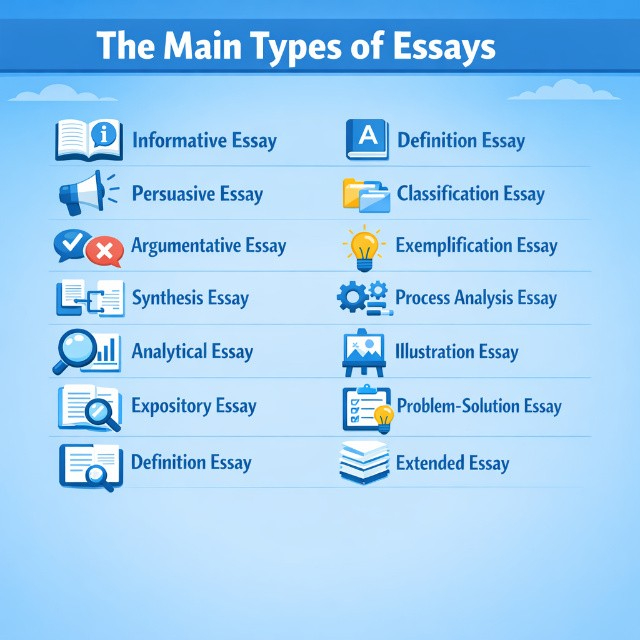
The Main Types of Essays
Informative Essay
An informative essay explains a topic clearly and objectively. No argument. No persuasion. Your job is to give the reader an accurate, thorough understanding of something they may not know much about.
- What it looks like: A clear central topic, organized sections that break the topic into digestible parts, facts and examples that support each section, and a conclusion that summarizes what the reader now knows.
- Common assignments: Science reports, historical overviews, "explain how X works" prompts, and health and social issue explainers.
- What trips students up: Accidentally sliding into opinion. The moment you write "this is why X is better than Y," you've left informative territory. Stay neutral throughout.
Persuasive Essay
A persuasive essay argues a position and tries to bring the reader around to your view. You pick a side and defend it using logic, evidence, and sometimes emotional appeal.
- What it looks like: A clear thesis that states your position, body paragraphs that each advance one argument, evidence that supports each argument, and a conclusion that reinforces why your position holds.
- Common assignments: Opinion pieces, debate-style prompts, "do you agree or disagree" questions, policy argument essays.
- What trips students up: Treating it like an informative essay, presenting both sides without committing to one. A persuasive essay is supposed to be one-sided. That's the assignment.
Argumentative Essay
Close to persuasive, but more rigorous. An argumentative essay doesn't just advocate for a position; it acknowledges the opposing view and dismantles it with evidence. The distinction matters in academic settings where the expectation is scholarly reasoning, not just rhetoric.
- What it looks like: A debatable thesis, body paragraphs built around evidence (academic sources, data, documented examples), a counterargument section where you address the strongest objection, and a rebuttal.
- Common assignments: Academic writing courses, research-based prompts, "argue both sides but take a position" questions.
- What trips students up: Forgetting the counterargument section, or treating it as a throwaway. The counterargument is where argumentative essays are won or lost. A strong rebuttal shows the reader you've thought seriously about the other side.
Synthesis Essay
A synthesis essay pulls from multiple sources and builds one coherent argument or explanation from them. You're not summarizing each source; you're weaving them together so they support a single central claim.
- What it looks like: A thesis that your sources collectively support, body paragraphs that each bring together multiple sources around a single point, and transitions that show how the sources connect rather than just listing what each one says.
- Common assignments: AP Language and Composition exams, research papers, literature reviews, comparative analysis essays.
- What trips students up: Writing a summary of each source in sequence instead of synthesizing. If your paragraphs read "Source A says this. Source B says this. Source C says this:" that's a summary, not a synthesis. The sources should be in conversation with each other.
Analytical Essay
An analytical essay breaks something down into its component parts and examines how those parts work together to create meaning or produce an effect. The "something" is usually a text, a film, a historical event, or a piece of art.
- What it looks like: A thesis that makes a claim about how or why something works the way it does, body paragraphs that each examine one element, close reading or specific evidence, and a conclusion that ties the analysis back to the larger significance.
- Common assignments: Literary analysis, film criticism, historical document analysis, and cultural criticism.
- What trips students up: Summarizing instead of analyzing. Describing what happens in a novel is not the same as explaining how the author constructs meaning. Every paragraph should answer "so what?" not just "what."
Expository Essay
An expository essay explains, describes, or defines something in a straightforward, structured way. It's the broad category that informative, process analysis, definition, and classification essays often fall under. If your prompt says "explain" or "describe," you're likely writing expository.
- What it looks like: A clear thesis that states what will be explained, logically organized body paragraphs, and a conclusion that reinforces the explanation. No argumentation. No opinion.
- Common assignments: General education courses, standardized tests, "explain the causes of X" or "describe how Y works" prompts.
- What trips students up: Confusing expository with argumentative. Expository essays explain. Argumentative essays debate. If there's no real opposing position to take, it's probably expository.
Definition Essay
A definition essay explores the meaning of a term or concept in depth, going beyond the dictionary definition to examine nuance, context, and complexity.
- What it looks like: An opening that introduces the term and why it's worth examining, multiple lenses for defining it (origin, usage, what it is and isn't, examples), and a conclusion that offers a more complete understanding than a standard dictionary would.
- Common assignments: Philosophy courses, ethics seminars, English composition, "what does X really mean" prompts.
- What trips students up: Stopping at the dictionary definition and then padding the essay with obvious examples. The point of a definition essay is to reveal complexity, to show that a word like "justice" or "identity" means something richer and more contested than a single sentence can capture.
Still not sure which of these is yours? If your prompt is ambiguous or your professor didn't name the type explicitly, tell us the prompt wording, your course, and your word count. Our essay writing services by type cover every format on this page, and we can identify the right approach and write the essay for you.
Classification Essay
A classification essay organizes a subject into categories and explains the logic behind the grouping. You're not just listing, you're sorting, and the sorting principle is the argument.
- What it looks like: A clear sorting principle introduced in the opening, one body section per category, examples that illustrate each category, and a conclusion that explains why this classification system is useful or meaningful.
- Common assignments: Social science courses, biology, economics, any prompt that asks you to "categorize" or "group" something.
- What trips students up: Using overlapping or inconsistent categories. If something can fit in two categories at once, the classification system is broken. Each category should be distinct, and the criteria should be consistent across all of them.
Exemplification Essay
An exemplification essay makes an argument and supports it primarily through examples, many of them carefully chosen and developed. The examples are not decoration; they are the evidence.
- What it looks like: A clear thesis that needs proving, body paragraphs each built around one or more specific examples, and a conclusion that draws out what the examples collectively demonstrate.
- Common assignments: English composition, social science courses, "support your argument with examples" prompts.
- What trips students up: Using examples that are too vague or too brief to do any argumentative work. An example that gets one sentence isn't really an example; it's a mention. Exemplification essays require real development of each example.
Process Analysis Essay
A process analysis essay explains how something works or how to do something, step by step, in sequence. Think of it as a detailed how-to, but written with the analytical depth of an academic essay.
- What it looks like: An introduction that explains what process is being analyzed and why it matters, sequential body paragraphs that walk through each stage, and a conclusion that explains the significance of understanding the process.
- Common assignments: Science and technical writing courses, "explain how X happens" or "describe the process of Y" prompts.
- What trips students up: Writing an instruction manual instead of an essay. A process analysis essay explains the process and its significance, not just the steps. Each step should be accompanied by enough context that the reader understands why it matters, not just what to do.
Illustration Essay
An illustration essay uses specific, vivid examples to make an abstract idea concrete and understandable. Similar to exemplification, but the emphasis is on clarity and clarity through showing, making the reader see something they couldn't see before.
- What it looks like: A central idea or claim, body paragraphs that each bring in a well-developed example to illustrate it, and a conclusion that reflects on what the examples collectively reveal.
- Common assignments: Creative nonfiction, general composition, any prompt asking you to "show" rather than "tell."
- What trips students up: Selecting examples that are too familiar or too safe. The best illustration essays choose examples that are surprising, specific, and genuinely illuminating, not the first obvious case everyone thinks of.
Problem-Solution Essay
A problem solution essay identifies a specific problem, analyzes its causes and scope, and proposes one or more practical solutions. It's argumentative in structure but solution-oriented in purpose.
- What it looks like: A clear problem statement with evidence of its significance, analysis of causes, one or more proposed solutions with supporting reasoning, and a conclusion that addresses feasibility and stakes.
- Common assignments: Policy writing, social science courses, public health, environmental studies, and civic engagement prompts.
- What trips students up: Proposing a solution without engaging seriously with the problem first. If the problem section is thin, the solution feels disconnected and unconvincing. Spend real time establishing why the problem matters before you propose the fix.
Extended Essay
The extended essay is primarily an IB (International Baccalaureate) requirement, a 4,000-word independently researched academic paper on a topic of the student's choosing. It functions more like a mini-thesis than a standard essay.
- What it looks like: A focused research question, a structured literature engagement, a methodology section, detailed analysis, and a conclusion with reflection. Formal academic conventions throughout.
- Common assignments: IB Diploma Programme (mandatory).
- What trips students up: Choosing a topic that's too broad for 4,000 words, or failing to develop a sufficiently specific research question. The extended essay rewards specificity and depth over coverage.
Use the guides linked above for whichever type you're working on. They go deeper into structure, thesis construction, and the specific mistakes to avoid. If you get stuck partway through, with a topic in hand but the writing proving harder than expected, our essay type writing specialist team works across all of these formats and can step in at whatever stage you need.
How to Identify Which Essay Type You've Been Assigned
Most prompts signal the type in their wording. Here's how to read those signals:
If the prompt says... | You're writing... |
"Explain" or "describe" | Informative or expository |
"Argue" or "take a position" | Argumentative or persuasive |
"Use sources to support" | Synthesis or argumentative |
"Analyze" or "examine" | Analytical |
"Define" | Definition |
"Categorize" or "classify" | Classification |
"Use examples to support" | Exemplification or illustration |
"Explain how to" or "describe the process of" | Process analysis |
"Identify the problem and propose a solution" | Problem-solution |
When in doubt, look at what kind of thesis the prompt seems to want. A thesis that takes a side = argumentative or persuasive. A thesis that explains something = informative or expository. A thesis that makes a claim and supports it with examples = exemplification or illustration.
If you're still weighing which type fits your assignment after working through the table, the guide for how to choose the right essay type walks through the decision based on your prompt wording, course level, and word count.
Choosing the Right Essay Type Matters More Than Most Students Realize
Writing the wrong type of essay for an assignment, or understanding the type but misreading what it requires, is one of the most common reasons students lose marks they shouldn't lose. The content might be good. The argument might be solid. But if a classification essay doesn't classify, or an analytical essay only summarizes, the grade reflects the mismatch.
Conclusion
You now know which type you're dealing with. The next problem is writing it, the right structure, the right thesis, the right length for your assignment. If you'd rather hand that off, tell us your essay type, topic, word count, and deadline, and CollegeEssay.org's essay type specialists will deliver a complete draft within 24 hours.
Frequently Asked Questions
What are the main types of essays students write in college?
The most common types of essays in college are argumentative, analytical, expository, and synthesis essays. Which one you write depends on the course and the prompt; argumentative and analytical essays dominate English and humanities courses, while expository and synthesis essays appear frequently in general education and AP-level work.
What is the difference between the types of essays, and when do you use each one?
The core distinction is purpose. Informative and expository essays explain. Argumentative and persuasive essays take a position and defend it. Analytical essays examine how something works. Synthesis essays build a single argument from multiple sources. Definition, classification, and exemplification essays each have a specific structural logic. The prompt wording is almost always the clearest signal for which type applies.
Are persuasive and argumentative essays the same type of essay?
They are similar but not identical. Both take a position, but an argumentative essay is held to a higher evidential standard; it requires engaging with the opposing view and rebutting it with documented evidence. A persuasive essay can rely more heavily on rhetoric and emotional appeal. In most academic settings, argumentative signals a more rigorous expectation than persuasive.
How many types of essays are there?
There is no fixed number; different institutions and style guides categorize them differently. This page covers the 12 types most commonly assigned at high school and college levels. Some types overlap (expository is a broad category that includes informative, definition, and process analysis essays), so the count depends on how granularly you draw the distinctions.
Which type of essay is the hardest to write?
Synthesis essays are consistently the most difficult for students who are new to them. The requirement to weave multiple sources into a single coherent argument, rather than summarizing each one, is a genuinely different skill from other essay types. Extended essays are demanding in a different way: the challenge is sustaining academic rigor across 4,000 words of independent research.
Benjamin Cole Verified
Author
Dr. Benjamin Cole, holding a Ph.D. in English from Stanford, brings a decade of experience in academia and essay composition across a diverse range of writing forms. Specializing in expository and analytical writing, Benjamin has developed deep expertise in informative, classification, definition, exemplification, illustration, problem-solution, process analysis, synthesis, and extended essay formats. His comprehensive understanding of essay typology, from outlining, classification, and definition essays to selecting compelling topics for exemplification and synthesis essays, makes him a trusted authority in academic writing. Benjamin's ability to guide writers in identifying the right essay type and mastering its structure has earned him widespread recognition in essay education and expository writing methodology.
Specializes in:
types of essays
informative essay
classification essay
definition essay
exemplification essay
extended essay
illustration essay
problem solution essay
process analysis essay
synthesis essay
Read All Articles by Benjamin Cole
Keep Reading
Was This Blog Helpful?
On this Page