Your professor either gave you an essay type or left the choice open. Either way, most students treat it as the least important detail in the assignment. It isn't.
The essay type is the instruction manual. It tells you what to argue, how to structure your evidence, and what your conclusion is actually supposed to do. Get it wrong, and a well-written essay still fails the assignment. Get it right, and the rest of the work gets easier, because you know exactly what you're building.
This guide walks you through how to identify your essay type, how to choose one when it's left open, and how to match the type to your argument so the whole thing holds together.
Step 1: Look for Type Signal Words When Choosing the Right Type of Essay
Most prompts tell you the type directly or through signal language. You just have to know what to look for.
Prompts that Tell you Directly
Some prompts name the type outright:
If the prompt names the type, use that type. Do not interpret your way into a different one.
Prompts that Signal the Type Through Verbs
When the prompt doesn't name the type, the verb usually does:
Prompt verb | Essay type signals |
Argue / convince / defend | Argumentative |
Explain / describe / define | Expository |
Analyze / examine / evaluate | Analytical |
Compare / contrast / distinguish | Compare and contrast |
Reflect / describe a time when / tell about | Narrative or personal |
Discuss both sides / consider | Discursive / exploratory |
If your prompt uses "argue," write an argumentative essay. If it uses "explain," write an expository one. Don't blend them unless the prompt explicitly asks you to do both.
When the Prompt is Genuinely Open
Some assignments say something like: "Write a five-page essay on a topic of your choice." In that case, you choose the type. Jump to Step 3 below. If you're not confident in what each type actually requires before you choose, our types of essays guide covers every type in full, including structure, requirements, and where students most often go wrong.
Step 2: Match the Right Type of Essay to What the Prompt Actually Asks You to Produce
Once you've identified the type signal, check that it matches what the prompt is asking you to produce at the end. This is where students often drift.
- Argumentative prompts ask you to take a position and defend it. Your conclusion should restate why your position is right, not summarize both sides neutrally.
- Expository prompts ask you to explain something clearly and completely. Your conclusion should close the explanation, not introduce a new argument or try to persuade anyone of anything.
- Analytical prompts ask you to examine how or why something works the way it does. Your conclusion should name what the analysis revealed, not just list what you covered.
- Compare and contrast prompts ask you to show meaningful similarities and differences between two things. Your conclusion should say what those comparisons mean and why the comparison matters.
- Narrative prompts ask you to tell a story that illustrates a point. Your conclusion is the reflection of what the story meant, not a recap of the events.
If the type you identified leads naturally to the kind of conclusion the prompt is asking for, you've got the right type. If there's a mismatch, if "explain" is leading you toward a persuasive conclusion, you've misread the prompt. Go back to Step 1.
Still not sure which type fits your prompt? Tell us your assignment instructions, your topic, and your deadline. Our essay type writers can handle the rest, from picking the right type to delivering a complete draft.
Step 3: When Choosing the Right Type of Essay is Your Call
Open prompts are common in upper-division courses and in college application essays. When the type is yours to decide, choose based on three things: your argument, your evidence, and your comfort with the form.
Choose Argumentative If You Have a Clear Position
If you have something to argue, a specific claim you can defend with evidence and anticipate objections to, write an argumentative essay. It's the most common academic type for a reason: it tests the core skill professors care about, which is whether you can build and defend a logical position.
Good fit: You have a claim. You have at least two strong pieces of evidence. You can name at least one counterargument and address it. |
Bad fit: You have a topic but no position. You're not sure what you actually think. In this case, write analytically first because the position usually emerges. |
Choose Expository if your Job is to Inform, Not Persuade
If the goal is to explain something that isn't contested, a process, a concept, or a historical event, write an expository essay. You're not arguing. You're clarifying.
Good fit: The topic has the right answer or a correct explanation that your essay will deliver. You have organized information and a logical sequence. |
Bad fit: The topic is genuinely contested. If a reasonable person could disagree with your conclusion, you're in argumentative territory, not expository. |
Choose Analytical if You're Examining Something Specific
If your essay is about a text, a film, a policy, a historical decision, or a piece of data, and your job is to explain how or why it works the way it does, write an analytical essay. Analysis is not a summary. The essay isn't about what happened. It's about why it happened the way it did, or what it means that it did.
Good fit: You have a specific object to examine. Your claim is an interpretation, not just a fact. |
Bad fit: You're tempted to summarize more than you analyze. If more than 20% of your essay is plot summary or event recap, the ratio is wrong. |
Choose Compare and Contrast if you have Two Clear Subjects Worth Comparing
This type earns its keep when the comparison itself reveals something, when putting two things side by side shows you something you couldn't see by looking at each one separately. Don't choose it just because you have two subjects.
Good fit: The comparison produces a meaningful insight. "Both X and Y do Z, but for opposite reasons, which means..." |
Bad fit: The comparison produces only a list. "X has these qualities. Y has these qualities. They differ in A, B, and C." That's a table, not an essay. |
Choose Narrative if You're Writing a Personal or Creative Piece
If the assignment invites first-person voice and a story, a college application essay, a personal statement, or a reflective piece, write a narrative essay. The story is the vehicle for your point; it's not just a warm-up paragraph before the argument.
Good fit: You have a specific experience that illustrates a larger truth. You can identify what the story means before you write it. |
Bad fit: You have a story but no point. The point is not optional in a narrative essay. Find it before you start, or the essay will find its way to the wrong conclusion. |
Step 4: Check the Right Essay Type Against Your Assignment Requirements
Before you commit to a type and start writing, run a quick check against your assignment sheet.
Length
Some types naturally expand or compress. Expository and analytical essays tend to run shorter than argumentative ones because they don't require rebuttal sections. Compare and contrast essays can run long if you're covering multiple criteria. Make sure your chosen type can fill, or fit within, the word count.
Source Requirements
Argumentative and analytical essays almost always require external sources. Expository essays often do too. Narrative essays generally don't. If your assignment requires six cited sources, a personal narrative is probably not the right type, regardless of what the prompt says.
First-Person Voice
Most academic essay types default to the third person. Narrative and reflective essays are the exceptions. If your professor hasn't specified, assume third person unless the prompt explicitly invites personal voice.
Format Expectations
Some assignments come with format requirements, a specific heading structure, an abstract, or a required thesis placement. These are separate from the essay type but must be reconciled with it.
Step 5: Lock In the Right Essay Type Before You Outline
This is the discipline most students skip. They start outlining, sometimes start writing, before committing to a type. The result is a draft that mixes modes: half-analytical, half-argumentative, with a narrative hook that doesn't fit either.
Commit to the type before you build the outline. Write the type at the top of your document if it helps: This is an argumentative essay. It makes a claim, defends it with evidence, addresses counterarguments, and concludes with a restatement of the position. Then outline against that template.
If you change your mind about the type during the outline, which happens, stop, update the type declaration, and rebuild the outline. Do not carry a draft forward if the type isn't settled. Everything else in the essay depends on it.
The Most Common Essay Type Mistakes and What They Cost You
Knowing the right type matters less if you don't know what happens when students get it wrong. These are the four mistakes professors see most often.
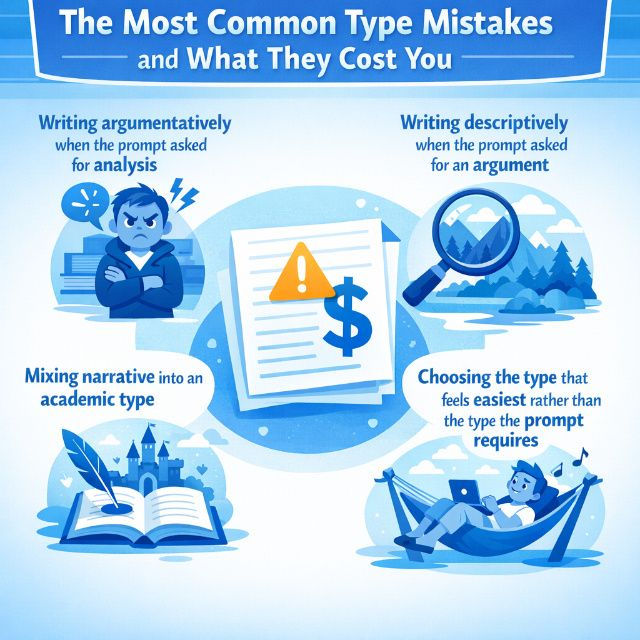
Writing Argumentatively When the Prompt Asked for Analysis
The student takes a position and defends it instead of examining how something works. The essay reads as opinionated rather than rigorous. The grade reflects a misread prompt, not weak writing.
Writing Descriptively When the Prompt Asked for an Argument
The student summarises the topic thoroughly but never commits to a claim. The essay is informative but earns a middling grade because it does not do what was asked. "You described it well, but never argued anything" is one of the most common pieces of feedback professors give.
Mixing Narrative into an Academic Type
A first-person anecdote as an opening hook in an analytical essay, or a reflective conclusion in an expository one, feels like a stylistic choice but signals to the professor that the student doesn't understand the form. Keep the types clean.
Choosing the Type that Feels Easiest Rather than the Type the Prompt Requires
Narrative essays feel approachable. Argumentative essays feel harder. Students default to the form they are most comfortable with, regardless of what the assignment asked for. The comfort does not survive the grade.
The pattern across all four: the writing itself is often fine. The type is wrong. Fix the type first, and the writing problem frequently disappears with it.
A Quick-Reference Decision Map on How to Choose the Right Essay Type
Use this if you're stuck and need to decide fast.
- Does your prompt name the type?
- Yes: use that type. Skip to Step 4.
- No: continue.
- Does the prompt use a verb from the signal list above?
- Yes: match the type to the verb. Confirm with Step 2.
- No: the essay type is open. Use Step 3.
- Do you have a clear position to defend?
- Yes: argumentative.
- No, but I have a clear subject to explain: expository.
- No, but I have a text or object to examine: analytical.
- No, but I have two subjects worth comparing: compare and contrast.
- I have a personal experience that illustrates a point: narrative.
- Does the type match the conclusion the prompt expects?
- Yes: you're set. Outline and write.
- No: go back to the prompt and re-read. The mismatch is usually in the signal verb.
Once you've nailed the type, the structure follows. But if you're working against a deadline and the type still isn't clicking, or if you've identified the type but aren't sure how to build the argument within it, that's where essay type writing service comes in. Tell us the type, the prompt, and the deadline. We match you with a writer who specializes in that specific form.
What to Do If You're Still Stuck on Choosing the Right Essay Type
Some prompts are genuinely ambiguous. If you've worked through the steps above and still can't land on a type, try one of these two moves before you start writing.
Write the Conclusion First
Don't write the full essay. Write one paragraph describing what you want the reader to think, feel, or know by the time they finish. If that paragraph takes a position and defends it, you're writing an argumentative essay. If it closes an explanation, you're writing an expository one. If it reflects on what a story meant, you're writing a narrative. The conclusion reveals the type more reliably than the prompt sometimes does.
Ask the Professor Directly
This move is underused. A one-line email, "I'm planning to write an argumentative essay on X. Does that match what you're looking for?" takes two minutes and removes all ambiguity. Professors prefer this to reading an essay that missed the assignment. Most will respond quickly and clearly.
Neither move requires more research or more time. They require deciding to resolve the ambiguity before it becomes a structural problem on page three.
Conclusion
You've got the type. You've checked it against the prompt, the evidence, and the assignment requirements. The hard part, the part that trips most students up before they write a single sentence, is done.
What's left is the writing itself. If the type is clear but you'd rather hand the execution to someone who knows the form cold, write my essay by type and get it back in 24 hours. Tell us the type, the prompt, and the deadline. Most students receive a complete draft within 24 hours.