Your professor assigned a persuasive speech, and somewhere in the brief is a phrase like "address a question of fact," or "argue a question of value," or "propose a policy change," and you need to figure out which of the three types you are actually being asked to write. Picking the wrong type means building the wrong kind of argument with the wrong kind of evidence, and the speech falls flat no matter how well you deliver it.
Quick identification of what your assignment is asking for:
If your assignment uses... | You're writing a... |
"Is true," "exists," "caused," "will happen" | Factual speech |
"Is good," "is bad," "is right," "is wrong," "is justified," "deserves" | Value speech |
"Should," "should not," "must," "ought to," "propose" | Policy speech |
If you also need the structure of a persuasive speech (the three patterns, the five elements, the writing process), see a persuasive speech guide.
The Three Types of Persuasive Speeches in One Table
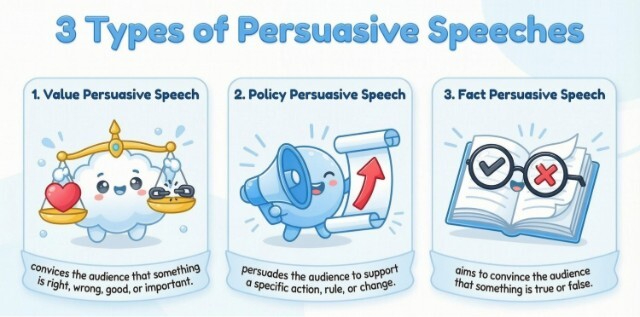
Before we go deeper, here is the quick decision view. Read your assignment brief, find the row that matches what your professor is asking for, and you have your type.
Your assignment asks you to... | Type | What are you arguing |
Prove that something is true, exists, did happen, or will happen | Factual (Question of Fact) | A claim about reality |
Argue that something is good or bad, right or wrong, better or worse | Value (Question of Value) | A judgment based on principles or ethics |
Argue that something should or should not be done | Policy (Question of Policy) | A proposal for action or change |
If your assignment uses the word "should" anywhere in the prompt, you are almost certainly writing a policy speech. If it uses words like "moral," "ethical," "justified," "deserves," or "is wrong," you are writing a value speech. If it uses words like "is," "exists," "caused," or "will happen," you are writing a factual speech.
Now the deeper version of each.
1. Factual Persuasive Speech (Question of Fact)
A factual persuasive speech argues that something is true, false, exists, does not exist, happened, did not happen, or will or will not happen. The claim is about reality. Your job is to convince the audience that your version of reality is the correct one.
This is the type of students confuse most often with informative speaking, because both deal in facts. The difference is the audience. An informative speech tells an audience that does not know something. A factual persuasive speech argues with an audience that already has a different position, or with an audience that is undecided between competing accounts.
"The Earth orbits the Sun" is informative. Nobody disagrees. "Climate change is human-caused and accelerating" is a factual, persuasive claim because reasonable people contest it, and you are taking a side.
What kind of claim does it defend
Factual claims come in three flavors:
- Existence claims. "Long-term cognitive effects from concussions in youth football are real and measurable." You are arguing something exists.
- Causal claims. "Social media use is the primary driver of rising teen anxiety." You are arguing one thing causes another.
- Predictive claims. "Generative AI will eliminate more white-collar jobs than it creates within the next decade." You are arguing about what will happen.
What evidence works
Factual speeches live and die on the quality of your evidence. Audiences will not take your word for it, and they should not. You need:
- Recent, peer-reviewed research wherever the topic touches science, medicine, or social science. Cite the year out loud. "A 2024 meta-analysis published in The Lancet found..."
- Verifiable statistics from credible institutions. Government agencies, established research institutes, and major news organizations with editorial standards. Not random infographics.
- Expert testimony from people whose credentials directly relate to the claim. A neuroscientist on brain injury, not a former player.
- Documented examples of the phenomenon you are claiming exists.
What does not work: anecdotes, single sources, opinion pieces, anything older than five years on a current-affairs topic, or any source the audience can dismiss in fifteen seconds with a phone.
Organizational pattern that fitsFactual speeches usually work best in one of two structures. - The causal pattern moves from cause to effect (or effect back to cause) and is strongest for causal claims.
- The categorical pattern divides your evidence into independent reasons your claim is true, with each main point standing on its own.
|
For factual speeches specifically, problem-cause-solution is overkill (you do not need a solution, you need a proof), and Monroe's is built for action speeches, not proof speeches. Stick with causal or categorical.
Topic examples
- The opioid crisis was driven primarily by pharmaceutical industry decisions, not by individual user behavior.
- Standardized testing is a poor predictor of college success.
2. Value Persuasive Speech (Question of Value)
A value persuasive speech argues that something is good or bad, just or unjust, ethical or unethical, better or worse than the alternatives. The claim is a judgment, and the speech defends that judgment by appealing to shared principles, ethics, or moral frameworks.
Where a factual speech proves something is true, a value speech proves something is worth a particular evaluation. "Capital punishment exists in 27 states" is factual. "Capital punishment is morally indefensible" is a value claim. The factual version asks what is. The value version asks whether it should be admired or condemned.
This is the type of students struggle with most, because the temptation is to argue a value claim with factual evidence. Statistics about wrongful convictions strengthen a value speech against capital punishment, but they do not finish it. The speech still has to argue the underlying moral principle: why a system that occasionally executes innocent people is wrong, not just that it exists.
What kind of claim does it defend
Value claims defend a judgment. Three common forms:
- Ethical judgments. "Genetic editing of human embryos for non-medical traits is ethically wrong." You are arguing about right and wrong.
- Quality judgments. "The shift from print to digital journalism has degraded the quality of public discourse." You are arguing one thing is better or worse than another.
- Worth judgments. "Free public higher education is more valuable to a democracy than tax cuts of equivalent cost." You are arguing about what deserves priority.
What evidence works
Value speeches need a different evidence mix than factual speeches. Statistics still help, but they cannot do the heavy lifting. You need:
- A clear standard or principle stated upfront. Audiences cannot evaluate a value claim without knowing what standard you are evaluating against. State it: "I am arguing this is wrong on the grounds of [autonomy / fairness / harm / dignity / fill in your principle]."
- Examples that illustrate the principle in action. Specific cases the audience can picture. Abstract value arguments lose people; concrete cases keep them.
- Expert moral or philosophical authority when relevant. Quoting a recognized ethicist or established moral framework adds weight. Quoting random opinion does not.
- Emotional resonance, used carefully. Value speeches benefit from emotional appeal more than factual speeches do, but the emotion has to be earned. A specific story about a real person hits harder than a vague appeal to feelings.
What does not work: trying to argue a value claim entirely on facts, attacking the audience's moral sense ("anyone who disagrees is a bad person"), or assuming your principle is universal when it is contested.
Organizational pattern that fitsValue speeches almost always work best in a topical pattern, where each main point is an independent reason your value judgment is correct, organized around the principle you stated upfront. A typical structure looks like: - State the value claim and the standard you are evaluating against.
- First reason the standard is met (or violated), with example.
- Second reason, with example.
- Address the strongest counterargument from the opposing value position. Steelman it. Refute it.
- Restate the value claim, sharper than the opening.
|
Avoid Monroe's Motivated Sequence for pure value speeches. It is built around a call to action, and value speeches that try to add a forced call to action ("...so we should ban it") have effectively turned into policy speeches and confused the assignment.
3. Policy Persuasive Speech (Question of Policy)
A policy persuasive speech argues that something should or should not be done. The claim is a proposal: a change in law, rule, behavior, organizational practice, or public action. Your job is to convince the audience that your proposed course of action is the right one.
If your assignment prompt contains the word "should," you are writing a policy speech. This is the most common type assigned in college public speaking courses, because it forces students to combine factual evidence (proving the problem exists), value reasoning (arguing the problem matters), and practical reasoning (defending the proposed solution) all in one speech.
Two flavors: passive agreement vs. immediate action
Public speaking textbooks split policy speeches into two sub-types based on what the speaker actually wants from the audience.
- Passive agreement speeches ask the audience to agree that a policy should exist, without asking them to personally do anything about it. "Congress should pass a federal universal background check law" is a passive-agreement claim for a classroom audience. The audience cannot literally pass the law, so you are arguing they should believe it should be passed.
- Immediate action speeches ask the audience to take a concrete action right now. "Sign this petition before you leave the room." "Vote for this candidate next Tuesday." "Switch your bank to a credit union by the end of the month." The audience can actually do the thing, and the speech is built around getting them to do it.
Most classroom policy speeches are passive-aggressive, because students rarely have access to audiences who can directly enact policy. But the strongest student speeches find some immediate action the audience genuinely can take, even a small one. To check how complete speech looks like, check out our persuasive speech examples blog.
Three burdens you have to meet
Every policy speech, whether passive or immediate action, has to clear three logical hurdles. Skipping any of them weakens the argument:
- Need. Prove the problem exists and matters. This is where factual evidence does its work.
- Plan. State exactly what you are proposing. Vague plans fail. "We should do something about climate change" is not a plan. "Our state should adopt a carbon tax of $50 per ton, rising annually with inflation, with revenues returned as a per-capita dividend" is a plan.
- Practicality. Show that your plan will actually solve the problem and that it can realistically be implemented. This is the burden most student speeches skip and the one professors most often grade on.
What evidence works
Policy speeches need the broadest evidence mix of any type:
- Evidence that the problem exists (factual research, statistics, documented harm).
- Evidence that the problem matters (impact data, affected populations, value reasoning).
- Evidence that the plan works (case studies of similar policies elsewhere, expert endorsements, projected outcomes).
- Evidence that the plan is feasible (cost estimates, implementation precedents, political viability).
You will not have time to develop all four at length. Pick the two or three that your specific audience will find most decisive, and lead with those.
Organizational pattern that fitsPolicy speeches have the most pattern flexibility, but two structures dominate: - Monroe's Motivated Sequence (attention, need, satisfaction, visualization, action) is the strongest pattern for immediate-action policy speeches. Its visualization step is built specifically to help the audience picture life after your policy is adopted, and its action step gives you a place to land the specific ask.
- Problem-Cause-Solution is cleaner for passive-agreement speeches, especially when your audience already accepts that the problem exists. Spend less time establishing need, more on the cause-solution link.
|
For audiences who already want change but disagree about which solution is best, comparative advantages is the right pattern. Skip the problem; argue your plan is better than the alternatives.
Still trying to identify which type your assignment is asking for, or have your type figured out, but have no idea how to actually structure the argument under the deadline? If you are running short on time, professional persuasive speech help is faster than working it out from scratch. Send the assignment prompt, the time limit, and the type, if you have identified it, and a writer can take it from there. |
How to Tell Which Persuasive Speech Type You Are Writing
The single most useful diagnostic is the verb in your assignment prompt or your working thesis. For quick reference, here is the pattern-by-type guidance from above in one place:
Verb in your prompt or thesis | Type |
Prove, demonstrate, establish, show that... | Factual |
Evaluate, judge, defend, condemn, assess the morality of... | Value |
Propose, argue for, advocate, recommend, urge... | Policy |
...is true / is real / exists / caused / will happen | Factual |
...is good / is bad / is wrong / is justified / is better than | Value |
...should / should not / must / ought to | Policy |
If your thesis sentence does not yet contain one of these verbs, you have not narrowed your speech enough. Rewrite the thesis to use one of them, and the type becomes obvious.
Once you know your type, the organizational pattern follows:
Type | Pattern | Why |
Factual | Causal or categorical | Builds proof; doesn't need a call to action |
Value | Topical | Each main point defends the moral standard from a different angle |
Policy (passive agreement) | Problem-cause-solution | Works when audience already accepts the problem |
Policy (immediate action) | Monroe's Motivated Sequence | Built specifically to drive a concrete action step |
Policy (audience deciding between options) | Comparative advantages | Skips the problem; argues your option is best |
A second check: ask yourself what the audience walks away believing if your speech succeeds.
- If they walk away believing something is true that they did not believe before, you wrote a factual speech.
- If they walk away believing something is good or bad/right or wrong, you wrote a value speech.
- If they walk away believing something should be done, you wrote a policy speech.
If your answer is "I want them to walk away knowing more about the topic," you are writing an informative speech, not a persuasive one. Talk to your professor.
If your deadline is closing in or you would rather hand it off, send your topic, your time limit, the type (fact, value, or policy), and any sources your professor requires. Our CollegeEssay.org speech team writes complete persuasive speeches matched to the type and time limit, fully structured with evidence and a working call to action where the type calls for one. |
Mixing Persuasive Speech Types: When You Cannot Avoid It
In real speeches, the lines blur. A strong policy speech almost always contains factual claims (proving the problem exists) and value claims (proving the problem matters). A value speech often contains factual claims as supporting evidence. This is fine, and trying to keep your speech pure to one type is usually not what your professor wants.
The rule is: identify the dominant type, and let it drive your structure. Your dominant type is whichever claim the speech ultimately stands or falls on. If your speech's success depends on the audience accepting that gun control reduces violence, that is a factual claim, even if you wrap it in policy framing. If the speech's success depends on accepting that the right to safety outweighs the right to bear arms, that is a value claim, even if it ends with a policy proposal. |
Pick the dominant type, structure around it, and let the supporting claims do supporting work.
Here's what that looks like in practice. A speech arguing "our state should ban single-use plastics within two years" is dominantly a policy speech (the verb is "should," the claim is a proposal). But the speech needs factual support (proof that plastic pollution is real and harmful) and value support (proof that the harm is morally significant enough to act on). Structure decision: build the speech around Monroe's Motivated Sequence (policy pattern) with the need step doing the factual work and the visualization step carrying the value framing. The speech is dominantly policy. Fact and value do supporting work inside that frame.
Same speech, structured wrong: built around the categorical pattern (factual) with three "reasons plastic is harmful," ending with a vague "we should do something." That speech proves a problem exists but never lands the policy proposal. The audience walks away knowing the harm is real but not knowing what to do. Informative outcome, not persuasive. |
Common Persuasive Speech Mistakes by Type
Each type has its own most common failure mode. Run your draft past these before you submit.
- Factual speeches most often fail by being informative in disguise. The speaker presents facts but never actually argues for a contested position. If your audience is not capable of disagreeing with your speech at the end of it, you wrote an informative speech. Sharpen the claim until it is genuinely contested.
- Value speeches most often fail by arguing fact instead of value. The speaker spends six minutes establishing that something exists, but never argues why it is good or bad. State the standard you are evaluating against, and spend most of your time defending the judgment, not the existence.
- Policy speeches most often fail by skipping practicality. The speaker proves the problem exists, declares a solution, and ends. The audience is left wondering whether the solution actually works and whether it can realistically be implemented. Always spend at least 30 seconds on practicality. It is what separates a speech from a slogan.
You now know what factual, value, and policy persuasive speeches each are, how to identify which one your assignment is asking for, what evidence works for each, and which organizational pattern fits. The hard part of any persuasive speech starts now: building the actual claim, finding evidence that holds up, and writing it out in spoken sentences that hit. Most drafts go out within 24 hours. Tell us the type, and we will get persuasive speech written and back to you, ready to rehearse. |