Speech assigned, examples requested, and the blank-page panic is real. Below are persuasive speech examples you can read on this page in under five minutes, sorted by length, audience, and type, so you can find one close to your assignment and use it as a model.
The best examples to study match your assignment's length, audience, and persuasive speech type (value, policy, or claim).
The 8 examples on this page:
Example | Length | Audience | Type | Best move to study |
Read 20 Minutes a Day | 3 min | General | Value | Hook ? data ? meaning ? small ask |
Move School Start Times Later | 5 min | High school | Policy | "Biology problem, not discipline problem" reframe |
Student Loan Debt Reform | 5 min | College | Policy | Counterargument-first structure |
"I Have a Dream" Excerpt | 17 min full / 2 min excerpt | General | Value | Argument from shared American value |
Fail Earlier | 3 min | General | Value | Personal stakes, small specific ask |
Social Media is Not Neutral | 4 min | College | Value | Moral framing, comparison to tobacco |
Vision Zero Traffic Policy | 4 min | Civic | Policy | Specific funding source + timeline |
The Great Wall Myth | 3 min | General | Claim | Correction + meta-lesson on listening |
If you also want a refresher on what separates a persuasive speech from an informative or argumentative one, our persuasive speech guide covers that. If you already know what you're doing and just need to find an example to model, keep reading.
How to Use Persuasive Speech Examples on This Page

Every example below is tagged with three things:
- How long does it run out loud (the runtime)
- Who it was written for (high school, college, general audience)
- What type of persuasive speech is it (value, policy, or claim)
Skim those tags, find one close to your assignment, and read the full example. Then look at the short structural breakdown underneath, because that's where the actual learning is. The words you'll write are yours. The shape of the speech is what you're here to borrow.
If you don't yet have a topic, our list of good persuasive speech topics is a better starting point than this page. Come back here once you've picked one.
Short Persuasive Speech Example (3 Minutes)
Runtime: 3 minutes spoken | Audience: General / classroom | Type: Value
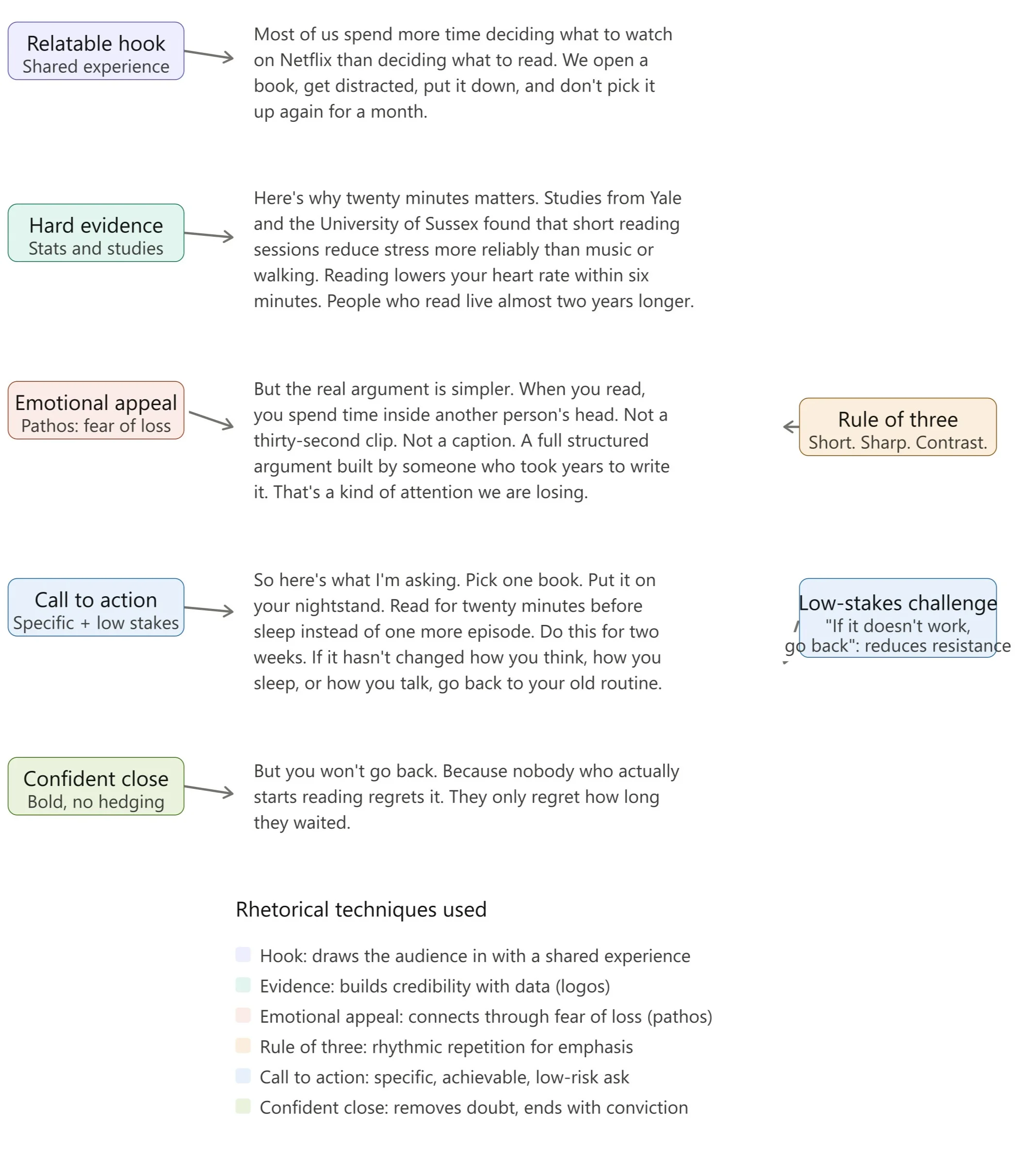
Most of us spend more time deciding what to watch on Netflix than we do deciding what to read. We open a book, get distracted by our phone, put the book down, and don't pick it up again for a month. Reading has become something we believe in but don't actually do. I want to convince you to change that, starting tonight, in twenty minutes. Here's why twenty minutes matters. Studies from Yale and the University of Sussex have found that even short, regular reading sessions reduce stress more reliably than music, walking, or a cup of tea. Reading lowers your heart rate within six minutes. It improves vocabulary and memory in ways that scrolling does not. People who read for thirty minutes a day live, on average, almost two years longer than people who don't. But the real argument is simpler. When you read, you spend an extended period of time inside another person's head. Not a thirty-second clip. Not a caption. A full, structured argument or story, built by someone who took years to write it. That's a kind of attention we are losing, and once it's gone we don't get it back easily. So here's what I'm asking. Pick one book. Put it on your nightstand. Read for twenty minutes before sleep instead of one more episode. Do this for two weeks. If by then it hasn't changed how you think, how you sleep, or how you talk to people, go back to your old routine. But you won't. Because nobody who actually starts reading regrets it. They only regret how long they waited. |
Structure breakdown:
Section | What it does |
Hook (sentence 1–3) | Names a behavior the audience already does (Netflix scrolling) and reframes it as the problem. |
Thesis | "I want to convince you to change that, starting tonight, with twenty minutes." Specific, time-bound, action-oriented. |
Evidence (paragraph 2) | Three concrete claims with named sources. Numbers do the persuading. |
Emotional appeal (paragraph 3) | Shifts from data to meaning. The argument the audience will actually remember. |
Call to action (paragraph 4) | One clear ask, with a specific timeframe and a fallback. The fallback ("go back to your old routine") removes resistance. |
Persuasive Speech Example for High School Students (5 Minutes)
Runtime: 5 minutes spoken | Audience: High school | Type: Policy
The bell rings at 7:45 AM at most high schools in this country. By the time it rings, half of you in this room have been awake since 5:30, are running on five hours of sleep, and have already spent forty minutes on a bus or in traffic. Your first-period teacher is about to try to teach you algebra, and your brain isn't online yet. This isn't a discipline problem. This is a biology problem. And I want our school board to fix it. The argument for moving high school start times to 8:30 AM or later isn't new, and it isn't fringe. The American Academy of Pediatrics, the CDC, and the American Medical Association have all formally recommended it. Their reasoning is consistent. During puberty, the body's natural sleep cycle shifts about two hours later. A teenager going to bed at 11 PM is biologically equivalent to an adult going to bed at 9 PM. When we force teenagers to wake up at 6 AM, we are doing something the science says we shouldn't. The schools that have already moved have shown what happens when this changes. In Seattle, after the district shifted high school start times by 55 minutes, students gained 34 minutes of sleep per night on average, attendance improved, and grades in first-period classes went up. In Minnesota, a study tracking eight high schools that delayed start times found significant drops in car accidents involving teen drivers. In every district that has tried this, the same pattern repeats. Students sleep more. They show up more. They drive better. They learn more. The most common objection is logistics. Sports practice, after-school jobs, bus schedules, and parent work hours. These are real concerns, but they are scheduling problems, not biology problems. Other districts have solved them. Sports practice can shift. Bus schedules can be reordered so elementary kids, who naturally wake earlier, ride first. Parents adapt. The biology of a teenage brain doesn't. So here's what I'm asking the board to do. Schedule a public hearing on this issue before the next school year begins. Hear from the doctors. Hear from the districts that have already made the change. And then make the same decision they did. We are not asking for fewer schools. We are asking for a school that starts when our brains are awake. That's not too much to ask. It's the bare minimum. |
Structure breakdown:
Section | What it does |
Hook | Specific, sensory scene. The audience can see themselves in it. |
Reframe | "This isn't a discipline problem. This is a biology problem." The whole speech turns on this line. |
Evidence | Names credible authorities (AAP, CDC, AMA), then specific case studies (Seattle, Minnesota) with measurable outcomes. |
Counterargument | Names the objection, validates it, then dismantles it. This is what separates a persuasive speech from a rant. |
Call to action | Concrete and small ("schedule a public hearing"), not impossible ("change the system"). |
Persuasive Speech Example for College Students (5 Minutes)
Runtime: 5 minutes spoken | Audience: College/undergraduate | Type: Policy
If you graduated from a U.S. college last year, there is a 70 percent chance you left with student loan debt, and a roughly 1-in-3 chance that the debt is over forty thousand dollars. You will spend, on average, the next twenty years paying it back. The total amount of student debt in the United States is now over $1.7 trillion, larger than every credit card balance in the country combined. We have built a system in which the price of a college degree has tripled since 1980, while the wage for a graduate has barely moved. Tonight I want to argue that this isn't an unfortunate accident. It's a policy choice. And policy choices can be reversed. When people defend the current system, they usually argue one of two things. The first is that students chose to take on the loans, so the responsibility is theirs. The second is that a college degree still pays off, so the debt is worth it. Both arguments are weaker than they sound. On the first: an eighteen-year-old being told that college is the only path to a stable middle-class life, and being handed a loan agreement they don't fully understand, is not making a free-market choice. It's signing a contract under structural pressure. We don't usually call that a fair transaction in any other part of the economy. On the second: yes, a degree still pays off on average. But "on average" hides who is being crushed. Students who took on debt and didn't finish their degree are in the worst possible position. So are graduates from for-profit schools that misled them about job placement rates. The system works for some students and breaks others, and we built it that way. What can actually be done is more concrete than people think. Tying tuition increases to inflation, capping interest rates on federal loans at the Treasury rate, automatically enrolling borrowers in income-driven repayment, and forgiving balances after twenty years of consistent payment are all policies that exist somewhere in the world right now. They aren't theoretical. So here's what I'm asking. The next time a politician asks for your vote, ask them which of those four policies they support, and which they don't. Don't accept "I care about affordability" as an answer. That sentence is free. Specifics cost something, and that's the point. Vote for the candidates whose specifics match what your future bank account actually needs. |
Structure breakdown:
Section | What it does |
Opening with statistics | Concrete numbers immediately. No warmup. |
Thesis | "It's a policy choice. And policy choices can be reversed." Empowering, not despairing. |
Counterargument first | Takes the two strongest opposing arguments and dismantles them before making the positive case. Shows the audience they've been heard. |
Solutions | Four named, specific policies. Vague speeches don't persuade. |
Call to action | Doable. The audience isn't asked to fix the system, just to ask better questions of candidates. |
Persuasive Speech Example Using Monroe's Motivated Sequence (4 Minutes)
Runtime: 4 minutes spoken | Audience: College/general | Type: Policy
Attention. A 19-year-old college student named Sarah took her own life last spring. She had been on a waiting list at her university's counseling center for nine weeks. The center wasn't understaffed by accident. It was understaffed by design, the same design at almost every campus in this country. Need. One in three college students reports significant symptoms of anxiety or depression. The American College Health Association's most recent national survey found that fewer than half of those students get any treatment, and the most common reason is access. The average campus counseling center has one full-time clinician for every 1,600 students. The recommended ratio, according to the International Accreditation of Counseling Services, is one for every 1,000. We are at almost twice the threshold of crisis. We are not building toward it. We are already there. Satisfaction. Universities can fix this in a single budget cycle. Hire enough clinicians to meet the recommended ratio. Reallocate from the marketing budget if you have to. Every campus I have read about has a marketing budget larger than its mental health budget. Fund peer support programs, which the research shows reduce wait times and improve outcomes for non-crisis cases. And publish wait time data publicly, every semester, so prospective students can see what they're walking into. Visualization. Picture a campus where a student in crisis is seen within 48 hours, not nine weeks. Where the counseling center isn't a place students avoid because they've heard the wait is too long, but a place they go without thinking twice. Where the front-page story isn't about another suicide, it's about graduation rates rising for the third year running because students didn't drop out due to untreated anxiety. That's not a fantasy. That's what hiring twenty more clinicians on a 30,000-student campus would actually produce, and we know because four universities have already done it. Action. Tomorrow morning, go to your university's website and find your campus's clinician-to-student ratio. If they don't publish it, that's your first answer. Email your student government representative the number and the recommended threshold and ask what's being done. One email per student per semester is what changes campus budgets. The administration counts. They always count. |
Structure breakdown:
Section | Move |
Attention | Specific human story (Sarah). Name the problem inside the human cost, not the abstraction. |
Need | Names the gap with two specific numbers (1 in 3 students, 1:1,600 vs 1:1,000 ratio). |
Satisfaction | Three concrete actions, each tied to existing evidence. |
Visualization | Forces the audience to picture the after-state alongside the before-state. |
Action | Specific, small, doable in 15 minutes. |
Monroe's Motivated Sequence is the most widely taught persuasive speech pattern in college communications courses. The other examples on this page use shorter problem-cause-solution or comparative-advantages structures. This one demonstrates the full five-step pattern.
Seen enough examples to picture what good looks like, but starting your own from a blank page is a different problem. If you'd rather skip the staring-at-the-cursor stage entirely, you can have a persuasive speech written by CollegeEssay.org. Tell us your topic, time limit, and audience, and we'll deliver a speech that mirrors the structure of the examples above. |
Famous Persuasive Speech Example (Excerpt)
Runtime: 17 minutes full speech, 2 minutes for this excerpt | Audience: General/civil rights | Type: Value
The most studied persuasive speech in American history is Martin Luther King Jr.'s 1963 address at the Lincoln Memorial. The full speech runs about seventeen minutes, but the persuasive engine of it sits in roughly the last four. The reason it works as persuasion, not just oratory, is that it does something most speeches don't: it argues from a shared American value (the promise of equality written into the founding documents) to a specific demand (deliver on the promise now, not later), and it makes the audience feel that delaying any longer would be a betrayal of who America claims to be. The structural moves in the speech that students should study: The speech opens with a reference to the Emancipation Proclamation, "five score years ago," echoing Lincoln's Gettysburg Address. This is not decoration. It places the speech inside an existing American story the audience already accepts. You start a persuasive speech where your audience already agrees with you. The middle of the speech names the gap between the promise and the present. "America has given the Negro people a bad check, a check which has come back marked insufficient funds." The metaphor is concrete enough that everyone understands it, financial enough that it carries weight, and angry enough to mean what he means without losing the audience. The famous closing repeats "I have a dream" eight times. Repetition in persuasive speeches isn't lazy writing. It's a memory device. The audience leaves the speech remembering the structure even if they forget every individual sentence. |
Persuasive Speech Example About Life (3 Minutes)
Runtime: 3 minutes spoken | Audience: General/motivational | Type: Value
When people ask me what I wish I'd done differently in my twenties, I never say I wish I had worked harder. I worked plenty. What I say is that I wish I had failed earlier. Not failed more. Failed sooner. Because the failures I avoided in my twenties caught up to me in my thirties, and they were more expensive then. We treat failure as something that happens to us, like weather. It isn't. Failure is a piece of information. When you try something and it doesn't work, you've learned what doesn't work. That's a thing you didn't know before. The person who tried ten things and failed at eight of them is two successes ahead of the person who tried two things and got both right, because they also know what eight things to avoid. The reason most of us avoid failure isn't that we're lazy. It's that we're embarrassed. We don't want other people to see us try and miss. So we play it small. We pick the safe internship, the safe major, the safe relationship, the safe city. And then somewhere around thirty, we wake up and realize we built a life out of avoiding embarrassment, and embarrassment turns out to be the cheapest thing on the menu. So here is what I want you to do. Pick one thing this month that you have been avoiding because you might fail at it. Apply for the job that's a stretch. Ask the person out. Send the pitch. Make the bad first draft. Don't wait until you're ready, because you will never feel ready. Ready is what you become after you do the thing, not before. The cost of trying and failing is one bad afternoon. The cost of not trying is the rest of your life wondering. |
Why this works: Personal stakes, named clearly. The speaker isn't quoting research; they're making a moral argument. Notice how the call to action is small ("pick one thing this month") rather than impossible ("change your whole life"). Persuasive speeches about life almost always fail when they ask for too much. They almost always work when they ask for one specific small thing the audience can do this week.
Value Persuasive Speech Example
Runtime: 4 minutes spoken | Audience: College/general | Type: Value (right vs wrong)
We talk about social media as if it's a neutral tool, like a hammer. A hammer can build a house or break a window, and the hammer isn't the problem; the person swinging it is. I want to argue that social media isn't a hammer. The platforms we use every day are designed, on purpose, to make us feel worse so we use them more. And calling that neutral is the lie we keep telling ourselves so we don't have to think about it. Internal documents leaked from a major social platform in 2021 showed that the company's own researchers had concluded that their product made teenage girls feel worse about themselves, and that the company knew this and didn't change the algorithm. That isn't a hammer. That's a product whose business model depends on a particular emotional state in the user, and which optimizes for that state because the state is what generates revenue. The moral question isn't whether you, personally, can use social media in moderation. Some people can. The moral question is what we owe each other when a private company has built a system that demonstrably harms the mental health of children for profit, and refuses to change it because changing it would cost money. We have answered this question before, with cigarettes, with leaded gasoline, with seatbelts. The pattern is always the same. The industry says the product is neutral. The data says it isn't. Eventually, slowly, the law catches up. Tonight I'm not asking you to delete your accounts. I'm asking you to stop pretending the platforms are neutral. Talk about them honestly. Vote for politicians who treat them the way we treated tobacco companies in the 1990s. And the next time someone says "it's just a tool, it depends on how you use it," ask them whether they'd say the same about a slot machine. |
Type breakdown: A value speech argues something is right or wrong. The speaker isn't arguing for a specific policy ("ban TikTok") or a specific factual claim ("teen depression is up"). They're arguing for a moral framing: that pretending these platforms are neutral is itself a lie. Value speeches live or die on the strength of their moral framing.
Policy Persuasive Speech Example
Runtime: 4 minutes spoken | Audience: Civic/public meeting | Type: Policy
Every year, our city spends roughly seven million dollars on traffic enforcement, and almost none of that money makes our streets safer. We know this because we have the data. Speeding tickets, the largest category of traffic citations, are issued mostly on roads where speeding doesn't cause crashes. Crashes cluster in different places, at different times, for different reasons. We've been pouring resources into a problem that doesn't match the solution, and people are dying on our roads while we do it. Tonight I'm proposing a policy change. Redirect 60 percent of the city's traffic enforcement budget into engineering. Speed bumps on residential streets where children walk to school. Protected bike lanes on the corridors where most cyclist deaths happen. Pedestrian islands at the six intersections that account for nearly a quarter of all our pedestrian fatalities. We don't need more tickets. We need streets that are physically harder to drive dangerously on. The evidence for this approach is overwhelming. Cities like Hoboken, New Jersey, have gone seven years without a single traffic fatality, not because they ticket harder, but because they redesigned the streets. Oslo and Helsinki have hit zero pedestrian and cyclist deaths in entire years using the same approach. The international term for this is Vision Zero, and the cities that adopt it seriously, by changing the streets and not just the policing, see results within five years. The objection I expect from the council is that we can't afford it. We are already paying for it. The seven million we're spending on enforcement that doesn't work is the budget. The question isn't whether to spend it. The question is whether to spend it on something that has been proven to save lives, or to keep spending it on something that hasn't. So here's the proposal in one sentence. Move 60 percent of traffic enforcement funds into engineering. Adopt Vision Zero formally, with a public ten-year goal of eliminating traffic deaths in this city. Schedule the vote within ninety days. The data is in. The cities that have done it are open about how they did it. The only thing we're missing is the will. |
Type breakdown: A policy speech advocates for a specific action. Notice that the speaker doesn't just argue that something is bad. They name the exact change, the exact funding source, the exact mechanism, and the exact timeline. Vague policy speeches don't persuade decision makers. Specific ones do.
Claim Persuasive Speech Example
Runtime: 3 minutes spoken | Audience: General/informational | Type: Claim (true vs false)
The Great Wall of China is not visible from space with the naked eye. This is one of the most repeated facts in American education, taught in textbooks, repeated by teachers, and printed in trivia books. It is also wrong. And the reason this small wrongness matters is because it tells us something about how myths survive even when the evidence against them is overwhelming. The claim seems plausible at first. The Great Wall is over thirteen thousand miles long. Surely something that long would be visible from orbit. But length isn't what matters when you're looking at something from space. Width is. The Great Wall, at its widest, is about thirty feet across. From low Earth orbit, that's narrower than a single lane of highway. Astronauts have repeatedly confirmed that the wall is not visible without significant magnification. Chinese astronaut Yang Liwei, who orbited the Earth in 2003, said directly that he could not see it. So why does the claim persist? Three reasons, and they apply to most persistent myths. First, it sounds satisfying. A wall that long ought to be visible. The fact that it isn't feels like a glitch in the universe, so we resist it. Second, the claim was repeated in textbooks for decades before anyone with first-hand knowledge could check it. By the time astronauts were in a position to verify, the claim had been taught to two generations. Third, correcting it requires the listener to admit they were taught something wrong, and most people would rather keep believing the myth than feel briefly stupid. The takeaway isn't really about the wall. It's about how to listen to confident-sounding claims, including the ones in this room. Length doesn't make a claim true. Repetition doesn't make a claim true. The number of textbooks something appears in doesn't make it true. Only the evidence does. So the next time someone tells you a fact that everyone knows, ask them where it came from. Eight times out of ten, they don't know, and the trail ends in the same place: a textbook from decades ago whose source nobody bothered to check. |
Type breakdown: A claim speech argues whether something is true or false. The speaker presents evidence, refutes the popular alternative, and explains why the false version persists. The strongest claim speeches don't just correct the record. They use the correction to teach the audience how to think about future claims.
You Have the Examples. Now Comes the Writing. You've now read examples across short and long, school and college, value and policy, and claim, famous and everyday. The structure isn't the hard part anymore. The hard part is filling that structure with your topic, your evidence, and your voice, on whatever deadline your professor set. If you're short on time or just need a strong draft to react to, our writers offer persuasive speech writing help that delivers a fully written, source-backed speech in under 24 hours, formatted to your time limit and audience. |
What Every Example Above Has in Common
Five moves are visible across every example on this page. Use them as a checklist when drafting your own.
- Start where the audience already is. A behaviour, a statistic, a moment, they recognise never a definition.
- Defend a single argument. None of the examples above argues more than one thing.
- Use specific numbers and named sources. "Studies show" doesn't persuade. "A 2018 University of Sussex study found 68 percent reduction in stress within six minutes." does.
- Name the counterargument before the audience does. Every example above takes the strongest opposing view seriously, then dismantles it.
- End with one small, specific ask. Not "let's change the world." Pick one book. Schedule one hearing. Send one email.
Get Your Speech Written You've got the examples, the structure, and the tips. The only thing left between you and a finished speech is sitting down and writing it. If that's the part that always takes the longest, or the part you'd rather not do at all the night before it's due, send us your topic, time limit, and audience, and we'll get your speech written today. Most students get their full draft back within 12 hours, formatted, sourced, and ready to deliver. |