Your professor assigned a philosophy essay. The examples online are either full academic papers that are hard to parse, or vague outlines that don't show you what the finished thing actually looks like. This page gives you four annotated philosophy essay examples; argumentative, comparative, analytical, and personal, with notes on exactly why each one works. Read through the type that matches your assignment and you'll know what to aim for.
These are excerpts, each one shows the key structural moves (introduction, body argument, objection and response, conclusion) rather than every paragraph in full.
Philosophy Essay Examples: Annotated Samples for Students
What Makes a Philosophy Essay Example Worth Studying
Before you read the examples, it helps to know what you're looking for. Philosophy essays that earn good marks tend to share five qualities. Once you spot these in the examples below, you'll know what to aim for in your own writing.
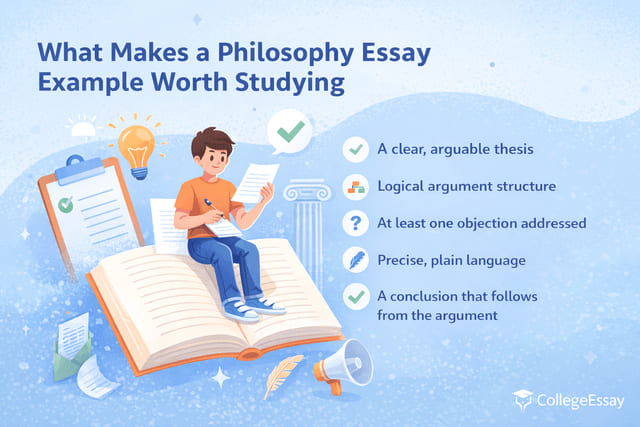
- A clear, arguable thesis. Not a fact. Not a topic. A position someone could reasonably disagree with. "Descartes was a philosopher" isn't a thesis. "Descartes' method of doubt fails to establish a reliable foundation for knowledge" is.
- Logical argument structure. Each paragraph should do one job: introduce a premise, develop reasoning, or draw a conclusion. If you can't say what a paragraph is for, it probably doesn't need to be there.
- At least one objection addressed. This is what separates a decent philosophy essay from a strong one. Every philosophical position has critics. Acknowledging the strongest counterargument, and responding to it, shows you understand the debate, not just your own side of it.
- Precise, plain language. Philosophy doesn't require jargon. In fact, hiding behind complex vocabulary often signals that the writer isn't sure what they mean. Say exactly what you mean in the clearest words you can find.
- A conclusion that follows from the argument. Your conclusion shouldn't just repeat your intro. It should show what your argument has actually established, and why that matters.
These five qualities are what you're looking for as you read the examples below.
Example 1: Argumentative Philosophy Essay
Before you read the examples |
Essay type: Argumentative, takes a clear position and defends it against opposing views
Essay topic: "Is free will compatible with determinism?"
This is one of the most studied debates in philosophy, which makes it a useful example: you can see how a student writer handles a complex topic without needing prior knowledge of the specific arguments.
Introduction Excerpt
Every decision you make, what to eat, what to say, whether to keep reading this feels like a genuine choice. But what if every one of those "choices" was the inevitable result of prior causes stretching back before you were born? This is the problem that sits at the heart of the free will debate. In this essay, I argue that free will and determinism are compatible that a person can act freely even in a fully determined universe, provided we understand freedom correctly.
Why this works: The opening uses a direct second-person question to put the reader inside the problem immediately. It doesn't open with "Throughout history, philosophers have debated...", it puts the philosophical tension front and centre in two sentences. The final sentence is the thesis: specific, arguable, and it signals the approach (compatibilism) without using the technical term right away.
Thesis Statement (isolated)
I argue that free will and determinism are compatible, that a person can act freely even in a fully determined universe, provided we understand freedom correctly.
Why this works: It makes a claim. It signals what the essay will argue AND what it will hinge on ("provided we understand freedom correctly"). This gives the reader a framework for what's coming. Compare it to a weak thesis like "Free will and determinism is a complex topic that philosophers have different views on", that tells the reader nothing.
Body Argument Excerpt
The compatibilist position rests on a distinction between two kinds of constraint: internal and external. When a person acts from their own desires, values, and reasoning, without being coerced, manipulated, or compelled by forces outside their control, they act freely, even if those desires were themselves shaped by prior causes. A person who chooses to donate to charity because they genuinely value generosity acts freely, even if that value was instilled by their upbringing. The relevant question is not whether the action was caused, but whether it was caused by the agent's own will.
Why this works: One paragraph, one idea. The writer introduces the internal/external distinction, explains what it means, illustrates it with a concrete example (charity donation), and closes with a sharp principle. There's no padding. Notice the italics on "by the agent's own will", used sparingly, to emphasise exactly one thing.
Objection and Response Excerpt
The most obvious objection to compatibilism is that it changes the subject. Hard determinists argue that if every desire you have was caused by factors you didn't choose, your genes, your upbringing, your brain chemistry, then you didn't really choose it at all. The compatibilist answer is the right one: this objection assumes that for an action to be truly free, its causal chain must originate with the agent. But this is an impossibly high standard. Nothing meets it, not humans, not any possible entity. A freedom defined this way is a freedom nothing could ever have, which makes it philosophically uninteresting. What matters, instead, is whether the action flows from the agent's own rational deliberation.
Why this works: The writer names the objection fairly and doesn't strawman it. Then the response doesn't just dismiss the objection, it shows why the objection's standard is unreasonable. This is the hallmark of genuine philosophical engagement.
Conclusion Excerpt
Compatibilism doesn't require us to pretend that determinism is false. It asks us to be precise about what freedom actually requires. If freedom means "uncaused action," then nothing is free and the concept is empty. If freedom means "action that flows from one's own rational will, free from coercion," then determinism poses no threat to it. The fear that determinism eliminates freedom rests on a confusion about what freedom is, not on a genuine incompatibility.
Why this works: The conclusion doesn't summarise the essay, it synthesises it. The writer revisits the two definitions of freedom and shows which one holds up. The final sentence lands a clean, quotable claim that follows directly from the argument.
What makes this example strong:The thesis is specific and arguable, it doesn't just say "free will is complicated." The objection chosen is the best objection, not a weak one that's easy to knock down. And every paragraph has exactly one job. |
If you want a step by step breakdown of how each section is built, our guide on how to write a philosophy essay covers the complete structure from thesis to conclusion. |
Example 2: Comparative Philosophy Essay
Essay type: Comparative, examines two philosophers' positions and draws a meaningful conclusion about the difference
Essay topic: "How do Kant and Mill differ in their approach to moral duty?"
Comparative philosophy essays are common at college level. The trap most students fall into is just describing two positions and stopping there. A strong comparative essay shows what the comparison reveals, why it matters that these two views differ.
Introduction and Thesis Excerpt
Immanuel Kant and John Stuart Mill are often taught as opposites: one grounds morality in universal duty, the other in the consequences of actions. But framing them as simple opposites misses something important. In this essay, I argue that the deepest difference between Kant and Mill is not their conclusions about what we should do, but their disagreement about what makes an action moral in the first place. For Kant, morality lives in the will; for Mill, it lives in the outcome. This distinction has consequences that neither philosopher fully escapes.
Why this works: Most students would write "Kant and Mill have different views on morality. This essay will compare them." This intro does something better: it identifies a specific tension (will vs. outcome) and uses it as the thesis. The phrase "consequences that neither philosopher fully escapes" signals that the essay will evaluate both views, not just describe them.
Section on Kant's Position
For Kant, the moral worth of an action depends entirely on the intention behind it. An action performed out of duty, in accordance with the categorical imperative, is morally good regardless of what it produces. The categorical imperative demands that we act only according to principles we could will to become universal laws. This means that lying, for example, is always wrong: if everyone lied whenever it suited them, the very concept of truth-telling would collapse, making lying pointless. The consequences of a particular lie, even one that prevents harm, are morally irrelevant to Kant. What matters is whether the principle guiding the action could be universalised.
Why this works: The section explains Kant's position fairly and fully before the comparison begins. The specific example (lying) is concrete and easy to follow. The final sentence isolates the key principle cleanly.
Section on Mill's Position
Mill's starting point is almost the opposite. For Mill, the morality of an action is entirely a function of its consequences: actions are right insofar as they promote happiness and reduce suffering, wrong insofar as they do the reverse. This principle, the greatest happiness principle, means that lying is not inherently wrong. If a lie produces more happiness than the truth would, the lie is the moral choice. Mill's framework is flexible in a way Kant's isn't: it can accommodate the complexity of real situations, where rigid rules often produce bad outcomes.
Why this works: The parallel structure with the Kant section makes comparison easy. The same example (lying) is applied to Mill's framework, so the contrast is direct and clear. "Flexible in a way Kant's isn't" sets up the comparative conclusion without telegraphing it fully.
Comparative Conclusion Excerpt
The tension between Kant and Mill is ultimately a tension about where morality is located. Kant locates it in the rational will, the quality of character from which actions spring. Mill locates it in the world, in the actual effects actions produce on real people. Neither position is obviously wrong. Kant captures something true about moral integrity: that it matters why you do something, not just what happens as a result. Mill captures something equally true: that intentions untethered from consequences can be a dangerous luxury. A complete moral philosophy may need both, which is why neither Kant nor Mill has had the last word.
Why this works: The conclusion names what the comparison reveals, a genuine disagreement about where morality is located, and then evaluates both positions without collapsing into "both have good points." The closing sentence opens the question rather than shutting it down, which is exactly right for a philosophy essay that's meant to engage with ongoing debate.
What makes this example strong:The thesis doesn't just say "they're different", it says why the difference matters. The parallel structure in the body makes comparison easy to follow. And the conclusion draws a meaningful insight rather than simply restating the essay. |
For more on the philosophical topics that work well for comparative essays like this one, see our list of philosophy essay topics. |
Example 3: Analytical Philosophy Essay
Essay type: Analytical, breaks down and critically evaluates a philosophical idea or text
Essay topic: "What is Plato's theory of the Forms, and does it hold up?"
Analytical essays are less about arguing for a position and more about closely examining a philosophical idea. You explain it accurately, then evaluate it honestly. The thesis for an analytical essay usually tells the reader both what you'll examine and what your evaluation will be.
Introduction and Thesis Excerpt
Plato's theory of the Forms is one of the most influential ideas in the history of Western philosophy, and one of the most contested. According to Plato, the physical world we perceive through our senses is not the most real world: behind it lies a realm of perfect, unchanging Forms, of which everything in our world is merely an imperfect copy. In this essay, I examine the theory of the Forms and argue that while it identifies a genuine philosophical problem, the gap between particulars and universals, its solution generates difficulties that Plato himself could not resolve.
Why this works: The thesis does two things clearly: it signals what the essay will explain (the theory of the Forms) and what it will argue (that the theory identifies a real problem but creates new ones). This is the right structure for an analytical thesis, it frames the essay as both explanation and evaluation, not just one or the other.
Exposition of the Theory
For Plato, ordinary objects are unstable and imperfect. A beautiful painting fades; a just law can be unjust in a different context; a large stone looks small next to a mountain. Yet we recognise beauty, justice, and largeness as consistent concepts. How? Plato's answer is that these concepts point to Forms: eternal, perfect, non-physical entities that exist independently of the physical world. The Form of Beauty is not any beautiful thing, it is Beauty itself, the standard against which all beautiful things are measured. We grasp Forms not through our senses, but through reason.
Why this works: The exposition comes before the critique. The writer gives the theory a fair chance to make its case before evaluating it. This matters in analytical philosophy: if you criticise a strawman version of the theory, the critique is worthless. Here, the key claims are clearly laid out: Forms are eternal, perfect, non-physical, grasped through reason, so the critique that follows has something solid to engage with.
Critical Evaluation Excerpt
The theory faces a significant problem that Plato himself raised in the Parmenides: what philosophers call the "Third Man Argument." If two large things participate in the Form of Largeness, what accounts for the resemblance between those two large things and the Form? We'd need another Form, a "third man", to explain that resemblance. And then another to explain the resemblance between the first two large things, the Form of Largeness, and the third man. The regress is infinite. Plato's attempt to explain universals seems to generate an infinite hierarchy of Forms, which raises serious questions about whether the theory actually solves the problem it was designed to address.
Why this works: The critique is specific. It names a real philosophical objection (the Third Man Argument), explains how it works, and connects it back to the essay's central evaluative claim. Notice that the writer doesn't say "some philosophers think the theory has problems." They say this problem, explain why it's a problem, and draw a specific conclusion from it.
Conclusion Excerpt
Plato's theory of the Forms takes seriously a problem that continues to preoccupy philosophers: how we manage to have reliable knowledge of concepts when everything in the physical world is changing and imperfect. The theory's answer, that universals exist as perfect, eternal entities, is elegant, but it is not obviously true, and the Third Man Argument suggests it may not even be coherent. A more promising path may be to question whether universals need to exist at all, rather than positing a realm of perfect entities to explain them. What the theory of the Forms gets right is the question. What it gets wrong may be the answer.
Why this works: The conclusion doesn't just restate the thesis, it reflects on what the theory gets right and what it gets wrong, and opens a direction for further inquiry. The final sentence is deliberately quotable and captures the essay's evaluative position in a single crisp line.
What makes this example strong:The introduction signals both what the essay will explain and what it will evaluate. The exposition is fair and accurate, no strawmanning the theory before criticising it. The critical evaluation takes a specific position, not "some argue X, others argue Y." |
If you're working on building the argument structure in an analytical essay, our guide on how to write a philosophy argument walks through how to structure a position, introduce an objection, and respond to it without losing the thread of your own claim. |
You've seen how three essay types work in practice. If you're now staring at your own blank page and the structure still isn't clicking, tell us your essay type, your topic, and your deadline, our philosophy writers can take it from here, whether that means outlining the argument or writing the full essay from scratch.
Example 4: Personal Philosophy Essay
Essay type: Personal, articulates and defends your own philosophical worldview or set of values
Essay topic: "What is your personal philosophy of failure?"
Personal philosophy essays are common in high school (college applications, capstone assignments) and in undergraduate courses that ask you to reflect on your own values in light of philosophical frameworks. The trap most students fall into is writing a list of beliefs without defending them, essentially a value statement rather than a philosophical argument. A strong personal philosophy essay takes one genuine position, grounds it in reasoning, and is honest about the tension that position creates.
Introduction and Thesis Excerpt
Most people treat failure as something to be minimised, a signal that you've done something wrong and need to correct course. I used to think that too. But over time, and through more failures than I'd like to count, I've come to believe the opposite: that failure is not an obstacle to understanding but the primary means of it. In this essay, I defend the position that failure is epistemically necessary, that some things can only be learned by getting them wrong first, and I consider what follows from that for how we should approach risk and effort.
Why this works: Personal philosophy essays live or die on whether the thesis is genuinely arguable or just a comfortable statement that no one would disagree with. "Failure teaches us things" is not a thesis, it's a platitude. "Failure is epistemically necessary, some things can only be learned by getting them wrong first" is a real claim, because it has a strong implication: if this is true, we should actively seek failure under certain conditions, which is counterintuitive and worth defending. The intro earns this claim by briefly narrating the change in perspective, which grounds it as the writer's own, not just a borrowed idea.
Body Argument Excerpt
The epistemic case for failure rests on a simple observation: certain kinds of knowledge are not transferable through instruction. You can tell someone how to ride a bicycle. You can describe the physics of balance, the mechanics of steering, the adjustment of speed. None of it will prevent them from falling the first time they try. The fall is not a failure of instruction, it is the instruction. There is a category of knowledge that the body and mind acquire only through direct encounter with what doesn't work. Philosophy has a name for this distinction: propositional knowledge (knowing that something is true) versus procedural knowledge (knowing how to do it). Failure is often the mechanism by which propositional knowledge becomes procedural.
Why this works: The bicycle example is the right kind of concrete, it's immediately familiar and doesn't require any prior philosophical knowledge to follow. The writer uses it to build toward a real philosophical distinction (propositional vs. procedural knowledge) rather than staying at the level of anecdote. In a personal philosophy essay, grounding your personal observation in an actual philosophical concept is what separates a reflective piece from an argument.
Objection and Response Excerpt
The obvious objection is that this argument proves too much. If failure is epistemically necessary, does that mean we should manufacture failure, take unnecessary risks, attempt things we're not prepared for just for the learning value? That seems wrong, and it is wrong. But the objection misreads the claim. I am not arguing that failure is always valuable or that it should be sought for its own sake. I am arguing that when failure is the natural consequence of attempting something genuinely difficult, it should not be treated as evidence that the attempt was a mistake. The distinction is between failure that results from recklessness and failure that results from genuine effort at the edge of one's current ability. The latter is not just acceptable it is, on this view, unavoidable if real learning is the goal.
Why this works: This is exactly what a personal philosophy essay needs to do with its objection: take the strongest version of the challenge (doesn't your position justify recklessness?) and answer it precisely rather than waving it away. The response draws a distinction, reckless failure vs. effort-at-the-edge failure, that sharpens the original thesis rather than retreating from it. This is the move that shows philosophical thinking, not just personal opinion.
Conclusion Excerpt
A philosophy of failure is, in the end, a philosophy of what we owe to our own development. If some things can only be learned by getting them wrong, then protecting ourselves from all failure is a form of epistemic self-deprivation, a refusal to encounter the world as it actually is. This doesn't make failure comfortable. It doesn't make it painless. It means only that the discomfort is not incidental to the learning, it is part of the mechanism. To treat every failure as a reason to have done something differently is to mistake the noise for the signal.
Why this works: The conclusion takes the thesis to its logical endpoint without overstating it. "Protecting ourselves from all failure is a form of epistemic self-deprivation" is a strong, memorable claim that follows from everything that came before; it doesn't appear out of nowhere. The final sentence ("mistake the noise for the signal") lands the essay's core insight in a compact, quotable form. In a personal philosophy essay, the conclusion should leave the reader with a clear statement of what the writer actually believes and why, not a summary of what was discussed.
What makes this example strong: The thesis is arguable, not just agreeable. The personal reflection is grounded in a real philosophical distinction, not just memoir. The objection is taken seriously and answered precisely. And the conclusion reaches a position the writer will actually defend, rather than softening into "of course, balance is important." |
You now know what a strong philosophy essay looks like and what separates it from a weak one. The harder part, for most students, is building that argument from scratch under a deadline. If you'd rather hand it to someone who does this daily, you can get your philosophy paper written by a specialist, with your topic, your word count, and your deadline built in from the start.
What Separates a Strong Philosophy Essay Example from a Weak One
Now that you've seen all three examples, here's the pattern. Here's a quick comparison.
The difference between a good philosophy essay and a mediocre one usually comes down to one thing: whether the thesis is actually arguable.
But that's just the start.
Element | Strong Philosophy Essay | Weak Philosophy Essay |
Thesis | Specific, arguable, original position | Vague statement of fact or topic |
Argument | Logical chain with evidence | Unsupported assertions |
Objection | Real opposing view, genuinely addressed | Ignored or strawmanned |
Language | Precise and plain | Jargon-heavy or too casual |
Conclusion | Follows from the argument | Just restates the intro |
All four examples above all hit the left column. Notice how none of them start with "Throughout history, philosophers have debated..." they get into the problem immediately. Notice how none of them just describe ideas, they take positions and defend them.
Conclusion
You've now seen three different philosophy essay types: argumentative, comparative, analytical, and the annotation that goes with each one. You know what a strong thesis looks like, what a real objection looks like, and what a conclusion should actually do.
The students who struggle with philosophy essays usually aren't bad writers, they just haven't seen enough examples to know what "good" looks like. Hopefully, that's no longer the problem. If you have the model but not the time, or you want a first draft to react to rather than starting cold, our philosophy writing team at CollegeEssay.org can deliver a complete draft within your deadline. Tell us your essay type, your topic, and how long it needs to be.
Frequently Asked Questions
What's the difference between examples of argumentative and an analytical philosophy essays?
Look back at Example 1 and Example 3. The argumentative essay takes a position on a contested question (is free will compatible with determinism?) and defends it. The analytical essay explains a philosophical theory (Plato's Forms) and then evaluates it critically. Both require a thesis and a structured argument, but the analytical essay spends more time closely examining an existing idea before passing judgment on it.
Do philosophy essay examples need to include citations?
Yes. If you're engaging with a philosopher's argument, you need to cite it. The citation format depends on your department, humanities courses often use Chicago or MLA, while some philosophy departments have their own preferences. When in doubt, ask your professor. For further reading on citation formats, Stanford Encyclopedia of Philosophy and the University of Toronto Writing Advice pages are both reliable, free resources.
Where can I find a good philosophy essay example to study?
The best philosophy essay examples are usually closer than you think. Your professor's course materials, your university writing centre, and academic databases like JSTOR often have annotated samples. The examples in this article are a solid starting point, each one shows not just what a finished essay looks like, but why specific choices work.
How do I use a philosophy essay example without copying it?
A philosophy essay example is a model, not a template. Use it to understand structure, where the thesis sits, how objections are handled, what a conclusion actually does. Then close the example and write your own argument from scratch. The goal is to absorb the moves, not the words.
Can a philosophy essay example help me if my topic is completely different?
Absolutely. The principles that make a philosophy essay example strong, a clear thesis, logical argument structure, a real objection addressed, apply regardless of topic. Whether you're writing on ethics, epistemology, or political philosophy, the same structural moves work. Topic changes; craft doesn't.
What does a philosophy example essay introduction look like?
A strong philosophy essay introduction does three things: it hooks the reader by framing the philosophical problem clearly, it provides brief context for the topic, and it ends with a clear thesis. You saw this in all three examples above. The argumentative example opens with a question that puts the reader inside the problem. The comparative example opens with a common assumption and immediately complicates it. The analytical example opens with the theory's scope and then signals both what will be explained and evaluated.
What should I look for when reading a philosophy essay example?
Focus on four things: how the thesis is framed, how each paragraph advances the argument, how the objection is chosen and handled, and how the conclusion goes beyond restating the intro. A philosophy essay example is most useful when you read it actively asking: why did the writer make this choice? at every turn.
Professor Gabriel Sullivan Verified
Professor Gabriel Sullivan is a distinguished philosopher focusing on the intersections of philosophy of science, philosophy of biology, and philosophy of mind. His research contributions and dedication to scholarship have been widely acknowledged.
Specializes in:
Philosophy of Science
Philosophy of Biology
Philosophy of Mind
Read All Articles by Professor Gabriel Sullivan
Keep Reading
Was This Blog Helpful?
On this Page