What Makes a Philosophy Essay Different
Most students approach a philosophy essay the way they'd write a lit analysis, summarize the text, explain what the author meant, maybe offer a personal reflection. That's the wrong approach, and it's one of the main reasons philosophy essays get marked down.
In philosophy, your job is to defend a claim. Not describe one. Not summarize one. You construct an argument, support it with reasoning, and then actively engage with the best counterargument you can think of. That last part, addressing objections is almost unique to philosophy. You're expected to argue against yourself within the essay.
Clarity matters more than sophistication here. Professors reward plain, precise reasoning over academic vocabulary. If your sentence could mean two things, it means nothing in philosophy. The goal is to make your argument so clear that a reasonable skeptic can't poke holes in it, and where they can, you've already addressed it.
| In a philosophy essay, your job isn't to tell your professor what Kant thought it's to tell them what you think, and then prove it. |
How to Write a Philosophy Essay: Step by Step
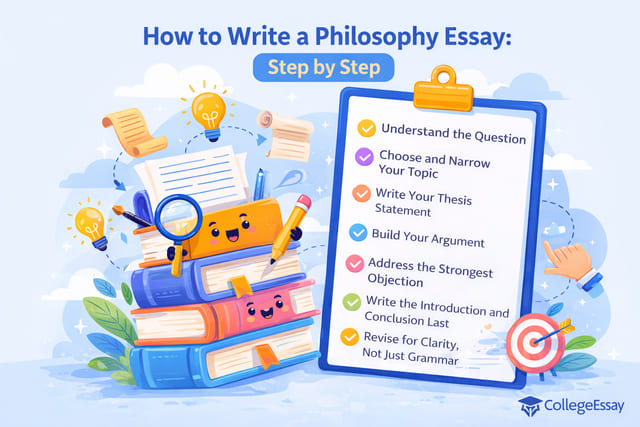
Step 1: Understand the Question
Before you write a single word, read the prompt twice. Identify what it's actually asking you to do. Is it asking you to argue a position? Compare two views? Evaluate whether an argument holds up?
The type of task changes your structure entirely. If the prompt is open ended, you'll need to narrow it yourself before you start. The most common early mistake is starting to write before you've decided what the essay is actually arguing. It sounds basic, but it derails a lot of students.
Step 2: Choose and Narrow Your Topic (If Open Assignment)
A broad topic is not a philosophy essay topic. "Free will" is a subject area. "Free will is incompatible with determinism because every choice traces back to prior causes outside our control", that's a philosophy essay topic.
Narrower is always stronger in philosophy. A tight, well-argued position on a small claim beats a shallow tour of a big question every time. If you're still figuring out what to write about, browse philosophy essay topics that work well for college assignments.
Looking for topic ideas? You can browse 100+ philosophy essay topics organized by category and difficulty, including topics broken down by ethics, metaphysics, epistemology, and philosophy of mind. |
Step 3: Write Your Thesis Statement
Your thesis is a specific, arguable claim, not a topic, not a question, and not a statement of fact. It has to be something a reasonable person could genuinely disagree with. If it isn't, there's nothing to argue.
Your thesis should be one sentence, placed at the end of your introduction.
Here's what the difference looks like in practice: Weak thesis: "Free will is an interesting philosophical topic with many perspectives." This is a topic statement. It doesn't argue anything. Strong thesis: "Free will cannot exist in a deterministic universe because every choice is the product of prior causes outside our control." This works because it makes a specific claim, gives a reason, and takes a position someone could push back on.
|
Here's how that thesis sets up the rest of the essay: every body paragraph now has one job, prove that free will and determinism are incompatible. The thesis is doing the organizing work before a single body paragraph is written.
When you have a strong thesis, you know exactly what every body paragraph has to do: support that claim.
Still not sure what your thesis should actually claim? Tell us your prompt, your position if you have one, and your word count, and our philosophy paper writing help team can take it from there, drafting a defensible thesis or writing the full essay from scratch.
Step 4: Build Your Argument
Each body paragraph is one supporting reason for your thesis. The structure within each paragraph is: claim, reasoning or evidence, connection back to your thesis. Don't just state a point, explain why it matters for your overall argument.
In philosophy, "evidence" doesn't usually mean statistics. It means logical reasoning, thought experiments, examples, and references to philosophers whose arguments support your point. Each paragraph should follow from the last, building the case rather than listing separate reasons in no particular order.
A practical tip: write your topic sentences first. If they don't each connect clearly to your thesis, rethink the paragraph before you write it out in full.
Using our free will thesis as an example: a first body paragraph might argue that determinism means every human decision is the product of prior causes, genetics, upbringing, environment, none of which the person chose. The claim is stated, the reasoning follows, and the connection back to the thesis is explicit: if no one chose their prior causes, no one could have chosen differently.
If you want a deeper breakdown of how philosophical arguments are constructed and where they typically break down, our guide on how to write a philosophy argument, covers the mechanics in detail. |
Step 5: Address the Strongest Objection
This is the part that separates a philosophy essay from almost every other type of academic writing. You argue against your own thesis.
Pick the best objection to your position, not the easiest one to knock down, state it fairly, and then explain why your thesis holds despite it. Professors can tell immediately when a student has chosen a weak objection to make their response look easy. Choose the one that actually challenges you.
For the free will thesis, the strongest objection is compatibilism, the view that free will and determinism aren't actually in conflict because "free will" just means acting without external coercion, not acting outside the causal chain. State that fairly, then counter it: if your definition of free will requires the ability to have done otherwise, compatibilism sidesteps the problem rather than solving it.
Students often treat this section as optional or rush through it. It's neither. A full paragraph on the objection and your response is standard.
| A philosophy essay that doesn't engage with the other side isn't an argument, it's just an opinion. |
Step 6: Write the Introduction and Conclusion Last
It sounds counterintuitive, but write your body paragraphs first. Your argument often develops as you write it, and your introduction should reflect what you actually argued, not what you planned to argue when you started.
Your introduction needs three things: brief context for the question, your thesis statement, and a map of how you'll argue it (tell the reader what's coming in one or two sentences).
Your conclusion needs to restate the thesis in different words, summarize the key support briefly, and close with one sentence on why this matters. Don't introduce new arguments in the conclusion. And don't open it with "In conclusion", it's unnecessary and signals a weak ending.
The most common mistake here: students write the introduction first, their argument goes a different direction as they write, and they forget to fix the intro before submitting. |
Step 7: Revise for Clarity, Not Just Grammar
Grammar is the minimum. Philosophy professors penalize vague writing more than most, and "clarity" often appears as an explicit grading criterion.
Go through each sentence and ask: could this mean two things? If yes, rewrite it until it can only mean one thing. Avoid jargon you can't define, if you use a technical term like "ontological," you need to explain it the first time it appears. |
The best philosophy essays are written in plain, precise language. Academic vocabulary doesn't make you sound smarter in philosophy, clear reasoning does.
Practical test: read your argument aloud. If you stumble over a sentence, your reader will too. Rewrite until it flows. |
You now know the full process, from reading the prompt to revising for clarity. The harder part for most students is actually executing it under a real deadline with a real grade attached. If you'd rather hand the writing to someone who does this every day, our philosophy paper writing service delivers complete, argument-driven philosophy essays built to your prompt, your word count, and your deadline.
What Philosophy Professors Actually Look For
Most philosophy courses grade on four things: clarity of argument, strength of thesis, quality of reasoning, and engagement with objections. Everything in the steps below maps directly to those criteria, the thesis step covers criterion two, the argument-building step covers three, and the objection step covers four. Clarity runs through all of it.
On structure: a typical undergraduate philosophy essay breaks down roughly like this, your intro should take about 10% of your total word count, your body paragraphs around 60%, your objection section around 15%, and your conclusion the remaining 15%. If you're writing 1,500 words, that's roughly 150 words of intro, 900 words of argument, 225 words on the objection, and 225 words of conclusion. Use this as a guide, not a rule, but if your intro is running 400 words, something's off. |
Philosophy Essay Structure and Format
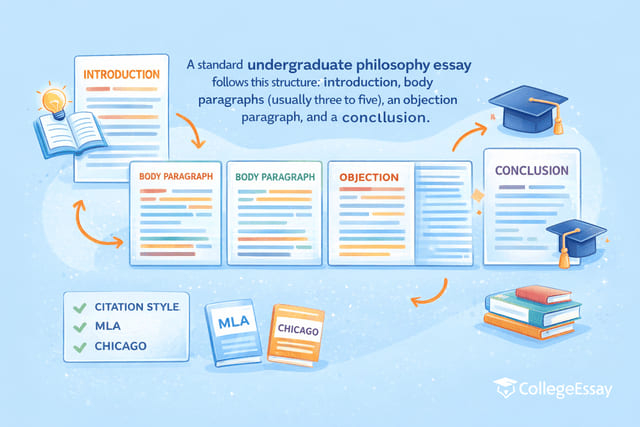
A standard undergraduate philosophy essay follows this structure: introduction, body paragraphs (usually three to five), an objection paragraph, and a conclusion. The steps above map directly onto this structure.
On length: most undergraduate philosophy essays run between 1,000 and 2,000 words. Always check your assignment sheet. Your professor's word count requirement overrides any general guideline. If no length is specified, aim for the minimum needed to fully develop your argument, usually five to seven paragraphs.
For citation style: MLA and Chicago are the most common in philosophy courses, but check your syllabus. When you reference a philosopher's argument, cite the specific work. When you quote directly, cite the page number. You don't need heavy citations in philosophy the way you would in a research paper, but you do need to cite when you quote, paraphrase, or build directly on someone's argument. For guidance on specific citation formats, the University of Toronto Writing Advice has clear examples.
First person is not only allowed in philosophy, it's often encouraged. "I argue that…" or "I contend that…" is philosophically appropriate because you're owning your claim. Avoid "I feel" or "I believe", those suggest emotion rather than argument. Use "I argue" or "I contend."
On headers: most undergraduate philosophy essays don't use section headers. Flowing paragraphs are the norm unless your professor specifies otherwise. This is one of the ways philosophy essays differ from research papers or reports. |
Types of Philosophy Essays
Not all philosophy assignments are the same. Knowing which type you're writing changes how you structure your response.
Argumentative Philosophy Essay
This is the most common type. You defend a specific claim using the step-by-step process above. If your prompt says something like "argue for or against the existence of free will," this is what you're writing. Everything in this article applies directly.
Comparative Philosophy Essay
Here, you analyze two positions, often two philosophers, and evaluate which is stronger, or how they relate to each other.
The structure shifts: introduce both positions, compare them on the key points of disagreement, and then either argue for one or show how they can be reconciled. The most common mistake with comparative essays is summarizing both positions without actually comparing or evaluating them. Summary is not comparison.
Analytical Philosophy Essay
In this type, you break down an argument, often a specific text, and assess its strengths and weaknesses. You don't necessarily defend your own independent thesis. You evaluate someone else's argument. This requires close, precise reading before you evaluate, because you can't fairly assess an argument you've misread.
Not sure which type your assignment is? Read the prompt again and look for keywords: "argue" points to argumentative, "compare" points to comparative, and "analyze" or "evaluate" points to analytical. |
Common Philosophy Essay Mistakes (And How to Fix Them)
- A thesis that isn't arguable: "Philosophers have debated free will for centuries" is a fact, not a thesis. If someone can't disagree with your thesis, you don't have one.
Fix: Make sure your thesis takes a position and gives a reason. Someone should be able to read it and say "I don't think that's right", then your essay is the response. |
- Skipping or rushing the objection: Students treat the objection section as optional filler. Professors treat it as a core part of the essay.
Fix: Give it a full paragraph. State the best version of the objection before you respond to it, steelman it, then counter it. |
- Vague language: "Many philosophers believe that consciousness is complex." Which philosophers? What exactly do they believe? Vague language signals unclear thinking.
Fix: Be specific. Name the philosopher, state the argument precisely, and use your own words. |
- Summarizing instead of arguing: Describing Kant's view is not a philosophical argument. It's background.
Fix: State your position first, then use Kant's view as support for it. Your thesis drives the essay, the philosophers you reference are evidence, not the main event. |
- A thesis that's too broad: "Does God exist?" is a question, not a thesis, and it's too large for a short essay.
Fix: Narrow to one specific aspect. "The existence of gratuitous evil is incompatible with the existence of an all-powerful, all-knowing, and all-good God" is a thesis you can actually defend in 1,500 words. |
The most common philosophy essay mistake isn't bad writing, it's having nothing to argue.
A Quick Look at What a Strong Philosophy Essay Looks Like
Here's a sample introduction paragraph to show what good philosophy writing looks like in practice:
The question of whether human beings have free will has occupied philosophers for centuries, but the debate becomes especially pressing in light of modern determinism. If every event in the universe, including every human decision, is causally determined by prior events, it appears that no one could have done otherwise than they did. In this essay, I argue that free will, understood as the ability to have done otherwise, is incompatible with determinism, and that this conclusion has significant implications for how we assign moral responsibility.
Notice what's happening here: the context is set briefly, the problem is stated clearly, the thesis appears in the final sentence, and it maps the argument without spelling out every paragraph. It's specific enough to guide the entire essay.
That's one example. To see real philosophy essay examples with full annotation, including complete essays across different types, head to our philosophy essay examples guide. |
Wrapping Up
A philosophy essay comes down to seven things: understanding the question, narrowing your claim, writing a strong thesis, building your argument paragraph by paragraph, engaging seriously with the best objection, writing your introduction and conclusion after the body, and revising for clarity rather than just grammar. Get those seven right and you'll have a solid essay.
It takes practice, but now you know exactly what you're aiming for.
You've got the framework. Seven steps, a clear structure, and the most common mistakes mapped out. What's left is the writing itself, and if you'd rather spend that time on something else, tell CollegeEssay.org's philosophy writers your prompt, your position, and your deadline. Most students get a complete draft back within 24 hours.